
Cracking the Code
As digital transformation touches every aspect of how we work and communicate, businesses face ever more complex challenges. The evolution of cybersecurity means that companies must rethink how they hire for this critical task. Robert Half shares how to secure the best cybersecurity talent.
Recruiter Robert Half shares how to find the best cybersecurity talent.
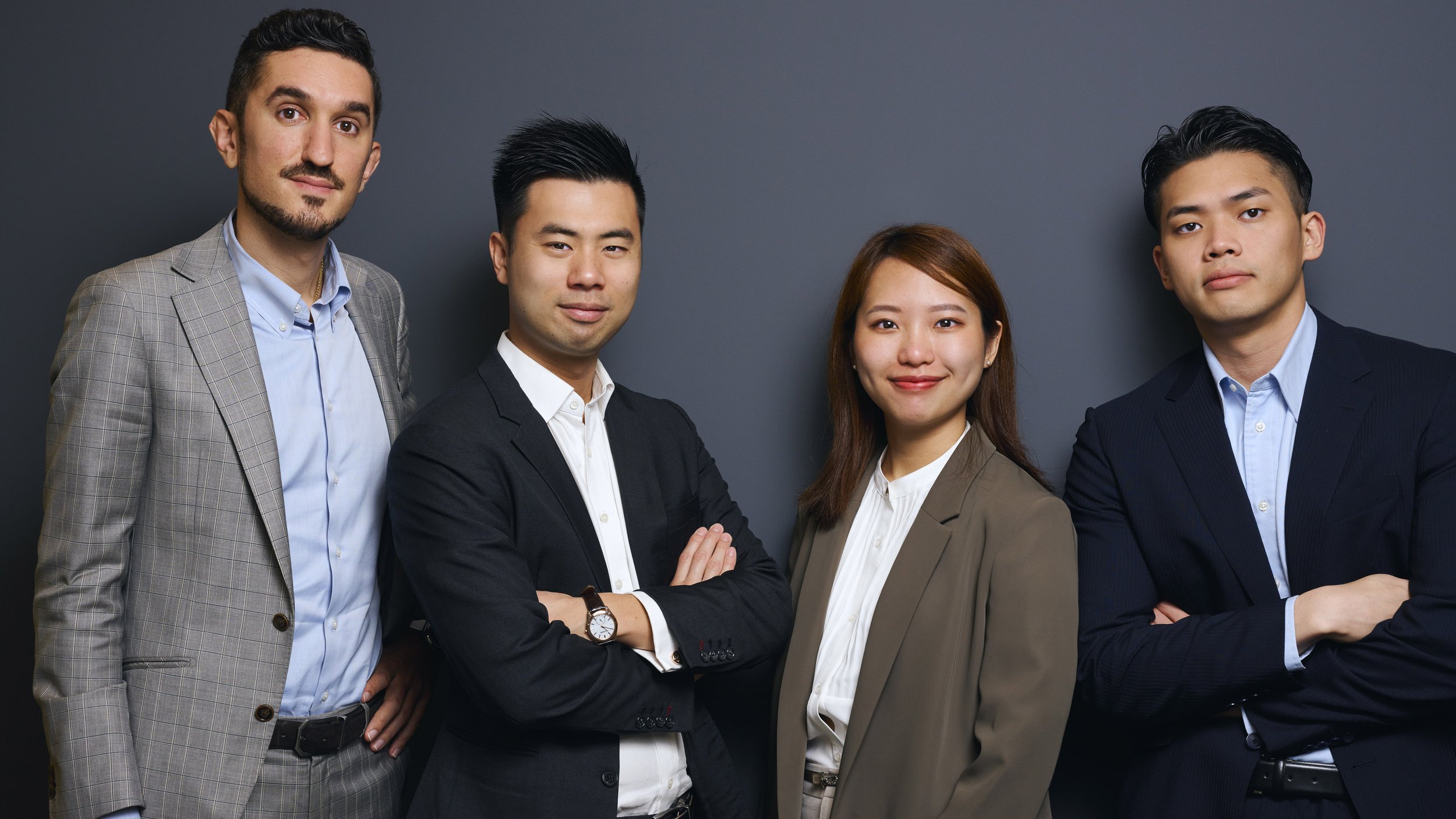
From left: Robert Half cybersecurity team members Fabrizio Fumagalli, Steven Li, Kani Taeng, and Naoto Hamada
As digital transformation (DX) touches every aspect of how we work and communicate, businesses face ever more complex challenges when it comes to protecting data—whether it is their own or that of customers. The evolution of cybersecurity means that companies must rethink how they hire for this critical task.
Steven Li, senior division director for cybersecurity at recruitment company Robert Half, told The ACCJ Journal that they see a lot of companies going through digital or IT transformations to shared service models, including for security.
“One of the challenges with security is that it’s all about data, and it’s all about being able to see your entire ecosystem or environment using a single source of truth or a single tool,” he said. “And a problem you may face is how to bring different business units that you’ve acquired onto a common platform for security operations and vulnerability management, so that when someone asks, ‘Are we impacted by this incident?’ you can answer with a degree of confidence.”
Robert Half advises clients on how to do just that and helps them find the right people to lead that transformation.
Expertise Matters
From a people perspective, previously siloed teams are being consolidated on a group level to create a centralized point of contact for cybersecurity that then provides support to each business unit, Li explained. Instead of outsourcing technical tasks to consultants, companies are now looking to hire specialists for their internal teams. But with much of this talent coming from outside Japan, domestic salaries are an obstacle.
“Employees here in Japan are typically rewarded based on tenure and age instead of merit and skill,” he noted. “To get around this, some companies have started to offer contracting solutions. They’ll say, let’s do a fixed-term contract. And with this fixed-term contract, we can step outside the bounds of our salary structure and give the specialist what the [global] market is paying, and a little bit more.”
This is important as there is an estimated shortfall of 190,000 cybersecurity professionals in Japan.
“Our clients are sharing that they need people who are application security engineers and can dynamically test the code.”
“Japanese companies are not used to hiring mid-career security professionals. They are used to hiring graduates, so to bring in someone mid-career, they don’t know how to do it, where to find them,” Li explained.
“Good cybersecurity engineers don’t typically fit the traditional model of an IT person. They may not have finished university, but they are adept at problem-solving and seeing patterns that other people might miss. We’ve placed people like this, and our clients have been absolutely happy with them,” he added.
Recruiting Manager for Cybersecurity Naoto Hamada shared an example of how Robert Half successfully placed a candidate who made a big difference for their client. But to do so, they had to overcome a challenge common in Japan: hesitation to change jobs.
“It was for a key project, and closing the role was a high priority. However, it’s challenging to find this talent in Japan,” Hamada explained. “We were able to find a match, and he received a competitive offer. But just one day before the deadline, on a weekend, he messaged me and said, ‘I can’t take this.’”
The problem wasn’t the offer but that he felt sympathetic towards his current manager should he leave.
“After receiving the message, he asked me to come meet at his station in person. I outlined the benefits of joining this international company and how it would provide him the career growth opportunities in line with his goals,” Hamada explained. “In the end, the key element was that we helped him visualize his priorities, then compare them to his current company. Based on this exchange, he decided to sign the offer and is now a key member in the newly created incident response team at his new company.”
Working hands-on in this way is at the core of Robert Half’s approach to recruitment. An important part of that are cyber risk meetups, which they host to bring together security professionals to share information and experiences which can help bridge the gap in cyber skills. A recent senior leaders’ meetup at Deloitte focused on ransomware resilience, and a public security meetup at Microsoft focused on software supply chain security.
“If we all share best ideas, best practices, and experiences, and implement those, perhaps we can improve cybersecurity maturity in Japan,” Li said.


Changing Regulations
Another thing to consider is the impact of changing regulations. Fabrizio Fumagalli, Robert Half’s recruiting associate director for cybersecurity, pointed out changes to ISO 27001, an international standard for information security management systems.
“This was updated in 2022, and companies have three years to comply,” Fumagalli said. “There are a few notable requirements on code security and the code supply chain. Companies need to be extremely careful about what’s in their code and conduct appropriate audits to assess where vulnerabilities may be.”
On average, about 80 percent of the code in a typical application is open source, Fumagalli noted, so it can be difficult to know what vulnerabilities may be hiding there. As a result, companies will need people in security who are proficient in software development.
“Instead of relying on documents from an external vendor, companies need a specialist who can check the code to ensure it is secure. Teaching security is easier than teaching the development side, so that is where companies’ priorities should be,” he added.
Specific to Japan, he said, is the need for mid-career cybersecurity talent. “You cannot randomly reassign, or do rotations, as most Japanese companies do. Due to the specific set of skills needed for the role, there is an urgent need for individuals who are experts in cybersecurity.”
Li added: “Our clients are sharing that they need people who are application security engineers and can dynamically test the code, play around with it, see if they can break it. Or do static analysis by reading the code itself and figuring out where the logic problems are. These skills are in extremely high demand.”
Partner for Success and Security
In closing, Li said that Robert Half is working to change the perception of recruitment in Japan and to help clients look beyond the numbers and the next quarter. If you are reassessing your cybersecurity, Li, Fumagalli, Hamada, Taeng, and the Robert Half team are ready to expand upon this approach and partner with you to build the best teams for today and the future.

Register now to learn, connect, and get inspired by Robert Half Japan networking events: roberthalf.jp
2023 Tax Reform Proposals
On December 16, 2022, the Government of Japan released its 2023 tax reform proposals. The amendments contain changes to the rules related to gifts and inheritance tax. The proposals are usually promulgated into law by the end of March and enter into force on April 1. Here is an overview of what to expect.
How changes to gift tax rules and audits may impact you
On December 16, 2022, the Government of Japan released its 2023 tax reform proposals. The amendments contain changes to the rules related to gifts and inheritance tax. The proposals have been promulgated into law and entered into force on April 1. Here is an overview of the changes.
Seven Year Lookback for Gifts
Currently, gifts bestowed within three years of the giver’s death are added back to the estate of the deceased for Japan inheritance tax (IHT) purposes. The value of the assets is reduced by any gift tax paid at the time the gift was received, and this amount is then subject to IHT along with the other assets of the deceased.
To offset this, one aspect of long-term estate planning is to make small annual gifts which are taxed at gift-tax rates lower than the effective IHT rate that would be levied if the gifts had remained part of the estate.
The reforms increased the lookback period to seven years for gifts made on or after January 1, 2024. This brings Japan in line with countries such as the United Kingdom.
Unlike the UK, however, there is no gradual reduction in the value of the gift over the seven-year period. One hundred percent of the gift’s value is added back to the taxable estate, regardless of whether it was made seven years or one day prior to death. A ¥1 million deduction is allowed for gifts made between three and seven years prior to someone’s passing.
The chart below shows this in action:

This change has a significant impact on lifetime estate planning, as gifts made on or after January 1, 2024, will be subject to a seven-year lookback for inheritance tax purposes.
For expats, discussion about Japan IHT planning with overseas parents can be difficult—especially if being subject to the Japanese rules would impact overseas planning. However, these proposed changes will accelerate the need for gift planning during 2023.
Valuation Methods for High-Rise Apartments
Although there are no specific amendments, another issue that needs to be considered in the near future is the government’s discussion of amending the rules surrounding the IHT valuation of apartments in high-rises.
Currently, there can be a large disparity between the fair market value of an apartment and its tax basis for IHT purposes. This is due to the use of various tax valuations that reduce the IHT value. For apartments in certain parts of Tokyo, the IHT value can be significantly lower than the fair market value. This disparity can be used to reduce the value of an estate considerably for IHT purposes. The government has indicated that it will look to close this avenue for tax planning in the future.
Tax Audit Statistics
The government also released its tax audit statistics in December, covering audits conducted between July 2021 and June 2022. Direct comparisons to previous years are unreliable due to the impact of the Covid-19 pandemic on the tax authority’s ability to conduct audits. However, the number of audits involving overseas assets increased by 20 percent over the previous year and is approaching the level seen prior to the pandemic. About two-thirds of the cases involved undisclosed assets in North America or Asia.
Additionally, the number of simple inquiries where the tax office contacts a taxpayer by post or phone increased by eight percent over the previous year and is 40 percent higher than pre-pandemic levels. This indicates that the tax office has shifted to less formal inquiries as a means of identifying taxpayers who require a full audit.
Summary
The increase in the lookback period for gifts accelerates the need for planning before the end of the year. This will be necessary to ensure that gifts fall out of the scope of IHT sooner. Current planning utilizing high-rise apartments may also need to be revisited in light of the anticipated changes.
As always, with any informal contact from the tax office, it is wise to consult with your tax advisor before submitting a response.

For more information, please contact Grant Thornton Japan at info@jp.gt.com or visit www.grantthornton.jp/en

Fantastical Fukui
There are many reasons to visit Fukui, a small tadpole-shaped prefecture facing the Sea of Japan. It’s home to a bevy of traditional crafts, magnificent temples, rugged landscapes, and some of Japan’s best freshly caught winter crab and sweet shrimp. All this begs the question: Why isn’t Fukui more well-known? We take you on a visit.
Nestled near the Sea of Japan, Fukui Prefecture is rich in cultural experiences
Presented in partnership with Fukui Prefecture
Photos by Florentyna Leow

An artisan at work in the Takefu Knife Village
There are many reasons to visit Fukui, a small tadpole-shaped prefecture facing the Sea of Japan. It’s home to a bevy of traditional crafts, including washi papermaking and knife forging, a world-class dinosaur museum (complete with life-sized raptor animatronics), magnificent temples, rugged landscapes, and some of Japan’s best freshly caught winter crab and sweet shrimp. Situated between tourist favorites Kanazawa and Kyoto, it’s an obvious pitstop when visiting both cities.
All this begs the question: Why isn’t Fukui more well-known?
Call it a serious case of middle-child syndrome. Although Fukui has all the ingredients for a fun weekend getaway, it’s often overlooked in favor of its glamorous neighbors. But this makes it ideal if you’re looking for travel minus the crowds. When planned right, a visit to this ferociously underrated prefecture offers an eye-opening look into Japanese craft, cuisine, and culture.
Paper Matters
Paper rarely merits a second glance in our daily lives. Money, flyers, utility bills—paper is just there in the background. But a sheet of washi is a different story. From uchiwa (summer fans) to wagashi wrapping, handmade paper has a warmth and elegance unmatched by most machine-made papers.
If Fukui has a signature craft, it’s Echizen washi paper. There are many varieties, all beautifully textured and supple, delicate yet durable. With its 1,500-year history of washi production, Echizen City is one of Japan’s top washi producers in terms of quality, quantity, and variety—more than earning its nickname "washi no sato," or the home of Japanese paper.
Faced with a decline in demand for washi—in large part due to fewer people using partitions and screen doors—papermakers have had to get creative with new paper products for contemporary consumers. These days, you can find washi earrings, bags, and even socks and jackets. The lampshades by Osada Washi, a family-run washi company in the Imadate district of Echizen City, are especially modern and striking. The intricate floral patterns are all drawn freehand with paper pulp and wrapped around acrylic stands as tall as totem poles.


But to appreciate washi, there’s no substitute for making a sheet of paper by yourself. I visited Ryozo Paper Mill, another family-run business in the Imadate district, to experience the production process.
It was early winter, and the snow was starting to pile up. Winter is the best season for papermaking, I was told, because the raw material in the pulp doesn’t spoil as quickly in the cold. I quickly realized two things: handling paper pulp feels like plunging your hands into a vat of ice-cold egg white; and papermaking is bloody hard work. Made the traditional way, tesuki washi (handmade paper) involves quickly dipping a large wooden frame fitted with a bamboo screen into a tub of paper pulp, then swishing liquid pulp back and forth until the screen is evenly coated. The frame is heavy enough that I almost dropped it the first time.
With no small amount of assistance from Kyoko Yanase, one of Ryozo Paper Mill’s main craftspeople, I finally managed to get even coverage on the screen. She set the frame on the ground and placed a large spiral-patterned metal mold on top—like a stencil, but in reverse. Following instructions, I flicked a showerhead up and down while moving it across and above, the spray of water droplets creating thousands of tiny holes in the paper. When she lifted the mold, before us lay a large sheet of perforated washi embossed with spirals. Dried, the paper resembled embroidered lace.
I had made a sheet of rakusui-shi, or “water-dropping paper,” an uncommon variety of washi made by very few craftspeople in Japan. It was gorgeous. I couldn’t believe how much fun I’d had making it. Suddenly, every sheet of washi I’d seen in Fukui made sense, each the result of skill and technique honed over a lifetime.
Sharp as a Knife
If paper is best made in the cold, the fiery process of knife-making feels like its thermal opposite. Working near the charcoal-powered forge, with its constant heat, can make your time in a knife workshop warm, toasty, and downright sweaty—from the physical labor involved in making knives, that is.
Once known as Takefu, Echizen’s history of knife-making stretches back 700 years, beginning with sickles and fighting swords to bonsai tools and chef’s knives. Today, Japanese chef’s knives are loved worldwide for their quality, sharpness, and durability. One small facility in particular attracts a steady stream of knife enthusiasts from all over the world looking to add to their collection and learn more about the traditions and techniques behind Echizen’s hand-forged knives.
Started as a cooperative between a dozen local independent knife manufacturers, Takefu Knife Village is something of a curiosity. The facility was built in 1993 but, looking at these incongruously sleek buildings in the middle of rural Fukui, you’d be forgiven for thinking it new and under-promoted. The 20-minute drive there from JR Takefu Station is poorly signposted for what’s meant to attract tourists. It’s the kind of place where “if you know, you know.”
At Takefu Knife Village, you can shop for knives, but also learn about local knife-making history, take a workshop, and watch the artisans at work from an observation deck. Because it’s a cooperative by name and in practice, the craftspeople from all the different knife companies share equipment and make their products in the same space. There’s no secretive squirrelling-away of technique and know-how; it’s an unusually democratic operation compared to many other industries.




Speaking of workshops: If you have six hours, you can learn the basics of making a knife from one of the craftspeople in the dedicated backyard building, experiencing almost every step of the process from hammering to forging to attaching the handle. If you don’t, an hour or two can give you the skills required to sharpen chef’s knives at home like a pro.
I didn’t have six hours, or even an hour, so I compromised by trying out a treadle hammer to flatten vaguely blade-shaped bits of steel. Most knifemakers work on a single blade at a time. Here, they stack two blades together and hammer them simultaneously, in what is a technique supposedly unique to the Echizen region. I appreciated the efficiency of getting to screw up two blades at the same time.
Using a treadle hammer, if you have never tried it, is an awesome and challenging feat of hand-foot-eye coordination plus some physical strength (neither of which I possess). You heat two steel molds in fire until they’re bright red, remove them with tongs, and set them under the hammer. With your right foot, you gently press a pedal to activate the murderous pulverizing hammer while simultaneously moving the blades counterclockwise, making sure the hammer pounds the surface evenly while the steel is still hot and malleable. Lose your grip and your blades will come out weird. Move too slowly and the cooled steel will simply break. The phrase “strike while the iron is hot” suddenly made complete sense.
It was one of the coolest things I’d ever done in my life. I would also never have visited this place without a car. As with most places in rural Japan, the lack of public transportation infrastructure is probably Fukui’s largest barrier to becoming a more tourist-friendly destination. Officially named “Geisha de GO,” the “one-coin taxi” service offered by Echizen City is an ingenious stopgap solution. Buy taxi tickets (each worth ¥500) at the tourist information center near JR Takefu Station, hop into a taxi (or ring one up), point at one place on a list of major tourist destinations in the area (including the paper mills and Takefu Knife Village), and they’ll drive you there.
Disappearing Art
Fortunately, not every place of interest requires a taxi ride, especially if you only have time for a quick wander around one stop in the prefecture. For example, Oyanagi Tansu, the fourth-generation maker of tansu (Japanese storage chests or cabinets), is a mere 15-minute walk from JR Takefu Station.
A workshop tour here offers incredible insight into the disappearing art of tansu-making, which requires a mastery of three separate crafts: sashimono (wood joinery), lacquering, and metalwork. A dwindling number of craftspeople specializing in each of these tasks means that Oyanagi now handles the entire process from start to finish. Completing a single tansu can take anywhere from six months to a year. I’ve never been so dazzled by cabinets, and have to hastily leave before I shell out several hundred thousand yen for a karakuri tansu full of hidden trick mechanisms and secret drawers—perfect for hiding my stack of diaries. If home ownership ever becomes a reality for me, this is where I’d order my storage chests.


Even nearer Takefu Station—seven minutes on foot—is Urushiya, a buckwheat noodle restaurant set in a traditional wooden house. Its claim to fame is having once served Echizen oroshi soba (soba with grated radish) to the Showa emperor. We ate our way through plates of pressed sushi, tempura, and an array of bite-sized appetizers. The noodles alone were worth the wait.
If you’re alighting at JR Fukui Station, you could take a 10-minute bus ride to Komego Miso for a fun afternoon diversion. Take a guided tour of the factory (they’ve been making miso for 190 years, which the staff mentioned almost as an afterthought), join a flavored miso ball-making workshop (which you then use to make instant miso soup in a mug), buy miso by weight, or have lunch at second-floor cafe misola, where everything from beer and ice cream to soup is spiked with miso.
Maybe you’re only in Fukui for a lunchtime train transfer. In that case, drop by Fukufuku Chaya in the Tourism Promotion Building next to Fukui Station for the Echizen Seikogani-zukushi, a winter-only snow crab-themed feast. A crab-stravaganza, if you will. Wedged between two souvenir shops, it’s hardly the most atmospheric restaurant, but who cares when lunch consists of four crab dishes, several sides, and soba to finish?
Morning Mantra
However, if I could only choose one experience worth the extra trek out of central Fukui, it would be joining the morning prayers at Eiheiji, whose name translates to “Temple of Eternal Peace.”
Ensconced on a cedar-covered mountain slope 15 kilometers east of Fukui City, this 13th-century Zen Buddhist temple complex is one of the largest, most-visited temples in Japan. (Fun fact: Steve Jobs almost took tonsure here.) It’s not far, but with more forest than buildings in its vicinity, this serene monastery is remote enough to feel a world away.
In 2019, Eiheiji and tourism corporation Fujita Kanko teamed up to open Hakujukan, an 18-room inn located in front of the monastery that embodies traditional Japanese aesthetics. The facility caters largely to foreign tourists interested in experiencing the world of Zen without forgoing material comforts like multi-course dinners, alcohol, and hot spring baths. This may induce mild cognitive dissonance, but Eiheiji has always been a temple and popular destination for tourists. It’s never pretended otherwise.

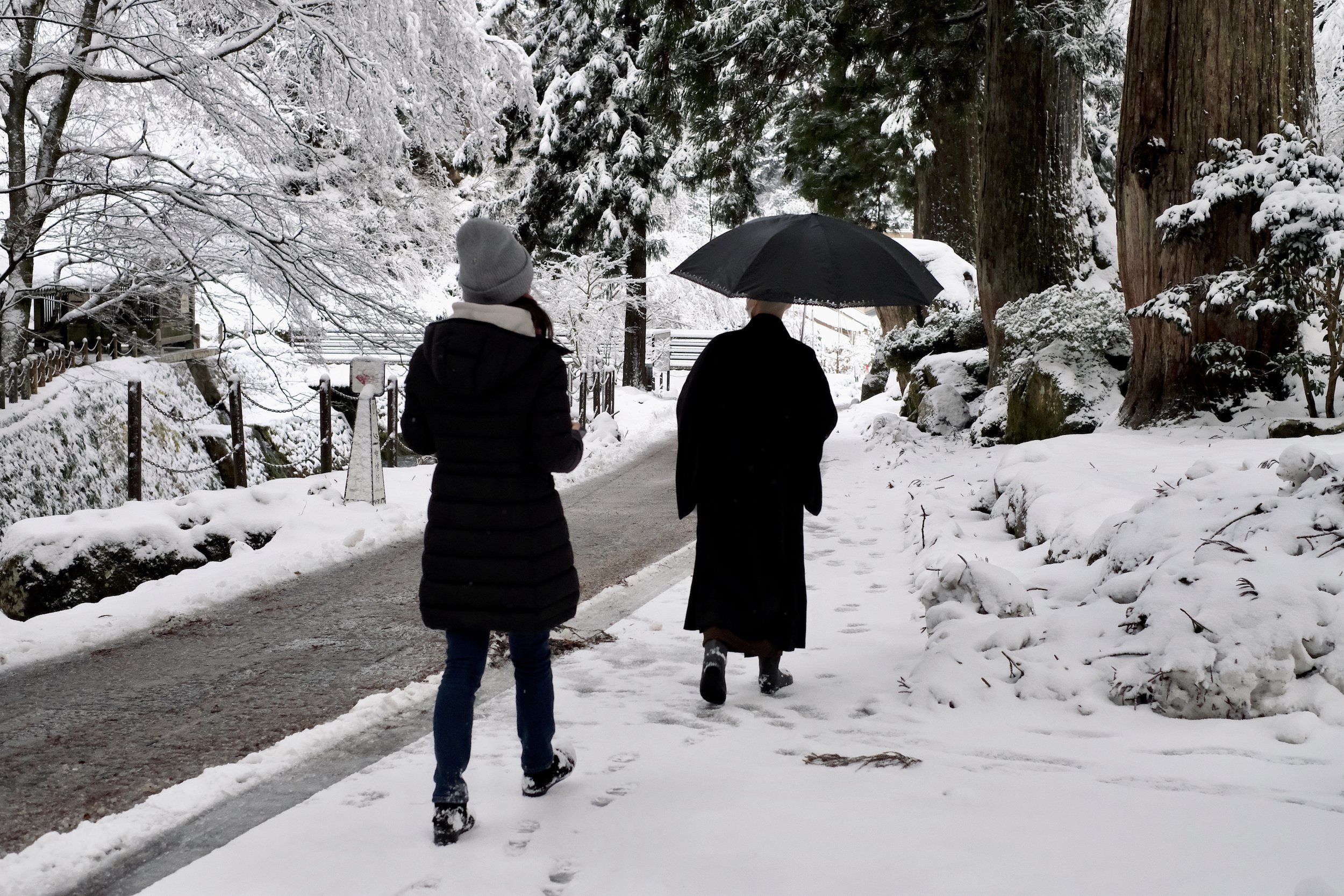
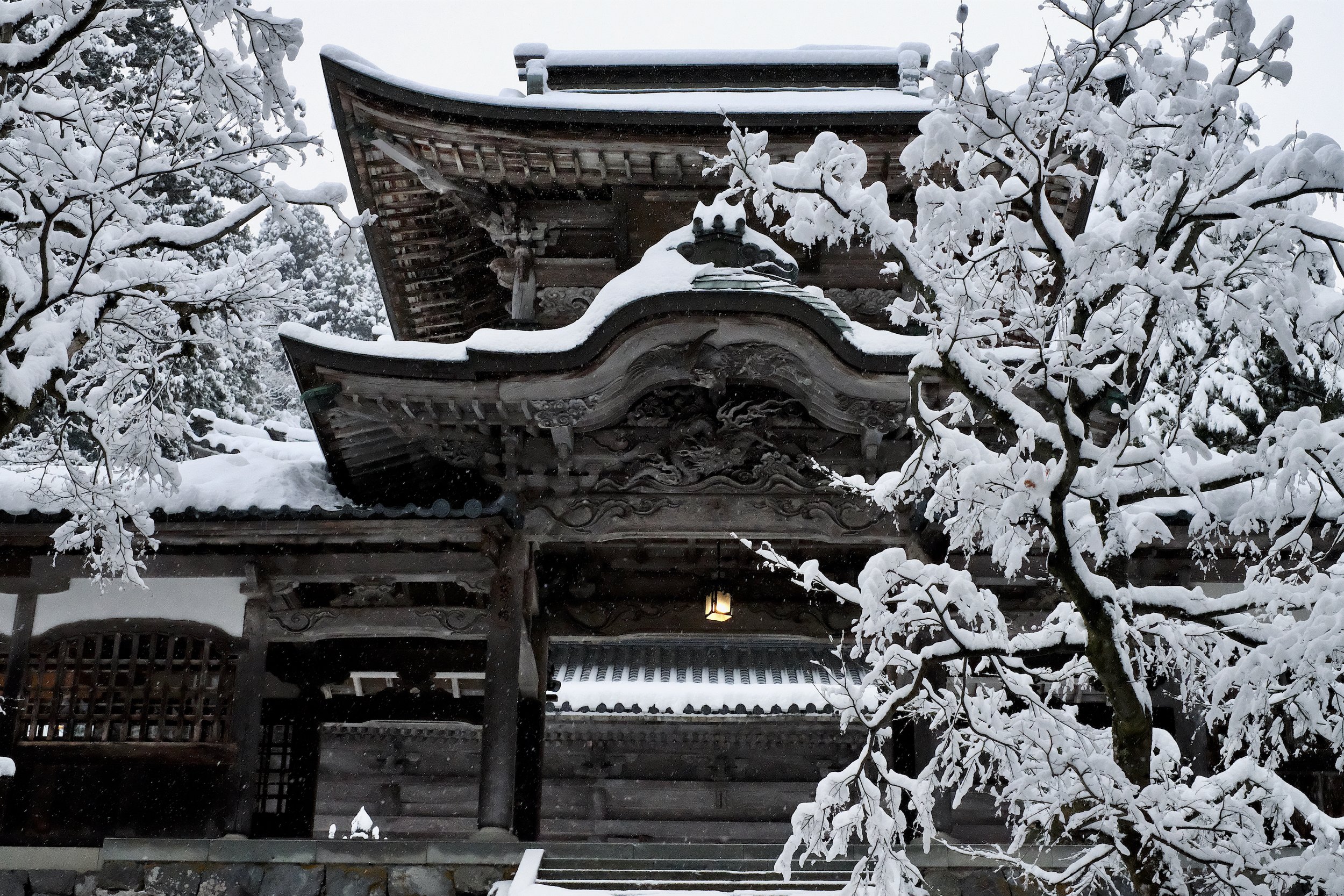

At 5:30 a.m., we gathered in the lobby and followed our guide up the slope to the temple, trudging through ankle-deep snow in the dark. It took us at least 40 minutes to get through the doors, remove our shoes, listen to an opening lecture by one of the senior monks, and climb a succession of staircases through winding corridors before we reached the main hall—and we’d still seen but a fraction of the 70-building complex.
At half past six, dozens of barefoot monks clad in black robes filed into the hall, sat in orderly rows, and began the morning prayers. I was raised in a culturally Buddhist environment, so listening to monks chant sutras wasn’t new, but listening to about 60 of them do it in perfect unison was. A monk at the front set the pace and rhythm with a drum. Another struck prayer bells at regular intervals, each bong echoing in the hall. I had no idea what any of the words meant. My pulse quickened, I felt compelled to sit straighter. Their voices seemed to coalesce into a single booming entity, expanding to fill the air. A tidal wave of sound enveloped us, and it felt like I was drifting on a vast, inky sea. It shifts your perspective, when you can see yourself taking part in a centuries-old practice of people coming together to pray. It felt good to feel so small.
Was this worth the trip to Fukui? I certainly thought so. Only time will tell if Fukui receives the attention it deserves. In the meantime, I’d pay it a visit before everyone else finds out.
Learn more and plan your visit …
Osada Washi
Ryozo (Japanese only)
Takefu Knife Village (Japanese only)
Oyanagi Tansu (Japanese only)
Urushiya (Japanese only)
Komego Miso
Fukufuku Chaya (Japanese only)
Eiheiji
Hakujukan

Past Meets Future
The glass panel separating the Enoura Observatory’s gallery from Sagami Bay erupts in an orange glow. It’s the summer solstice and the sun rises in perfect alignment with the long, narrow gallery designed by Japanese contemporary artist Hiroshi Sugimoto. The fiery spectacle is just one of the wonders that awaits travelers in Kanagawa Prefecture.
Kanagawa Prefecture offers travelers a gateway to Japanese culture, tradition, and breathtaking nature

Photo © Odawara Art Foundation
The glass panel separating the Enoura Observatory’s gallery from Sagami Bay erupts in an orange glow. It’s the summer solstice and the sun rises in perfect alignment with the long, narrow gallery designed by Japanese contemporary artist Hiroshi Sugimoto. The fiery spectacle, a cornerstone of this extraordinary project which intertwines art and nature, illuminates Sugimoto’s famous black-and-white seascapes photography series, which lines the wall and leads you to the edge of the water.
Visiting this gallery is an incredible start to our tour of four stops in Kanagawa Prefecture that take us through time, capturing deep tradition and forward-looking vision. While Tokyo may top the list for travelers exploring Japan, neighboring Kanagawa once played the same role and today is home to some of the nation’s most beautiful scenery and opportunities to come face to face with Japan’s deep history.
This first stop, the expansive facility nestled in the Enoura district of Odawara along the outermost edge of the Hakone Mountains in Kanagawa Prefecture, opened in 2017 and is home to many of Sugimoto’s works. It is managed by the Odawara Art Foundation, which he established in 2009.
As we stand alongside a long wooden table supported by a massive stone, Odawara Art Foundation Director Haruko Hoyle starts our tour by explaining how the observatory has grown. The striking table was designed by Sugimoto using 1,000-year-old cedar saved from Yakushima, a small island south of Kyushu, in Kagoshima Prefecture, whose ancient forest was designated a World Heritage Site in 1993. The stone was once a washbasin at a temple on Mount Koya and has been crafted into a leg for the table. The design reflects the mission of Sugimoto’s New Material Research Laboratory, which the artist set up in 2008 with architect Tomoyuki Sakakida, to preserve traditional methods of craftsmanship as well as traditional materials.
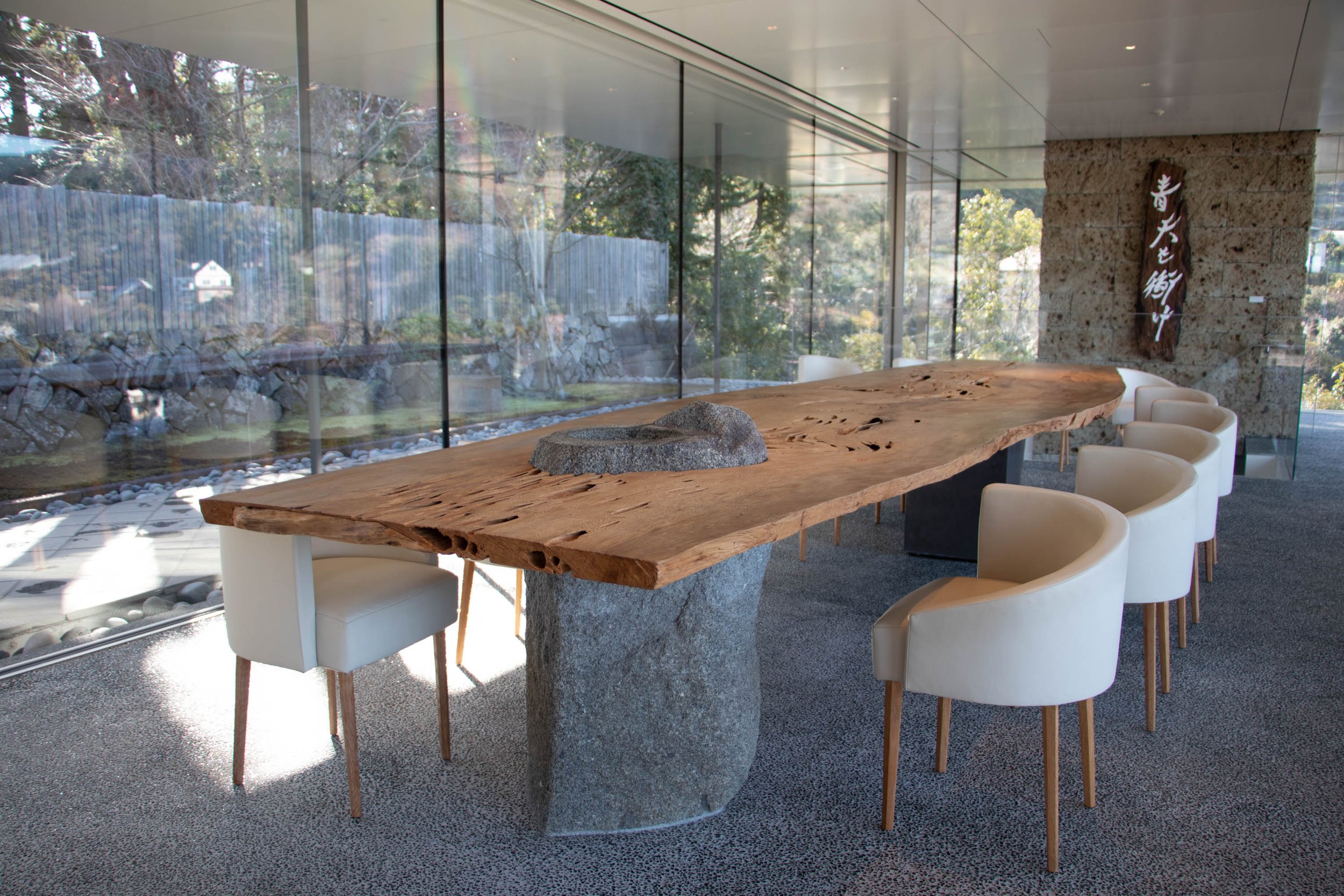



Stones play a major part in the Enoura Observatory concept. Sugimoto, who has made New York City his home since 1974, was in Japan during the pandemic and could not get back to New York for three years, Hoyle explains. “So, he kept buying more stones and developing this site.” The result is inspiring. A variety of stones from around Japan, each with an interesting history and connection to the country’s past, are preserved on 9,500 square meters of a former citrus grove.
Exploring the observatory is a contemplative experience—and that’s by design. “[Sugimoto] didn’t want people to just stay inside, looking at his artwork, so he developed this concept,” Hoyle says. “People can come here, get away from their busy life, and contemplate where they came from, where they are going, and their ideal relationship with nature.”
The architectural alignment that allows the summer solstice spectacle is an example of this intentional reconnection with nature. So is the design of a 70-meter-long tunnel of stone and rusted corten steel which runs underneath the gallery and creates a similar view of the winter solstice. A light well at its center provides a refuge for contemplation. This reflection on how ancient people looked to the sky and built astronomical markers, such as Stonehenge in England, is part of Sugimoto’s philosophy.
“He really wants this to be a future ruin,” Hoyle explains. “Five thousand years from now, all the glass will be shattered, no wooden structure will remain. All that future people might see are the stones and tunnel.”


They may also see the remnants of the hillside amphitheater, where the Odawara Art Foundation presents classical theater and avant-garde stage performances, including traditional Japanese Noh.
The stone steps and seats were meticulously designed by Sugimoto, who traveled to Italy to measure those of an amphitheater there to precisely recreate a millennium-old venue for artistic presentation. The seating looks out on a stage of optical glass that aligns with sunrise on the winter solstice.
Another reflection on Japan’s past, and a reprieve from modern life, can be found in the Uchoten teahouse, the style of which was inspired by that of a national treasure in Kyoto and designed by 16th-century tea master Sen no Rikyu. But Sugimoto gave the small space a local touch.
“As this was an abandoned citrus grove, there was a small storage [shed] which was used for harvesting,” Hoyle explains. “He took the corrugated tin roof off very carefully and placed it on top of the teahouse. Today, when it rains, you hear the ‘ton, ton, ton’ sound of the falling drops, so he named it Uchoten, ‘rain-listen-heaven’.”
Inside is a scroll bearing calligraphy, written by Sugimoto himself.
Like the stone stage, the room is aligned with the equinox. “On that morning,” Hoyle says, “we open the door and take the scroll down. The sun shines through the entrance and the alcove becomes pink.”
It’s yet another example of the precision with which Sugimoto has created a loving and visionary tribute not only to nature and art but to nature as art. It’s well worth a trip to Odawara to traverse the tunnel, stroll through the groves, and sense the pulse of history presented in unexpected ways.
Okada Museum of Art

Photo © Okada Museum of Art
From the coast of Sagami Bay, we wound our way along mountain roads into the depths of Hakone to visit the Okada Museum of Art.
The facility welcomed its first guests in 2013 and is celebrating its 10th anniversary this year. With an exhibition area of 5,000 square meters (54,000 square feet), it is the area’s largest museum.
The first glimpse of art can be seen on approach to the museum entrance. At 30 meters (98 feet) wide by 12 meters (39 feet) high, it is difficult to miss. Kotaro Fukui’s enormous mural entitled Kaze/Toki (Wind/Time) depicts the Wind God and Thunder God, painted on 640 gold-ground panels. These guardian deities of Hakone soar through the air overlooking the popular foot baths in front of the museum. The baths are continuously filled with natural alkaline hot spring water and are free to use for guests or ¥500 for those not viewing the exhibits. Drinks and sweets are available from the accompanying café.
As we made our way around the museum exterior, we came upon trails running up the hillside. The area is particularly beautiful in autumn, when the foliage is ablaze in fiery colors, but also tantalizingly tranquil in winter, when snowfall casts the sloping hill in ethereal white. A mix of wooded areas, trickling streams, delicate waterfalls, and picturesque ponds, the entire path around the garden and can take 10–20 minutes to fully traverse. Admission is currently free and open to the public.


Photos © Okada Museum of Art (except lower right)
But the true delights are inside the five-story museum, where you’ll find an extensive collection of more than 450 treasures from Japan, South Korea, China, and other East Asian countries.
As the doors slide open to the first collection, I’m astounded by the spaciousness of the presentation. Museums in Tokyo can often present challenges to the viewer, who finds themself competing for position in tight spaces just to see works amid crowds. But here, in the dimly lit vastness, there’s no difficulty in getting up close, and the austere dark blue walls provide a framing which vividly brings these incredible works of art to life.
Learning about the art is easy, thanks to the LCD touch screens placed in front of many pieces which offer notes in Japanese, English, Chinese, and Korean.
Each of the first two exhibition floors has a distinct flavor and story to tell as you stroll the timeline of artistic and cultural history.
The first houses ceramics from China’s Han Dynasty (206 BC–AD 220), Tang Dynasty (618–907), and Qing Dynasty (1644–1911), along with those from Korea’s Goryeo (918–1392) and Joseon Dynasties.
The second features Japanese art, primarily screen paintings from the Momoyama (1573–1600) and Edo (1603–1868) Periods. Taikan Yokoyama’s 1926 work Mt. Fuji, a sprawling 94x873 centimeter hanging scroll, is a centerpiece of the floor’s collection and is on display through June 4.


Images © Okada Museum of Art
The third floor is reserved for special exhibitions. For example, at the time of our visit, Jakuchu and Isson • Transcending Time, an exhibition featuring Edo-Period painter Jakuchu Ito and Isson Tanaka, an artist from the Showa Period, was on display. Part 1 of the Okada Museum of Art’s 10th anniversary celebration, the exhibition continues through June 4, and if you visit on your birthday, you and a companion can view it for free. Part 2, featuring Utamaro and Hokusai, will run from June 11 to December 10.
On the fifth floor are pieces of religious art, including sutra manuscripts, paintings, and Buddha statues from Japan’s Heian (794–1185) and Kamakura (1185–1333) Periods. The craftsmanship of these wood-carved figures is astounding.
With such a wealth of art on display, it takes about two hours to view the entire collection.
After browsing the works, return to the garden entrance and Kaikatei to unwind against the backdrop of nature as the soothing splash of a waterfall can be heard across the carp pond. Named after a hotel popular with foreign visitors that stood on the same property in the late 1800s, the renovated Japanese house is a memorable place to enjoy dishes such as horse mackerel tempura udon and dorayaki, a small pancake-like sandwich filled with sweet red bean paste.
A visit to the Okada Museum of Art is not only a delightful way to learn about the history of Japan and the region, but a refreshing escape to nature.
Admission is ¥2,800 for adults and university students and ¥1,800 for elementary through high school ages.
Jochi-ji Houan

An hour from Tokyo, hidden in a forested valley behind Jochi-ji Temple in Kita-Kamakura, is a quaint little tea house that time forgot.
Built in 1934 by journalist Tai Sekiguchi, Houan is home to three tea rooms—one an eight-tatami space that accommodates eight to 10 people and a smaller room of four mats which looks out onto the garden behind the house. Smaller still, a separate tea house based on the famous Ihoan tea hut inside Kyoto’s Kodai-ji Temple offers an intimate ceremony space for two people.
Houan was designed by Bunzo Yamaguchi, one of the leaders of Japan’s modernist architectural movement, and is an example of the sukiya style of Japanese architecture, which dates back to the Momoyama Period (1573–1600). Based on a natural aesthetic and rustic simplicity, sukiya is intended to exist in harmony with the surroundings; and Houan certainly does.
But as Yukiyo Matsuzaki, planner at Kyoto-based travel experience company Mitate, Ltd. and founder of Kamakura Mind explains, “Yamaguchi studied modernist architecture in Germany, so Houan is a fusion of traditional Japanese and modernist styles which creates a unique tea house.”


We explore the house on arrival with Matsuzaki and Southi Yokoyama, a professor of the Omotesenke school of tea ceremony. Yokoyama shares about the connection green tea has to the area, and some of its roles in Japanese history.
“Kamakura had a lot of Zen temples and many people practiced Zen meditation, so they used green tea as a sort of stimulate to keep awake during meditation,” she explains. And on a fiercer note, she adds, green tea was a favorite of samurai warriors before going into battle.
Samurai, we learn, were once buried in the caves along the back side of the garden, which were also used as a training ground and a grave for Zen monks.
We turn our attention to the main space and the tokonoma, the alcove commonly found in Japanese-style rooms, or washitsu. In the space is a kakejiku (hanging scroll) with calligraphy showing Zen words appropriate for the season, and alongside an ikebana flower arrangement. In recognition of the sacred nature of the tearoom, we bow to each and carefully read the inscription.
As we prepare to take part in the tea ceremony, we learn the proper way to wash our hands in the tsukubai (washbasin) outside before entering the tea house.
Hands cleansed, we take our positions, kneeling on the tatami, and Yokoyama explains each step of the ceremony. (Don’t worry, if kneeling for an extended period isn’t your style, Houan can provide chairs.)


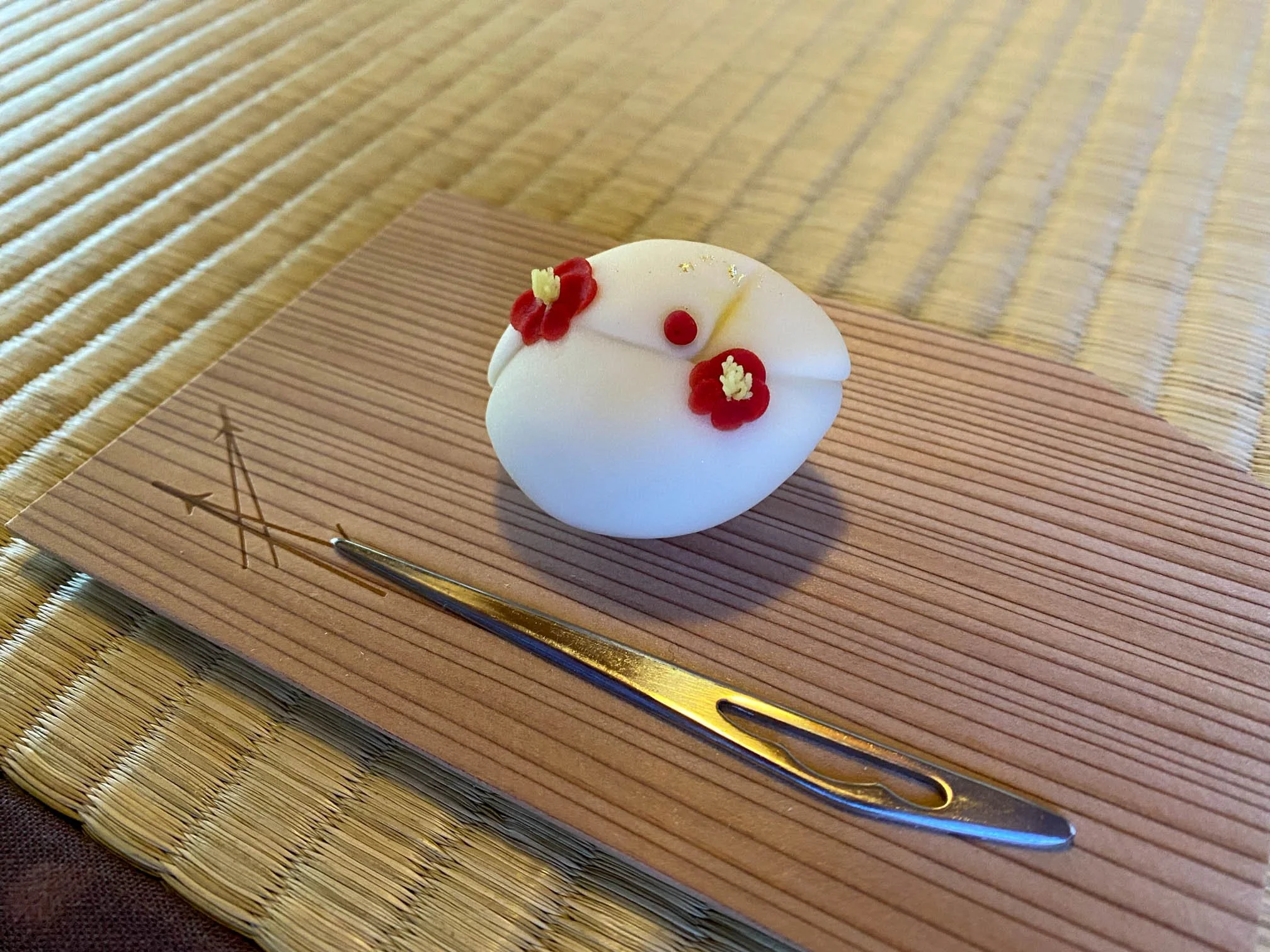
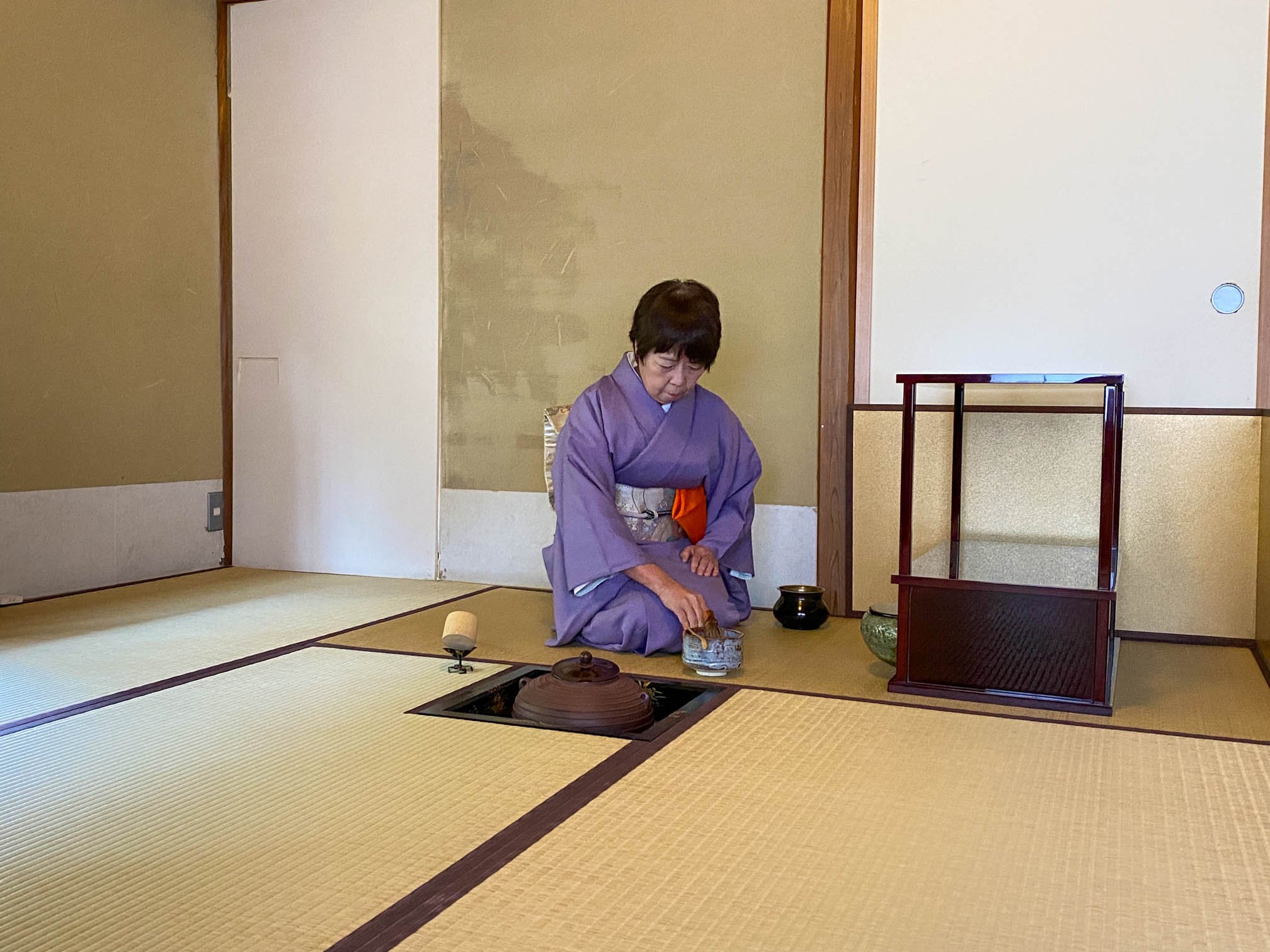
Having watched the master prepare the tea, it’s now time to learn the proper way to drink and to show appreciation, as well as to savor the delectable wagashi (Japanese sweet) which accompanies the tea to take away the bitterness. I’ve eaten more wagashi than I can count in my many years in Japan, but this morsel, crafted by local artisan Kuu, is easily one of the most delicious I’ve ever tasted, with a splash of citrus that is eye opening. You can learn to make wagashi from Kuu in another experience offered here by Kamakura Mind. You can even enjoy your creation as part of the tea ceremony.
When the time comes to drink, admiring the beauty of the bowl is a key part of the experience. I take a close look at the playful yet restrained craftsmanship as I gently rotate the cup in my hands. Finally, I sip the tea and gently slice the wagashi in half. Savoring these flavors through the silent steps of this centuries-old tradition is a momentary escape into tranquility.
In addition to tea ceremony, Kamakura Mind also offers workshops for other traditional Japanese arts, hosts corporate training retreats, provides a venue for Zen meditation, and even guides hiking tours along the trail to the Daibutsu, the Great Buddha of Kamakura—a journey that takes about an hour and a half at a leisurely pace.
A mix of historical perspective and cultural immersion, our hour-long visit to Houan made for a particularly peaceful and memorable morning in this beautiful city that served as Japan’s capital for almost 150 years.
Hasedera

Just a short walk from Hase Station on the quaint and historic Enoden train line is Hasedera, an eighth-century Buddhist Temple that is one the oldest and most significant in Kamakura.
Formally the Kaikozan Jishion Hasedera, it is believed to have been founded in 736 after an 11-faced Kannon Boddhisattva statue washed ashore on Nagaiura Beach in Sagaminokuni and was brought to Kamakura.
Hasedera is the fourth of the four temples on the Bando 33 Kannon pilgrimage route, and as we arrive a group of visitors were gathering near the entrance to conclude their own journey.
We’re greeted by one of the temple’s monks who will lead us on a guided tour of the beautiful grounds featuring koi ponds, rock gardens, waterfalls, and a variety of trees and flowers. Famed for its hydrangea in summer, Hasedera is also delicately painted pink in spring, when the cherry blossoms burst forth, and brilliantly picturesque in fall, when the leaves turn. As we tour in late January, plum blossoms are beginning to dot the branches.


As we stroll through this tranquil setting, we come to Bentendo Hall, where we see the eight-armed statue of Benzaiten, the Goddess of Water and Wealth and the only female among the Japanese Seven Gods of Fortune. As we move past her, we enter the darkness of the Bentenkutsu Cave. Inside, Benzaiten and her 16 followers are chiseled out of rock walls.
As our guide explains, legend says that Kobo Daishi, known as Kukai when he was alive, traveled across Japan to spread Buddhism and secluded himself in this very cave. Here, he meditated and attained a state of spiritual communication with Benzaiten, and carved a wooden statue of the goddess with eight arms. Kukai, who lived from 775 to 835, founded the Shingon school of Japanese Buddhism.
Past the stone figures, we duck deeper into the cave. The low ceilings mean we must crouch to navigate the catacomb-like corridors. Partway through, we happen upon a small chamber filled with miniature Buddhas on which visitors have copied sutras as they wish for good fortune.


Emerging from the cave, we make our way up the hill and into Kannondo Hall, which houses the statue of the Kannon Boddhisattva that is said to have washed ashore in 736. Standing an astonishing 9.18 meters (30.1 feet) tall, it is one of the largest wooden Buddhist statues in Japan and is the centerpiece of Hasedera. According to legend, it has been enshrined here since the temple’s founding 1,300 years ago.
As the hall long predates the advent of electric lights, viewing the statue was not always as easy as it is today. Long ago, our guide explains, lanterns were hoisted up alongside the statue so that it was possible to see the Kannon Boddhisattva’s face in the darkness.
A particular treat during this part of our tour was the recitation by our guide of a sutra, “Enmei Jukku Kannon Gyo” or the “Life-Extending Ten-Line Kannon Sutra.” We joined in by following the words provided in both kanji and romaji.
In the Kannon sutra, Kannon appears in 33 different forms to best appeal to the nature of each individual whom they are guiding out of suffering and toward enlightenment. We come face to face with these 33 avatars in the form of exquisitely detailed, life-size wood carved statues as we make our way through the museum which adjoins the chamber where the nine-meter Kannon Boddhisattva resides. Opened in 1980 as one of the first temple museums in Japan, the space presents many ancient artifacts that tell the history of Buddhism and the area surrounding Hasedera.


Upper left photo © Hasedera
We also examine the bonsho (temple bell), made in 1264 and now preserved in a glass case. The third oldest bonsho in Kamakura, it bears the earliest known inscription of the name Hasedera. It was replaced in 1984 with the current bell after an astonishing 720 years of service.
As our tour draws to a close, we make our final stop at the Kaikoan Restaurant where we enjoy green tea and mitarashi dango, a Japanese sweet of three skewered rice dumplings glazed with a sweet and savory sauce. The restaurant even offers vegan options based on the traditional recipes of Buddhist monks.
As we unwind by the window, the panoramic view across Yuigahama Beach and Sagami Bay is enchanting, and it is easy to understand why Kamakura drew so many seeking connection with nature here all those centuries ago.

Learn more and plan your visit …
Enoura Observatory
📞 0465-42-9170
Odawara Art Foundation
✉️ info@odawara-af.com
Okada Museum of Art
📞 0460-87-3931 ✉️ nishidate.hiroshi@okada-museum.com
Hasedera
📞 0467-22-6300 ✉️ soumu@hasedera.jp

Japan to Foster Global Cooperation at the G7
In May 2023, the G7 Summit will be hosted in Hiroshima against the backdrop of a severe global energy crisis and supply chain disruptions that are stoking the fires of inflation, shaking consumer confidence, and threatening the most economically vulnerable in our society. METI will focus on three key policy areas: trade, climate and energy, and digitalization.
METI focuses on three key policy areas: trade, climate and energy, and digitalization
In May 2023, the G7 Summit will be hosted in Hiroshima against the backdrop of a severe global energy crisis and supply chain disruptions that are stoking the fires of inflation, shaking consumer confidence, and threatening the most economically vulnerable in our society.
Climate change, Covid-19, and Russia’s aggression against Ukraine are fueling global concern. In a speech given at the Center for Strategic and International Studies in January, Yasutoshi Nishimura, Japan’s Minister of Economy, Trade, and Industry, expressed his alarm, saying “the global shocks that have occurred, one after the other in the span of only a little more than two years, have truly been a wake-up call.”
All three challenges are likely to be high on the agenda at the G7 Summit and relevant ministerial-level meetings to be held throughout the year. The Ministry of Economy, Trade and Industry (METI) will take the lead at the ministerial meetings, along with relevant ministries, and aims to drive discussion and policy action in three key areas—trade, climate change and energy, and digitalization.
Revitalizing Global Trade and Investment
Trade is a key policy issue, especially given the rise of serious supply chain disruptions due to Russia’s devastating war in Ukraine.
“Russia’s aggression against Ukraine has shaken the international order, and there are concerns about a global economic slowdown,” said Takuya Kimura, principal director of METI’s Multilateral Trade System Department. “At the G7 meetings, we would like to emphasize the importance of upholding the free and fair economic order.”
Topics will include:
- Promotion of trade and investment
- World Trade Organization reform
- How the G7 will deal with unfair trade practices that distort markets
- Proposals for strengthening economic security
Even if these key issues are addressed, the global economy faces insurmountable hurdles without the existence of healthy trade and investment relationships between nations. METI’s work at the upcoming G7 Summit will include laying the foundation for future progress.
Around the world, shortsighted trade practices could lead to unfair trade. Such practices include forced technology transfer, whereby foreign companies operating in a host nation are required to carry out all processes—from design and development to the manufacturing of advanced technology products—in that nation, possibly forcing companies to share their sensitive technologies with the host nation’s companies.
Nishimura said that we must build a world where “countries will come together based on trust and strengthen their cooperation under the banner of free trade, without slipping into protectionism.”
Climate Change and Energy in Focus
Japan is looking to promote green transformation, or GX, which can rewrite the rules of the prevailing socioeconomic system by inducing transformational changes, without shoehorning emission reductions and economic growth into an either-or relationship.
“Green transformation is a major keyword in Japan,” explained Shinichi Kihara, deputy director general for technology and environment at METI. “The idea is that emissions reduction and economic growth are not in a trade-off relationship. Instead, they can coexist.”
GX will not stop at Japan’s borders, and the government will make efforts to approach countries responsible for major emission outputs while also providing appropriate support to developing nations that are in the process of transitioning to a green regime. Ultimately, Japan seeks to promote GX in all sectors, including energy and industry.
At the same time, the energy crisis has put the spotlight on global energy security. Nishimura believes it is necessary to undertake decarbonization in a way that is fully compatible with ensuring a stable supply of energy, and that it will be important to undertake various and practical pathways that fit the needs and expectations of individual nations.
Japan will make the utmost efforts to promote its clean energy transition, including installing the greatest possible amount of renewable energy facilities and using nuclear plants as much as possible.

Minister Yasutoshi Nishimura
Boosting Digitalization
Another major transformation underway is digital transformation, or DX, which has been defined as the creation of new value through innovation made possible by the adoption of digital technology that aims for the creation of a more prosperous society. The role of digitalization as a bulwark against unpredictable events has been highlighted in recent years by global challenges such as the Covid-19 pandemic and Russia’s aggression against Ukraine.
The free flow of data in the face of arbitrary restrictions and ensuring data integrity are essential if the digitalized world is to operate as intended.
In a move that has garnered positive international feedback, Japan proposed a guiding principle, Data Free Flow with Trust (DFFT), which seeks to enable cross-border free flow of data while addressing privacy, data protection, intellectual property rights, and security concerns. The principle was first suggested by then-Prime Minister Shinzo Abe at Davos 2019, and later endorsed at the G20 Osaka Summit in June 2019. Since then, the DFFT has been widely accepted as a primary principle for international digital policy coordination in various international forums.
Reaching a global consensus or convergence on the rules that involve privacy and security will take time. The G7, currently under Japanese presidency, is expected to formulate the priorities in operationalizing the DFFT so that countries can work together despite their varied approaches to data governance. Vigorously moving the DFFT into its operational phase, the Japanese government has announced that it will establish an institutional arrangement to promote interoperability across data regimes, implement the priorities that have been identified by the international forum, and advance solutions for cross-border data transfer through public–private cooperation.
It is also important to redesign governance for a digitalized society. DX technologies, such as artificial intelligence, the Internet of Things, and the metaverse, now have the ability to fundamentally reshape the way companies operate and how individuals relate to society.
It is vital to explore new governance options, including involving multiple stakeholders in discussions on how to flexibly update governance systems in response to changes in the operating environment.
International Cooperation Is the Only Way Forward
At the end of the day, the G7 is not just about the interests of advanced industrialized nations, but about building a way forward together with the entire international community.
“In 2023, Japan will host the G7 Summit, and the United States, India, and Indonesia will chair APEC, the G20 Summit and ASEAN, respectively,” Nishimura said. “While working in cooperation to deal with global-level issues, we will lay out for the international community a path forward for building a new economic order.” It will be also essential for Japan to work in coordination with the Global South to tackle various global challenges. “Japan, working within that partnership, is fully determined to fulfill its significant responsibilities.”


The Toranomon Hills Station Tower: Transforming a Neighborhood
Home to a buzzing community that melds business and art with innovation and tradition, Toranomon is one of Tokyo’s most vibrant and interesting neighborhoods. And later this year, the area will take a bold step with the opening of Toranomon Hills Station Tower.
This fall, Mori Building's new project will elevate innovation in business, retail, and art
Tokyo Node Hall
Home to a buzzing community that melds business and art with innovation and tradition, Toranomon is one of Tokyo’s most vibrant and interesting neighborhoods. And later this year, the area will take a bold step with the opening of Toranomon Hills Station Tower. The new facility will help to expand and evolve the Toranomon Hills complex as a new international hub and global business center where various businesses and global players gather to disseminate new ideas and values.
The 49-story tower will be located above Toranomon Hills Station, the first new station on the Hibiya Line in 56 years. For many visitors, the first experience will be stepping into the Station Atrium—an impressive three-story, 2,000-square-meter plaza brilliantly illuminated with natural light. The space serves not just as a point of passage for travelers and commuters, but a welcoming entrance to the entire area.
Toranomon Hills Station Tower will be completely integrated with the new station and connected to Mori Tower’s Oval Square by the large-scale pedestrian T-Deck, significantly improving pedestrian flows. This continues the work done with the construction of Toranomon Hills Mori Tower, which integrates with Loop Road No. 2, seamlessly connecting central Tokyo with Haneda Airport.
In addition, a bus terminal on the first floor of Toranomon Hills Business Tower offers access to airport limousine buses and the Tokyo Bus Rapid Transit network. Together, these will strengthen Toranomon Hills as a transportation node of the gateway connecting central Tokyo with the world.

The pedestrian path to the Toranomon Hills Station Tower, nicknamed “The T-Deck.”

The Station Atrium
Along with 32 floors of office space, Toranomon Hills Station Tower features the innovative Tokyo Node, a 10,000-square-meter interactive communication facility that will take up part of the eighth floor and the 45th to 49th floors. Tokyo Node features a main hall and three galleries, which can be used on their own or as a single integrated space. The space will also be home to four dining facilities that can be used in conjunction with events.
On the rooftop, a sky garden and pool help create an unforgettable atmosphere for events. On the eighth floor, the facility features a cutting-edge laboratory for research into future urban experiences. Tokyo Node aims to be a space from which new content and creativity can be shared with the world.
The Station Tower completes the redevelopment of Toranomon Hills that began in 2014 with the opening of Toranomon Hills Mori Tower. This was followed by the Toranomon Hills Business Tower in 2020, which is home to Arch, an incubation center for business creation that has attracted more than 110 major corporations, as well as CIC Tokyo, an innovative coworking space that serves as a hub for the startup ecosystem in the city. In 2022, Toranomon Hills Residential Tower opened in the complex, providing an unmatched standard for urban residential living. In total, the urban complex will include about 300,000 square meters of office space, 730 residential units, 26,000 square meters of retail space, 370 hotel rooms, and 21,000 square meters of green areas.

Tokyo Node sits atop the Toranomon Hills Station Tower.
Spaces for All
Shoppers will have a great deal to look forward to this fall, as there will be a broad variety of stores in Toranomon Hills Station Tower. Spanning from B2 to the seventh floor, a retail space featuring about 80 stores will cater to a broad range of needs. One of the highlights will be the T-Market, boasting 27 restaurants, delis, and food stores where shoppers can pick up an array of gourmet items. Altogether, the retail space will more than double what is currently available in the Toranomon Hills area.
The tower will also house the Hotel Toranomon Hills, the first in Hyatt’s Unbound Collection to be launched in Tokyo. Space Copenhagen of Denmark is responsible for the hotel’s stunning interior design, which combines natural materials with traditional Japanese architecture.
The sleek and modern look of Toranomon Hills Station Tower itself was designed by Shohei Shigematsu, partner at international architecture design group OMA. The tower’s design is informed by the idea of creating an “urban axis” that links Toranomon Hills with the surrounding neighborhood in a seamless, natural way.
Throughout the engaging and welcoming space, there will be captivating works of public art—from a scintillating work created with software-controlled LEDs to paintings and sculptures. These aesthetic touches combine to create an inspired atmosphere.
Toranomon Hills Station Tower is set to help Toranomon Hills continue to steadily evolve as a mixed-use complex that integrates with the urban infrastructure, achieving an impact comparable to that of Mori Building’s epoch-making Roppongi Hills. This fall, the new project will elevate the neighborhood to greater heights of innovation in business, retail, and art.


Winds of Change
After two years in virtual space, one of the largest annual events held by the ACCJ returned to its traditional in-person format on December 3, when chamber members and guests gathered at the Hilton Tokyo in Shinjuku for Chicago: An Evening in the Windy City.
First in-person Charity Ball since 2019 brings the ACCJ together
After two years in virtual space, one of the largest annual events held by the American Chamber of Commerce in Japan (ACCJ) returned to its traditional in-person format on December 3, when chamber members and guests gathered at the Hilton Tokyo in Shinjuku for Chicago: An Evening in the Windy City.
The first live Charity Ball since 2019 kept some virtual aspects of the pandemic galas to give the whole chamber community—across the Tokyo, Chubu, and Kansai chapters—the opportunity to participate.
The goal was to raise funds for charity while also bringing one of the ACCJ’s most important social events back to life, and the evening was a roaring success thanks to a great venue; spectacular entertainment, inspired food, wine, and spirits; and a special guest: Chicago’s own Rahm Emanuel, US ambassador to Japan.
The Charity Ball Committee, with the help of the amazing ACCJ staff, worked together to make this event happen. But it would not have been possible without the support of our generous sponsors, all those who attended, and the many people who participated online in our raffle and auction.
With everyone’s support, we raised ¥4.5 million for charities, making a big difference in our ability to help those in need.
The Charity Ball Committee cannot thank our sponsors and the ACCJ community enough for making the event a success. We are grateful to each and every person involved, and extend a huge thank you to all!
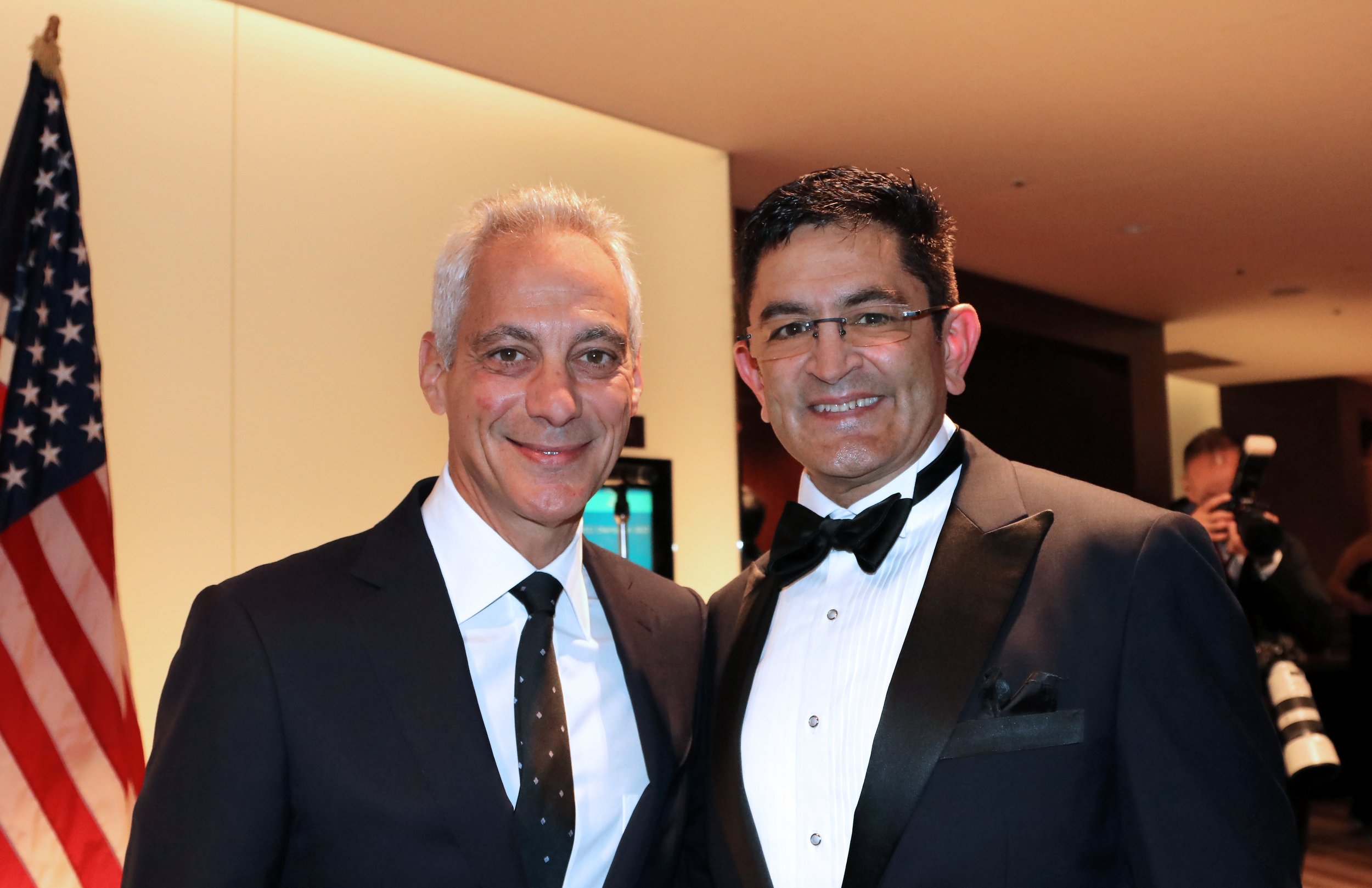



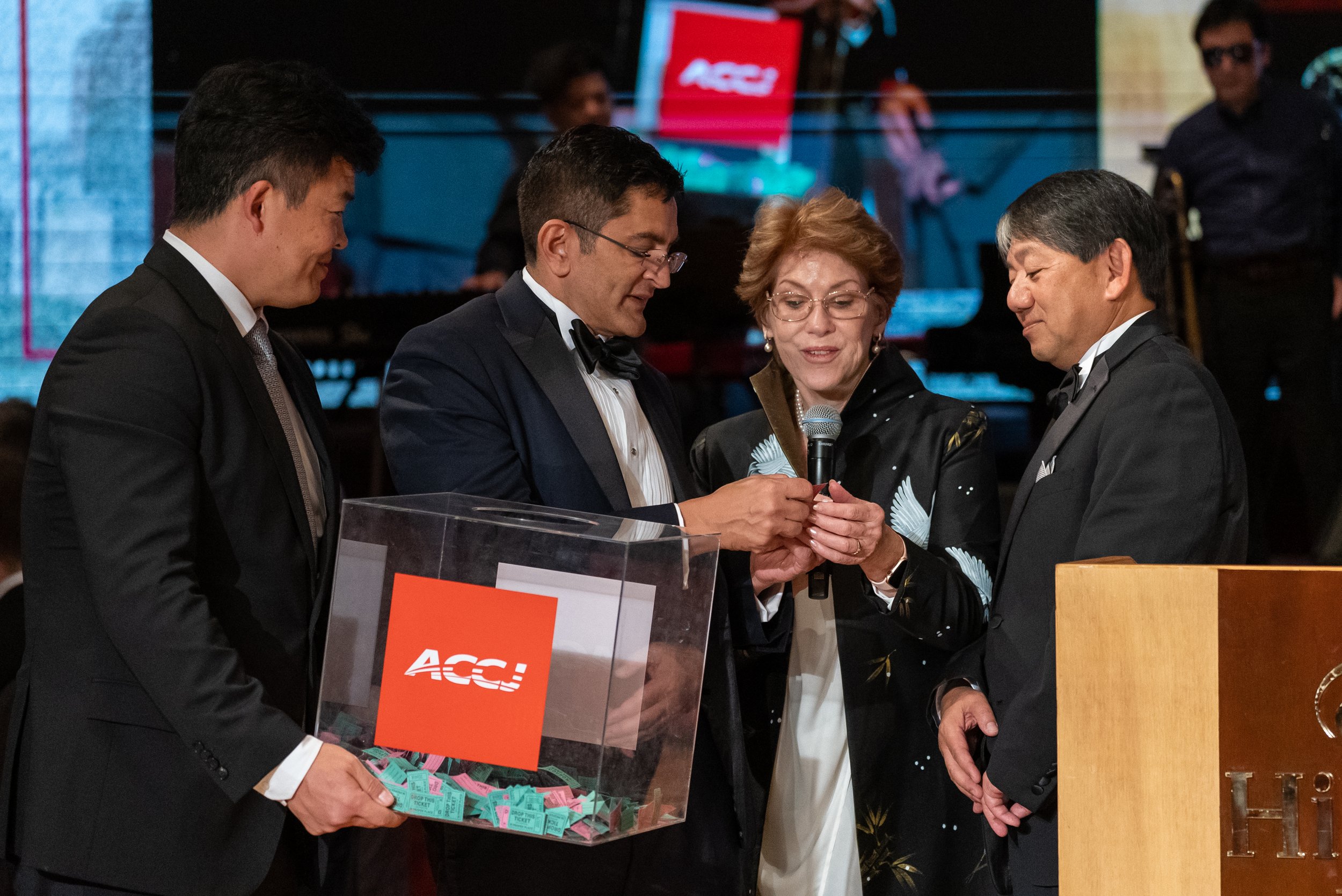



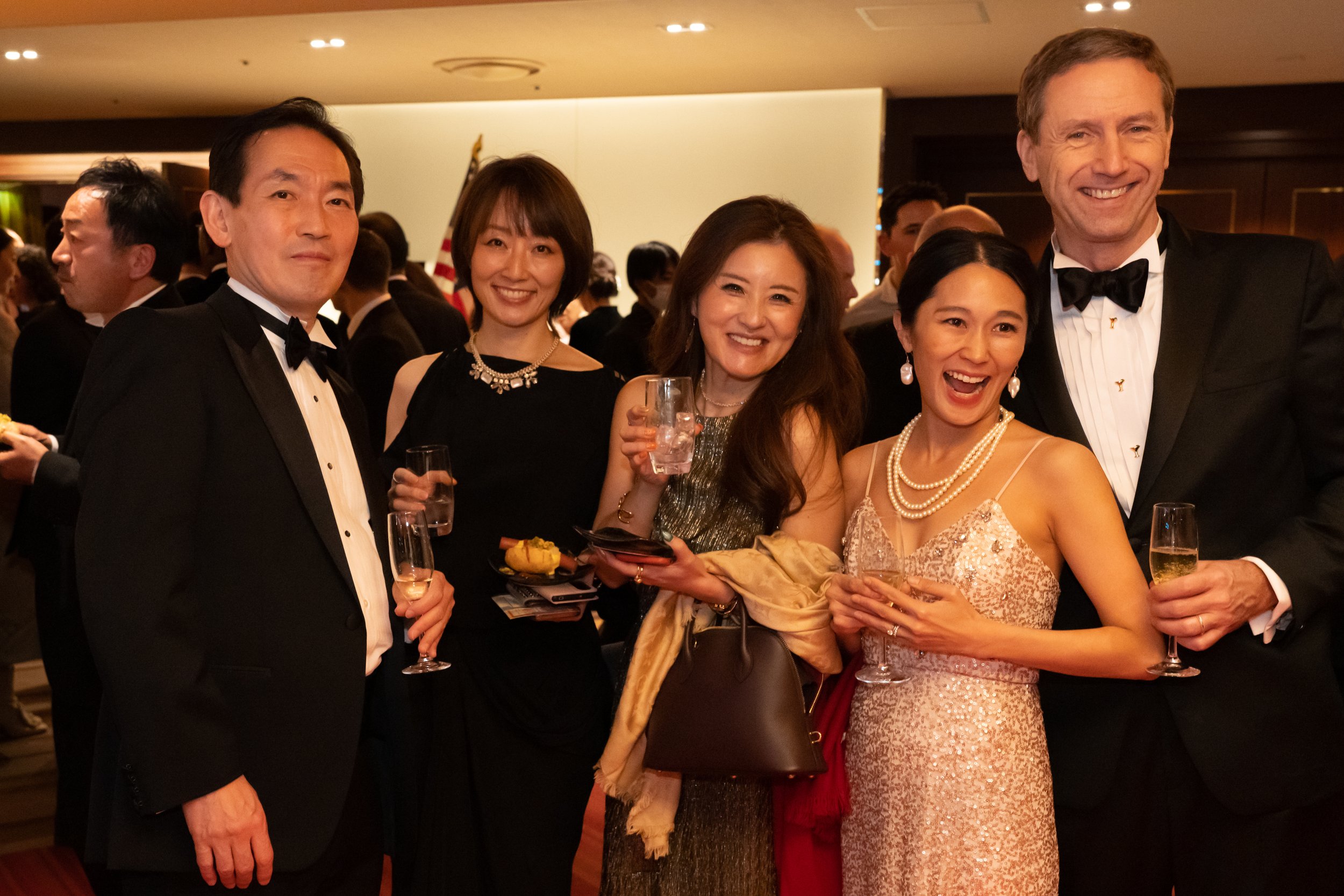

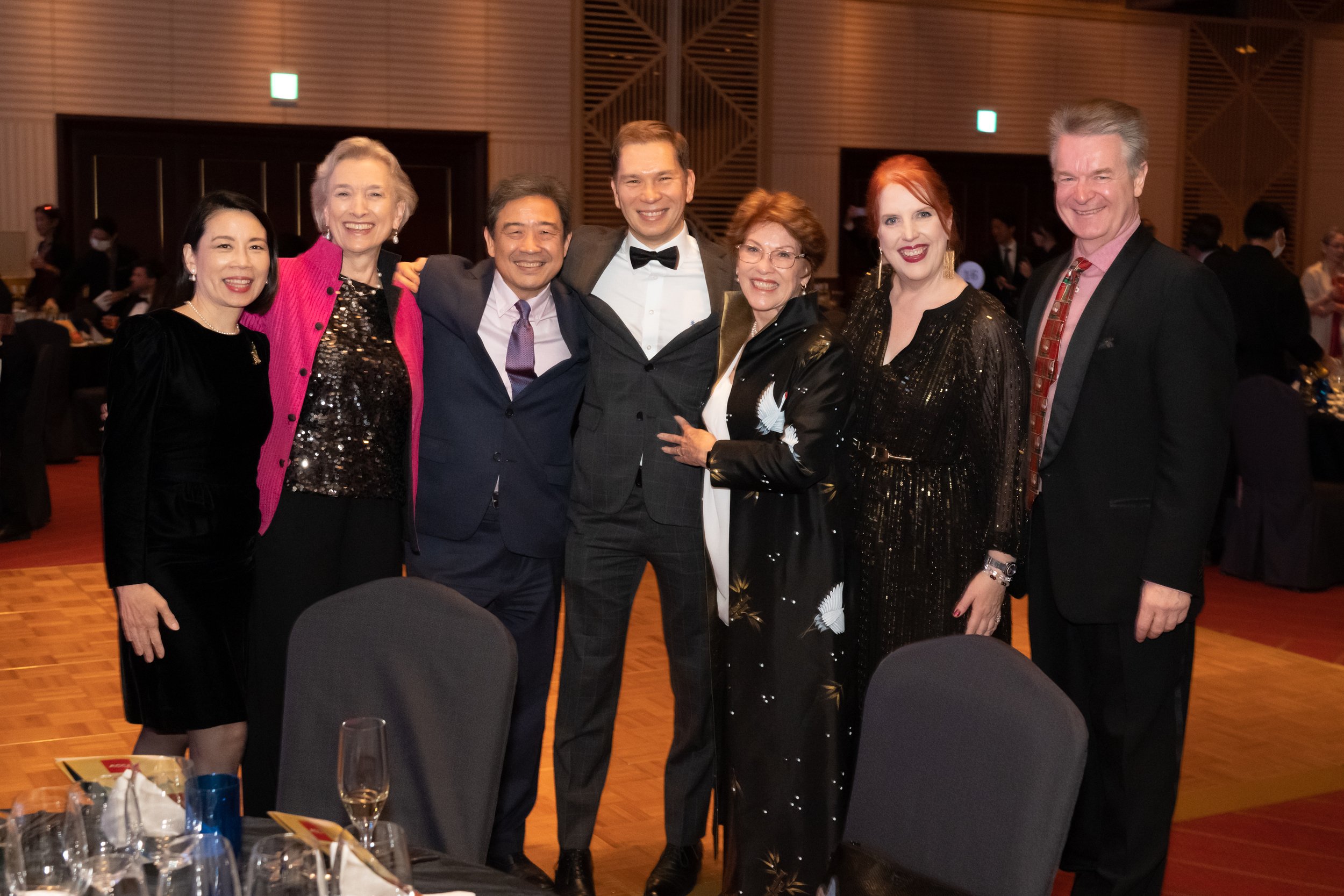



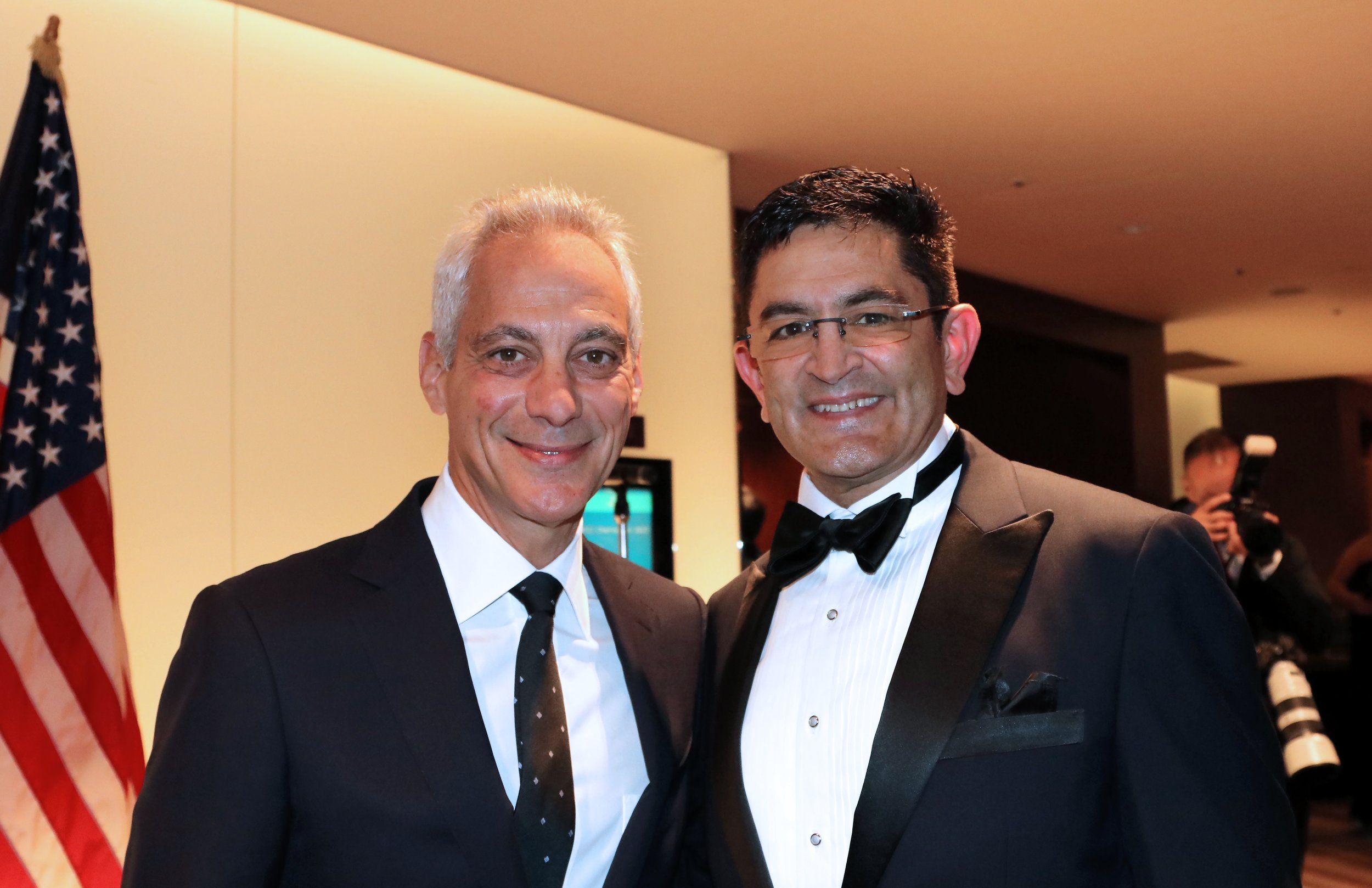





Photo of Ambassador Emanuel: US Embassy, Tokyo • All other photos: Media Sense K.K.
President’s Circle Sponsors



Platinum Sponsor
Thomson Reuters
Bronze Sponsors
AIG Companies in Japan
Coca-Cola (Japan) Co., Ltd.
Prudential Financial, Inc.
Gold Sponsor
Boeing Japan K.K.
Mercury Sponsors
Morgan, Lewis, & Bockius LLP
American Automobiles Space
NRK Sogo Kikaku Co. Ltd.
Prize Sponsors
Diamond
Air Canada
Aquasense Hotel & Resort
Delta Air Lines
Double Bounce Productions Inc.
Fufu Hakone
Herman Miller Japan, Ltd.
KOA Production Inc.
Marriott International, Inc.
MediaSense K.K.
MnK Niseko
United Airlines, Inc.
Vega Project K.K.
Ruby
Andaz Tokyo Toranomon Hills
Grand Hyatt Tokyo
Hakuba Hotel Group
Sapphire
Amway Japan G.K.
Dhillon Marty Inc.
ELC Japan K.K. (Estée Lauder)
Mondelēz Japan Ltd.
Park Hyatt Tokyo
Shop Japan
Sunrockers, Ltd.
Tokyo American Club
Emerald
All Nippon Airways Co., Ltd.
ANA InterContinental Tokyo
Antenna America
Asian Tigers Mobility
Big Picture International, K.K.
Bistro Vino Cellars
Conrad Tokyo
DevilCraft
Eastern Carpets
Elana Jade
Enplus Inc.
Food-e
Godiva Japan Inc.
Hafele Japan K.K.
HARIBO Japan
Hilton Tokyo
Hilton Tokyo BayHotel Indigo Inuyama Urakuen Garden
Hotel Indigo Karuizawa
Hyatt Regencv Kyoto
Jupiter International Corporation
M. ISHII & SONS
Northrop Grumman Japan
Palmer House
pearls.jp
Riedel Japan
Sazerac Japan
Simon Dalby Art
The Strings by InterContinental Tokyo
Temple University Japan Campus
Tsingtao Brewery
Yellow Toes Art Gallery
YouMeWe

Investing in Biotech
To help Japan capture a market forecast to grow to up to $4 trillion by 2040, METI has created an $8 billion fund to support biomanufacturing, a field that encompasses technologies which leverage genetic technology to maximize the ability of microorganisms to produce substances.
From plastics that melt in the sea to cultured foie gras, Japan is pushing innovative technologies forward with government support
In terms of taste, IntegriCulture’s prototype cultured foie gras has been praised by culinary experts as having a good balance of richness and sweetness.
A decade on from Dr. Shinya Yamanaka’s win of a Nobel Prize for his research into induced pluripotent stem cells, or iPS cells, Japan is lagging in bringing biotechnology to a market forecast to grow to up to $4 trillion by 2040.
To help capture this huge opportunity, Japan’s Ministry of Economy, Trade and Industry (METI) revealed plans last fall for an $8 billion (¥1 trillion) fund to support biomanufacturing. The field encompasses technologies that leverage genetic technology to maximize the ability of microorganisms to produce substances.
Hirokazu Shimoda, director of METI’s Bio-Industry Division, explained why the country plans to go big on bio.
“It is only a matter of time before the global manufacturing industry is replaced by bioprocesses,” he said. “That’s why we are making medium- to long-term investments on the scale of about ¥1 trillion to build a system for companies in the biotechnology and drug discovery markets to develop and manufacture in Japan, then earn money in the global marketplace.”
As well as driving economic growth, biomanufacturing is also expected to be key in solving global issues such as marine pollution, global warming, and food shortages. Some top players in Japan’s biomanufacturing field are already making a difference in those areas.
Green Planet
In 2011, Kaneka Corporation achieved the world’s first commercial production of plastic that degrades in the ocean. The Osaka-based company plans to quadruple the production capacity of its biodegradable biopolymer called Green Planet to 20,000 tons in January 2024.
Kaneka began developing Green Planet in the early 1990s, when global environmental problems such as global warming began to emerge. The project was launched due to the strong desire of researchers to provide environmentally friendly products that don’t depend on fossil fuels.
Green Planet has qualified for the BiomassPla Identification and Labelling system, awarded to materials composed of biomass. It has also received the OK Biodegradable MARINE certification, issued by TÜV Austria Belgium NV/SA for materials that biodegrade in seawater.

Osaka-based Kaneka Corporation plans to quadruple the production capacity of its biodegradable biopolymer called Green Planet to 20,000 tons in January 2024.
Currently, Green Planet is used in straws, plastic shopping bags, cutlery, food containers and agricultural supplies. Seedling pots made with the material can be left to biodegrade after being buried in the soil. Kaneka is studying the material’s effects on natural cycles, including changes to bacteria in the soil.
“The focus of our research is to expand the range of physical applications for which Green Planet can be used,” explains Dr. Shunsuke Sato, a researcher at Kaneka’s Agri-Bio & Supplement Research Laboratories. According to the company’s own estimates, the combined annual production volume of plastic alternatives in Japan, the United States, and Europe currently is about 25 million tons. The market for Green Planet as a substitute for traditional plastic is expected to expand as regulations tighten and awareness grows.
Looking to capture this demand, Kaneka is focusing on carbon dioxide (CO2) as a new raw material for mass production of Green Planet. The goal is to recycle CO2 using microorganisms thereby creating a new process of manufacturing that can address both environmental problems and economic development. Sato explains: “We have the technology to do this in the lab. For mass production, we need to develop a culture process that efficiently converts gas components, such as CO2 and H2 [Dihydrogen], into Green Planet.”
Redefining Meat
Culturing has deep roots. For hundreds of years, humans have used and improved upon it to make wine, cheese, and more. In recent years, new culturing techniques have unlocked the process for making lab-grown cultured meat, redefining what we believed to be possible.
One pioneer of this movement is IntegriCulture Inc. As competition in the development of cultured meat heats up globally, this Japanese startup is the world’s first to succeed in producing cultured foie gras. Dr. Yuki Hanyu, IntegriCulture’s CEO, began research in 2014 on the CulNet System, a unique cell culture technology for manufacturing cultured meat. In 2019, he completed a prototype of cultured foie gras using duck liver cells.
The expansion of the worldwide market for cultured meat provides a tailwind for development. According to market forecasts by US consultancy A.T. Kearney, cultured meat will make up 35 percent of the meat market by 2040. Hanyu believes that the spread of cultured meat will depend on price, taste, and consumers’ belief in its safety.
In terms of taste, IntegriCulture’s prototype cultured foie gras has been praised by culinary experts as having a good balance of richness and sweetness. The first commercial sales are planned for 2024 in Singapore, a market with a precedent. In 2020, Singapore approved the sale of cultured chicken developed by a US company. Domestically, IntegriCulture is aiming to begin sales in 2025, but Japan’s screening standards for areas such as safety have not yet been decided.

Kaneka researcher Shunsuke Sato

IntegriCulture CEO Yuki Hanyu
The potential advantages that come with cultured meat are enormous. IntegriCulture’s CulNet System makes it possible to produce cultured meat at about one ten-thousandth the cost of conventional culture methods. With conventional methods of cultivation, ingredients contained in the blood, such as the serum necessary for cell culture, are expensive and seen as an obstacle to commercialization. However, with CulNet System, IntegriCulture has succeeded in maintaining the appropriate nutritional content without using expensive ingredients. It can also culture cells from various animals including fish.
IntegriCulture plans to sell the CulNet System to food manufacturers and other organizations, and to work together with them to develop technologies that will enable mass production.
“Leveraging our core strength of engineering technology, we want our system to find its proper place in the world,” said Hanyu, who first got involved in so-called cellular farming because he wanted to make the cultured meat he read about as a child in science fiction novels. To this day, he continues to strategize about what he can make with biotechnology, taking inspiration from his beloved world of science fiction.
Companies such as Kaneka and IntegriCulture are just the tip of the iceberg in terms of Japanese biotechnology’s true potential. “Japan is good at the zero-to-one stage of research and development, but is often less adept at scaling up as an industry on the global level,” explains Kaneka’s Sato. That’s exactly what METI aims to change, helping these pioneers and other like them with the funding they need to mass produce and commercialize their innovative biotechnologies.
Thank you for reading this article.
To help improve the quality of content from the Ministry of Trade, Economy and Industry, your feedback is extremely valuable to us. We would appreciate it if you could take the time to answer this short survey.

Leading the Way
Each year, the American Chamber of Commerce in Japan (ACCJ) honors members who have shown extraordinary dedication. On December 20, recipients were recognized in person for the first time since 2019 at a special Leadership Forum networking event, chaired by ACCJ Governor John W. Carlson III, at The Tokyo Edition, Toranomon.
The ACCJ recognizes exceptional contributions for 2022 from across its three chapters
Each year, the American Chamber of Commerce in Japan (ACCJ) honors members who have shown extraordinary dedication. On December 20, recipients were recognized in person for the first time since 2019 at a special Leadership Forum networking event, chaired by ACCJ Governor John W. Carlson III, at The Tokyo Edition, Toranomon.
“ACCJ leaders set the bar high, but are incredibly generous about sharing their knowledge and experience, and I have benefited so much from being a part of this community,” Leader of the Year Anne Smith told The ACCJ Journal. “To be recognized and to have my name officially added to the history of the ACCJ in this way is a career highlight.”
Steven Brown, who created the Ten Points on Business Dinner Series, said being named Leader of the Year for Chubu was “a great honor and quite a surprise.” He added that the most challenging part of the year was overcoming the long hiatus from in-person events forced upon the chamber by Covid-19. “In truth, I was a bit nervous about whether the presentations would be a success, but the speakers have been excellent—both entertaining and informative.”
Kansai Volunteer of the Year Naomi Iwasaki said the award was “like receiving a Christmas present. But I know I am receiving this representing the D&I Committee. Without their love and support, I would not be here today.”
Taking on the emcee role at the D&I Summit and Leadership Series “was exciting and challenging,” she explained.
The ACCJ also honored Ritchell Madikaegbu with a Special Recognition Award for her work as liaison from the US Embassy, Tokyo. Her valuable updates on women’s empowerment and leadership development initiatives—along with spearheading opportunities to connect and share best practices with other organizations supporting the committee’s shared goals—made a big difference in 2022.
“I am truly happy about the honor, and it is a reminder of the importance of the US Embassy–ACCJ partnership,” she said. “I look forward to doing my part to advance US Embassy and ACCJ priorities in Japan in 2023.”

Anne Smith
Dual roles led to Leader of the Year honors for Anne Smith, whose tireless work as vice-chair of both the Government Relations and Healthcare Committees has elevated the ACCJ’s relationships with US and Japanese government partners. She is the face of the Government Relations Committee, setting meeting agendas and running committee-hosted events, and she spearheaded several defining events of the year, including the welcome luncheon with US Ambassador to Japan Rahm Emanuel, attended by more than 160 members and guests. And her work with the Healthcare Committee resulted in meetings with top-level government and industry leaders. Smith’s passionate dedication serves as an inspiration to others and the ACCJ is grateful for her impactful contributions to the chamber’s position as the voice for global business in Japan.

Akimasa Kataoka (Kansai)
Recognized for his superb leadership as co-chair of the Kansai Membership Relations Committee (MRC), Akimasa Kataoka revitalized the MRC and was a driving force behind the committee’s first in-person event in more than two years. Thanks to his efforts, the committee now has a growing membership base and many new events underway, including a young professionals mentorship program. Kataoka’s energy and commitment have created new opportunities for members to participate and get involved in the Kansai Chapter.

Steve Brown (Chubu)
As a founding member of the Chubu Independent Business Committee (IBC), Steve Brown served as the committee’s first chair. He returned to IBC leadership this year, determined to reinvigorate the Chubu Chapter, and provided exceptional leadership as co-chair. He conceived of the Ten Points on Business Dinner Series, in which experienced business leaders shared key insights that led them to success and mistakes that have proved educational. Brown’s enthusiasm and tireless efforts made these monthly events a tremendous success, reengaging members and reestablishing the solid foundation of the Chubu community, and he continues to inspire leaders in the Chubu Chapter and throughout the chamber.

Takako Onoki
Contributing endless energy and expertise to the Competition Policy Committee, Takako Onoki has made invaluable contributions, proactively organizing new speaker events and coordinating advocacy initiatives. She swiftly marshals the committee’s views on public comment opportunities to ensure that the ACCJ has a strong voice on key industry issues. As the committee’s most active member for several years, Onoki is an integral part of the committee’s leadership. The chamber is grateful for her passion and continued dedication.

Naomi Iwasaki (Kansai)
It is for her proactive and enthusiastic support of the Kansai Diversity and Inclusion Committee that Naomi Iwasaki was named Volunteer of the Year. She was critical to the success of the D&I Summit Series, where she managed the Day 2 networking session and served as emcee on Day 3. She also collaborated directly with committee leaders and the speaker for one of the popular Leadership Series speaker sessions. Iwasaki provides an important perspective during committee meetings and is an indispensable asset to leaders and members alike. Her inclusive workstyle encourages others to further participate in realizing the committee’s goals and inspires inclusive business practices.

Rafael Dantas (Chubu)
The ACCJ expresses its deepest appreciation to Rafael Dantas for his outstanding efforts in support of the Chubu Aerospace and Manufacturing Committee (AMC). He organized the Chubu Chapter’s first in-person networking event since before the pandemic, secured a venue where adequate social distancing was possible, and planned activities to facilitate networking among the participants. Due to his ingenuity and initiative, this and a follow-up event were resounding successes, resulting in three new members joining the ACCJ Chubu Chapter. Dantas’s positive energy, superb ability to organize, and strong networking skills are an asset to the entire chamber.

(Re)Open for Business
It isn’t easy to do business when you’re standing outside staring through the window. But that’s the situation so many found themselves in during much of the pandemic, thanks to some of the world’s most stringent border restrictions. Japan finally reopened its borders to mostly normal travel, including visa-free entry in October 11. We look ahead at the journey past and ahead.
Japan’s long journey to open borders and what lies ahead for business and education
It isn’t easy to do business when you’re standing outside staring through the window. But that’s the situation so many found themselves in during much of the pandemic, thanks to some of the world’s most stringent border restrictions. Japan’s reluctance to allow non-citizens to enter the country, slowness in loosening the reins, and insistence on complicated and costly requirements once the trickle was allowed to start put both domestic and non-Japanese companies in a tough spot.
Getting these policies eased became a centerpiece of advocacy for the American Chamber of Commerce in Japan (ACCJ) and other foreign chambers in 2021, and the efforts continued in 2022. It took most of the year to get the desired results, but Japan finally reopened its borders to mostly normal travel, including visa-free entry, just months ago, on October 11. And now we look ahead to 2023.
Long Road
When Japan placed visa restrictions on travelers from 38 countries at midnight on March 21, 2020, no one imagined the journey back to normality would take so long. There was still the feeling that this would be a short-term measure to minimize the duration of the pandemic, which itself was expected to pass within months if strict steps were taken. But by May 27, the list had grown to 111 countries, including the United States, and it had become clear that Covid-19 wasn’t going away anytime soon.
The ACCJ, other foreign chambers, and the European Business Council in Japan set out on a long advocacy journey calling for fair and equal treatment of foreign residents. Eventually, two of the most influential domestic lobbies—the Japan Business Federation (Keidanren) and the Japan Association of Corporate Executives (Keizai Doyukai)—added their voices, and on November 8, 2021, the Japanese government temporarily loosened restrictions on business travelers and students.
The move was welcome, but many agreed more was needed. The ACCJ continued to push for change in 2022, and the chamber’s advocacy received broad exposure in media, with coverage by Bloomberg, Kyodo News, and Nikkei Asia, and in Japanese through the Mainichi Shimbun and NHK.
On March 3, Japanese Prime Minister Fumio Kishida announced that the daily cap on entrants would be raised from 5,000 to 7,000 on March 14. More phases played out as small-scale tours were allowed and the daily arrival cap raised to 20,000 in June. Another rise to 50,000 came in September, and the country fully reopened in October.
“Our experience during the pandemic demonstrated that the ACCJ remains the single most important vehicle in Japan for its members to address shared concerns with Japanese and US leaders and with the media,” Christopher J. LaFleur told The ACCJ Journal. LaFleur, who was ACCJ chair when the pandemic began and later served as a special advisor, often spoke to media on behalf of the chamber about the border issue and advocacy positions.
“We also demonstrated our unique capacity to bring together like-minded organizations to amplify our impact. Moving forward, the chamber should continue to monitor travel policies as it focuses on other high priority issues, such as economic security and digital transformation.”
Then and Now
Just before the November 2021 announcement, ACCJ members shared with The ACCJ Journal how the strung-out restrictions had impacted their businesses.
Kenneth Lebrun, a partner with the law firm Davis Polk & Wardwell LLP in Tokyo and co-chair of the ACCJ FDI and Global Economic Cooperation Committee, said his business had been impacted in two ways. “First, we have been unable to bring new employees to Japan, whether internal rotations from our US offices or external hires, because the government is not issuing new long-term work visas. This has impacted the ability of professional service firms to provide services to Japanese clients concerning their overseas operations,” he explained.
“In addition, the blanket ban on foreign business travelers coming to Japan—and the quarantine requirements for Japanese residents traveling abroad, and then returning to Japan—has negatively affected the level of cross-border investment and M&A activity, which is a significant portion of our business.”
Revisiting these issues now, Lebrun said that the Japanese government’s resumption of issuing business visas in 2022 allowed the firm to bring new hires and rotations from its US offices to work in Tokyo and thus return normality to its services.
He also feels optimistic about M&A recovery. “As Japanese companies typically desire to conduct site visits and meet face-to-face with the management of potential acquisition targets, the easing of border restrictions has encouraged many Japanese companies to resume their overseas acquisition activities,” he said while noting a caveat.
“The rebound of outbound M&A has been tempered by the strong yen, which makes foreign assets more expensive, but I am optimistic that cross-border M&A will return to pre-Covid levels during 2023 as the macroeconomic and demographic trends underpinning Japanese companies’ desire for overseas growth remain unchanged.”
Catherine O’Connell expects that increased business activities involving non-Japanese companies and entrepreneurs will boost her own law practice, Catherine O’Connell Law. Co-chair of the ACCJ Legal Services and IP Committee, O’Connell believes that demand for fractional general counsel support for businesses will expand.
“As borders open, people need experienced, bilingual lawyers to ensure full compliance across all their business activities,” she said.
“Long before the pandemic, I was well placed to service corporate clients who need efficient, competent, and practical legal advice, tapping into a network of specialist Japanese lawyers to cover all aspects of the law. This has only gotten better during the pandemic for me, so I have full confidence the work will be consistent and rewarding.”
O’Connell, who serves as independent audit and supervisory board member for Fujitsu Limited—the first foreign woman to hold the position—also sees benefits in other areas as a result of the pandemic.
“Performing my outside board roles has also become far easier and acceptable to do remotely outside Japan when necessary—yet another pandemic silver lining,” she explained. “In my view, the border closure has not impeded the advancement in board governance as companies continue to hire directors and statutory auditors who are based overseas for part of the year.”
Learning Again
Another sector significantly affected was education. Matt Wilson, president and dean of Temple University, Japan Campus (TUJ), expressed concerns to The ACCJ Journal in November 2021 over the impact on TUJ’s students and Japan’s reputation.
“Because of the borders being closed, we have had some long-term, degree-seeking students who decided they were going to attend other institutions, take an indefinite leave of absence, or simply abandon their plans to study here in Japan,” he said. “Our concern is that the patience of our current students who are unable to enter Japan will run thin, and they will burn out on online education at strange hours in their home countries. They could decide to take a leave of absence or pursue other opportunities.”
Fortunately, the situation has improved greatly, he said when asked how things have progressed. “The reopening of the country to educators and students in March 2022 has turned the tide, and students seeking an international experience in Japan have flocked to our campus since the reopening while expert faculty from our main campus in Philadelphia have started asking about short-term teaching opportunities on our campus,” he explained.
“And due to a major influx of overseas students and increased interest among domestically based students, TUJ’s undergraduate program has soared to new heights, reaching a record 1,841 students. In 2020, TUJ’s undergraduate enrollment was about 1,250.”
Mark Davidson, a board member of TUJ as well as the U.S.-Japan Bridging Foundation, which awards scholarships to US undergraduate students to study in Japan for one semester or an academic year, said, “I’m delighted to say that inbound student mobility is back to pre-pandemic levels.”
Davidson, who also serves as vice-chair of the ACCJ Education Committee, is a strong advocate of internships and helped the ACCJ—together with the Embassy of the United States, Tokyo, and the US–Japan Conference on Cultural and Educational Interchange (CULCON)—to launch an online portal in 2019 where ACCJ member companies can post internship openings. He hopes the progress made on reopening entry into the country for students will spur development of more internship opportunities.
“In the post-pandemic world, I hope that both foreign-based and Japanese companies will redouble efforts to offer substantive, US-style internship programs to Japanese and foreign students alike,” he said. We need to get beyond the one-size-fits-all, lockstep shukatsu system and promote more flexible, practical, and innovative approaches to hiring. A serious internship program will help companies to win the war for talent and also contribute to cultivating the kind of globally talented young people that every company—and Japan as a whole—needs to succeed and prosper in the 21st century.”
TUJ’s remarkable recovery certainly points in a positive direction for young talent in Japan’s future. “With the borders open, TUJ is seeing strong demand for 10 undergraduate degrees and short-term study abroad programs from the United States and around the world,” Wilson explained. “In 2023, we anticipate that this will continue so long as Japan continues to prioritize entry for students and educators. Based on a weaker yen and issues with China’s approach to the pandemic, now is a prime time for Japan to attract students seeking higher education.”

MGM Resorts’ Osaka integrated resort concept. Image: MGM Resorts International
Have Ticket, Will Travel
Perhaps the most noticeable impact of the border closures was the end of tourism. Some 32.5 million tourists visited Japan in 2019, and the government had set a target of 40 million for 2020. But just 2,900 foreign nationals arrived in April 2020, down 99.9 percent from the same month a year before. It was the first time since 1964 that the monthly arrivals figure had slumped below 10,000. And it’s been a slow climb out of that hole.
Now that tourists can once again enter the country, ACCJ Vice President-Kansai Jiro Kawakami, who is vice president and chief of staff at MGM Resorts LLC, is positive about Japan’s prospects for a robust tourism recovery.
“The signs are starting to emerge in the form of high occupancy and rates at hotels, large crowds at tourist sites in Tokyo and Kyoto, as well as popular attractions such as Tokyo Disneyland and Universal Studios Japan,” he said. “China was the largest source of inbound tourism before the pandemic, and we should see some of that segment return as their government eases outbound travel restrictions.”
Prior to the pandemic, there was much talk of building Japan’s first integrated resort (IR), and a number of companies were competing for the license to do so. While tourism came to a stop due to Covid-19, the IR process did not. MGM Resorts and Orix Corporation were awarded rights in September 2021 and Kawakami said they are now in the process of applying for a license to develop Japan’s first IR in Yumeshima, Osaka.
“Osaka’s IR candidate site is the same location as the 2025 Osaka Kansai Expo,” he explained. “We look forward to hearing back from the Government of Japan in the near future. In the meantime, we continue to work closely with tourism and hospitality stakeholders in Kansai to develop Osaka into a global tourism hub leading up to the 2025 Expo and projected 2029 opening of the IR in Osaka.”
O’Connell is also confident tourism will rebound, and events such as the 2025 Expo may be well timed for what she expects to be a gradual recovery.
“Any tourist who traveled here for the Rugby World Cup in 2019 has Japan as their last fantastic, vivid travel memory,” she said. “So I believe Japan is a very hot travel destination and people will be desperate to return. That said, I’m happy if tourism is slower and more controlled than before to prevent overtourism of Japan’s scenic spots.”
Resolution
LaFleur said that, through its advocacy on travel restrictions over the past three years, the ACCJ helped its members and the broader foreign community in Japan secure fair treatment and a reopening of borders that sustains both public health and the economy.
“Covid and its aftereffects remain global challenges,” he added. “However, the ACCJ can and should continue urging Japan and its global partners to ensure their heath policies enable the fullest possible economic recovery, not least because stronger economies are crucial to ensuring our countries have the resources to maintain global peace and security.”

Healthy Ideas
The 2022 HxD event was modeled on the concept of ideathons, or workshop-like gatherings of groups tasked with challenges for which they are to propose solutions. Through this model, a total of 86 ideators, facilitators, and mentors worked together through a cyclic ideation process to identify root causes and develop the next big project in healthcare.
Innovators empower elderly patients at ACCJ Healthcare x Digital Ideathon
Started in 2020, the Healthcare x Digital (HxD) initiative of the American Chamber of Commerce in Japan (ACCJ) has grown to become a key platform for collaboration among innovators, startups, entrepreneurs, and top pharma executives.
After hosting pitch events for the first two years, the first ever HxD Ideathon took place late last fall with a hybrid in-person and online kickoff at the Hilton Osaka on October 29. This was followed by two virtual sessions on November 5 and 12, then finalized by the hybrid pitch event on November 19 at the Hilton Osaka. The four-day event was inspired by the tagline “empowering elderly patients through digital health.”
Participants included university students from the United States and Japan as well as healthcare professionals and a panel of judges from healthcare fields. Their aim? To forge new partnerships and create solutions for some of Japan’s most critical challenges in community healthcare and individual patient care.
Ideathon
The 2022 HxD event was modeled on the concept of ideathons, or workshop-like gatherings of groups tasked with challenges for which they are to propose solutions. Through this model, a total of 86 ideators, facilitators, and mentors worked together through a cyclic ideation process to identify root causes and develop the next big project in healthcare.
Day one began with opening remarks by Simone Thomsen, president and representative director of Eli Lilly Japan K.K. as well as ACCJ governor-Kansai, and continued with a panel discussion and ideation in groups to define problem statements and the healthcare challenges to be tackled. Ideation continued on days two and three, when teams focused on initial designs and worked to find agreement on a solution—one per group—that was to be presented on pitch day.
The event culminated on November 19 with a pitch contest in which nine teams presented their concepts, and engaged in question and answers sessions with judges, who then selected the best ideas. The winning teams will move forward to the next phase of the competition—a hackathon—to be held in 2023.
Pitch Day

The final day was divided into two rounds during which each group had five minutes to pitch their solution to a panel of judges.
Perhaps the biggest draw of HxD is the opportunity to present ideas directly to—and receive invaluable feedback from—industry leaders. There’s also the possibility of entering into a joint venture with, or receiving investment from, an industry player.
Winners also receive cash prizes and, this time, will have the chance to present their ideas at the 2025 Osaka Kansai Expo and as part of the Japanese government’s Super City Initiative.
Let’s take a look at this year’s pitches.
Kyocare
Presented by Hiba Abulgasim, Kyocare is a digital customer-to-customer and business-to-business platform that provides flexible, personalized, quality care.
In the pitch, Abulgasim noted that 28.9 percent of Japan’s population is over the age of 65 —a record number that is growing. But the workforce tasked with caring for them is understaffed and overworked, and about 70 percent want to leave the profession.
This means care services are poorly coordinated. Many elderly people feel lonely and disconnected as a result, and family members tasked with their care feel stressed out.
The solution? Kyocare provides on-demand caregiving services for the elderly through an app that matches those who need long-term home care with nearby care workers.
Hi-Real System
A digital ecosystem pitched by Masato Suzuki and Sachiko Nakatsuka, Hi-Real System allows emergency-patient health records to be accessed by healthcare professionals even before emergency care is provided.
In their problem statement, Suzuki and Nakatsuka asked, “How do we support emergency triage when medical resources, such as medical staff, are limited?” Their solution involves a blockchain emergency information transmission service that instantly shares patient information to the hospital before patient arrival, which can then be used for smoother emergency treatment diagnosis.
Maya Mind
Osaka University Assistant Professor Gajanan Revankar presented Maya Mind, a web platform accessible via smartphones, tablets, or personal computers that targets patients who suffer from dementia. Revankar noted that, during early onset of dementia, diagnosis is time consuming and costly, while accuracy is low. Maya Mind seeks to tackle all these challenges.
The app uses eye tracking, speech processing, artificial intelligence (AI)-based analytics, and machine learning algorithms to create an index score for classifying different kinds of dementia, among other provisions.
AI Assistant
Ajinkya Takawale and Tomoko Mitsuoka pitched a voice-controlled AI assistant with a focus on early diagnosis of chronic kidney disease (CKD) and diabetes. The challenge before Takawale and Mitsuoko included how to leverage digital technologies to make the elderly more aware of their health risks through early diagnosis. Their voice-controlled robot uses non-invasive methods such as retinal imaging to track, record, and analyze an elderly person’s healthcare data. Using the results, they provide a diagnosis and help the person plan their lifestyle based on the insights.
Toilet Light Sensor for CKD
Chisato Banno and Reiko Tsubaki, both third-year students at Tokyo Medical and Dental University, also pitched a digital solution for patients at risk of CKD. Their solution offers a low-cost yet accurate Internet of Things device that samples, analyzes, and visualizes a person’s real-time health data, helping them to diagnose the onset of CKD early.
Their first prototype will use toilet-based light sensors that can analyze urine. The data gathered can be visualized via a smartphone app, which also can share data with a relevant healthcare provider, such as a hospital.
Helper-san
An avatar bot that identifies and neutralizes triggers that cause aggression in dementia patients, Helper-san is a digital platform that was presented by students and researchers Shobha Dasari, Allison Jia, Kanon Mori, Aarushi Patil, and Tsubasa Tanabe.
The students and researchers are part of a collaboration involving universities in Japan and the United States brought about by the Japan-American Innovators of Medicine, a four-month program in which medical innovators from both countries join to tackle a global healthcare issue related to dementia, such as aggression.
Their bot, which is embedded in a small, television-like device, can track a patient’s behavior, identify aggression triggers, and defuse them. An example would be dimming or turning off a light source that has been identified as the trigger.
Parapul
A web app presented by Kasper Watanabe, Parapul helps caregivers obtain the information they need, build relationships with like-minded people, and support their caregiving lives.
As the portion of society classified as elderly increases, Watanabe noted, the physical, mental, and financial burden on family members will grow, and yet such caregivers often lack the information necessary to provide care.
The Parapul platform is based on three pillars:
- Providing customized information, such as nursing care, educational materials, or local service listings to family members who are caregivers
- Connecting caregivers so they can share their challenges on bulletin boards, question-and-answer boards, or via direct messaging
- Offering a caregiving management system that, for instance, allows users to schedule nursing care support
Mobile Health
Pitched by Jingwen Zhang and Nondo Jacob Sikazwe, Mobile Health (mHealth) is a community platform that allows those at risk of CKD to be inspired to connect and receive information that can help them manage the condition.
During their presentation, the ideators noted that there are few digital tools on the market to help patients prevent or manage CKD. Why is this? First, individuals at risk, or who have early onset, of CKD have no or only slight symptoms that cause them inconvenience in daily life.
What’s more, those with middle-to-low incomes often struggle with daily living, which leaves little time and few resources to access primary healthcare.
Lastly, current biomarkers used to screen for CKD are affected by many factors, so there is a need for regular checkups.
Their community platform solves these challenges by incentivizing elderly people and their caregivers in three key areas:
- Motivation: where you can collaborate with the local community and receive community rewards for positive lifestyle changes
- Connection: where you can communicate directly with a healthcare provider
- Education: participate in customized, immersive games, quizzes, audio guides, and more that shed light on the issues of CKD
Coupon Kun
The final pitch, by Zechen Zeng and Keita Tsuyuguchi, addressed loneliness among elderly, which has reached epidemic levels. Zechen and Tsuyuguchi’s solution is a social network being developed in four phases. Phase one is to create a “Groupon experience,” through coupons for groups, that incentivizes elderly individuals to experience new things—such as hobbies, lessons, or traveling—with new social connections.
In phase two, the platform aims to introduce digital literacy to the elderly, including adoption of smart devices, while they undertake the group experiences.
In phase three, apps are used to monitor, collect, and share the health data of users with healthcare professionals following strict data privacy and security protocols.
And in phase four, insights gleaned from healthcare data are used to help users follow a healthy lifestyle.
Winners
With so many innovative ideas to consider, selecting the winners was not easy for the panel of industry professionals tasked with judging the 2022 HxD Ideathon.
Pitches were scored based on scientific innovation, relevance and timeliness, business feasibility, and how well they addressed the core issue.
Three ideas were selected to advance to the HxD hackathon in 2023:
- Maya Mind
- Hi-Real System
- Toilet Light Sensor for CKD
One other, Kyocare, was given special recognition and will also be part of the hackathon.
Overall, 119 ideators, facilitators, and students participated in at least one day of the ideathon, and connections were made with more than 22 universities for future events.
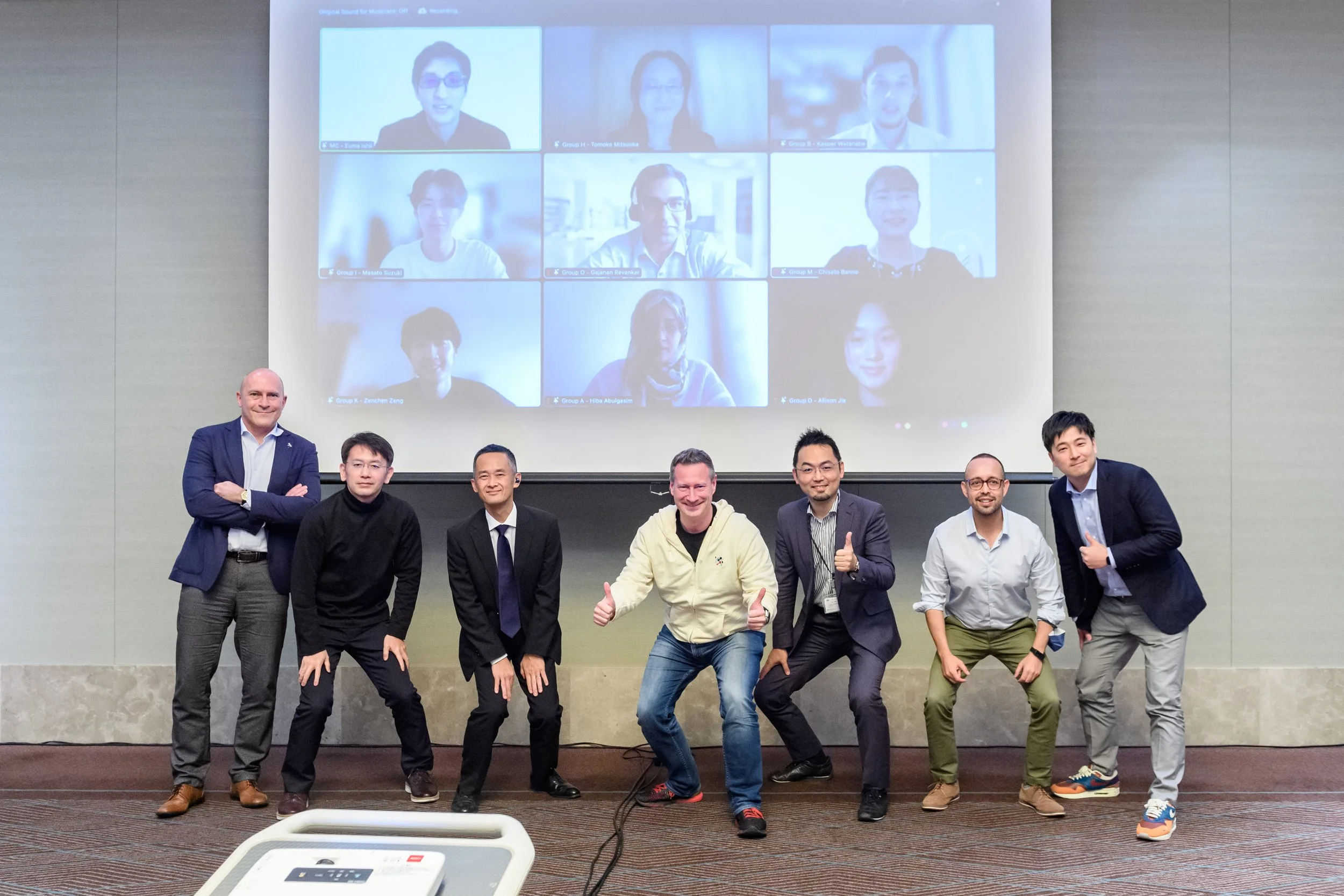
Judges
Kozo Mori
Director, Medical Industry City, Medical and New Industry Division, Planning and Coordination Bureau, Kobe City Hall
Masayoshi Yamada
Deputy director, Department of Smart City Strategy, Strategy Promotion Office, Regional Strategy Promotion Division, Osaka Prefecture
Torsten Kanisch
Executive officer and vice president, commercial excellence, AstraZeneca K.K.
Christian Boettcher
Consulting partner, health sciences and wellness, EY Strategy & Consulting
Francisco Proano
Head of strategy and digital transformation, Bayer Yakuin
Yasuhiko Iida
Senior director, Consumer Experience Team and Next Generation Customer Engagement Strategy, Eli Lilly Japan
Hiroki Kayama
Strategic partnership development manager, AI for Japan, Google G.K.
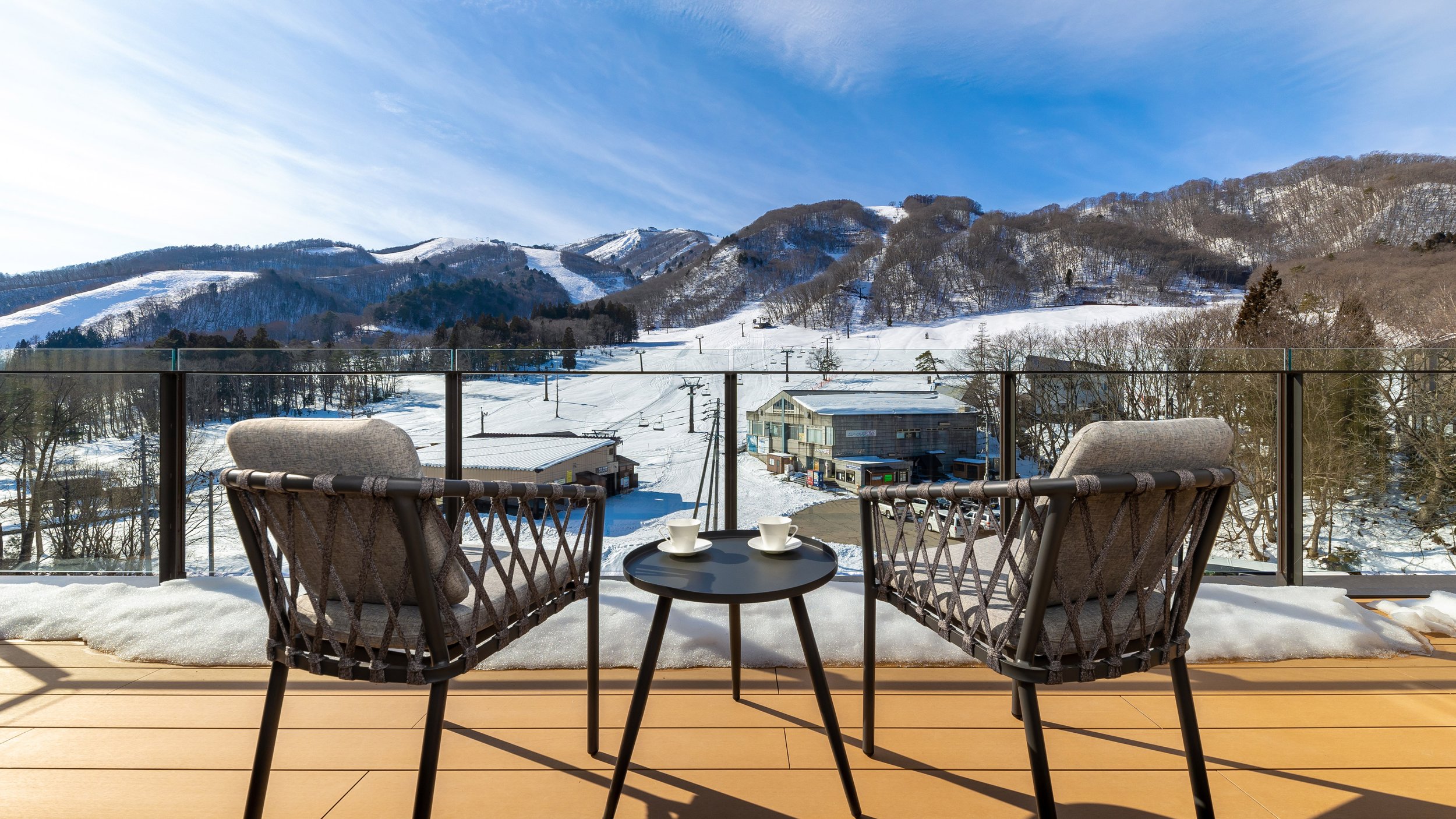
Perfect Powder
Hakuba Hotel Group (HHG) has been a driving force behind the development of the area over the past 10 years and manages a portfolio of more than 50 premium chalets and apartments situated in prime locations surrounding the Happo-One Resort. ACCJ members get 10 percent off at any HHG property this winter.
A luxurious winter escape from Tokyo is just a few hours away in Hakuba
Glistening lakes and rivers in summer, flamingly vibrant foliage in fall, and delicate powder snow in winter have made Hakuba a top destination for Japan’s international residents in recent years. The explosion of expats flocking to the valley for powder skiing and reconnecting with nature is boosted by other things that separate Hakuba from similar resort areas in Japan: its proximity to Tokyo and its international flair.
Hakuba Hotel Group (HHG) has been a driving force behind the development of the area over the past 10 years. Launched in 2012 with the purchase of the Hakuba Springs Hotel, HHG has grown from a small hotel operator to the Hakuba Valley’s largest hospitality company. The group owns or manages hotels, apartments, chalets, travel agencies, and events, as well as restaurants and bars featuring some of Asia’s most premium accommodations and dining. HHG is truly all things Hakuba.
Chalets and Apartments
HHG manages a portfolio of more than 50 premium chalets and apartments situated in prime locations surrounding the Happo-One Resort, host to downhill and Super-G Alpine skiing during the 1998 Nagano Winter Olympic and Paralympic Games. The properties combine the creature comforts of Western homes with the convenience of a fully serviced hotel. Guests can access a 24-hour concierge team, receive food and wine deliveries, and use complimentary resort and restaurant shuttle services.
The newest property is the ski-in, ski-out Roka Apartments. Completed in 2021, the eight serviced luxury units are the most exclusive in Hakuba.
Hotels
HHG hotels range from rustic and cozy to modern and sleek. The flagship property The Happo is among the most modern in Hakuba, having recently reopened after extensive renovation. With 30 rooms in the heart of Happo Village, 200 meters from the Happo-One slopes and surrounded by Hakuba’s best dining and nightlife, The Happo features onsen and Finnish sauna, a restaurant, bar, café, rental shop, and retail store.

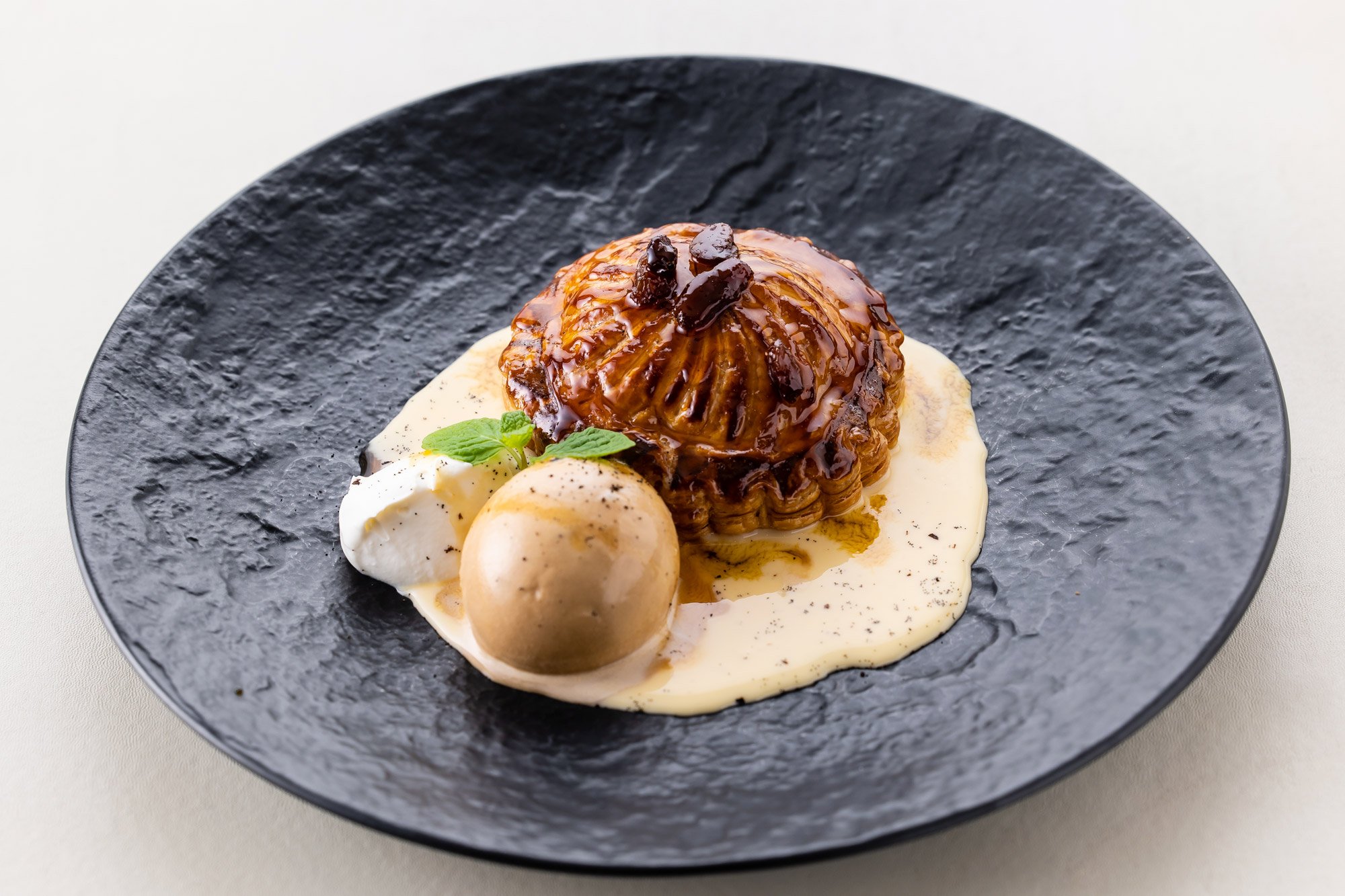

Dining
Mimi’s Restaurant & Bar is the jewel of the Hakuba culinary scene and among the few true fine-dining experiences in the valley. This HHG venue has ranked as Hakuba’s No. 1 restaurant on TripAdvisor for several years running. Other group restaurants include The Rabbit Hole, Blizzard Pizza, and The Grill.
Premium Partnerships
HHG is proud to be partnering with Land Rover to provide the most stylish shuttle service in Hakuba. Chalet and apartment guests receive complimentary shuttles to the ski slopes and local restaurants in Range Rover and Defender vehicles.
The group has also teamed up with Hyperice to help guests at The Happo recover and recharge with premium massage guns after a day of powder skiing.
Book Now for a Discounted Vacation
We’re proud to offer all ACCJ members 10 percent off any HHG property this winter.
Visit hakubahotelgroup.com and use booking code ACCJ2023 to secure your discounted accommodations.


Yonezawa Artistry
Legacy and vision. Two words that describe and drive Gentaro Nitta’s Nitta Textile Arts and Michiko Yamakuchi’s Yozando. Both are eminent textile enterprises based in Yonezawa City, Yamagata Prefecture, and manifest a celebration of the past as the industry looks toward the future.
Local textiles reflect a passion to create and determination to preserve

Formal kimono safflower with luxurious crimson hue. Photo: Nitta Fabric Art Inc.
Legacy and vision. Two words that describe and drive Gentaro Nitta’s Nitta Textile Arts and Michiko Yamakuchi’s Yozando. Both are eminent textile enterprises based in Yonezawa City, Yamagata Prefecture, and manifest a celebration of the past as the industry looks toward the future.
Nitta Textile Art Inc.
To fifth-generation head Gentaro Nitta, “the past is not a burden, but a window.” Nitta Textile Art’s forward-thinking production model triumphantly draws on the past to produce one-of-a-kind, hand-crafted elegance made from the highest quality silk, woven on wooden looms by local experts employing skills passed down for centuries. These silk masterpieces, painstakingly colored with locally sourced dyes made from hand-picked safflowers, radiate colors ranging from the subtlest hues of pearl to the company’s renowned shades of crimson.
It’s not that Nitta’s traditions—its safflower cultivation and silk dyeing techniques—are separate processes; rather the agricultural and artistic traditions merge to form an integrated whole, developed together over centuries and applied organically and harmoniously in response to the land and local climate.
Conditions, Nitta explains, change throughout the year, according to the season. In sum, the human arts—be they agricultural or artistic—depend on and reflect the demands of the land and the challenges of the climate.

The Yoneori Komon range includes a wide variety of products with seasonal as well as traditional designs. Photo: Yamakuchi Orimono Yozando
Yamakuchi Orimono Yozando
Designer, proprietress, and curator Michiko Yamakuchi leads a whirlwind tour of her multiple facilities, including a quaint retail shop, coffee-house art gallery, and petite cabin that houses her coffee bean roasting ovens. An extraordinary manufacturing site reveals the enormous Japanese-Italian weaving machines which bring Michiko’s designs to life, while a cavernous art gallery houses art pieces by internationally recognized artist Hideo Yamakuchi.
Michiko’s creativity is manifest in the intricate, unbroken patterns of her seasonal designs (shown above), be they purses, handbags, tablemats, coasters, or traditional furoshiki wrapping cloths. The seamless patterns echo the finest, perfectly aligned wallpapers.
Colors and designs are abundant and change with the seasons; winter holiday products are currently on view. Items are reversible—for example, red on white on one side, white on red on the other.
Most other products affirm the designer’s emphasis on a practical aesthetic that instills beauty in everyday objects, such as bags for smartphones and temple diaries, and by using washable cotton fabrics and creating designs that reduce leftover materials.
Together, Nitta Textile Art and Yamakuchi Orimono Yozando provide a window not only into Yonezawa’s artistic past but also its future.


Stronger Together
The US–Japan partnership is the cornerstone of peace, security, and stability in the Indo-Pacific region, and the alliance got a boost in May when US President Joe Biden, visiting Tokyo, launched the Indo–Pacific Economic Framework for Prosperity (IPEF) with a dozen initial partners.
The ACCJ promotes US, Japan, and regional collaboration for economic security
The US–Japan partnership is the cornerstone of peace, security, and stability in the Indo-Pacific region, and the alliance got a boost in May when US President Joe Biden, visiting Tokyo, launched the Indo–Pacific Economic Framework for Prosperity (IPEF) with a dozen initial partners.
The launch came soon after the introduction of the Economic Security Promotion Bill in the Diet in February and was a welcome development for the American Chamber of Commerce in Japan (ACCJ), which believes that Japan’s efforts to promote economic security represent an important opportunity to further strengthen the vital bilateral partnership.
IPEF is built on four key pillars:
- Connected economy
- Resilient economy
- Clean economy
- Fair economy
The ACCJ was honored to be present at the launch, with leaders in the room with Biden, Japanese Prime Minister Fumio Kishida, and Indian Prime Minister Narendra Modi, while officials from 10 other IPEF member nations joined online.
In announcing IPEF, the White House said in a fact sheet that “the United States and our partners in the region believe that much of our success in the coming decades will depend on how well governments harness innovation—especially the transformations afoot in the clean energy, digital, and technology sectors—while fortifying our economies against a range of threats, from fragile supply chains to corruption to tax havens.”
In addition to Japan and India, those partners are Australia, Brunei, Fiji, Indonesia, Malaysia, New Zealand, the Philippines, Singapore, South Korea, Thailand, and Vietnam. There is an open invitation to other nations to join.
Task Force on Economic Security
Along with entry restrictions, digital economy, healthcare, and sustainable society, economic security was one of the ACCJ’s five key advocacy pillars in 2022.
With the Diet taking up the Economic Security Promotion Bill and IPEF approaching launch, in February the chamber formed a Task Force on Economic Security, led by Chair Arthur Mitchell and Vice-Chairs Shuichi Izumo, David Richards, Eric Sedlak, Megumi Tsukamoto, and Toshiki Yano.
On April 12, in support of the efforts by the Government of Japan (GOJ) to promote Japan–US economic security in the context of further strengthening the US–Japan partnership, the task force announced six principles to maximize the contributions of foreign companies to further enhance Japan’s attractiveness as a place for business to invest, innovate, and grow. These are:
- Maintain commitment to economic growth and free market principles.
- Work with partner countries and ensure a level playing field.
- Define critical infrastructure, equipment, and services narrowly and clearly.
- Ensure transparent and fair processes.
- Leverage global best practices.
- Reinforce US–Japan economic collaboration.
The first notes that the promotion of competitive and efficiently regulated markets, as well as open trade and investment, are essential to harnessing the dynamism of the private sector to drive economic growth, prosperity, and overall welfare in Japan. Ensuring predictability, consistency, and alignment across various regulations, while avoiding overly prescriptive, inconsistent, or duplicative measures that risk impairing market dynamism, is key.
The second points out that allowing new market entrants fair access and guaranteeing fair treatment of all market participants is critical. Any measures to introduce differential treatment on the basis of promoting economic security should be narrow, targeted, and not undermine the ability of companies from allied and like-minded countries to continue making important contributions to Japan’s economic welfare and economic security.

From left: ACCJ Economic Security Task Force Vice-Chair Shuichi Izumo, then-Economic Security Minister Takayuki Kobayashi, ACCJ President Om Prakash, task force Chair Arthur Mitchell, and Vice-Chair Megumi Tsukamoto
The third requires that certain infrastructure, equipment, and services designated as critical be narrowly and clearly scoped, and not cover wide categories of offerings in Japan. This will help ensure that the right resources are applied to protecting the parts of the infrastructure that are most essential, and not extended to non-critical systems.
The fourth asks the GOJ to ensure ample opportunity for broad stakeholder engagement at all stages of development, implementation, and enforcement of rules related to economic security. Ensuring that procedures such as notification or reporting requirements are clear, simple, reliable, and appropriately scoped—and are informed on an ongoing basis by private sector engagement and expertise—will be critical, the task force says, to avoiding negative unintended consequences and achieving their intended goals.
The fifth notes that the adoption of global best practices will promote efficiency and sound regulation, thereby helping Japan benefit from innovation and expertise developed across the globe. By proactively engaging with like-minded countries, such as the United States, the GOJ can develop and elevate best practices as internationally recognized standards, including with regard to ensuring data free flows with trust.
The final principle calls for bilateral mechanisms for cooperation, such as the US–Japan Economic Policy Consultative Committee, established in January 2022, as well as multilateral groupings such as the G7 and IPEF, to be leveraged to share best practices and promote alignment and interoperability in each country’s respective mechanisms for promoting economic security.
Task force Chair Mitchell, Vice-Chairs Izumo and Tsukamoto, and ACCJ President Om Prakash had the honor of discussing the principles directly with then-Economic Security Minister Takayuki Kobayashi on April 21.
With the passage on May 11 of the Act for the Promotion of Ensuring National Security through Integrated Implementation of Economic Measures by the Diet, IPEF underway, and Japan set to host the G7 Summit in Hiroshima in May, economic security will continue to play a key role in ACCJ advocacy throughout 2023.

Committee Matters
Looking back at 2022, it was a year of great progress for the American Chamber of Commerce in Japan (ACCJ). I was honored to represent you as president and am humbled to have been reelected for a second term. This year, I look forward to building on our progress, harnessing the energy of our members and leaders who so generously share their time and expertise.
Together we can harness the energy of 2022 and advance ACCJ advocacy
The ACCJ Board of Governors gathered for their November meeting in Nagoya on November 18 prior to the ACCJ/TJCS Champagne Ball.
Looking back at 2022, it was a year of great progress for the American Chamber of Commerce in Japan (ACCJ). I was honored to represent you as president and am humbled to have been reelected for a second term. This year, I look forward to building on our progress, harnessing the energy of our members and leaders who so generously share their time and expertise.
At the heart of all we do are committees. They are the lifeblood of the ACCJ. As I began my first term, I met with each committee leader. That was time well spent, as I learned where the action happens and saw firsthand where our energy emerges.
I learned your challenges. It was also a good reminder that all of us who serve on the Board of Governors must represent all members as our primary mission. What better way to do so than to have firsthand contact with the committee leaders? That is why we established the committee liaison program.
One ACCJ
The Board of Governors also took to heart building bonds of friendship across the entire chamber. Our board meetings have typically been in Tokyo, but the Chubu and Kansai chapters are key parts of the chamber and where a lot of critical business activity occurs. To strengthen our One ACCJ family, this year we also held meetings in Nagoya and Kobe.
As a board, we focused on transparency—transparency into what we discussed at board meetings and how decisions are made. To that end, I’ve enjoyed delivering video updates immediately after each meeting.
We also made changes to the Constitution to allow members easier access to the minutes.
Government Engagement
Our advocacy efforts with US and Japanese government officials often result in the greatest value the chamber brings to all its members. Unfortunately, the pandemic forced these interactions to become virtual. Resuming and reinvigorating these engagements in person was another highlight of 2022. We had more than 85 meetings with the Government of Japan, including a Diet Doorknock. We also took a delegation to Washington in June for our critical DC Doorknock after a two-year hiatus. It made quite a difference to have eye-to-eye contact and person-to-person conversations.
It was an honor to be in the room with US President Joe Biden and Japanese Prime Minister Fumio Kishida for the launch of the Indo-Pacific Economic Framework (IPEF) on May 23, but more importantly it highlights what an important voice of US business we represent to Japan and the United States.
Looking Ahead
There are big events on the horizon, with Japan hosting the G7 Summit in May. The ongoing rollout of IPEF and the continued focus on economic security will also be front and center this year. I look forward to an exciting year ahead as we continue to build connections, engage with government, and help US businesses thrive. I encourage everyone to harness the energy we built up in 2022 and take the ACCJ to new heights in 2023.
On a personal note, one of the best parts of 2022 was getting out there and meeting all of you in person at our networking forums, at the Charity Ball and Champagne Ball, and at our numerous other in person gatherings. I look forward to building more mutual energy with each of you in the coming year!

Out on the Town Once Again
Live sports and in-person gatherings added to the feeling of normality as chamber events such as the ACCJ Charity Ball, which returned to its in-person format at the Hilton Tokyo in Shinjuku, and the Tokyo and Kansai Shinnenkais kick off the year.
Live sports and in-person gatherings bring back a sense of normalcy
The scoreboard in Aoyama Gakuin Memorial Hall read 95–94 with 0.5 seconds remaining. The visitors had the lead. After a hard-fought game, it seemed that the Sunrockers Shibuya of Japan’s pro basketball B.League would fall a point short. The crowd cheered and then held its collective breath as a quick pass and a long three-point shot whooshed through the net and sent the Ibaraki Robots home with a 97–95 loss.
It was an exciting way to spend a Sunday in late November, and a reminder to me that life was starting to return to normal. Having spent most of the past three years in my countryside studio, peering through a screen to talk to friends and colleagues—and to watch sports—it was refreshing to take in a game in person.
It was also a chance for me to meet one of our new American Chamber of Commerce in Japan (ACCJ) company members, Sunrockers, Ltd., who joined the chamber in September. They provided courtside seats as part of the ACCJ’s Member to Member Offers and put us so close to the action that I even caught a stray ball!
Chamber events have also added to the feeling of normality. The ACCJ Charity Ball returned to its in-person format at the Hilton Tokyo in Shinjuku, where the Charity Ball Committee put together a spectacular Chicago-themed bash. It’s clear from the photos that all who attended had a blast, including US Ambassador to Japan Rahm Emanuel, a Chicago native.
January brings us the ACCJ Shinnenkai at the Imperial Hotel for the first time since 2020. I remember that last gathering on January 29 and the energy that filled the room as we did not yet know of the pandemic that would soon come. It will be wonderful to properly kick off a new year together once again! The Kansai chapter will host their Shinnenkai in person for the first time in three years as well.
And perhaps the biggest sign that we’re getting back to normal is the number of people traveling again, in and out of Japan, heading home to see loved ones, and arriving to do business. It took a long time and a lot of effort to get to the point where Japan’s borders reopened, but the benefits are already being felt. We look back at that journey, and to the path ahead, in our cover story. Here’s to a happy, prosperous, and healthy 2023!

Japan Surprises 2023
Surprises are the spice of life that make us perk up and challenge our baseline assumptions. And what better time to sprinkle them on than the start of a new year? Of course, there will always be a surprise or two, but here is my annual list of possible surprises that could add up to a heaping load for Japan in 2023. Whichever may come to be, I wish a happy, healthy, and prosperous new year to all!
Ten twists and turns that could make for an interesting Year of the Rabbit
Surprises are the spice of life that make us perk up and challenge our baseline assumptions. And what better time to sprinkle them on than the start of a new year? Of course, there will always be a surprise or two, but here is my annual list of possible surprises that could add up to a heaping load for Japan in 2023. Whichever may come to be, I wish a happy, healthy, and prosperous new year to all!
1. Growth of Japan’s gross domestic product (GDP) outperforms that of the United States, Europe … and China.
It has been more than 30 years since Japan’s economy last outperformed that of the United States and the Europe Union, so it would be a real surprise if Japan climbs back up this year to become the top G7 growth performer.
Chances are better than ever. While both the United States and the EU poised to be pulled towards recession by the combined effects of rising interest rates and high inflation, Japan has kept interest rates stable and boosted fiscal spending while private business investment has been accelerating. Thus, outgrowing the United States and the EU should be easy. And if, as I suspect, Japan’s consumers open their wallets after three years of austerity, the country’s GDP could even outperform China’s in 2023.
2. The Bank of Japan (BOJ) maintains zero rates, but the Ministry of Finance insists on raising taxes.
By April, the BOJ will have a new governor. Many expect the new leader will, perhaps sooner rather than later, end Japan’s extraordinary monetary policy. Of course, the BOJ will only change policy and step on the monetary brakes if the economy needs slowing down. A real shock would be if the Ministry of Finance insists that the policy braking must come via tighter fiscal policy in general and higher taxes in particular. In Japan, fiscal policy priorities tend to dominate monetary ones, no matter who runs the central bank.
3. Keidanren promotes pay-for-performance compensation.
For the past six years, prime ministers have been lobbying Japanese business leaders to increase wages. A positive surprise would be if the country’s biggest business lobby, Keidanren, agrees not only to a three-percent hike in base pay for 2023 but, more importantly, endorses a push for a structural change in Japanese employment culture: merit-based compensation where possible.
Business leaders agreeing to a simple rise in base pay for workers would be good for one year only. Business leaders pushing for reform of employee incentives, however, would create credible prospects for multi-year, productivity-led growth.
4. Prime Minister Fumio Kishida loses a vote of no confidence, calls a snap election.
In politics, Japan is a bastion of stability. In many ways, Kishida appears so much better off than most of his democratically elected peers. His Liberal Democratic Party (LDP) has a de facto supermajority in the Diet and he faces no national election until 2025. A surprise would be if Kishida were forced to call a snap election in 2023. Typically, prime ministers exercise their power to dissolve the Diet for one of three reasons:
- They are riding high in the polls and think they can gain even more seats for the LDP
- They are threatened by a revolt from within and need to keep party members in line
- They want to minimize losses as the opposition begins to capitalize on growing voter dissatisfaction with LDP rule
For Kishida, the time of maximum pressure is poised to be right after he hosts global leaders at the Hiroshima G7 Summit in mid-May. If this event does not deliver the expected bounce in his popularity, he may well be forced to take dramatic action to keep his party in line.
5. Young LDP leaders promote the abolition of the inheritance tax.
Over the coming 15 years, an estimated ¥500–750 trillion of household wealth will become unstuck due to inheritance. That’s 1–1.5 times GDP. Much of this will be used to pay down the national debt.
At more than 50 percent, Japan’s inheritance tax rates are famously high. While this makes the accountants happy, it does not create growth nor does it drive investments in future prosperity. A long-overdue, positive surprise would be if Japan’s next-generation leaders started to demand reform of the inheritance tax.
Japan could take a clue from the otherwise much-admired Nordics. Recently, Sweden cut its inheritance tax to zero and Denmark dropped its to 15 percent—policies promoting ways to channel the accumulated wealth of the baby boomers into future investments. Now that’s worthy of being called New Capitalism.
6. Japan wins major global defense contract.
Japanese national security policy made a clear turn in 2022, and the defense budget will be more than doubled, from one to two percent of GDP. A real surprise would be if, on top of increased defense spending, Japan won a major global defense contract. The greater the evidence that Japan’s spending on national security is actually an investment in global competitiveness, the happier taxpayers and investors will be.
7. Japan corporate governance goes global, Japanese on Wall Street boards.
Corporate governance reform continues to be on everyone’s agenda, yet cross-national corporate board representation has basically been a one-way street. There are now just over 70 non-Japanese serving on the boards of Japanese listed companies—a healthy if small increase from last year’s 60—but you can still count on one hand the number of Japanese nationals serving on the boards of US listed companies. There’s Oki Matsumoto at Mastercard Inc., Jun Makihara at Philip Morris International Inc., Hiromichi Mizuno at Tesla, Inc., and Yu Serizawa at the Renault Group. A righting of this imbalance would be a real surprise.
Japanese corporate governance reform has gathered considerable momentum over the past decade. In my view, a good way to judge whether true progress has been made is by whether (or when) US companies begin to appoint Japanese to their boards. At the very least, it would prove that Japan’s leaders have become more global, more open-minded, and are now capable of demonstrating to global peers how Japan-style corporate stewardship can be very relevant when building a better, more sustainable, and inclusive world. Perhaps an even bigger surprise would be US CEOs actually listening to their advice.
8. Japan develops a working quantum computer.
While the world is obsessed with speculating on whether the United States or China will win the race for technological supremacy, Japan has the potential to become a surprise champ in at least one big category: quantum computing. Specifically, Toshiba’s engineering team is, by many accounts, consistently on the cutting edge of all things quantum computing, be it the manufacturing of a physical machine or the software needed to control it. Success in creating a scalable quantum computing solution would certainly mark a welcome return of the former crown jewel of Japan’s engineering prowess.
9. China starts an Asian currency war.
My biggest worry for a negative surprise in 2023 is China being forced to dramatically devalue its currency. Why? Unemployment is rising, the economy is slowing and, since last summer, China has been trying to stimulate growth by easing both monetary and fiscal policy. If China’s economy does not respond and does not begin to accelerate by late spring, pressure will rise to use currency devaluation to help kick-start growth. China starting a currency war in Asia would force a dramatic disruption of the prospects for prosperity in Japan and around the world.
10. Kyoto receives more Michelin stars than Paris.
Since 2007, Tokyo has been the world’s culinary supercity, consistently beating Paris in the annual Michelin star rankings. The 2022 tally was 263 stars for Tokyo versus 152 for Paris. Less known is that Kyoto has been gaining on Paris and, after receiving 129 stars in 2022, could well surpass the French capital in 2023 for a well-deserved Japan one-two finish in the gourmet world cup. Of course, the real surprise would be if this double defeat were to trigger a change in Parisian waiters’ attitudes. How do you say omotenashi in French?

Supply Chain Woes
Nowadays, it is common to hear and to read in the news that the world is experiencing unprecedented supply chain woes. China lacks coal and paper. The United States has a shortage of toilet paper and toys. And India is low on microchips. Why is this happening? Here are four current issues that negatively impact the world’s supply chains.
Four causes of worldwide shortages and how to address them
Photo: Photo by Tom Fisk from Pexels
Nowadays, it is common to hear and to read in the news that the world is experiencing unprecedented supply chain woes. China lacks coal and paper. The United States has a shortage of toilet paper and toys. And India is low on microchips. Even we, the masses, have experienced delivery delays and found that certain items, previously one click away, are out of stock. Why is this happening? Below are four current issues that negatively impact the world’s supply chains.
1. Lockdowns (Still) in the World’s Factory: China
Economists say that companies with an overreliance on factories in China are the most vulnerable in this supply chain crisis. But this describes most companies. Back in the early 2000s, when an outbreak of severe acute respiratory syndrome, or SARS, forced China to temporarily shut its manufacturing capacity to control the virus, the country had just the sixth-largest economy in the world, with a nominal gross domestic product (GDP) of $1.4 trillion. Fewer than 20 years later, China’s economy had grown to be the world’s second largest, with a nominal GDP of $14.72 trillion in 2020.
China has also become the producer of 28.7 percent of all the world’s goods, and exports $2.6 trillion of worth of products annually. This makes it the top exporting economy. Coupled with its number-two ranking for imports, it’s no wonder China has garnered the moniker “the world’s factory.”
How did China achieve such a rise? By making itself a manufacturing powerhouse and primary recipient of foreign investments thanks to a large, cheap, but capable labor force and low tax rates. With these manufacturing credentials under its belt, and huge amounts of trade coming in and out, China became a key player on the world stage.
More than two years into the coronavirus pandemic, as vaccines were being rolled out and populations inoculated around the globe, Covid-19 became a norm in our daily lives. We all thought that lockdowns were a thing of the past. But China has continued to implement a zero-Covid strategy, loosening its grip on the population only as 2022 draws to a close under growing pressure from weary citizens.
China’s zero-Covid policy required strict quarantine, even if just a handful of cases are reported. As a result, tens of millions of people in at least 30 regions of China have been ordered to stay at home under partial or full lockdowns. How changes will affect the severity and impact of countermeasures remains to be seen. Until now, these lockdowns have caused massive disruptions to China’s manufacturing activities that have translated into worldwide supply chain interruptions.
2. Worldwide port congestions and bottlenecks
As we all get back to our normal lives and try to move on from the bad memories of the pandemic, economic activity has restarted and demand for various goods are returning to pre-pandemic levels. This hefty appetite from various economies—on top of the prevailing delivery backlogs and shortages caused by the pandemic—has put massive strain on the world’s ports. The situation has been exacerbated by various businesses trying to pile up their respective stocks in the face of supply uncertainties.
Ninety percent of global trade is transported via sea. Delays caused by port congestion have driven up the cost of many goods or, in the worst cases, caused depleted stock of some much-needed items. For example, the United States, the world’s largest importer and second-largest exporter, has seen its ports experience unprecedented cargo ship backlogs. Billions of dollars’ worth of goods are stranded off the coasts of the United States as there’s neither enough manpower nor resources to unload them. Ultimately, this causes delays in delivery to end users. The same thing is happening at major ports around the world.
This existing issue has caused cargo prices, as well as average port-to-port waiting times, to multiply to record levels.
3. Power levels: on red alert
As businesses around the world struggle to address the ongoing logistical and manufacturing disruptions caused by the pandemic and existing production backlogs, another problem has arisen: Where to source power?
It is a given that power is necessary to fuel manufacturing capacity around the world and keep goods in production, but meeting demand means overcoming challenges.
In the Pacific, China last summer experienced its worst heatwave and drought in six decades, and its power source portfolio suffered. Hydroelectricity, the country’s second-largest source of power, yielded an all-time low output due to the much lower water levels at hydroelectric plants. To conserve electricity, the government took steps such as ordering the closure of factories, demanding that air conditioners be set to above 26 degrees Celsius, or shutting down elevators for the first three floors in some provinces. The regions affected are key manufacturing centers for semiconductors, solar panels, and batteries, and the reduced production affected some of the world’s largest electronics companies.
Europe has been on red alert since March as economic sanctions imposed on Russia for its war in Ukraine, measures which include the cessation of gas imports from Russia, have diminished energy supplies. Russian gas normally accounts for about 40 percent of European Union (EU) fuel imports. As winter starts, the EU is bracing for two scenarios—one in which a few member states experience power cuts and another in which blackouts occur in many member states at the same time. Can you imagine the famous Eiffel Tower on a lights-off schedule? The EU is also the location of some of the world’s biggest manufacturing brands, hence this development will mean further disruptions to the global supply chain.
4. Russia’s economic embargo, Part II
As the West and its allies impose costly economic sanctions on Russia to cripple its economy and ability to fund its military operations in Ukraine, they have also cut themselves off from what Russia contributes to the supply chain. Aside from oil and petroleum products, industry relies on the country for metals, including nickel, palladium, platinum, rhodium, aluminum, and copper. These minerals are key components in the production of automobiles, semiconductors, aerospace components, packaging, renewable energy, and other industrial products.
Russia also specializes in chemical production, particularly of the potassium compound potash and ammonia, key ingredients in fertilizers. This area may be impacted most as Russia accounts for roughly 10 percent of ammonia and five percent of urea production globally, as well as 20–25 percent of global ammonia exports. The country is also a significant producer and exporter of potash, delivering about 18 percent of the world’s supply in 2021. Low or no supply from Russia, combined with the existing issue of high energy prices, is likely to result in significant disruption to the supply of fertilizers for the foreseeable future.
It is very evident that manufacturing companies were caught flat-footed as these developments were thrust upon us and found to be overly reliant on certain countries to produce their products. Many have preferred suppliers for materials and labor located in countries where conditions have impacted manufacturing. As these supply chain woes were often not considered in corporate contingency plans, it is normal to execute short-term reactive solutions, such as stockpiling supplies and chartering private container ships. But companies know that these are just temporary fixes and recognize the need for permanent solutions.
Recently, we began to see companies start to implement long-term strategies to “de-risk” their supply chains. Steps may include finding new and more diverse sources of raw materials, widening the list of suppliers, and setting up independent factories in multiple parts of the world to cater to demand in specific regions, diversify operations, and minimize risk.
Even though these long-term action plans will further exhaust significant resources, it is indeed worth the investment for a company to secure its operations and, most importantly, to ensure an uninterrupted supply chain to meet consumers’ unending demand for goods.
For more information, please contact Grant Thornton Japan at info@jp.gt.com or visit www.grantthornton.jp/en

Setting the Stage for Green Transformation
If renewable energy production is not doubled by 2030, power outages and energy system disruptions could become everyday affairs. To help the international community rise to what may be this generation’s greatest challenge, and to showcase some of the technologies that will assist the world in meeting it, the Ministry of Economy, Trade and Industry (METI) organized Tokyo GX (Green Transformation) Week. The 10-day event ran from September 26 to October 7.
Japan gathers leaders and experts for key conference on decarbonization
If renewable energy production is not doubled by 2030, power outages and energy system disruptions could become everyday affairs. The World Meteorological Organization’s State of Climate Services annual report, released on October 11, has found that nations around the world are far off the 7.1-terawatt target needed to keep global temperatures from rising 1.5 degrees Celsius above pre-industrial levels.
Setting 2050 net-zero goals is well and good, but it is clear even more immediate action is needed.
To help the international community rise to what may be this generation’s greatest challenge, and to showcase some of the technology that will assist the world in meeting it, the Ministry of Economy, Trade and Industry (METI) organized Tokyo GX (Green Transformation) Week. The 10-day event, which ran from September 26 to October 7, was a series of 10 international conferences focused on the many aspects of GX. The conferences covered everything from clean energy sources to carbon capture, highlighted some of the latest technological developments in a wide variety of fields, and explored joint policy frameworks in Asia.
Tokyo GX Week wrapped up a month ahead of the 2022 United Nations Climate Change Conference (COP27), which was held November 6–20 in Sharm El Sheikh, Egypt. The GX Week conferences looked ahead to the issues that this key global gathering would address. Japan will also host the G7 meeting next year, and world leaders can build on the groundwork established during Tokyo GX Week to reach ambitious and sustainable strategies that will influence the future of our planet.
Inaugural Meeting
More than 140 countries aim to be carbon neutral by 2050, but achieving this goal is no simple matter. GX offers a way forward. The strategy is a bold one, and seeks to bring about a change in economic, social, and industrial structures, so that they are driven by clean energy and spur economic growth and development through emissions mitigation.
To drive this strategy, METI hosted the inaugural Global Green Transformation Conference (GGX) on October 7, the final day of Tokyo GX Week. GGX was the first time that leaders and industry experts gathered to begin charting a path towards global GX.
The GGX addressed everything from how to incentivize the public and companies to turn to green products and services to introducing a new way to evaluate the reduction in CO2 emissions by using these products and services. It also tackled the tough questions related to establishing a more workable framework for decarbonization and rule-making that will help the whole world thrive.
Drawing the World
The conference was held in a hybrid format and more than 1,300 people attended online and in person. Given the significance of the event, it drew an impressive selection of participants. Speakers and panelists included representatives from five G7 countries, two international organizations, and 12 universities as well as research institutes and private companies.
Keynote speeches were delivered by prominent speakers from around the world:
- Shinichi Nakatani, state minister of METI
- John Kerry, special presidential envoy for climate from the United States
- Peter Bakker, president and chief executive officer of the World Business Council for Sustainable Development (WBCSD)
- Frans Timmermans, executive vice president of the European Commission
- Mathias Cormann, secretary-general of the Organisation for Economic Co-operation and Development
- The Right Honorable Lord Callanan, parliamentary under secretary of state (minister for business, energy, and corporate responsibility) of the United Kingdom
- Fatih Birol, executive director of the International Energy Agency
In his keynote address, Nakatani pointed out that the time for the world to act is now and highlighted some of the ways in which Japan has set a rigorous path for itself.
“First, by the end of the year, we will formulate a 10-year roadmap for GX investment, which aims to realize ¥1.1 trillion in investment through public–private sector cooperation over the next 10 years,” he explained. “Second, we will establish the GX League, a voluntary emissions trading framework for companies with ambitious reduction targets, which will be fully operational by 2023. And third, we will promote transition finance in the industrial sector, particularly high emissions industries.”

State Minister Shinichi Nakatani delivers his keynote address.
Nakatani also introduced the key topic of “mitigation contribution”—a means of evaluating the positive effects of a company’s influence on decarbonization that may lie outside its supply chain or national boundaries. The topic was subsequently referred to as “avoided emissions” at COP27. He explored this by presenting the example of a company selling heat pumps. If inefficient gas heating systems are replaced by efficient heat pumps the company produces, this may lead to a reduction in total global emissions. However, the company’s own emissions may rise due to the increased production of the heat pumps. While such a company is positively contributing to global emission reduction, it may be criticized for increasing emissions. This does not undermine the crucial importance of emission reduction from the company, but clearly indicates the need to recognize a new perspective.
Currently, mainstream frameworks focus on the reduction of greenhouse gas (GHG) emissions of a specific organization or entity, and it is key to continue to support the efforts based on these frameworks. But if a mechanism can be created to appropriately value avoided emissions, and resources such as finance can be directed to entities that are promoting these efforts, it will encourage the diffusion of green products and services and promote the achievement of net-zero emissions through economic growth.
Avoided emissions are being explored in the private sector through international partnerships, but if governments begin to support the concept and encourage more companies to incorporate it in their decarbonization efforts, it can lead to greater innovation across a wide swath of industries.
Looking ahead to the G7 in Hiroshima next year, Nakatani was optimistic.
“While each country has its own position, Japan will support the world’s GX while furthering international goals so that developing and developed countries will work in unison to promote initiatives that transcend barriers,” he said.
The G7 and other international forums will also offer the Japanese government opportunities to further discuss and refine the avoided emissions concept.
In his initial remarks, Peter Bakker put the task of the conference in stark relief, given the need to develop a strategy to combat climate change.
“We need full-fledged system transformation … We need to change everything,” he said. “The energy we use, the food we eat, the transport solutions that we look for. Therefore, being here at the Global Green Transformation Conference is a unique opportunity to engage with all of you about what needs to happen.”
First Movers
GGX was also groundbreaking because it marked the first event in Asia for the First Movers Coalition (FMC) of the World Economic Forum (WEF). The coalition was launched in November 2021, following COP26, with a distinct aim to decarbonize key economic sectors—such as materials and long-range transportation—which are critical to organizations around the world, but which generate 30 percent of annual GHG emissions.
More than 50 companies are members of the FMC and, as Nancy Gillis, program head for Climate Action and the FMC with the WEF, explained, their participation sends a message.
“When a company joins the First Movers Coalition, what they are doing is signing a demand commitment,” she explained. “That means that they are making a commitment to buy products and services [as] they do now. But instead of buying the products and services that they’ve bought historically, they choose those with more GHG emissions consequences.”
Gillis said the FMC is a natural fit for Japan, given the country’s dedication to innovative, green technologies. She added that transportation company Mitsui O.S.K. Lines, Ltd. made an ideal member of the FMC, and its commitment to decarbonization can drive innovation in many fields. Toshiaki Tanaka, the company’s representative director and executive vice president, explained that the time was right to join the coalition: “What we need now is to take concrete actions to reduce our value chain emissions. But at the same time, we are going beyond the value chain and taking urgent action to mitigate emissions outside of our value chain by supporting emerging [carbon dioxide removal] technologies. Therefore, we decided to take part in the First Movers Coalition, a platform where we can leverage our collective purchasing power to develop and scale zero carbon technologies.”
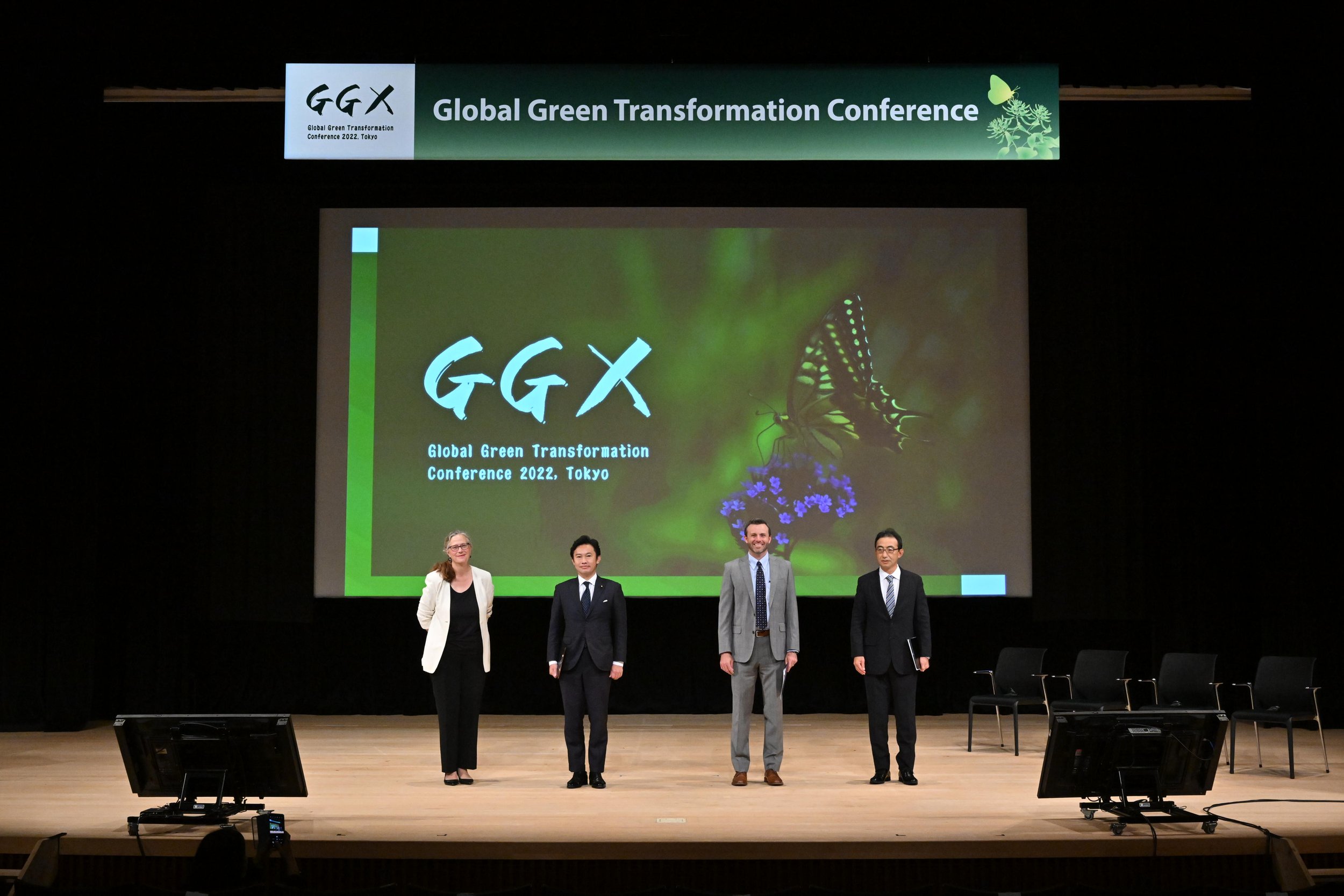
From left: Nancy Gillis, Shinichi Nakatani, Acting Deputy Chief of Mission for the US Embassy in Japan Philip Roskamp, and Toshiaki Tanaka at the FMC in Japan panel discussion.
Towards a Greener Society
Other panel discussions during GGX tackled the ways in which GX can be implemented in markets, the setting of standards, and international cooperation. “Designing a Green Market” explored methods for reducing emissions from the perspectives of supply and demand. Panelists agreed that there is no single policy that will lead to net-zero GHG emissions, but that it is necessary to create an environment which leads to the greater diffusion of green products.
The topic of avoided emissions was a recurring theme during the conference, and in the panel discussion “Standards and Evaluations Promoting Green Products/Services,” participants explored it in detail. They concurred that it is important to expand evaluation frameworks beyond the reduction of supply chain emissions to consider how countries and companies are helping cut GHG emissions through indirect means.
One key point that needs to be addressed when it comes to avoided emissions is to which products and sectors efforts can be applied. Participants in the discussion brought up the idea that it is important to establish clear differences between avoided emissions and existing GHG protocols and nationally determined contributions (NDCs), because the concept’s importance lies in additionally evaluating the contribution to global emission reduction, rather than undermining the efforts of a company to reduce its own emissions.
Panelists also pointed out that it is necessary to establish a strict method for evaluating avoided emissions. For example, subtracting avoided emissions from NDCs and Scope 1–3—that is, a company’s direct and indirect emissions—would be a form of greenwashing, and should be avoided when establishing these guidelines.
Finally, in the panel discussion “International Cooperation for Developing a Green Society,” participants delved into the thorny topic of working across borders to develop decarbonization strategies. The participants pointed out the importance of recognizing each country’s circumstances in setting cross-border policies. Considering the increasing dichotomy between the positions of developed and developing countries, the importance of developing a society which realizes both economic growth and emission reduction was also raised as an important topic. Business is an important enabler for these societies, and frameworks such as the Joint Crediting Mechanism—a system by which developed nations collaborate with developing nations to reduce greenhouse gas emissions—and business in adaptation could offer win–win actions for both developed and developing countries.
Following on the insightful conversations at GGX, METI hosted an event at COP27 about avoided emissions. During the session, the WBCSD—which founded the Scope 1–3 standards—gave an overview of their developing guidance for the concept. METI has also included countries such as the United Arab Emirates, host of COP28, and the United States, as well as representatives of the financial sector, including members of the Glasgow Financial Alliance for Net Zero, in the discussion.
Conversations that began at GGX are expanding to a wider group of stakeholders, and next year, when Japan hosts the G7 meeting, METI will escalate the dialogue on these key issues that will help future generations live on a greener Earth.

Tax and Trends
Yamada & Partners can help non-Japanese better understand how their assets are taxed and assist them in reducing their tax liability while accurately reporting income and assets.
Understanding Japan’s asset-related taxation system and shifts in audits
Understanding how income and assets are taxed in Japan can be a challenge for anyone, whether citizen or non-Japanese resident. And for those with significant wealth, investments, and real estate, a lack of understanding can lead to higher-than-expected taxes. Finding your way around the meshwork of regulations and calculations can be difficult, however, as most documents published by Japan’s National Tax Agency are only available in Japanese. Likewise, filings must be done in Japanese.
Yamada & Partners can help non-Japanese better understand how their assets are taxed and assist them in reducing their tax liability while accurately reporting income and assets.
“The tax system in Japan is one of the most complex in the world,” said Saori Koiso, an Osaka-based certified public accountant and senior tax manager with Yamada & Partners. The firm, founded in 1981, specializes in international tax consulting, inheritance and real estate, and tax compliance, among other services. Koiso hosts the webinar which covers:
- Individual income tax
- Inheritance tax
- Gift tax
- Audit trends
Individual Tax on Financial Investments and Real Estate
Individual income tax in Japan ranges from 15.105 to 55.945 percent. In the webinar, Koiso explains the brackets, deductions, and how capital gains, foreign assets, and real estate are taxed.
Capital gains derived from the sale of land and buildings are taxed separately from other income, and at different rates depending on whether they are considered short- or long-term. Various other factors, such as location of the property, residency status of the owner, and how the lessee uses the property also play a role.
Assets and liabilities—both domestic and foreign—must also be reported. The value of those assets at the time of taxation could be impacted by the international currency market, which has seen great turmoil with regard to Japan in 2022. On October 20, the Japanese yen slipped past ¥150 against the US dollar for the first time since August 1990, and there are warnings that it could slide to ¥170. This dramatic shift in currency value can have a significant impact on taxation for those who hold financial assets or own real estate overseas.
Understanding value thresholds and who must report what, and when, can make a big difference in minimizing the chance of an audit and avoiding penalties for misreporting. In the webinar, Koiso explains the key points of the system.
Inheritance Tax
Planning for the future is also important, but can be tricky when dealing with an unfamiliar system and language. If you live in Japan and continue living here, and one day pass away here, then your family members will be responsible for paying inheritance tax in Japan.
Japanese inheritance tax rates are among the highest in the world, Koiso said, in some cases reaching 53.2 percent. Understanding the rules that determine this amount is vital to minimize the impact, but can be difficult when most documents explaining the system are only available in Japanese.
Yamada & Partners’ on-demand English webinar will help you understand the rules contained in these documents.
An important thing to note is that individual heirs are taxed rather than the estate itself, as is done in the United States and many other countries. What’s more, the scope of the tax depends on a variety of factors, including:
- Whether or not the heir lives in Japan
- The heir’s visa status
- The nationality of both the heir and decedent
Another factor that has been used to determine inheritance tax liability is the period of residence, but changes were made to this in the 2021 tax reform. Under the new rules, those who have maintained a domicile in Japan for fewer than 10 of the past 15 years are only taxed on assets located in Japan rather than worldwide, as was the case before. This applies to particular types of visas, as defined by the Immigration Control and Refugee Recognition Act, but many categories are applicable to American Chamber of Commerce in Japan members, including investor/business manager, legal/accounting services, researcher, and intracompany transferee.
Also important to consider are ways to ease the process for a spouse or children left behind. Japan has rules which differ from those of the United States and other countries, and inheritance tax in Japan is calculated in accordance with the statutory inheritance ratio set forth in the Japanese Civil Code. And because there is no probate system in Japan, transferring money from a bank account can be complex for heirs if there is no will.
There are many more complexities to navigate when planning for the eventual inheritance tax, and this on-demand English webinar will help you better understand the rules and plan accordingly.
Tax Audit Trends
There have also been changes in how the National Tax Agency approaches audits. Due to the growing diversification and internationalization of asset management, the agency has increased active investigation of high-net-worth individuals with an eye towards overseas assets. Those with significant securities, real estate investments, and particularly high ordinary income have been on the radar.
The number of incorrect declaration cases grew each year from 2016 to 2019 before dropping in 2020 due to the coronavirus pandemic curtailing investigations. Of the 4,463 audits of personal income tax filings by wealthy individuals conducted in 2019, incorrect declarations were found in 3,837. The average amount of underreported income per case was ¥17.67 million and additional tax levied was ¥5.81 million. And while audits dropped to 2,158 in the first year of the pandemic, the average unreported income rose to ¥22.59 million, an increase of 127.8 percent year over year. Additional tax averaged ¥5.43 million.
As has been the trend in the past, cash and deposits are the most common underreported assets, and North America is the top region in which these assets are located.
The National Tax Agency is using the Standard for Automatic Exchange of Financial Account Information, better known as the Common Reporting Standard (CRS) to obtain data about individuals’ overseas transactions and assets by effectively utilizing the CRS system. And while the United States has not adopted the system, it does participant in the Global Forum on Transparency and Exchange of Information for Tax Purposes and has a tax treaty with Japan which allows the National Tax Agency to obtain information.
Be Prepared
Whether misreporting involves ordinary income, inheritance or gifts, capital gains, foreign assets, or real estate, understanding the system and rules—and working with professionals who know how to ensure that you are in compliance—is a must in today’s complex and interconnected world of global finance.

For more information, please visit Yamada & Partners at www.yamada-partners.jp/en/