

Digitizing Women’s Health
In recent years, Japan has seen a boost in femtech. The portmanteau of female and technology refers to services using tech and products that help improve women’s health. Government support and media coverage have enabled femtech business offerings to move from niche to mainstream. But how soon might the fledgling industry take off as it has in the United States and Europe? The ACCJ Journal spoke with experts to explore prospects for femtech in Japan.
Startups and entrepreneurs leverage tech to improve care and equality for women in Japan
Listen to this story:
In recent years, Japan has seen a boost in femtech. The portmanteau of female and technology refers to services using tech and products that help improve women’s health. Government support and media coverage have enabled femtech business offerings to move from niche to mainstream. But how soon might the fledgling industry take off as it has in the United States and Europe? The ACCJ Journal spoke with experts to explore prospects for femtech in Japan.
In 2021, the word femtech was nominated for publisher Jiyu Kokumin Sha Co., Ltd.’s Word of the Year, an annual award for language best representing life in Japan over the previous 12 months. The word eventually lost out to phrases related to US-based baseball superstar Shohei Ohtani, who made a splash in 2021. Yet the nomination alone is significant.
Awareness of femtech has remained low in Japan since the term was first coined in 2016 by Danish entrepreneur Ida Tin, founder of period- and fertility-tracking app Clue. But 2022 might see that change.
A February 2021 survey by Sompo Himawari Life Insurance Inc. shows that only 1.9 percent of its 1,000 working female respondents recognized the term. Once it was explained to them, however, more than half said they were “interested in” or “hopeful” about the concept.
Fast-forward to year-end, and 47.5 percent of respondents said they were aware of the word femtech. Though this is positive for the market, a Statista survey of 3,068 girls and women carried out in December 2021 and January 2022 also shows a long way to go, as just 15.3 percent of those polled report knowing the meaning.
Raising Awareness
Still, the increase is welcome for industry players. They say the market can grow only with an uptick in public awareness of, and willingness to talk about, women’s health—a topic that remains taboo in Japan. Progress over the past 12 months has been attributed to the launch of new products and services, exposure in media and social media, events, and other activities that support conversations about women’s health.
In March 2022, awareness-raising events Femtech Japan and Femcare Japan were held in Tokyo, while Japan Sports Week 2022, an industry event held in May, saw an area dedicated to femtech products and services supporting women in sports.
Promotion has already begun for Femtech Tokyo, an inaugural event to be held October 20–22 at Tokyo Big Sight, Japan’s largest international exhibition center. It will usher in what are expected to be annual trade fairs, designed to welcome the general public and businesses interested in “solving various problems in women’s life stages,” according to organizers.
“The term femtech is getting more recognition among women in Japan than ever before,” said Yoko Fukata, investment director at Sony Innovation Fund, which supports femtech startups in Japan. “Women want to know how their body works, such as its rhythms and hormones, and [want] to live better lives … exposure of the word and its different solutions will catch women’s attention.”
Indeed, consumers have been quick to notice femtech offerings entering the market. Almost 80 percent of some 10,000 working-age women in Japan said they knew of at least one femtech product or service, according to a 2021 Statista poll. Most familiar were sanitary shorts (48 percent), cloth sanitary pads (47.9 percent), ovulation test kits (40.9 percent), period tracker apps (40 percent), and sleep bras (38.3 percent).
These products are the result of several early stage femtech startups that emerged in 2019 and went on to release products and services in 2020 and 2021 in what can be considered “the first movement of the femtech industry,” according to Tomoko Minagawa, founder of industry association Femtech Community Japan and a leading investor in the femtech domain.
Improving Gender Equality
Now many players in Japan, including enterprise companies, are starting to launch new femtech businesses, Minagawa explained. Their motivation has been boosted by policies from a national government that sees the femtech industry as one method of addressing the country’s poor record in gender equality.
Japan ranks 120th among 156 nations in the World Economic Forum’s 2021 Global Gender Gap Report, far behind its G7 counterparts (which place between 11th and 63rd) as well as many of its Asian neighbors. The study, which tracks gender equality in four areas, evaluated Japan highly in health and education, but very low in economic participation and opportunity, as well as political empowerment.
Minagawa said the main reasons for Japan’s ranking are the lack of:
- Support for women in balancing their professional and private lives
- Consciousness of the very deep chasm between the experiences of men and women
She added that femtech can empower women by exposing the gap between the need for, and availability of, femtech products and services, and by leading discussions on femtech’s necessity and advantages for society.
Indeed, Minister of State for Gender Equality Seiko Noda, in her message on International Women’s Day 2022, listed “promoting femtech” as a government measure to improve Japan’s gender equality performance. Boosting women’s health by supporting the femtech industry is part of its efforts for “the realization of a society in which women live with dignity and pride,” one of the Japanese government’s four pillars in its Fifth Basic Plan for Gender Equality.
Government support includes the Subsidy Project for Demonstration Projects for Femtech and Similar Support Services that distributed a combined subsidy of ¥150 million to 20 femtech companies in 2021. According to the Ministry of Economy, Trade and Industry, which runs the program, the goal is to prevent events, such as the unwanted turnover of working women (triggered by life turning points, including pregnancy, childbirth, and menopause); to improve the well-being of individuals; and to increase the diversity of human resources at companies.
A healthy femtech industry, therefore, supports not only a societal need, but an economic one.
Business Cost
Loss of productivity, resulting from improperly treated health issues experienced by women working in Japan, is estimated at ¥2.7 trillion ($20 billion). According to Minagawa, the figure includes ¥323 billion ($2.4 billion) from menstruation, ¥672 billion ($5 billion) from fertility, and ¥1.75 trillion ($13 billion) from menopause.
With employees’ physical and mental health front of mind due to the acceleration of new work styles stemming from the pandemic, many companies are looking to the femtech industry for solutions to some of Japan’s long-running problems.
Kathy Matsui, general partner of MPower Partners, Japan’s first global venture capital fund focused on environmental, social, and corporate governance, told The ACCJ Journal that health and well-being has “become the priority” for more companies, particularly during the pandemic.
Startups have responded well. For example, lots of them have emerged that measure employee stress—now a legal requirement for companies in Japan. In the area of mental health support, companies are offering services, such as the outsourcing of care for children and elderly parents, she added.
Yuko Kidoguchi, operating officer and head of communications at life science company Bayer Holding Ltd. (Japan), which is active in women’s health policy advocacy, is also seeing more companies supporting the health and well-being of staff. Some are providing education on women’s health topics, including infertility treatment for women and men. Others are connecting female employees with gynecological care or providing financial support for women’s health treatments.
It’s all part of improving productivity and carrying out healthy management, Kidoguchi said.
Gradual Growth
With the needs and demand for femtech in Japan firmly established, what does the future hold? Japan’s femcare and femtech market grew from ¥57.5 billion ($428 million) in 2019 to almost ¥60 billion ($448 million) in 2020, and further development of the market is projected to generate an economic impact of about ¥2 trillion ($14.9 billion) in 2025, according to Statista.
In global terms, though, Japan’s market is tiny, with Asia accounting for only eight percent of the world’s femtech companies. Compare that with North America, which is home to 55 percent.
Sony Innovation Fund’s Fukata predicts that Japan’s femtech market will “grow gradually, not exponentially,” in part due to there being fewer female founders and investors than in the United States and some other countries.
Still, the industry consensus is that women femtech founders can make a big impact in both this industry and the wider healthtech domain.
“Women are often key decision-makers when it comes to household spending, and this is especially true in Japan,” according to Nuala Connolly, co-chair of the American Chamber of Commerce in Japan (ACCJ) Women in Business Committee and an ACCJ governor, as well as being head of talent, and the regional diversity, equity, and inclusion lead at AIG Japan Holdings. “Having women in leadership positions in startups and in femtech—and in every other sphere of business—means having leadership who represent this important consumer base and can innovate directly to optimally meet the needs of women. This, in turn, leads to the development of new products and markets, and boosts and elevates the overall economy.”
Fukata also cites the general population’s lack of deep understanding and the early stage of the industry as dampers on femtech growth, alluding to the fact that most femtech companies are focused on femcare, such as period underwear, rather than the technology aspect. She suggests this may be due to data that shows women are most concerned about period-related issues when it comes to women’s health. Alternatively, it might be due to the ease with which consumers can see, touch, and use such products.
“I think [femcare is] the starting point. Once they get accustomed to using those products and get to know more about the industry and the solutions there are in the world, there will be more people who want to focus on using femtech in different stages of their life,” she said.
Femtech Community Japan’s Minagawa agrees that most companies are providing non-tech products and services, but she is seeing some movement in the tech space, such as apps to track period cycles or to chat remotely with medical experts, as well as expansion into fertility treatments and early detection and support of menopause symptoms.
E-MCH
One area of women’s healthcare in Japan that is getting digital attention is the maternal and child-health (MCH) handbook, a printed booklet that can be obtained from a ward office or city hall which is used by doctors to track the results of pregnancy and post-birth health checks.
Lanex Co., Ltd. has developed an electronic version of the process—the E-MCH—an innovation for which the company won the From Japan and Beyond Award at last year’s ACCJ Healthcare x Digital competition.
“We analyzed the actual trend of existing digital healthcare solutions and found that most were not directly applicable to maternal and child healthcare, so we came up with the idea to digitalize the Japanese MCH,” explained software developer and project manager Boubacar Sow. “The E-MCH can play a significant role in tackling public health issues in both urban and rural areas of Japan. Our digital maternal and child healthcare system can collect and manage data from checkups during pregnancy, track the baby’s development, and enable women to communicate efficiently with their doctors and monitor their pregnancies.”
Sow said that femtech and supporting female entrepreneurship contributes to women’s empowerment and helps to achieve gender equality. “Specifically in Japan, femtech will boost the role of women in bettering healthcare and related activities. Femtech can be seen as one of the pillars of achieving gender equality in healthcare and bringing equal opportunities to women.”
The Road Ahead
There remains a long way to go, however. A full-fledged femtech market includes all kinds of hardware and software, including:
- Medical devices
- Wearables
- Telehealth and digital platforms
- Therapeutic drugs
- Vitamins and supplements
These items support everything from menstrual and reproductive health to pelvic, uterine, and sexual health to wellness and longevity.
Reaching that stage might not be smooth sailing, though, according to Dr. Amina Sugimoto, CEO of Fermata Inc., a platform and ecosystem designed to help domestic and overseas femtech companies enter the Japanese market.
Pointing to a lack of understanding, she explained: “People think there is nothing in the market and try to come up with their own services. But the problem is the market is not there.” She added that it is unlikely the 90 percent of women in Japan who choose sanitary pads during their period would be interested in a device to predict fertility if it requires insertion.
Consumers are also largely unaware of, or uncomfortable discussing, what their personal health issues might be, Sugimoto added. But she aims to change that with Fermata’s mission “to turn taboos into triumphs” by facilitating more openness on women’s health.
“If people could talk about [women’s issues] more freely, the market would slowly start to grow—companies and startups would get ideas to come up with new products,” she believes.
The public would also benefit from understanding women’s bodies better, said Kidoguchi, a vice-chair of the ACCJ Healthcare Committee and the brainchild behind Bayer’s gynecological health education program in Japan. Inspired by the country’s limited female health literacy and access to gynecological care compared with what is available in other nations, the program has been delivered to more than 50,000 students in 200 high schools, from Hokkaido to Okinawa, over the past seven years. Such schemes that educate both men and women can act as seeds for the future growth of Japan’s femtech market by creating more individuals who are open about, and understand, women’s health issues.
Minagawa said the current lack of understanding and cultural non-acceptance by investors, mainly dominated by men, is the structural impediment for investment in the femtech domain in Japan.
This was one driver for her to establish Femtech Community Japan, which connects investors, startups, enterprises, research institutions, government, and media for networking and discussion.
With the growth of such forums that support the development of an open conversation around femtech in Japan, it surely won’t be long before the term graduates from its current status as a year-end listing on language trends to being a topic of everyday conversation.

Sushi Singularity
Is this a glimpse of the future of food? Japanese scientists and companies are developing 3D food printers to produce sushi, *wagyu*, and a host of other foods. They say the technology holds great promise for personalizing food to meet nutritional needs, reducing food waste, and even providing something to eat during extended space travel. “I think there’s huge potential. Food itself will probably change,” said Yamagata University’s Hidemitsu Furukawa.
3D printers offer a vision and taste of future food—but will consumers embrace it?
Listen to this story:
Is this a glimpse of the future of food? Japanese scientists and companies are developing 3D food printers to produce sushi, wagyu, and a host of other foods. They say the technology holds great promise for personalizing food to meet nutritional needs, reducing food waste, and even providing something to eat during extended space travel. “I think there’s huge potential. Food itself will probably change,” said Yamagata University’s Hidemitsu Furukawa.
The soft and wet materials-engineering scientist is developing a 3D food printer dubbed the Laser Cook that heats and hardens liquid food poured into a mold. He envisions the equipment being used in convenience stores within the next 10 years to prepare custom-designed food for consumers. He is even in initial discussions with Seven & i Holdings Co. Ltd., the owner of the 7-Eleven chain, about doing just that.
As Japan’s population ages, the technology could also prove useful for feeding elderly people with specific nutritional needs or providing softer food for those who have trouble chewing and swallowing, Furukawa and other developers have noted.
The sushi and wagyu projects are still works in progress, and there are obvious questions about how receptive consumers will be to food that may seem industrial or artificially engineered. But already, 3D food printers are being used at universities, restaurants, and food companies in Japan and around the world. Developers predict they will become fixtures in household kitchens within a generation.
“We’re trying to create a competitive food culture for the 21st century,” observed Ryosuke Sakaki, who founded Open Meals, a venture backed by ad agency Dentsu Inc., which is pursuing seven projects that involve 3D food printers, including some that essentially squeeze sushi and wagashi (Japanese confections) out a nozzle.
Sakaki remarked that getting the taste and texture right have been huge challenges, and he has enlisted the help of sushi chefs in this regard. But he acknowledges that the results will never measure up to the sushi we are used to. “We’ll never be able to match that,” he admitted, adding that the fish or seafood portion of printed sushi may be crispier and may be placed on top of regular pats of rice shaped by a machine. “We’ll need to think of it as a new kind of sushi experience,” he concluded.
Still, Sakaki has high hopes. By year-end, Open Meals plans to hold an event at which printed sushi and wagashi can be eaten and the technology demonstrated. If it is well received, he hopes to open a restaurant serving the food in the not-too-distant future. The name? Sushi Singularity.
Mini Food Factories
These Japanese ventures aim to join a number of startups from Europe, the United States, and China that have taken the lead in this nascent business.
Food printers, which emerged 10–12 years ago, work in a variety of ways. The dispensing function operates like that of 3D printers with which we may be most accustomed. But, whereas the latter create plastic shapes, the function here causes capsules of paste-like or liquid food to be squeezed through a nozzle to produce a three-dimensional shape that can be eaten or baked. The method lends itself to creating cookies, cakes, chocolates, and other confection. Some dessert shops have already started to display them.
But many machines can also handle mashed vegetables and even minced meat. The Foodini, a 3D food printer designed by Barcelona-based Natural Machines, comes equipped with capsules that users can fill with almost any sort of food, as long as it’s relatively soft.
The technology is not as foreign or far-out as it might sound, Chief Executive Officer Emilio Sepulveda told The ACCJ Journal. And it is already widely used in food processing plants. “These printers use the same processes and same technology that major food brands use to create pasta or meat patties,” he explained. “It’s basically 3D printing, but no one calls it that.”
Tackling Food Waste
The Laser Cook printer being developed by Yamagata University’s Furukawa operates differently. It combines water with dehydrated, powdered food, which is poured into a vessel and then zapped with a laser to cook or harden it.
In this way, 3D printers can help reduce food waste, Furukawa and others have said. Instead of discarding food that isn’t sold at the supermarket—or the “ugly” vegetables that don’t even get to the store, because they’re not the ideal shape—it can be turned into powder and saved for future use. “If we think differently … and convert food into powder, it becomes an on-demand item and there’s little waste,” Furukawa explained.
There’s also potential here for use in space, he added. Transporting lightweight powder is easy. It doesn’t require refrigeration and it can last several years. “So, when we go to Mars—a journey that could take two or three years—this kind of food could be used. You can make it just by adding water.”
The technology is something the Japanese government is getting behind as well. One goal of the Cabinet Office’s Moonshot Program is to reduce food waste, and some developers, including Furukawa, are receiving government research funding.
Personalized Nutrition
Another benefit, scientists and developers say, is that ingredients can be customized to meet individual nutritional needs. That might include vitamins and other supplements.
It could be particularly helpful, in Japan and other developed nations, for the growing ranks of elderly people, who may not get enough nutrition as their stomachs and appetites shrink. Producing softer food can also help elderly people who have dysphagia, or difficulty swallowing, a common problem for those with Parkinson’s disease. “With this technology, you can make dense nutrition,” Furukawa explained.
Athletes and soldiers could also benefit from specially designed food. Perhaps during disasters, the technology could also be used to feed people who lack provisions, developers say.
“The opportunity and potential to use this in hospital settings, in homes for the elderly, where consumers need very specific nutrients, and where nutrients must be provided at specific times—that’s a huge market,” said Jennifer Perez, a venture capitalist at the $20 million Future Food Fund, established by online food delivery service Oisix ra daichi Inc., which invests in food-technology ventures.
So far, the fund hasn’t invested in any 3D food printing companies, but Perez sees great potential. “This technology is a dream of the future, but it’s starting to happen right now,” she added.
Synthetic Wagyu
Japan is on the cutting edge in one particular area: developing “structured” synthetic meat that contains ripples of fat, blood, and sinew, just like the steaks we might buy at the supermarket.
While food printers have been able to process fresh and synthetic ground meat for some time, Osaka University bioengineer Michiya Matsusaki is spearheading research and working with Shimadzu Corporation to develop chunks of synthetic, or cultured, wagyu, Japan’s famous marbled beef.
The complicated process involves injecting stem cells from fresh meat into a gelatinous bath. The cells are then exposed to stimulating chemicals to differentiate them. Some become tiny muscle fibers just 500-microns wide, while others become tissue, such as fat and blood vessels.
The muscle fibers are then assembled to create tiny pieces of meat—72 strands, for example, create a tidbit just 5 millimeters x 5 millimeters x 1.5 centimeters. Matsusaki has not been able to do a taste test yet, because he hasn’t received clearance from the university’s ethics committee. But his team aims to complete the project for demonstration at World Expo 2025 in Osaka, where they hope to offer visitors tiny edible pieces of such printed wagyu.
Matsusaki said he’s received inquiries about his research from a number of companies around the world. “We’re getting lots of interest from Singapore, Dubai, and the United States,” he shared. “Companies that make synthetic meat don’t have the technique to make this shape.”
Key reasons for the project include concern about the environment and the possibility that the world will face a shortage of meat in the future, making it difficult to feed the growing population, Matsusaki explained. Increasing the number of cattle—and expanding grazing land to meet their needs—would lead to the destruction of more forests. And cows produce a lot of methane, a potent greenhouse gas.
The equipment being developed with Shimadzu would allow consumers to manipulate the percentage of fat they want in their meat. “If you had one of these machines in your home, you could decide on the fat content and shape you wanted,” he observed. “Press a button and it would be done the next day. That’s the kind of future we’re trying to create.”
Very Analog
But how does such food taste, and will consumers go for it? Japanese are quite open-minded about robots and other applications of technology, but when it comes to food they have very high standards for quality, texture, taste, and freshness.
Tetsuya Nojiri, CEO of Oishii kenko Inc.—creator of the app that goes by the same name and who is not involved in 3D printer development—said he can see some positives in the technology, particularly for addressing nutritional needs of the elderly. However, he believes it won’t appeal to most Japanese consumers, and that it would take many years to be accepted. “Most people want food that is natural, safe, and tasty,” he stated. “That’s very analog, not digital.”
Aiming to contribute to health and healthcare issues through dietary management is the Oishii kenko app, which won the Empowering Patients Award and People’s Choice Award at last year’s American Chamber of Commerce in Japan Healthcare x Digital competition. The app’s name means “tasty health” and it provides recommendations for nutritionally balanced, delicious meals using artificial intelligence and Big Data.
Nojiri suggested that, if the equipment to make 3D printed foods is fun and easy to use, he can see some consumers using it to make niche products such as chocolates and other confections. He can also see it being put to work in larger-scale settings, such as hospitals and universities. “These printers have potential, but it’s hard to imagine that they would be used to prepare food for the ordinary person,” he added.
Perez of the Future Food Fund feels that more time and research is needed to gauge consumer receptivity. “Consumers are curious but, ultimately, it comes down to: Is the product going to taste good?”
Taste and texture are indeed very difficult, if not impossible, to replicate on a food printer. Chocolate and baked goods are easier on that score, but synthetic meat—or hybrid meat mixed with soy or other plant products—has generally proved disappointing. “It doesn’t really taste like meat yet, so that’s a problem,” Matsusaki remarked.
Price, Speed, Scalability
The 3D printers currently being used have built-in limitations on what they can produce, Sakaki explained. “Food made with certain ingredients will harden and taste good, but [made with] others will not. There are also limitations on how you can design the food to come out. And it takes quite a while to make each piece, so that raises the price.”
Yes, as with any new technology, price is an issue. Natural Machines’ Foodini sells for about ¥800,000 at current exchange rates ($6,000), although the company also offers less expensive subscription plans for set periods of time. The Laser Cook being developed by Furukawa costs roughly ¥1 million (about $7,500). Other machines being developed in Japan, such as the wagyu and sushi printers, do not yet have price tags.
Speed and scalability are other problems, according to Perez. Printing a simple round cake can take seven to 15 minutes, and making just one more complex structure can take 45 minutes to an hour. “When you compare that to what you can do on the standard factory line, it doesn’t make a lot of sense,” she said. “When you look at the logistics, it doesn’t quite work yet.”
On the flip side, once you have a successful product, it’s highly reproducible, Perez pointed out. And that data could be shared with other machines to create the same product on another continent—or in outer space.
Suraj Gujar, principal analyst for disruptive technologies at Meticulous Research in Pune, India, sees 3D printers as remaining a relatively niche product used by bakeries, caterers, hotels, and restaurants—but not the wider public.
The equipment is far too expensive, hefty, and slow to catch on among ordinary consumers, at least for the foreseeable future, he offered. Also, most printers don’t have a cooking feature, so that involves another step, adding more time and work. And some can be tricky to operate, he added.
“The consumer has to be tech savvy, because if you want to print food, it means you have to give a command to a machine. And if you want a customized design, then you have to program that into the computer,” Gujar explained. “If it’s for a cake, I would be happy to have it. But if it’s for daily food, I’m skeptical.”
To counter negative impressions that printers generate “plastic food,” Natural Machines’ Sepulveda said that, most often, fresh ingredients are used with the Foodini, several dozen of which are already being put to work in Japan at food companies, universities, hospitals and restaurants.
To win the trust of consumers in Japan, it’s important to work with established food brands, Sepulveda noted. Natural Machines is working with Hankyu and Dentsu. “Japanese corporates are super open and looking for partnerships that can bring them this extra value that they have not been able to develop on their own,” he added.
And demand in the region is on the rise: Asia has overtaken North America as the Foodini’s top market.
Despite the obstacles, developers say growing consumer awareness and concern about environmental, health, and sustainability issues are making them more receptive to this new technology. “Sustainability is getting more attention,” said Open Meals’s Sakaki, “including concerns about fish catch and resource use. 3D printing is one way to address that, so I think people will be receptive.”

State of Mind
For millions of people around the world who were already struggling with mental health issues, the past two-and-a-half years of the coronavirus pandemic have been a further trial. Isolation, a sudden shortage of opportunities to interact with friends or family in person, additional stresses in the workplace or the home, new financial worries, and difficulty in accessing appropriate mental healthcare have taken their toll, experts in the field told The ACCJ Journal.
How artificial intelligence is helping identify mental health concerns for better treatment
Listen to this story:
For millions of people around the world who were already struggling with mental health issues, the past two-and-a-half years of the coronavirus pandemic have been a further trial. Isolation, a sudden shortage of opportunities to interact with friends or family in person, additional stresses in the workplace or the home, new financial worries, and difficulty in accessing appropriate mental healthcare have taken their toll, experts in the field told The ACCJ Journal.
However, in the battle against mental health complaints, this time of adversity has also served to fast-track development and adoption of a new tool: artificial intelligence (AI). While the technology may be relatively new to the sector, the potential is huge, according to companies that are applying it to assist physicians with diagnosis and treatment.
A Tool for Our Time
AI has come a very long way since the first chatbots appeared back in the 1990s, and early mental health monitoring apps became available, explained Vickie Skorji, Lifeline services director at the Tokyo-based TELL Lifeline and counseling service. And it is urgently needed, she added.
“When we have something such as Covid-19 come along on a global scale, there is inevitably a sharp increase in anxiety, stress, and depression. The mental healthcare systems that were in place were simply flooded,” she said.
“A lot of companies were already playing around in the area of AI and mental healthcare, but the pandemic has really pushed these opportunities to the forefront,” she explained. “If, for example, a physician is not able to meet a client in person, there are now ways to get around that, and there has been an explosion in those options.”
Not every purported tool is effective, she cautions, and there are going to be questions around client confidentiality and keeping data current. The clinician must also become sufficiently adept at interpreting a client’s genuine state of mind, which might be different from the feelings that are communicated through the technology. On the whole, however, Skorji sees AI as an extremely useful weapon in the clinician’s armory.
Voice Matters
One of the most innovative solutions has recently been launched by Kintsugi, a collaboration between Grace Chang and Rima Seiilova-Olson, engineers who met at the 2019 OpenAI Hackathon in San Francisco. In just a couple of years, the company has gone from a startup to being named in the Forbes list of North America’s top 50 AI companies.
Kintsugi has developed an application programming interface called Kintsugi Voice which can be integrated into clinical call centers, telehealth platforms, and remote patient monitoring applications. It enables a provider who is not a mental health expert to support someone whose speech indicates they may require assistance.
Instead of using natural language processing (NLP), Kintsugi’s unique machine learning models focus on signals from voice biomarkers that are indicative of symptoms of clinical depression and anxiety. Producing speech involves the coordination of various cognitive and motor processes, which can be used to provide insight into the state of a person’s physical and mental health.
In the view of Prentice Tom, chief medical officer of the Berkeley, California-based company, passive signals derived from voice biomarkers in clinical calls can greatly improve speed to triage, enhance behavioral health metadata capture, and benefit the patient.
“Real-time data that augments the clinician’s ability to improve care—and that can be easily embedded in current clinical workflows, such as Kintsugi’s voice biomarker tool—is a critical component necessary for us to move to a more efficient, quality-driven, value-based healthcare system,” he explained. The technology is already in use in the United States, and Japan is on the waiting list for expansion in the near future.
Chang, the company’s chief executive officer, is confident that they are just scratching the surface of what is possible with AI, with one estimate suggesting that AI could help reduce the time between the appearance of initial symptoms and intervention by as much as 10 years.
“Our work in voice biomarkers to detect signs of clinical depression and anxiety from short clips of speech is just the beginning,” she said. “Our team is looking forward to a future where we can look back and say, ‘Wow, I can’t believe there was a time when we couldn’t get people access to mental healthcare and deliver help to people at their time of need.’
“My dream and goal as the CEO of Kintsugi is that we can create opportunities for everyone to access mental health in an equitable way that is both timely and transformational,” she added.
The Power of Data
Maria Liakata, a professor of NLP at Queen Mary University of London, is also the joint lead on NLP and data science for mental health groups at the UK’s Alan Turing Institute. She has studied the use and effectiveness of AI in communicating with the public during a pandemic.
Liakata’s own work has focused on developing NLP methods to automatically capture changes in individuals’ mood and cognition over time, as manifested through their language and other digital content. This information can be used to construct new monitoring tools for clinicians and individuals.
But, she said, a couple of other projects have caught her eye.
One is Ieso Digital Health, a UK-based company that offers online cognitive behavioral therapy for the National Health Service, utilizing NLP technology to analyze sessions and provide data to physicians. And last October, US-based mental and behavioral health company SonderMind Inc. acquired Qntfy, which builds tools powered by AI and machine learning that analyze online behavioral data to help people find the most appropriate mental health treatment.
“There has definitely been a boom over the past few years in terms of the development of AI solutions for mental health,” Liakata said. “The availability of large fora in the past 10 years where individuals share experiences about mental health-related issues has certainly helped in this respect. The first work that came to my attention and sparked my interest in this domain was a paper in 2011 by the Cincinnati Children’s Hospital. It was about constructing a corpus of suicide notes for use in training machine learning models.”
Yet, as is the case during the early stages of any technology being implemented, there are issues that need to be ironed out.
“One big hurdle is the availability of good quality data, especially data over time,” she continued. “Such datasets are hard to collect and annotate. Another hurdle is the personalization of AI models and transferring across domains. What works well, let’s say, for identifying a low mood for one person may not work as well for other people. And there is also the challenge of moving across different domains and platforms, such as Reddit versus Twitter.
“I think there is also some reluctance on the part of clinicians to adopt solutions, and this is why it is very important that AI solutions are created in consultation with clinical experts.”
Over the longer term, however, the outlook is positive, and Liakata anticipates the deployment of AI-based tools to help with the early diagnosis of a range of mental health and neurological conditions, including depression, schizophrenia, and dementia. These tools would also be able to justify and provide evidence for their diagnosis, she suggested.
To Assist, Not Replace
Elsewhere, AI tools will be deployed to monitor the progression of mental health conditions, summarize these with appropriate evidence, and suggest interventions likely to be of benefit. These would be used by both individuals, to self-manage their conditions, and clinicians.
Despite all the potential positives, Skorji emphasizes that AI needs to be applied in conjunction with in-person treatment for mental health complaints, rather than as a replacement.
“The biggest problem we are seeing around the world at the moment is loneliness,” she said. “Technology is useful, but it does not give people access to people. How we deal with problems, what the causes of our stress are, how can we have healthy relationships with other people—we are not going to get that from AI. We need to be there as well.”

Inflation!
A specter is haunting the world economy, the shadowy specter of inflation. Economists are fiercely debating from where it has come, politicians are busy blaming their opponents and, as always, the average citizen is left with no choice but to pay up. Yes, we all know inflation is lurking all around when you now must pay $50 for your $40 haircut that you used to get for $25 when you had hair. Japan stands out as the one economy in the world with a relatively benign inflation shock. Economist Jesper Koll explains why.
Who’s afraid of the big I? Not Japan.
Listen to this story:
A specter is haunting the world economy, the shadowy specter of inflation. Economists are fiercely debating from where it has come, politicians are busy blaming their opponents and, as always, the average citizen is left with no choice but to pay up. Yes, we all know inflation is lurking all around when you now must pay $50 for your $40 haircut that you used to get for $25 when you had hair.
Japan stands out as the one economy in the world with a relatively benign inflation shock. Whereas in the United States consumer prices are up by almost nine percent from a year ago, Japan’s consumer price index prints barely above two percent. This may come as a surprise, given the global nature of the inflation shock: excess money and credit, supply bottlenecks, the war in Europe, the surge in pent-up demand as the pandemic abates. Further, the global cost-push pressures—from rising energy, electronic component, and food prices—have been compounded by a falling yen.
Oil and Oligopoly
In the United States, the price of oil is up about 60 percent in US dollars compared with the end of December. In Japan, the yen price of oil is up almost 85 percent. And yes, the United States is a net exporter of energy—and food—while Japan is one of the world’s largest importers of energy—and food.
So, how come, despite greater and more severe exposure to global inflationary pressures, Japanese consumers are much less affected by the global inflation tsunami than their American counterparts?
There are two primary reasons:
- The government here is not afraid to intervene in markets to preserve the purchasing power of the people
- Japan’s industrial structure is more cutthroat competitive
The net result of this seeming contradiction—government intervention going hand in hand with extraordinary competition—is a much lower inflation equilibrium here in Japan compared with what we get in the less interventionist and more oligopolistic US economy. There, a few producers are price-leaders and effectively control the market.
Let’s start with the industrial structure. In the United States, of all the industries in the services and the manufacturing sectors—from hairdressers to pharmacies to steelmakers and semiconductor companies—on average, the top four players in each sector control about 32 percent of their respective total market. In contrast, here in Japan, the leading four companies command less than 15 percent. Clearspeak: Japan is much more fragmented and more competitive, while the US industrial structure has been consolidated and has, de facto, become more oligopolistic.
The net result is significantly lower price power for suppliers of goods and services in Japan relative to the United States. No matter how differentiated a product or service you offer in Japan, within days or weeks, a competitor will follow suit offering something similar but at a lower price point. Remember: every two weeks, a new soft drink is launched, and just about every 12–15 years, the equivalent of the entire central Tokyo grade A office supply comes onto the market. Good luck raising soft drink prices or rent.
Capitalism without Costs
There are, of course, complex reasons that excess competition has prevailed in Japan. The first investment report I ever wrote in Japan, back in the late 1980s, was entitled Capitalism without Costs. In it, I argued that corporate Japan effectively had no cost-of-capital constraint. In contrast to those in the United States, owners of capital in Japan simply did not hold corporate executives accountable to maximize return on capital.
Today, this still holds true, because just as the changes in capital stewardship and corporate governance have shifted private-sector capital allocation closer to the US model of demanding higher returns, Japan’s public sector intervention in capital markets has been stepped up dramatically. The Bank of Japan has purchased up to 10 percent of the TOPIX equity market as well as capped the cost of long-term debt at just about zero for almost a decade.
Whether this public sector provision of a cushion in capital markets is good or bad policy is subject to debate. But, for the purposes of trying to determine whether Japan does or does not face an inflationary threat, there is no question that the reality of a relatively low cost of capital has kept many marginal companies afloat. This, in turn, continues to restrict the price power of Japan Inc. in the domestic market. If your competitors don’t have to care about delivering a proper return or profit, whoever raises prices is doomed to lose customers and market share.
Which gets us right back to the first reason Japan is not afraid of inflation: government intervention and de facto price controls.
When you analyze Japan’s consumer price index, you quickly find that about one-quarter of the goods and services for which Japanese consumers pay are subject to government rules and regulation, i.e., de facto price controls.
Healthcare services and pharma are an obvious important example, as is education, much of transportation, and several staple foods. For the last of these, the Japan Agriculture Cooperatives, commonly known as the JA Group, plays a key part in expertly balancing fiscal support for producers while preserving the people’s purchasing power.
Line in the Sand
The willingness to fight immediately against threats of inflation that undermine consumer well-being was just demonstrated by Prime Minister Fumio Kishida. In April and May, he drew a line in the sand for the consumer price of regular gasoline at ¥170 per liter and passed, in record time, a supplementary budget to fund this price-keeping operation.
Again, the contrast with US government priorities could not be greater. Not only does the Japanese government see its primary mandate as protecting its citizens from economic shocks, but it also has the necessary parliamentary control and supermajority to act decisively and quickly. It is both the willingness to act and the ability to act that, in my view, make Japan’s parliamentary democracy and model of capitalism a worthy role model for the free world.
Be that as it may, practically speaking, the fact that Japanese political leaders actually can—and do—mobilize fiscal resources in a timely manner allows much greater flexibility for Japan’s central bank. Where the de facto political gridlock in Washington makes it unlikely that government policies can be mobilized to cushion US consumers against the ills of inflation, here in Japan the government can be counted on. No wonder, then, that the United States must rely on the Federal Reserve as the lone fighter against inflation, while here the Bank of Japan gets plenty of backing from all the other parts of the policy toolkit available.
All said, the current strong surge in global inflation is very real and is definitely having a strong impact on Japan. However, the Japanese system is responding well to the challenges and is doing so on its own terms. Resilience to shocks is what Japan excels at and, in my view, the inbuilt systemic priority placed on preserving consumer purchasing power makes it unlikely that inflation will force another lost decade.

Shared Interests and Values
Each year, the American Chamber of Commerce in Japan (ACCJ) honors those who have significantly impacted the global business environment in Japan with the ACCJ Person of the Year award. Former chair, president, and group chief executive officer of Mitsubishi UFJ Financial Group, Inc. (MUFG) Nobuyuki Hirano was selected as the 2021 Person of the Year not only for his work with MUFG, but also for his tireless efforts to promote better US–Japan business ties.
The ACCJ honors 2021 Person of the Year Nobuyuki Hirano
Listen to this story:
Each year, the American Chamber of Commerce in Japan (ACCJ) honors those who have significantly impacted the global business environment in Japan with the ACCJ Person of the Year award. Former chair, president, and group chief executive officer of Mitsubishi UFJ Financial Group, Inc. (MUFG) Nobuyuki Hirano was selected as the 2021 Person of the Year not only for his work with MUFG, but also for his tireless efforts to promote better US–Japan business ties.
During a career spanning more than 40 years, and as chair of the Japan–U.S. Business Council from 2017 to 2021 and a current vice-chair of the Keidanren (the Japanese Business Federation), Hirano has helped to strengthen global business. ACCJ members and guests recognized this on April 25 at an in-person event held at Tokyo American Club and livestreamed to remote attendees.
The luncheon began with a VIP session where ACCJ leaders greeted Hirano, after which ACCJ Governor and Financial Services Forum Chair Andrew Conrad welcomed members and guests, and provided background about the award. ACCJ President Om Prakash delivered remarks, saying that, in Hirano, “we are extremely lucky to have someone who is so thoughtful—and very methodical—in how he approaches incredibly complex issues between the United States and Japan, and the entire world.”
Values and Principles
Taking the podium, Hirano expressed his deep honor to have been chosen for the award, and thanked the chamber for its contributions as a member of the Japan–U.S. Business Council. “I appreciate the initiatives of all the ACCJ presidents—Christopher LaFleur, Sachin Shah, Peter Jennings, Peter Fitzgerald, and Jenifer Rogers—during my tenure."
He then addressed the importance of shared values and trust by taking attendees back to the eighties—1983 to be precise—when he had arrived in New York City as a trainee at Morgan Stanley. The two years spent there for his secondment was the start of an extraordinary journey that would make Hirano a bridge between the United States and Japan and lead him to a position on the firm’s board of directors, which he accepted in March 2008.
Speaking of his fellow directors, he said, “They often joke, ‘Nobu, you are the first, and possibly the last, guy who has been elevated from unpaid trainee to Board member.’”
During the 2008 global financial crisis, MUFG made a $9 billion strategic investment in Morgan Stanley—a move that Hirano says exemplifies the importance of shared values and principles between business partners. “This was a significant investment in its huge scale but, more so, in the sense that it is the only successful alliance between globally systemically important banks,” he explained. Worldwide, there are just 30 such banks, often called G-SIBs.
“But I believe it is more than this,” he continued. “James Gorman, now CEO of Morgan Stanley Investment Bank, and I agree that we actually have a similar corporate culture. I think it’s very important that our values and principles are similar, [in areas] such as putting the client first, doing the right thing, and [having] an appreciation for long-term perspective.”
Returning to the present, Hirano noted that there has been a series of global crises in the financial world—roughly one per decade—which “have had a huge impact that exceeded most people’s expectations.” These include the collapse of Japan’s bubble economy in 1990, the Asian financial crisis of 1997, and the global financial crisis that sent shockwaves through the markets in September 2008 with the collapse of Lehman Brothers—the event which brought together MUFG and Morgan Stanley.
Today, we are on the precipice of another shockwave.
“The world is at a critical juncture and has entered a period of great uncertainty. We are undergoing a once-in-a-century period of dramatic change, which has been described as the era of VUCA, or volatility, uncertainty, complexity, and ambiguity,” he said, adding that we are witnessing a crucial moment in history with Russia’s invasion of Ukraine.
“A question we need to ask in today’s society is what role business leaders should play.”
Cooperation on China
As part of his work with the Japan–U.S. Business Council, Hirano has been involved in the Japan–U.S. Business Conference, an annual event first held in Tokyo in 1961. The conference makes recommendations to the Japanese and US governments as well as related organizations.
At the 58th conference last fall—held virtually for the second year in a row due to the pandemic—a key topic of discussion was bilateral cooperation in the face of challenges from China.
“The struggle for supremacy between the United States and China is expected to be prolonged, while the economies of China and other countries are already deeply connected,” Hirano said. “There is consensus among business leaders that decoupling is unrealistic … with a slight difference [being that] Japanese businesses tend to be more cautious about risk due to Japan’s high level of dependence on China and its close geographical proximity. Their US counterparts take a more opportunistic stand.”
While this difference in risk aversion exists, the only way to successfully deal with China, he proposed, is for likeminded countries to continue acting together based on their shared interests and values.
“Working with likeminded countries to reach out to China has also affected the private sector. That’s what I believe,” he said. “In fact, last autumn, we jointly invited guests from the EU government and European industries to the Japan–U.S. Business Council for the first time, to discuss rebuilding the global order as well as sustainability.”
While China may not change course over the short term, in the next few decades, he added, China may face socioeconomic challenges, such as the declining birthrate and aging population. “These might substantially undermine China’s economic growth potential,” Hirano explained. “History shows that the distortions that occur alongside rapid economic growth are concealed until the growth slows. Once the distortions are revealed, they then force major structural reforms.”
Issues Uncovered
It has been more than two years since life as we knew it hit the brakes due to Covid-19. Hirano said the pandemic has not only disrupted the global economic order and increased political and geo-economic tension, but also revealed the global scale of the need to address sustainability issues. These include societal divisions, social inequality, and climate change.
“These problems,” he reasoned, “are largely due to globalization and excessive shareholder capitalism … Whether we like it or not, we will be forced to remodel the current socioeconomic systems that have supported capitalism up to now.
“However, we have no clear idea, yet, how to solve many of the problems. This is partly due to differences in values and principles among conflicting nations.”
This is where he sees the great asset that is the US–Japan relationship, which is built on shared values and principles. It is important, he stressed, for US and Japanese business leaders to discuss how to chart and navigate a course on issues such as carbon-neutrality targets and convey their opinions to local governments.
On this issue, he believes, it is very important that there be cooperation with other countries in Asia, particularly members of the Association of Southeast Asian Nations.
In terms of Japan’s economy, the country’s future may be in jeopardy, Hirano suggested, unless drastic measures are taken to address the serious issues laid bare by the pandemic.
“To overcome this situation, the public and private sectors must act with a sense of urgency to make large structural changes to socioeconomic systems, in particular, and to revitalize and restructure industry through digitization and green transformation,” he stressed.
United by Trust
As a final point, Hirano noted that it is trust which has allowed the United States and Japan to develop such good relations and that, while close-knit cooperation between the governments is no doubt a huge part of this, he believes a major factor is the human connection between the people of both nations, strengthened over many years.
And it is this trust, which “cannot be seen by just looking at economic numbers,” that he considers to be an extremely important asset as we move into a future that is uncertain—not just for countries, but for business partners as well.
“I’d like to conclude by expressing my sincere hope that the business leaders of Japan and the United States will further deepen relations and our mutual understanding which, in turn, will strengthen the relationship—the partnership—between our two countries,” he said. “I also wish for the continued prosperity and success of this excellent institution, the ACCJ.”
Stay Engaged
One of the greatest attractions of the American Chamber of Commerce in Japan (ACCJ) is our myriad activities and the vibrancy of our members. From networking to advocacy to information exchange, the ACCJ is not only the voice of global business in Japan, but a dynamic, rewarding community. The coronavirus pandemic challenged our ability to sustain our energy, but our members are resilient and resourceful. We not only adapted and maintained our inspiring event schedule and connections virtually, but we gained new skills along the way that now allow us to extend our reach and foster greater engagement as the way we interact continues to evolve.
As the pandemic enters a new stage and direct communication opens up, the chamber is fostering lasting change—thanks to all of you.

Listen to this story:
One of the greatest attractions of the American Chamber of Commerce in Japan (ACCJ) is our myriad activities and the vibrancy of our members. From networking to advocacy to information exchange, the ACCJ is not only the voice of global business in Japan, but a dynamic, rewarding community.
The coronavirus pandemic challenged our ability to sustain our energy, but our members are resilient and resourceful. We not only adapted and maintained our inspiring event schedule and connections virtually, but we gained new skills along the way that now allow us to extend our reach and foster greater engagement as the way we interact continues to evolve.
Look at the event photos. Those of you who were there felt the energy in the air as the veil lifted. Seeing our members together at in-person events filled me with optimism, the sense of urgency to shake hands and see faces, to get back to business, to reignite advocacy efforts, and to reinvigorate our relationship with government back in Washington. All safely, of course.
Hello, Capitol Hill
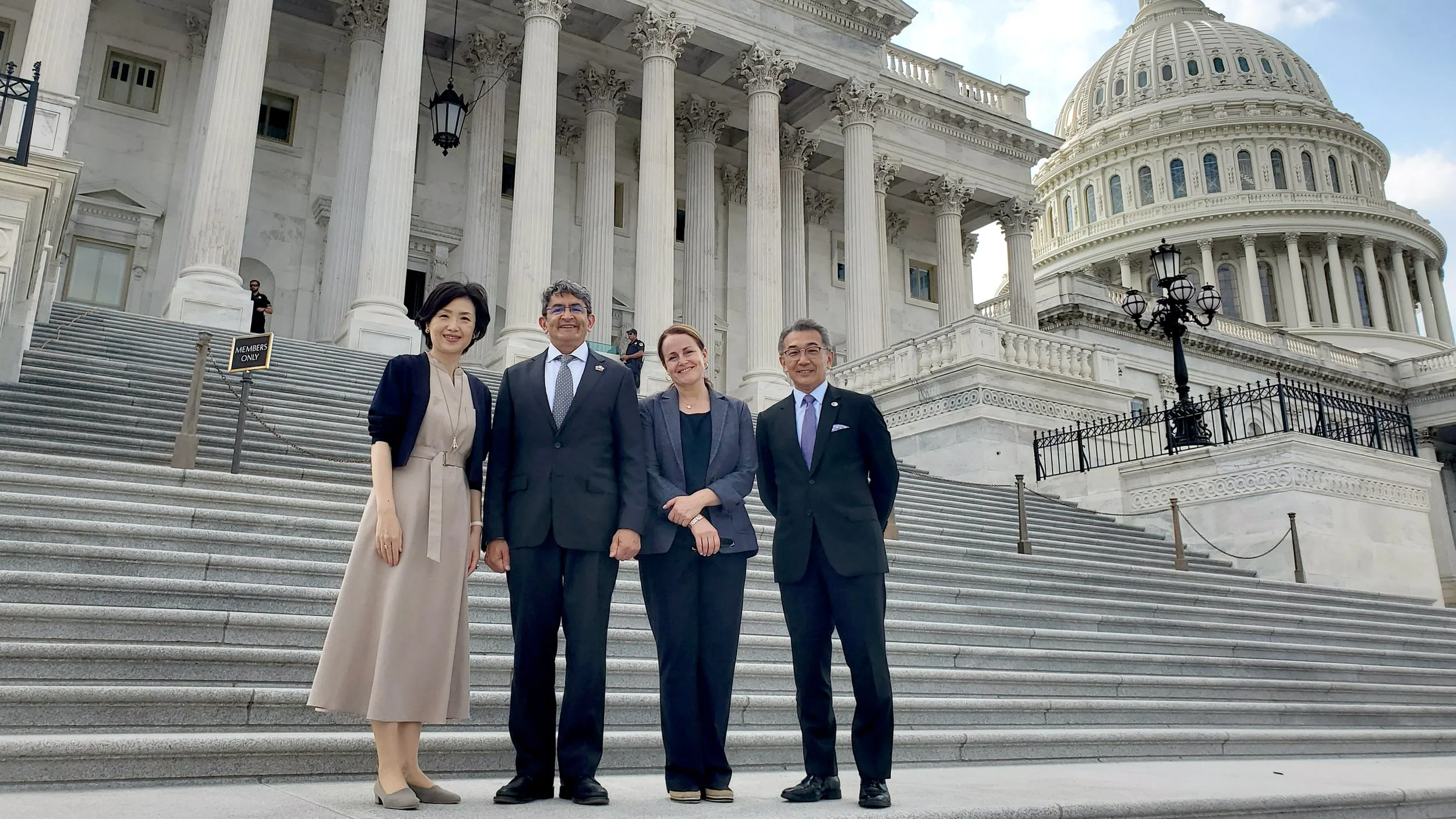
Speaking of government, it was an honor to lead, as president, an ACCJ delegation to Washington for our first DC Doorknock since before the pandemic. I was joined by ACCJ Chair Eriko Asai, Governor Victor Osumi, Special Advisor Christopher LaFleur, and Executive Director Laura Younger. Engaging face-to-face with members of the executive branch and Congress once again is very important to the chamber’s advocacy efforts.
With the recent rollout of the Indo–Pacific Economic Framework—an occasion to which the ACCJ was invited—and the recent Quad meeting of leaders from the United States, Japan, Australia, and India, the US–Japan partnership continues to be the most important nexus for peace and prosperity—not just in the region, but for the global order.
We in the ACCJ are a key conduit for lawmakers in Washington to what is going on in Japan in terms of the business aspects of the bilateral relationship, and through our discussions during the DC Doorknock we have had a positive impact over the years. As business leaders on the ground, we experience firsthand the opportunities, obstacles, and ground-truth in Japan. As a trusted primary source in a world awash with information and disinformation, our voices are heard and valued by the administration and members of Congress.
The way in which Washington is engaging with the ACCJ and the administration of Japanese Prime Minister Fumio Kishida is important. There’s energy and urgency in the US–Japan partnership on all fronts—from the economy to national security—
and you can see this in the number of Congressional delegations (well over 10 percent of the Senate leadership) coming to Japan, capped by US President Joe Biden himself in late May. We are pleased and encouraged to see the United States leading in the region, and the heightened role Japan has taken on the world stage.
US Ambassador to Japan Rahm Emanuel has been an incredibly positive addition to the US–Japan dialogue and a valuable partner for the ACCJ. We have hosted him at several meetings and events, including a special welcome luncheon (page 10). His energy, enthusiasm, and attitude are welcome, timely, and highly infectious!
Opening Up
In terms of advocacy and getting results, I’d like to thank you all for your important contributions to our core advocacy document—something new we have tried this year in addition to our viewpoint papers. For example, your input, leadership, and energy pushing for fair and science-based policy regarding Japan’s border restrictions very quickly led to results. We, combined with the voice of our fellow foreign chambers of commerce and other organizations—both foreign and domestic—are making a real difference.
Stay Engaged
I will end by asking all chamber members to embrace the sense of urgency that is defining the world we find ourselves in—one of transition—and help the ACCJ continue to champion strong partnerships and communication to create the best environment for global business in Japan.

Healthy Pursuits
The intersection of health and technology has become an important part of my life. They say that when you turn 40 your body starts to fall apart. They also say that 40 is the new 20. I say that neither is true, not entirely, but as you age you do have to work harder to stay fit. In this issue of The ACCJ Journal, we embrace the vision, ideas, and creations of those entrepreneurs and companies who are developing solutions to the wellness challenges facing society.
Entrepreneurship sprinkled with innovation is changing the future of food and health through technology
Listen to this story:
The intersection of health and technology has become an important part of my life. They say that when you turn 40 your body starts to fall apart. They also say that 40 is the new 20. I say that neither is true, not entirely, but as you age you do have to work harder to stay fit. As I turn 50 this year, a decade of navigating that forties-fitness maze has helped me figure out how to apply tech to the challenge.
I’ve been a techie since I was 10 years old and my great grandparents gave me a Commodore 64 computer for Christmas, so I’m always at the front of the line, eager to jump into the pool of latest innovations. Apple Watch and the Oculus virtual reality headset are already part of my health and fitness routine, and there’s plenty more out there to be excited about and to help us live longer, healthier lives.
In this issue of The ACCJ Journal, we embrace the vision, ideas, and creations of those entrepreneurs and companies who are developing solutions to the wellness challenges facing society.
The theme was inspired by the great success of the American Chamber of Commerce in Japan (ACCJ) Healthcare x Digital (HxD) competition and the incredible work and dedication of the organizing team. Preparation is well underway for the third annual event, which will take place later this year. The theme this time is Empowering Elderly Patients through Digital Health and will expand the format to include both an ideathon and a hackathon.
A couple of last year’s winners are included in features in this special health and technology issue of The ACCJ Journal. Oishii kenko Inc., winner of the Empowering Patients Award and People’s Choice Award for their nutrition app, shares thoughts on future food, while From Japan and Beyond Award winner Lanex Co., Ltd. talks about digitizing women’s health.
Steppin’ Out
The other big theme of this issue comes in the form of photos, not words. A surge of energy has been flowing through the ACCJ as we begin returning to in-person events, and you’ll find pages filled with scenes of networking, information sharing, and just plain fun. For me, it was a joy to produce this issue for that reason alone. After more than two years with very few (often zero) photos from such gatherings, I may have gone a bit overboard with my layouts. But I wanted to share with you the excitement that is in the air. This is what the ACCJ is all about: people coming together to share, explore, innovate, collaborate, and build the best possible business community and society.
For those who could not attend, I’ve recapped two major in-person events (which were also livestreamed to remote viewers). At one, the ACCJ presented the Person of the Year Award to former Mitsubishi UFJ Financial Group, Inc. chair, president, and group chief executive officer Nobuyuki Hirano. At the other, we welcomed US Ambassador to Japan Rahm Emanuel with a VIP session and luncheon. For me, it truly felt like I had fallen through a time portal to 2019. Walking into the New York Ballroom at Tokyo American Club and seeing so many people talking, exchanging business cards, listening to presentations, and eating felt like time had been paused and suddenly restarted. It was a great experience.
And let’s not forget about the Chubu Walkathon, our annual charity fundraiser organized and hosted by the ACCJ Chubu chapter. They did a wonderful job of adapting to the pandemic and embracing the mantra that I know so well from my years as an orchestral musician: the show must go on. This year, they kept the livestreaming aspect but were able to bring back much more of the activity to Nagoya’s Meijo Park. I couldn’t attend, but the photos tell the story as more than 1,000 people participated and raised over ¥7 million.
So, here’s to the new normal of more in-person events and to the health and fitness needed to embrace the activity as we go steppin’ out into the light。

Happy Independence Day!
I would like to wish our friends and partners at the ACCJ a Happy Independence Day on the 246th anniversary of the founding of our great nation. The US–Japan Alliance has much to celebrate as well …
A special message for ACCJ members from US Ambassador to Japan Rahm Emanuel

I would like to wish our friends and partners at the American Chamber of Commerce in Japan (ACCJ) a Happy Independence Day on the 246th anniversary of the founding of our great nation. As I look back on my first six months in Japan, we should be proud of what we have accomplished together in advancing US interests in partnership with our closest ally in Asia. Thanks in part to the leadership of the ACCJ, we successfully persuaded the Japanese government to ease entry restrictions and allow business travel and tourism to resume once again. Looking ahead, there is much more to do.
The US–Japan Alliance has much to celebrate as well, as Japanese policy has shifted from protecting and preserving our bilateral security alliance to projecting its strength outward in defense of a free and open Indo–Pacific region. Prime Minister Fumio Kishida warmly welcomed President Biden for their summit in May, underscoring the vital importance of our alliance in upholding democratic values and rallying other countries in defense of a rules-based order. Together, they co-hosted the launch the Indo–Pacific Economic Framework for Prosperity with a dozen other founding partner countries. Japan was our essential partner in this initiative, helping to bring partners from the Association of Southeast Asian Nations to the table and champion the rules-based economic order in the region.
Nowhere is the challenge to international order clearer than in Russia’s unprovoked and unjust war of aggression in Ukraine. Russia’s invasion threatens peace, prosperity, and the rules-based order established after the Second World War, as it continues to drive global inflation and exacerbate food instability throughout the world.
The response to Russia’s war of choice has been strong, swift, and unified, with the United States and Japan leading more than 140 nations in standing against the Kremlin. The Kishida Administration has matched our actions step-by-step on sanctions and export controls, and has sometimes even been ahead of us. In the face of this challenge, we also enjoy the opportunity to build a more prosperous and secure future. The united response has galvanized the North Atlantic Treaty Organization (NATO) member nations—and NATO-aspirant countries such as Finland and Sweden—more than any other event in the past decade, and their commitment to the alliance is as firm as ever.
The collective response to Russian military adventurism is already having a ripple effect beyond European shores. With Beijing’s eyes set on Taiwan and dominance in the Indo–Pacific region, we can be sure that the People’s Republic of China is watching carefully to see whether Russia can weather economic and political isolation. As CIA Director Bill Burns recently noted in a May 7 Reuters story, the costs that Russia is bearing is affecting Beijing’s calculation about Taiwan.
The lesson for us to bear in mind is that unity represents a vital strategic asset. It’s what separates us from our authoritarian competitors. At a time when globalization seems to be in retreat, alliances and partnerships with like-minded nations matter. What we do today to leverage the US–Japan alliance to build unity across the Indo–Pacific region over the next three years will define the next 30 years.
We also need to keep our eyes on the situation closer to home. We can provide a better living for the people of our two nations by implementing measures to make our economies more inclusive and by reimagining Japan as a global financial center for the 21st century, in partnership with the United States. Thankfully, we are fortunate to have strong friends at the ACCJ who share our vision, values, and sense of mission. I am confident that, together, we can make the changes necessary to pass along the same opportunities that we enjoyed.
Happy Independence Day. We have a lot to do, so let’s get to work.
Disclaimer: Opinions or advice expressed in the The ACCJ Journal are not necessarily those of the ACCJ.
Activist Investing in 2022
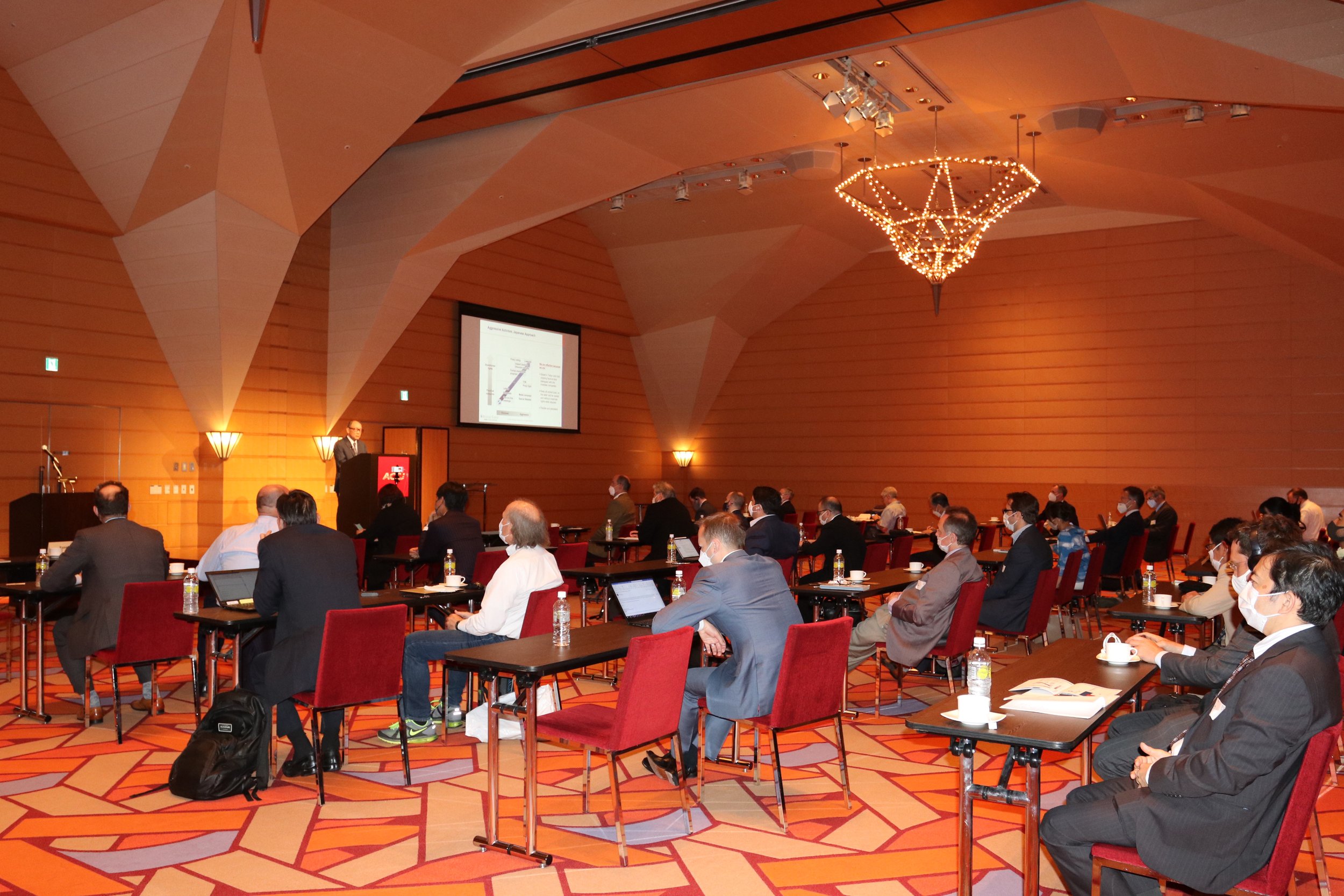
The Fourth Annual ACCJ Shareholder Forum brought together experts for a look at the state of activist investing in Japan and the realities of the Japanese market.
Fourth Annual ACCJ Shareholder Forum brings together experts from Japan and overseas for a look at the state of the market
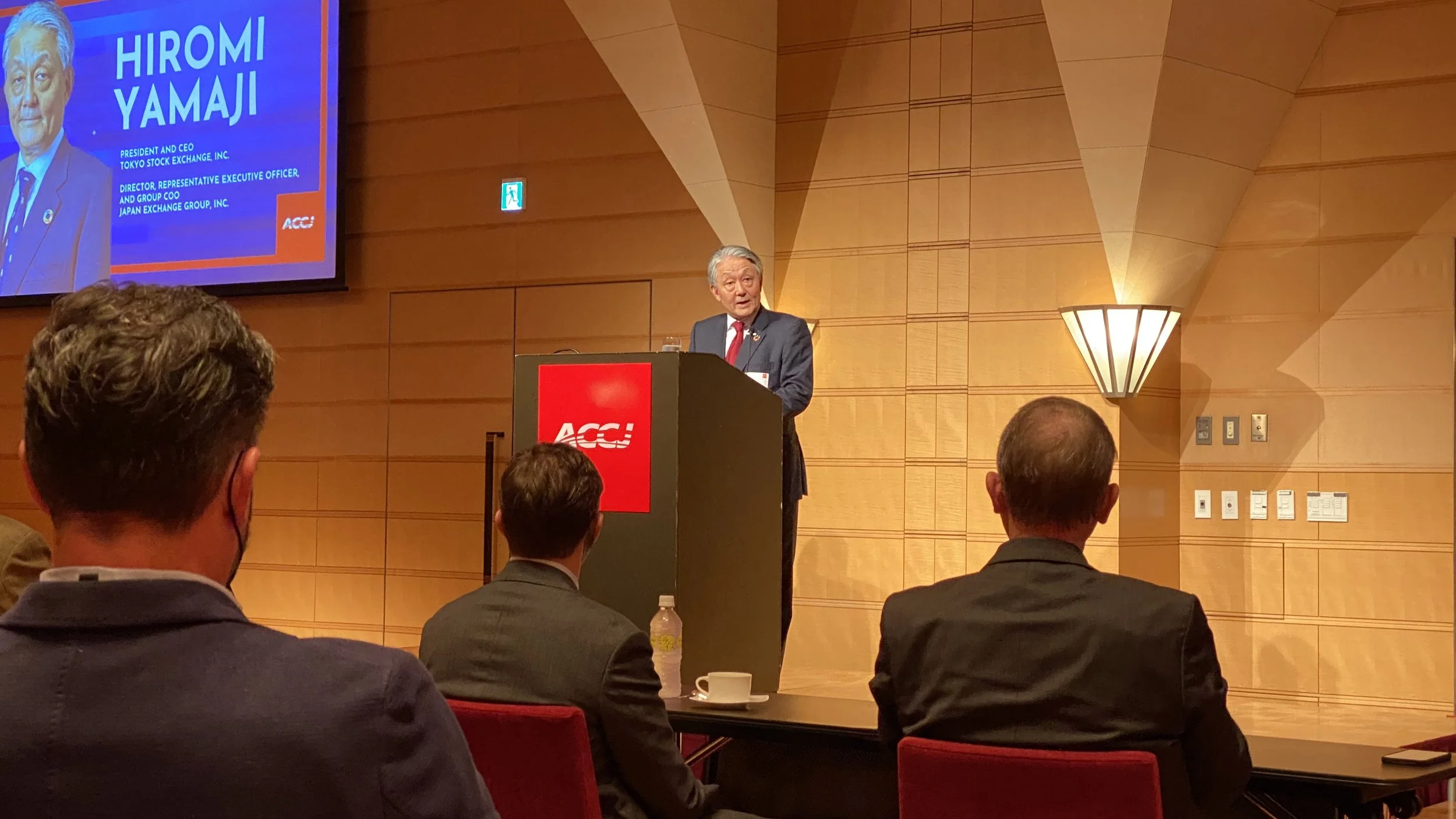
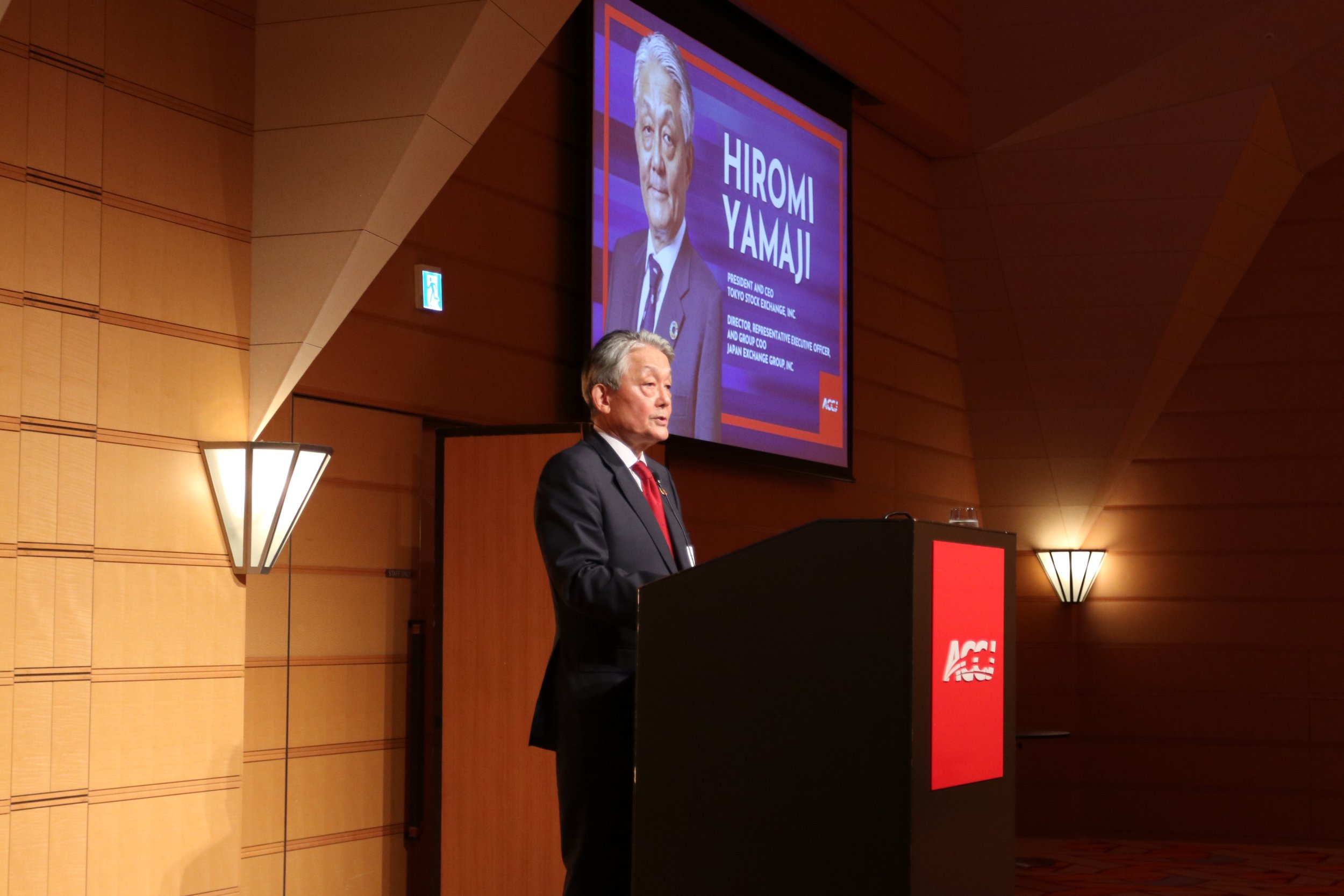
Tokyo Stock Exchange President and CEO Hiromi Yamaji delivers the keynote.
Why should anyone care about activist investing in Japan?
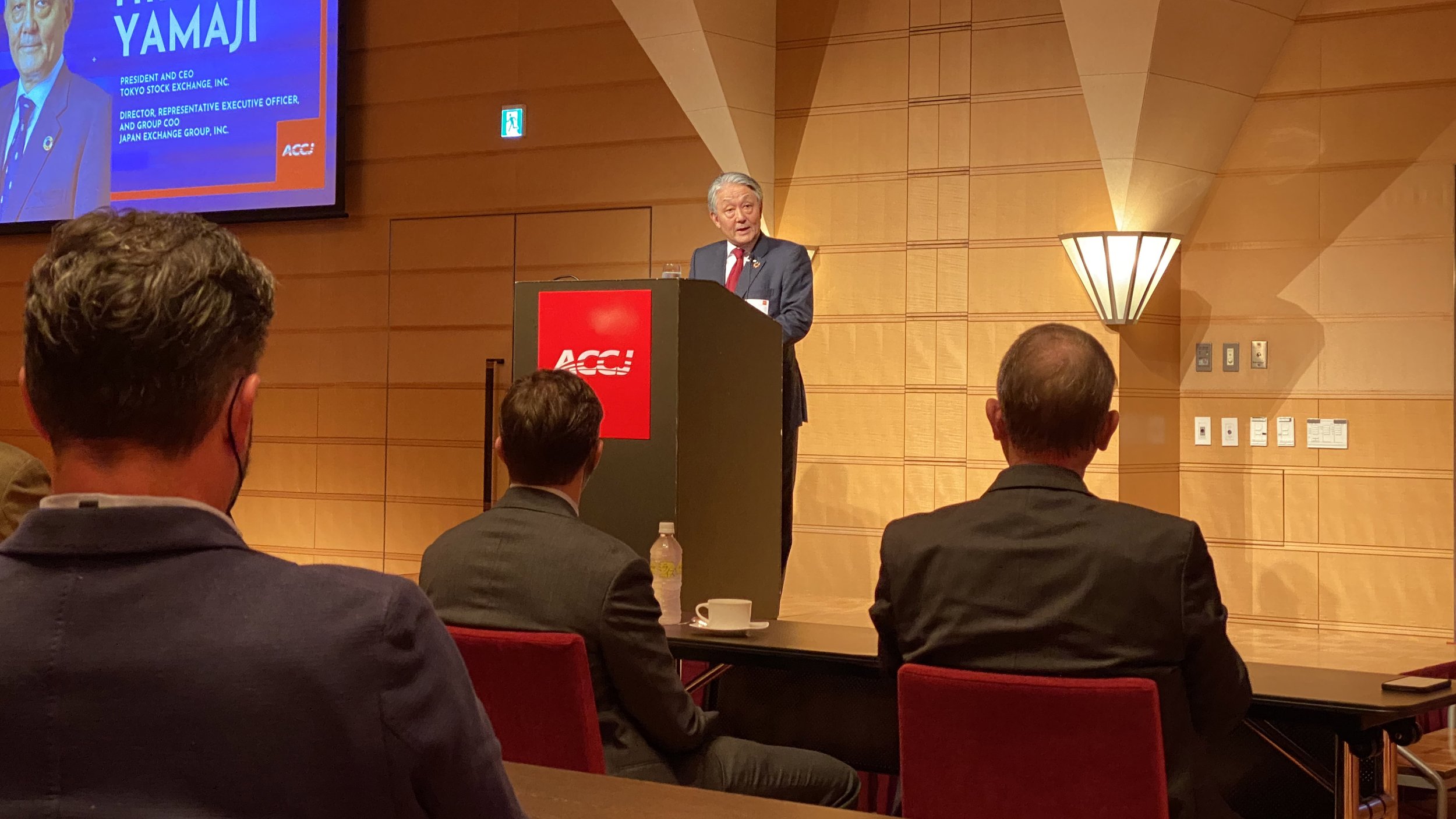
This is the question posed by American Chamber of Commerce in Japan (ACCJ) Alternative Investment Committee Chair Frank Packard as he opened the Fourth Annual ACCJ Shareholder Forum on June 7 at Tokyo American Club. The event, which was also livestreamed to remote attendees, has become an important part of the annual general meeting (AGM) season.
Four speakers explored this through a wide-ranging look at the realities of the Japanese market, corporate governance, activist investing, stewardship, shareholder proposals, and more after the keynote was delivered by Hiromi Yamaji, president and chief executive officer of Tokyo Stock Exchange, Inc. (TSE) as well as director, representative officer, and group chief operating officer of Japan Exchange Group, Inc.
Presenting were:
- Nicholas Smith, strategist with CLSA
- Andrew McDermott, president of Mission Value Partners
- Tsuyoshi Maruki, president and CEO of Strategic Capital
- Seth Fischer, founder and chief investment officer at Oasis Management
Packard himself offered some thoughts during the introduction.
“The past 30 years in Japanese public equities provide an interesting lens for today,” he explained. “I want to make the case that we should pay attention because active engagement in Japan might actually be the best global investment strategy today.”
This was not always the case. After the bubble economy of the 1980s burst, activist investing in Japan during the 1990s was somewhat primitive, Packard said. “Some notorious examples, often American, featured activists making simple demands for immediate action to get quick financial return for themselves, not for the companies or other shareholders. To be clear, activism in Japan did not start with an attractive image. But it’s come a long way.”
Japan’s Financial Services Agency began providing useful frameworks with written regulations in 2014 to encourage corporate governance and investor stewardship. Today, Japan is the world’s second-biggest market for activism. “Activists are doing well by doing good,” he said. These days, you’ll find many other groups addressing important governance topics—diversity of board members, foreigners as directors, and talk about disclosure on environmental, social, and corporate governance topics.”
But, Packard noted, very few people are focusing on the other code—the stewardship code—and what are best practices for improving corporate value. “This absence, we believe, is an opportunity for the ACCJ.”
Is ESG Good?
One of the most frequently heard terms in discussions of investing these days is ESG. And while a focus on improving environmental, social, and corporate governance would appear to be good, there are some growing doubts about how to apply it in a decision-useful and commercial manner.
“In theory, [addressing] climate change is a noble goal. Increasing disclosure of environmental impact, as the TSE has recommended and the ACCJ has advocated, that’s very good, too. But in practice, investing in ESG assets has led to many cases of greenwashing,” Packard said, using the term that refers to making inflated, unsubstantiated, or even false claims about the environmentally friendly nature of a product or practice.
“We’re seeing a lack of agreement on ratings and benchmarks, and some concerns that ESG might actually be too blunt an instrument for financial services,” he explained. “Some of the leaders of financial firms are now saying that, maybe, it’s time to retire ESG and its application for investing.”
Lastly, Packard asked where activist investing fits into today’s financial markets, at a time when all asset classes fell in value for the first time in 30 years. That happened during the first quarter of this year. “This has been very confusing for investors trying to do the right thing. Where can investors go to embrace sustainability and responsible investments? Could the answer be to focus on active investment and active engagement?” he asked. “It’s not only an academic or ethical question, it might also be optimal strategy in the current financial markets.”
A Look at the Market
Next, Yamaji delivered the keynote and spoke about what he sees as very important changes in the Japanese market.
“In addition to the excitement generated by the lifting of Covid-19 restrictions, this also has been an exciting time for us at the TSE as [we] went through a major overhaul this past April, kicking off major changes in the Japanese capital market.”
The TSE revamped its grouping of shares for the first time since 1961, replacing its four-market structure with one comprising three: prime, standard, and growth. The top tier is home to blue chips that have met corporate governance requirements which are higher than those of the previous first section. More than 80 percent of the companies that were listed in the first section have shifted to the prime market.
“As shareholders and investors engage with these companies, Japanese companies are undertaking significant changes to their business growth strategies through realignment of their business portfolio and through their new approaches to corporate governance,” Yamaji added.
The presentation portion of the event covered:
- A vertical review of activism comparison over several years as well as a horizontal view of the different engagements within the AGM season, provided by CLSA’s Smith
- A look at stewardship, what it means, and how it applies to 2022 Japan, as well as additional thoughts on ESG, from Mission Value Partners’ McDermott, who joined online from Tennessee
- A fund manager’s perspective on activism and tools used for preparing shareholder proposals, offered by Strategic Capital’s Maruki
- A recap of some past shareholder proposals and a look at the power of engagement and the 2022 proxy season, presented by Oasis’s Fischer
Packard concluded the event by thanking everyone who made it possible, including the ACCJ programs and communications teams as well as his fellow Alternative Investment Committee leaders, Vice-Chairs Pieter Franken, Deborah Hayden, Jason Topaz, and Christopher Wells. It was a great cooperative success.
Watch The ACCJ Journal for additional extended coverage of the presentations, coming soon.








From Disaster to Tech Hub
Soon after the Great East Japan Earthquake of March 11, 2011, Japan’s Ministry of Economy, Trade and Industry (METI) began coordinating a wide range of efforts to revitalize this former disaster zone. METI’s revitalization initiatives were raised to a new level with the launch of the Fukushima Innovation Coast Framework in May 2017. Here’s how things are developing five years on.
The bold ambitions of Japan’s Fukushima Innovation Coast Framework
Listen to this story:

For his first-ever trip to Japan, in 2011, Warren Buffett chose to visit Iwaki City, Fukushima Prefecture. What attracted the world’s most celebrated investor to a former mining community of some 300,000 residents far away from the bright lights of Tokyo? The Sage of Omaha came in person to show his support for Tungaloy Corporation, a leading maker of cutting tools. Tungaloy also happens to be owned and operated by a company led by Buffett. Just a few months after the Great East Japan Earthquake of March 11, 2011, devastated much of the surrounding region, Buffett stood in front of Tungaloy’s Iwaki headquarters holding a sign that read, “Never give up, Fukushima!” The act underscored his commitment to the company, its employees, and the community that hosts them.
Tungaloy President Satoshi Kinoshita explained: “Companies are only as good as their people. The workers here in Iwaki City are bright, diligent, and ambitious. They are filled with creative ideas. This wealth of local talent on our doorstep—combined with very supportive local communities and government agencies—makes the case for investing in Fukushima so compelling.”
Fukushima Reimagined
Iwaki City is just one of a string of towns and cities in the Hamadori area, Fukushima Prefecture’s coastal region facing the Pacific Ocean which was hardest hit by the earthquake, tsunami, and nuclear disasters. Soon after the catastrophe, the Ministry of Economy, Trade and Industry (METI) began coordinating a wide range of efforts to revitalize this former disaster zone. METI’s revitalization initiatives were raised to a new level with the launch of the Fukushima Innovation Coast Framework in May 2017. Under the framework, the ministry is attracting innovators in six core sectors through financial and other types of aid. The core sectors include:
- Decommissioning
- Robotics and drones
- Energy, environment, and recycling
- Agroforestry and fisheries
- Medical care
- Aerospace
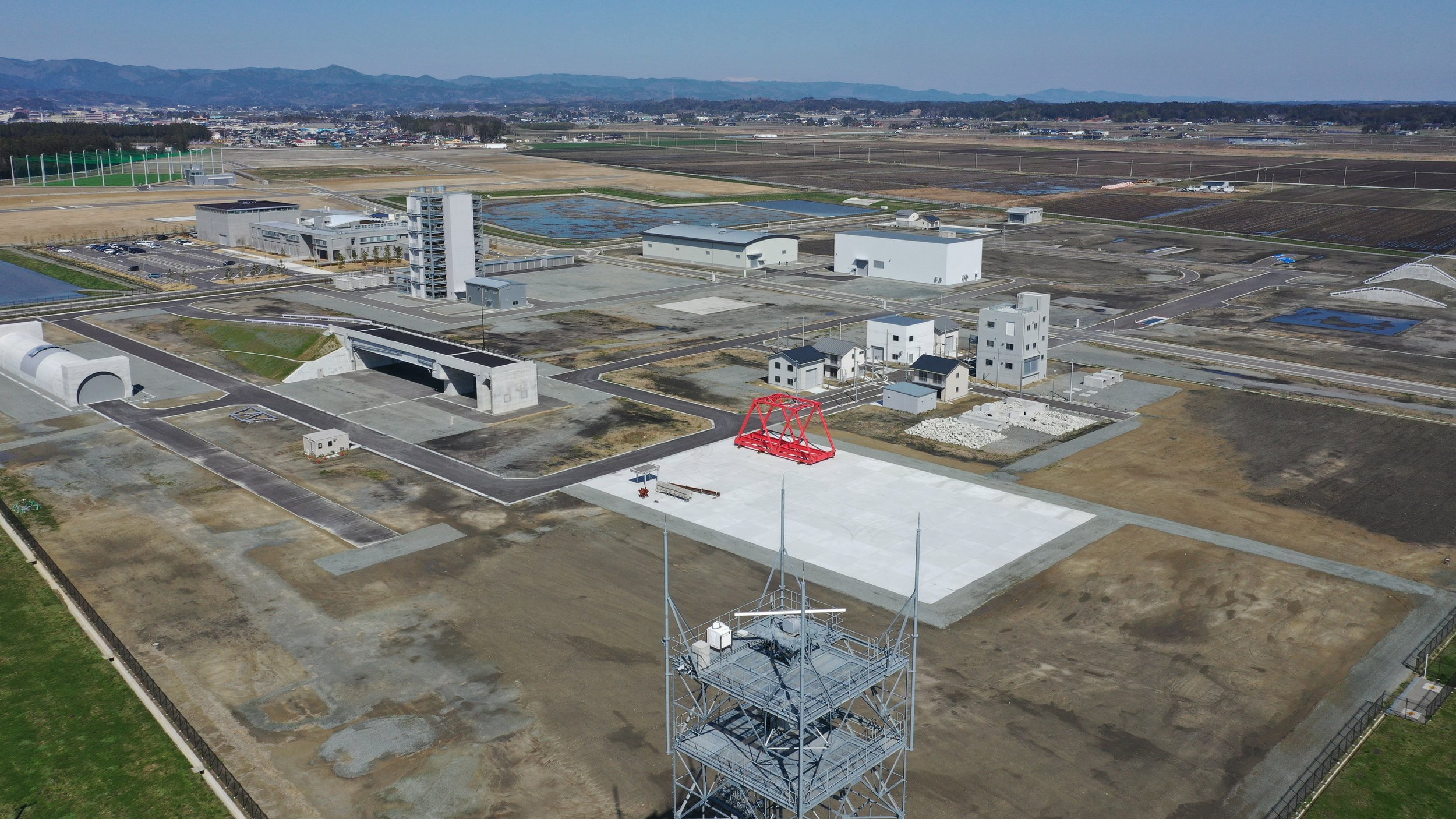
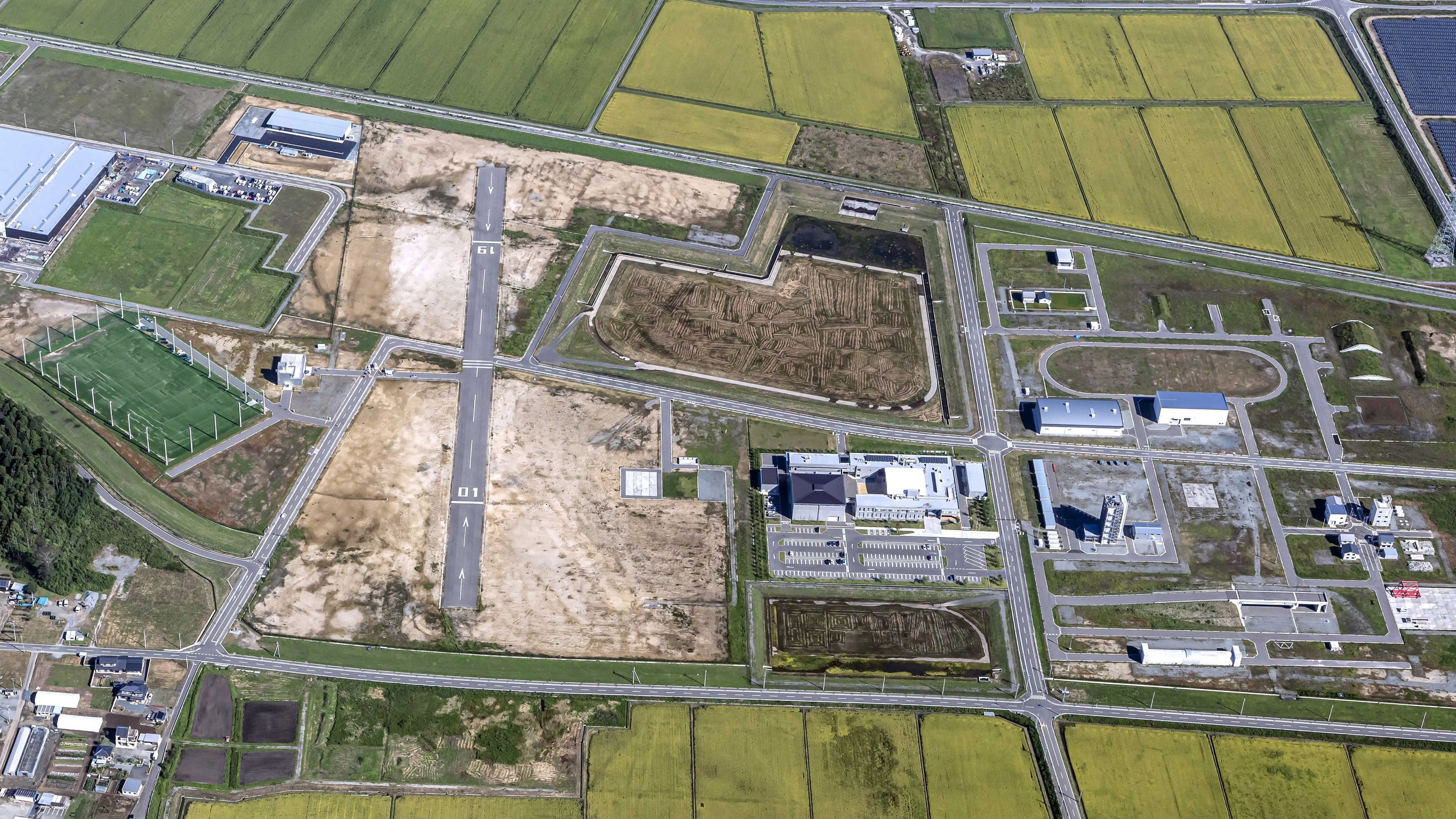
Future Tech Hub
In the 11 years since the earthquake, recovery has focused on restoring businesses to their original locations in Fukushima through business and livelihood restoration efforts; but that doesn’t provide a vision of Fukushima’s future. The Fukushima Innovation Coast Framework aims for “creative reconstruction” by developing new industries in the prefecture’s coastal region.
“As we attract outside companies, we also want locals to restart their businesses. True creative reconstruction is only realized once local companies successfully mesh with new partners and drive the creative cycle,” explained Masami Miyashita, director of METI’s Fukushima New Industries and Employment Promotion Office.
A Leg Up for Robotics
One of the cutting-edge research and development facilities is the Fukushima Robot Test Field. It offers experimental equipment and development facilities such as tunnels, bridges, and runways for aircraft to test the performance of robots for infrastructure inspection and communication towers for drones.
Sou Yanbe, growth manager of the venture capital Real Tech Fund, explained: “Test environments that can assess the durability of devices are indispensable for the commercial rollout of hardware such as robots and drones. But most startups can’t afford to own and operate the facilities needed to conduct these tests. Robotics startups aiming for mass production should first consider setting up a base in the Hamadori area of Fukushima.”
Big Hydrogen Plants
Take for example the small community of Namie, which has been reimagined as Hydrogen Town Namie and houses one of the world’s largest-capacity hydrogen plants: Fukushima Hydrogen Energy Research Field. Sucking up an enormous amount of energy generated by solar panels, the field applies this solar energy to produce enough hydrogen fuel daily to power about 150 households or to fully charge 560 fuel-cell vehicles.
In response to the national government’s 2050 Carbon Neutral Declaration, which is expected to encourage even further the introduction of renewable energy in Japan, Namie has declared itself a zero-carbon city, aiming to achieve virtually no carbon dioxide emissions by 2050. While this will promote the generation and use of renewable energy, the key to achieving their 2050 goal is found in the “create local, use local” strategy for clean Namie hydrogen produced at the Fukushima Hydrogen Energy Research Field.

Fixed-wing drones will scan disaster-struck areas.
Drones to the Disaster Response
Meanwhile, the startup Terra Labo is addressing the other side of the coin: disaster preparedness. Investing just over $2 million to build a research, development, and manufacturing hub next to Fukushima Robot Test Field, Terra Labo Chief Executive Officer Takahide Matsuura aims to develop and commercialize long-range, unmanned drones by the end of 2023.
Matsuura envisions a disaster management system where fixed-wing drones capable of long-distance flight share images and 3D models generated from aerial surveying with a special analysis team, which then passes them on to government bodies.
“No other facility is so well equipped with not only an airfield and testing facilities, but also ancillary facilities,” Matsuura said, noting how critical the facilities are to his vision. “This makes it ideal for a development-centered company. It must not have been easy to secure the site.”
Engaging Education
But it’s not all billionaires, venture capitalists, and entrepreneurs. The next generation of Fukushima residents is just as involved. In the classroom of a local school, children’s eyes light up when one palm-sized robot bows. The robot attracting their attention is the Aruku Mechatro WeGo, designed to help children learn programming. Classes such as these are held regularly in Fukushima for elementary and middle school students with the hopes that some will grow up to be the innovators of the future. And perhaps, in the years to come, one of Buffett’s successors will visit Fukushima and be inspired by local creativity and entrepreneurship to invest more in the vibrant Fukushima of the future.

Children interact with the Aruku Mechatro WeGo robot.


The Yen’s Fall from Grace
The Japanese yen is on track toward a parabolic move, with global and Japanese macro players set to become increasingly aggressive in betting on an overshoot toward ¥150–160 to the US dollar. Economist Jesper Koll examines the causes, the potential impact, and when the winds may shift again.
Who will stop it? When and why?
Listen to this story:
The Japanese yen is on track toward a parabolic move, with global and Japanese macro players set to become increasingly aggressive in betting on an overshoot toward ¥150–160 to the US dollar.
Why? Because the same economic forces that pulled the yen out of the remarkably stable range of ¥105–110 to the dollar, in which it was boxed for the past six years, are poised to get even stronger in the coming months. No mystery, no magic, no speculative excess. We got to ¥128–131 because of a decoupling of monetary policy. With Bank of Japan (BOJ) Governor Haruhiko Kuroda digging in his heels and the US Federal Reserve now floating the idea of accelerating the pace of rate hikes to possibly 75 basis points a pop, it very much looks like the yen’s slide is just beginning.
Policymakers: United America versus Disjointed Japan
The United States is mobilizing an all-out attack on inflation—raising rates and cutting the central bank balance sheet while, importantly, policymakers, politicians, and opinion leaders are busy signaling that more aggressive monetary tightening will have to come. Nobody knows how many rates hikes are necessary, or when the US monetary brakes will start to cut into demand, but everyone agrees that a strong dollar is good for the United States’ fight against inflation. After all, it reduces import prices.
Japan, in contrast, has a central bank that goes out of its way to keep on buying 10-year government bonds, determined to assure markets—through both action and talk—that nothing has changed, that deflation is still viewed as a bigger threat than inflation.
More importantly for investors looking for clues about the yen’s direction, neither the BOJ nor the Ministry of Economy, Trade and Industry, the Ministry of Finance (MOF), politicians, nor pundits agree on whether a weak yen is good or bad for Japan. Yes, everyone does agree that imported inflation is bad inflation, but many hope that a cost-push shock is just what is needed to break Japan’s deeply entrenched deflationary mindset and expectations. Remember: not so long ago, Nobel Prize winner and chief US economic commentator Paul Krugman, along with others, argued that an inflation target of seven to eight percent may be necessary to snap Japan out of deflation.
“Neither the BOJ nor the Ministry of Economy, Trade and Industry, the Ministry of Finance (MOF), politicians, nor pundits agree on whether a weak yen is good or bad for Japan.”
Personally, my work and investments away from macro theory, hands-on deep-dives into Japanese companies dealing with corporate chief executive officers and institutional chief information officers, and direct policymaking engagement with Japan’s industrial structure and demographic realities all have me convinced that inflation/deflation in Japan is not much of a monetary phenomenon, but primarily a regulatory and structural one.
Specifically, capital markets here are more or less explicitly designed to function far differently from the capital return-maximizing axioms underlying most of monetary policy theory in general, and the transition channels from central bank action to private capital allocation in particular. In my view, Japan Inc. works more in spite of monetary policy rather than because of it. Japan’s elite is far too pragmatic and realist than to entrust allocation of capital to some textbook theoretical models or economics dogma (particularly when they come from Chicago … just kidding).
But what may be true for the economy is not true for the currency. The yen is very much a slave to the masters at the BOJ and MOF. (Arguably, the yen is the only major capital market in Japan where, after decades of deregulation and liberalization, capital does flow relatively unencumbered. For example, it follows neoliberal market principals much more so than is the case in the bond, credit, or even equity markets. This has led to a relative loss of control, with both institutional and retail investors now much less influenced by “administrative guidance” than they were in previous decades.
An Asymmetric Risk
So, right now, if your job is to make money investing in currency markets, the contrast between a united US policy elite beginning to act—and poised to do so more aggressively (on the monetary front)—and a disjointed Japan elite only barely beginning to build consensus on a potentially necessary change, you’d be a bold trader to go against the rising US rates; and stable Japan rates equal weaker yen trade.
That’s why I think an overshoot toward ¥150–160 to the dollar is more probable than a return to the ¥105–110 range seen until a couple of quarters ago. Speculating against the yen has an asymmetric risk–reward profile now.
How long will this last? What forces could break the current dynamics? Yes, eventually Japan will follow the US lead. The BOJ always does. The one time it did not—and insisted on a decoupling from US policy—Japan got its bubble economy. Nobody, least of all Prime Minister Fumio Kishida, wants to go through that again.

Photo: gintsivuskansphoto/123RF.COM
Can Kishida Change Kuroda’s Mind?
Probably not. At least not until it becomes clear that Kishida is here to last. There is an upper house election in July. After that, yes. Kishida gets to appoint Kuroda’s successor early next year. If, by then, inflation becomes a political problem, Kishida may be well advised to pick an inflation hawk. That, however, is at least six to eight months away—an eternity for currency markets.
Again, the contrast between the United States and Japan is striking. For President Joe Biden, inflation is an immediate danger—a key reason for his continuing drop in popularity. Against this, Kishida’s popularity keeps climbing, and inflation running at barely one percent is far from becoming a political make-or-break issue. However, if, against the odds, the prime minister were to pick an open fight with the BOJ before the election, he is more likely to add to a yen-depreciation speculative frenzy.
Why?
First, Kuroda is both intellectually proud and politically pragmatic. He won’t risk his historic legacy of being the governor who beat deflation without seeing firm evidence of genuine demand-pull inflation. He does not want to go down in history as yet another BOJ governor who tightened too early. And, politically, he understands more than anyone the risk that rising interest rates pose to Japan’s fiscal flexibility. With public debt at nearly 2.5-times national income, public finances will be the biggest loser if and when interest rates go up too early (i.e., before domestic demand has entered a self-sustaining upcycle).
Second, markets want to see action and facts, not talk and debate. Show me the money. And with most forecasters now predicting an outright economic contraction during the latest quarter, it’ll get even harder to deny that Japan is indeed at the opposite end of the business cycle from the United States. Again, it is difficult to argue against the yen depreciation momentum accelerating in the immediate future.
When the Facts Change
But what about longer term? What structural dynamics might unfold that could trigger a reversal of fortune for the yen? Here are five primary moves that can or will force a change of direction from yen depreciation towards appreciation:
- The United States or China accuses Japan of starting a currency war
- The United States falls into recession
- Global investors, corporates, or tourists start buying Japan assets
- Japan’s investors and corporates start buying yen assets
- The BOJ starts following the Fed

From Fears of a Yen-led Currency War
Right now, the risk of Japan being accused of starting a currency war is low. If I am right and the US elite is indeed united in fighting inflation, it will continue to welcome a strong dollar and weak yen.
But what if China were to complain about excessive yen weakness? They did so the last time the yen weakened past ¥135–140 to the dollar in mid-1998. At that time, China successfully persuaded the Clinton administration to publicly abandon the strong-dollar policy that the United States was running at the time.
But times have changed. In 2022, Chinese complaints are unlikely to get much of a hearing in Washington. In 1998, the United States was focused on getting China to join the World Trade Organization and was happy to try and be helpful. Today, the United States regards China as its principal competitor, while Japan’s position as its principal ally in Asia is firmly reestablished. The more you believe the New Cold War rhetoric as an overarching US policy priority, the less you will worry about China triggering an end to yen depreciation.
US–China Agreement on Renminbi Devaluation?
However, rather than being lulled into a false sense of security by mainstream rhetoric, a pragmatist investor will constantly evaluate actual policy developments. Specifically, the latest overtures to China made by US Secretary of the Treasury Janet Yellen, suggesting US readiness to negotiate on reducing punitive tariffs still placed on US imports, is a potentially very significant about-turn in US–China economic policy.
Will US economic policy pragmatism prevail after all? Because, yes, Americans spend almost four times more on imports from China than they do on imports from Japan ($541 billion versus $140 billion in 2021). If a weak yen and strong dollar are good news for US consumers, a weak yuan is potentially four times more powerful.
No matter what the new cold warrior rhetoric says, given the deceleration of China growth and threats from asset deflation, the immediate economic policy (and domestic political) goals of China and the United States are now complementary—China wants inflation, the United States wants deflation.
Although very much a long-shot, given Biden’s industrial policy priorities—less from China, not more—a restart of US–China trade negotiations may set the stage for a devaluation of the yuan implicitly tolerated by the US Treasury.
Of course, for Japan and the yen, renminbi devaluation tolerated by the United States would add new fuel to the yen’s decline. So, while the risk of the United States accusing Japan of currency manipulation and engaging in a currency war is low, the possibility that it would tolerate the start of a currency war in Asia may well be underestimated as a next trip wire for dollar strength.
From a Strong Dollar to the Next US Recession
Of course, dollar strength will not be in the United States’ best interest forever. The turning point will come when US recession and deflation risks overpower the current inflationary pressures. More specifically, that point comes when Fed rate hikes begin to cut into US asset prices in general, and US equities in particular.
Never before has the combination of rising rates and falling corporate profits not brought troubles to Wall Street—a bear market at best, a crash at worst. And nothing will focus the minds of the US policy elite like the specter of asset deflation.
The numbers speak for themselves. With just about 40–45 percent of US listed-company earnings coming from global sales, a strong dollar forces weaker earnings. So, while a strong-dollar policy is a welcome tool in the fight against consumer price inflation right now, eventually a switch to a weak-dollar policy will become necessary.
Of course, we can debate whether, in the United States, “this time is different”; whether the threat of stubbornly high consumer price inflation cutting the purchasing power of the people is more important than the loss of capital gains on Wall Street. The Main Street versus Wall Street debate is very real. However, in practical terms for investors, a crash on Wall Street is poised to deliver an about-turn in Fed priorities faster than you can say “American dream.” This is how the dollar’s strong run will end.

US Stagnation Fueling Protectionism in the Run-up to 2024
The bad news is that reality probably won’t be that clear-cut. It is easy to imagine what will happen in the extremes of an inflationary boom and a deflationary bust. What about something more real world, more messy, less clear-cut? Many serious forecasters are predicting a US stagnation scenario—i.e., stubborn but no-longer-accelerating inflation, with growth (and Wall Street) not crashing, rather just meandering and going nowhere.
What are the policy options then?
In my view, the US stagnation scenario will also make it tempting for politicians and policymakers to begin advocating a switch to a weak-dollar policy. The potential windfall to help turn around corporate fortunes is one reason. A more worrying dynamic is that US stagnation is poised to fuel a next wave of protectionism.
Blaming “unfair” cheap imports, pointing to China, Mexico, and Japan, then accusing them of taking jobs from US workers becomes a more tempting narrative the longer stagnation depresses any feel-good factor among US voters. This isn’t likely now, in my view—not for the 2022 mid-term elections (inflation is the more immediate problem this year)—but it becomes a credible scenario for the 2024 presidential fight.
Personally, I worry more about stagnation feeding populism more so than inflation. Under inflation, there are winners and losers. But under stagnation, all you get is an increasingly corrosive disillusionment among every part of society. The American dream very much depends on the celebration of winners; maybe that’s why stagnation will not be tolerated for long. But to get out of it, promises of radical, populist, “only I can fix it” extremist solutions are bound to gain political currency.
Be that as it may, as far as global currency markets are concerned, the higher the US stagnation risk the greater the risk of the United States abandoning its current strong-dollar policy. Moreover, who will want to buy—or even hold—dollars if US interest rates, equities, and real estate prices are going nowhere?
Who Will Buy Japan Assets?
So, it looks like it will become easier to argue for selling US assets as the United States cycle flips from inflationary boom to either frustrating stagnation or deflationary bust. But for the yen to strengthen, investors will have to buy Japan. Why, and when, will this happen? Who will do the buying?
The last point is key, in my view. There is plenty of great analysis demonstrating Japan is cheap. Here are just some of the highlights:
- Japanese equities trade on a 13-times price-to-earnings (PE) multiple, which is cheap against its own 30-year history as well as against the 22-times PE you pay for US equities (TOPIX vs SPX500)
- Japanese labor costs are now down to half (!!) of US ones, $34,000 in Japan versus $69,000 in the United States
- A Big Mac costs ¥399 in Tokyo versus $5.30 in LA, so a US tourist could get two for one
Or at least they could if Japan allowed free travel. Personally, I think the most immediate and impactful way to begin creating new marginal demand for yen is for Kishida to open Japan’s borders. Inbound tourists spent about ¥5 trillion per annum before they were shut out. Although small in absolute terms, relative to the roughly ¥500 trillion daily currency market transactions, creating net new demand for yen is poised to have a positive impact. Markets thrive on new marginal demand.
Welcome to the World, Japan Service Sector Workers and Entrepreneurs
Structurally, the fact that relative Japanese labor costs have fallen so dramatically does open opportunities for more substantial global arbitrage, creating demand for yen. Here, don’t think industrial workers, but rather computer coding, information technology, and other location-agnostic service workers. A yoga class via Zoom with a teacher in Tokyo is now almost half the price of one taught by a Los Angeles- or New York-based yogi.
In fact, several US and Israeli venture capital firms have begun scouting for software engineers based in Tokyo, Fukuoka, or Osaka to do work they had originally planned to have done in Vietnam. Again, Japan engineers are now about 30-percent cheaper than their Vietnamese competitors—never mind Silicon Valley ones.
“Japanese labor costs are now down to half (!!) of US ones, $34,000 in Japan versus $69,000 in the United States.”
Clear speak: The combination of relative cheapness and the realities of remote work and Zoom-based individual services having become more acceptable suggests there is a real chance the world will begin to buy more Japanese services. More specifically, the entrepreneurial opportunities for Japan here are enormous as a much broader section of the service sector transitions from local-only and non-tradeable to global and tradeable. Bonzai classes from a true bonzai master, anyone? This is true not just for traditional Japanese expertise but, more importantly, for newly created Japanese deep tech, patents, and all forms of intellectual property-based innovation. I expect a buying spree by US venture capitalists, snatching up previously hidden innovation bargains created by Japanese private and public scientists and engineers.
Soft Onshoring? Yes. Hard Onshoring? No.
Against this, it is highly unlikely the world will begin to build factories here in Japan. Labor costs are one factor in deciding where to build a factory, but much more important is proximity to market and suppliers. Just look at how difficult it was for the government to persuade Taiwan Semiconductor Manufacturing Company Limited and Sony Semiconductor Solutions Corporation to commit to building a new factory here in Japan.
Labor costs matter in the service sector much more so than in the industrial sector, where capital costs, stakeholder and supplier proximity, and end-market reach are the much more dominant factors. So yes, soft-onshoring—global service sector companies raising their Japan-based footprint—absolutely; but hard-onshoring by industrial companies is unlikely, in my view. Watch for a pickup in inward direct investment, with more service sector global giants buying into Japan, following PayPal Holdings, Inc.’s $2.4 billion acquisition of Tokyo buy now, pay later startup Paidy last September, and the growing success stories of Salesforce, Inc., Amazon Japan G.K., Yahoo Japan Corporation, and law firm Morrison & Foerester LLP here in Japan, to name just a few.
Clear speak: in the coming months, I shall watch carefully for signs of a pick-up in cross-border merger-and-acquisition (M&A) flows into Japan for a possible source of new marginal demand for yen that could help break the current depreciation trend.

Big Guns to the Rescue
When all is said and done, however, Japanese investors hold the key to the fate of the yen. Japan’s status as one of the major global creditors dictates as much. As long as Japanese institutional and retail investors refuse to invest in their own markets and, instead, continue to prefer global or US assets, the case for yen appreciation will be hard to substantiate.
Here it is interesting to recall the history of the world’s single biggest asset manager, Japan’s Government Pension Investment Fund (GPIF). The GPIF manages $1.7 trillion, of which about 26 percent is in global bonds and 24 percent in global stocks. In all the grandstanding about the merits or demerits of yen depreciation, it should not be forgotten that Japanese pensioners are thus a major beneficiary of yen depreciation: a 10-percent decrease in value of the currency should create a two to three-percent upside performance windfall profit (obviously depending on hedge ratios and equity/bond markets performance). I am not a public pension actuary, but some friends who are suggest it is quite possible that, at ¥140–150 to the dollar (and on current asset allocation), Japan’s public pension may actually become overfunded.
“Japanese pensioners are thus a major beneficiary of yen depreciation: a 10-percent decrease in value of the currency should create a two to three-percent upside performance windfall profit.”
Importantly, the GPIF contributed greatly to forcing the last major inflection point in the yen’s fortunes when it announced a major reallocation out of domestic Japanese government bonds into global bonds and equities during the early years of former Prime Minister Shinzo Abe’s administration.
Market participants remember well how the GPIF inflection lent credibility and broader confidence that decades of yen appreciation had come to an end. The GPIF showed the money (with Japan Post Bank and Japan Post Insurance adding welcome firepower).
Performance Pressure: GPIF Public Pension Fund Beats Private Managers
Yes, Kuroda’s BOJ launched an all-out attack on deflation in early 2013, but only when Japan’s (and the world’s) largest asset manager began to act and switched asset allocation did the yen’s fortunes inflect from decades of appreciation towards depreciation. In other words, the GPIF became the primary “agent” for transmitting monetary priorities into the real world.
No, this is not a conspiracy theory. Both the BOJ’s and the GPIF’s assets are owned by the same principal, the Japanese general public. What is interesting, however, is that Japanese private pension managers, whose principals are not the general public but company- or industry-specific employees and pensioners, did not follow the GPIF’s lead and, to this day, have maintained much more conservative allocations to global securities. In contrast to the approximately 50-percent allocation to non-yen assets by the GPIF, private pension managers have slightly less than 30 percent in overseas securities.
Given the now accelerating trend of yen depreciation, the relative outperformance of the public GPIF fund over the private, “independent” ones will, before long, add more pressure for long-overdue professionalization of the stewards of Japanese private-pension schemes. There is no question the GPIF is a best-in-class global steward of capital, while many private pension schemes here are still ensnared in clientelism, cushy amakudari (descent from heaven) positions, and a general lack of financial professionalism.
The $850 Billion Question
When will the GPIF cut non-yen allocations? The bottom line is this: When predicting the yen’s fortunes from here, the real focus for practitioners is not so much whether the US Treasury will agree to let the MOF sell its US-dollar reserves, but whether—or more specifically when—the GPIF will cut down on the global allocations that have served it so well since it started buying dollars in 2013–14, when the yen was ¥80–100 to the dollar.
Make no mistake: the GPIF has evolved into the de facto primary agent for BOJ and MOF monetary policy objectives and stands at the very core of Japan’s capitalism in general, and the transmission from savings into investments in particular. The yen will pivot and start appreciating when the GPIF announces a cut in its global allocation in favor of the deep value offered by yen assets.
When will this happen? My money is on right around the time of the Fed’s third rate hike—i.e., when equity markets have no choice but to admit that the risk-reward of buying stocks makes no sense. To wit, an equity earnings yield of five percent and falling (because earnings are in a downward cycle), and a risk-free rate of three percent and rising, will leave no other choice to the financial professionals at the GPIF and other institutions. Contrast that to an earnings yield of 7.5 percent and a risk-free rate of 0.2 percent in Japan, and you know not just where to hide but where outperformance is likely: here in Japan.
Clear speak: Japan’s deeply engrained reputation as an equity “value trap” will be corrected exactly when Japanese investors begin to recommit to their home-country risk-assets markets. If the GPIF were to lead this charge, fellow global long-term investors are bound to follow—sovereign wealth funds in particular.
But Japanese investors will have to show us the money.

Kuroda’s End Game
How can the negative correlation between the yen and Japanese risk assets in general—and Japan equities in particular—be broken? In my personal view, Kuroda is exactly right to force this realization onto local asset allocators by de facto encouraging a currency overshoot toward ¥150–160 to the dollar. The yen can—and will—be a key force to defeat the deeply entrenched bias against domestic risk assets that Japanese asset allocators have been insisting on for more than 30 years.
If I am right, the current policy decoupling between the BOJ and the Fed will lead to a much more fundamental parting. When Japanese investors begin buying Japanese risk assets instead of non-yen ones, Japanese equities will begin to rise in tandem with yen appreciation.
Although still a long shot at this stage, here is the real escape hatch for Japan from deflation. The long-established negative correlation between Japanese stocks and the currency must be broken. The fact that, for the past 30 years, Japanese equities only go up when the yen goes down while yen appreciation always depresses local stock markets.
“When Japanese investors begin buying Japanese risk assets instead of non-yen ones, Japanese equities will begin to rise in tandem with yen appreciation.”
For this to be supported by fundamentals, domestic Japanese profit margins will have to rise to above those earned from overseas operations and sales.
Here, Kuroda is doing his bit by encouraging yen depreciation, but his efforts will be in vain if Kishida and his stewards of industrial policy do not follow through. For Japanese corporate profits to rise despite yen appreciation, Japan needs a serious round of industrial reorganization and domestic investment.
This is because yen depreciation offers a potentially misleading path. At ¥110 to the dollar, Toyota Motor Corporation’s most profitable factories were the ones in the United States; at ¥130, the ones in Japan will reclaim that spot. However, this windfall is unlikely to last due to the inherent volatility and cyclicality of any exchange rate. As explained above, the moment the Fed changes direction as US recession risks rise, the dollar is set to fall.
From Kuroda’s Cost-Push Stock Therapy …
Sustainable improvements in productivity and profitability will have to be earned through business investment at the level of individual companies and industrial reorganization at the sector and macro levels.
In other words, Kishida and his team must focus on removing regulatory obstacles to industry consolidation, incentivize M&A, and push harder for technological upgrade and capital deepening. Importantly, the current round of cost-push inflation actually creates a strong tailwind for this, because companies with outdated technology and old-fashioned customer acquisition strategies are poised to be squeezed out and lose market share which, in turn, will force them to either start investing in better human and physical capital or have them seriously considering M&A.
To wit, in Japan’s various industries and sectors—from hairdressers to banks to machine tool makers—the top three companies in each command barely 15 percent of their market on average, while in the United States the top three control about 33 percent. This degree of excess competition is also born out when comparing listed companies. US equity markets are almost seven times larger than those in Japan (by market capitalization), but the number of listed companies is almost the same: 4,266 in the United States versus 3,754 in Japan. In other words, Japan Inc. is as good a definition of “red ocean” cut-throat competition as you’ll find.
… to Kishida’s New Capitalism
There is no question that, since the end of the bubble in the early 1990s, Japan’s model of capitalism became increasingly focused on trying to shelter local companies from the forces of asset deflation, technology-induced disruption, rising capital costs, or other forces of “creative destruction” by providing more or less free capital.
Twenty years on, the result is a capitalism marked more by zombie companies that drag down industry and macroeconomic performance, productivity, and financial returns rather than by global top performers. This is where Kishida’s promise of a new capitalism could have real meaning. If new capitalism marks a departure from this zombie capitalism, and actually seeks to incentivize sector-by-sector industrial reorganization and streamlining, then prospects for a sustainable decoupling of Japan’s financial performance from the exchange rate dependency will come into sight. I know this is a big if, but let’s give optimism a chance.
“If new capitalism marks a departure from this zombie capitalism, and actually seeks to incentivize sector-by-sector industrial reorganization and streamlining, then prospects for a sustainable decoupling of Japan’s financial performance from the exchange rate dependency will come into sight.”
Clear speak: if the current pain of cost-push inflation delivers long overdue industrial reorganization and the emergence of true Japanese national champions, the GPIF and other professional investors will be rewarded handsomely—not just from a tactically expedient increase in yen equity allocations because of a Wall Street downcycle, but from a strategic Japan overweight position where yen companies deliver rising returns independent of the currency’s fortunes.
Either way, the yen’s decline will stop and reverse exactly when Japanese investors begin buying their mother markets here in Japan. With a little luck, they’ll do so not just for fear of a US crash, but for realistic expectation that Japanese corporate leaders will not just sweat existing assets but begin to actually invest in both human and physical capital at home.
That’s the optimist’s view. Until then, a pragmatist should prepare for parabolic speculative overshoot towards ¥150–160.

2021 Person of the Year Photo Gallery
On April 25, 2022, the American Chamber of Commerce in Japan (ACCJ) recognized Nobuyuki Hirano as the 2021 ACCJ Person of the Year for his leadership and substantial contributions to the US–Japan relationship. View a selection of photos from the event.
Photos by Miki Kawaguchi/LIFE.14
From left: ACCJ President Om Prakash, Nobuyuki Hirano, 2021 ACCJ President Jenifer Rogers, and ACCJ Financial Services Forum Chair Andrew Conrad
On April 25, 2022, the American Chamber of Commerce in Japan (ACCJ) recognized Nobuyuki Hirano as the 2021 ACCJ Person of the Year for his leadership and substantial contributions to the US–Japan relationship.
During a hybrid event held at Tokyo American Club and livestreamed to remote ACCJ members and guests, the former chair, president, and group chief executive officer of Mitsubishi UFJ Financial Group, Inc. (MUFG) spoke about his long career.
The event began with a VIP session where ACCJ leaders greeted Hirano, after which ACCJ Governor and Financial Services Forum Chair Andrew Conrad welcomed luncheon guests and provided background about the award. ACCJ President Om Prakash delivered remarks and welcomed Hirano to the podium.
In addition to his work at MUFG, Hirano served as chair of the Japan-U.S. Business Council from 2017 to 2021, working tirelessly to promote better US–Japan business ties and to further strengthen the international business environment in Japan.
Following Hirano’s presentation and a Q&A session, moderated by Conrad, 2021 ACCJ President Jenifer Rogers presented the certificate.
The ACCJ Person of the Year Award was created in 1996 to enable the chamber to recognize individuals for their outstanding contributions to business and commercial relations between Japan and the United States. Past recipients include: Fujio Cho, honorary chairman of Toyota Motor Corporation; Hiroshi Mikitani, CEO of Rakuten, Inc.; and Caroline Kennedy, the 30th US Ambassador to Japan.


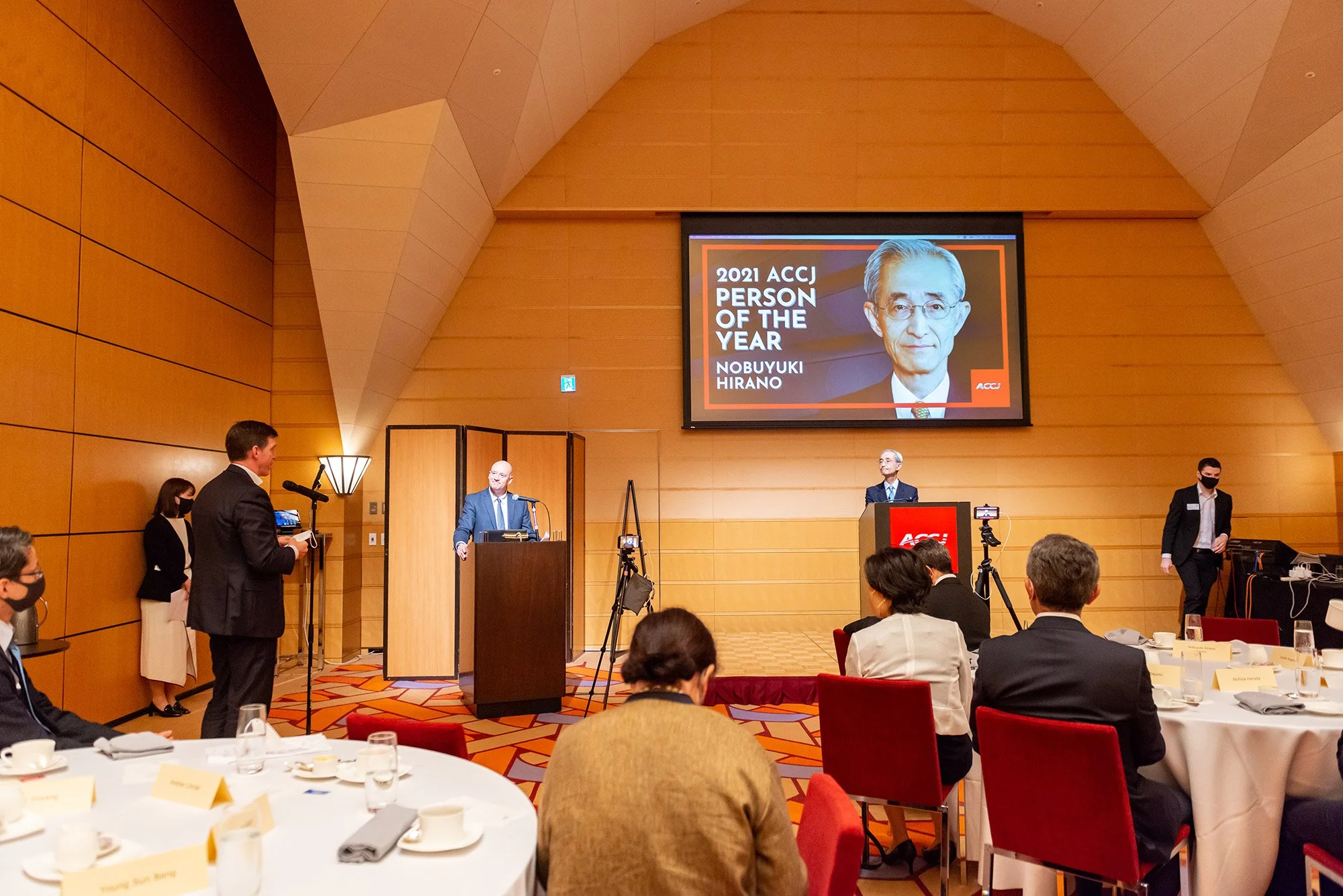


ACCJ Meets Congressional Delegations
A visit by senators in April also offered a chance to welcome back former Ambassador Hagerty.
A visit by senators also offered a chance to welcome back former Ambassador Hagerty
From left: ACCJ Vice President Douglas Hymas, ACCJ Chair Eriko Asai, Senator Ben Cardin, Senator Bill Hagerty, ACCJ President Om Prakash, ACCJ Governor Mari Matthews, and ACCJ Vice President Amy Jackson
The American Chamber of Commerce in Japan (ACCJ) was honored to meet with two congressional delegations this month.
On April 13, ACCJ leaders met with Senator Ben Cardin and Senator Bill Hagerty to discuss economic security and strengthening the US–Japan economic partnership.
This being the first opportunity to meet since the start of the pandemic, ACCJ President Om Prakash presented former US Ambassador to Japan Hagerty with the 2019 Person of the Year Award for his many contributions to the US business community in Japan during his tenure as ambassador and ACCJ honorary president from 2017 to 2019. Senator Hagerty was also a member of the ACCJ prior to serving as ambassador.
On April 16, the ACCJ met with Senator Lindsey Graham, Senator Robert Portman, Senator Richard Burr, and Representative Ronny Jackson to reaffirm the importance of strengthening the US–Japan business relationship and deepening our engagements in the Indo–Pacific region.
We look forward to working with the senators and US government leaders during future DC Doorknocks.

Photo 1: (from left) ACCJ Executive Director Laura Younger, Representative Ronny Jackson, ACCJ Chair Eriko Asai, Senator Richard Burr, Senator Robert Portman, ACCJ President Om Prakash, Senator Lindsey Graham | Photo 2: ACCJ President Om Prakash present former US Ambassador to Japan Bill Hagerty with the 2019 ACCJ Person of the Year Award, a moment long delayed by the pandemic.

The Great Resignation
The pandemic has brought tumultuous change to the workplace worldwide, and in the United States millions of employees have decided to quit or change jobs in what has been dubbed The Great Resignation. Could we see a similar upheaval in Japan?
Could the change Covid-19 sparked in the United States occur in Japan?
Listen to this story:
The pandemic has brought tumultuous change to the workplace worldwide, and in the United States millions of employees have decided to quit or change jobs in what has been dubbed The Great Resignation. Could we see a similar upheaval in Japan?
In several ways, we already are—although the changes may not be as dramatic or visible, for social, financial, and cultural reasons. Japanese workers aren’t quitting and changing their jobs en masse, but we are seeing more willingness to jump ship—particularly among the younger generation—as well as shifting priorities and expectations about one’s job, career, and employer that will probably transform Japan’s labor market, recruiters and experts have told The ACCJ Journal.
The Great Reflection
Suddenly finding themselves working from home, with extra time on their hands, many workers have had the mental space to think about their careers and broader purpose in life—something they often had been too busy to do previously. Some realized they weren’t satisfied with their jobs and work–life balance, and they began to explore new paths, such as volunteering, picking up side gigs, or changing jobs entirely. That’s a big step in Japan.
“Everybody is reassessing their values,” said Jeremy Sampson, managing director at recruiting company Robert Walters Japan K.K., which connects English-speaking candidates with foreign-affiliated or Japanese companies. “They’re reassessing their lives, their careers, and really wondering if they’re happy with what they’re doing.”
“It’s like stepping off the treadmill,” offered Simon Jelfs, managing director at FocusCore Group KK, which specializes in bilingual recruitment for US and European companies. “People have had a chance to step back, think, and reassess.”
Covid-19 has changed people’s priorities in evaluating a job. In a survey conducted by Robert Walters earlier this year, candidates said their top value was doing challenging and interesting work, followed by inspiring colleagues, corporate culture, and flexible working. Job security and excellent compensation were ranked sixth and seventh—well below where they had been in previous surveys.
“We’re seeing people wanting to change jobs for reasons around looking for something more fulfilling,” Sampson said. “Or because they realize life is short, and that they want to be doing something that makes them happy.”
Jumping off Kiyomizu
But changing jobs is hard in Japan. If you have special skills, such as English ability, as is the case with jobseekers being placed through FocusCore and Robert Walters, there is strong demand. But for most Japanese, switching jobs can be very risky—particularly for those in their forties, fifties, or sixties who have stable jobs and good salaries at major companies, and families who depend on them.
“Japan is less flexible in terms of your trajectory; you don’t have a lot of options to make mistakes and then pick it up and fix it,” explained Robin O’Day, a professor of anthropology at the University of North Georgia who has studied Japan’s youth culture. “If it doesn’t work out, it’s on you because you took a gamble.” In a business culture that values loyalty and is only gradually recognizing merit as a key hiring factor, there’s also not much professional incentive for mid-career employees to change jobs. In the United States and Europe, many who switch jobs can obtain higher salaries or promotions, but that’s usually not the case in Japan, according to Akie Nakamura, chief researcher at Rengo-RIALS. Some even see their salaries drop.
Surveys by the Recruit Works Institute show that, compared with workers in the United States, China, France, and Denmark, those in Japan express greater overall dissatisfaction with their jobs. But the lack of mobility discourages many from doing anything about it. “Changing jobs requires a lot of courage in Japan,” she remarked. “Sometimes it’s likened to jumping off Kiyomizu Temple’s high platform.”
The number of workers who change jobs has been rising in recent years, but fell over the past two years. During the pandemic, the figure fell to 2.9 million in 2021 from 3.5 million in 2019, government data shows. Still, those saying they would like to change jobs has continued to rise steadily, having reached 8.9 million in 2021, according to the government’s labor data, with those aged between 25 and 34 accounting for the biggest group, at 2.3 million. And a survey by Robert Walters of 800 employees across various industries registered with the recruiter shows that 60 percent of respondents were looking to change jobs over the next 12 months.
Generation Gap
Changing jobs is less risky—and a bit more common—among Japanese in their twenties and thirties. For these people, there is less to lose potentially in terms of salary, and more options from which to choose. Companies are also more likely to hire them. And increasingly, if young people are unhappy with their jobs or feel they don’t have much of a future there, they will look elsewhere.
Many in the younger generation have seen the often-grueling jobs their fathers (in most cases) held and aren’t necessarily enthused by the idea of devoting their entire career to a company, Professor O’Day said. They are thinking more in terms of how the company can benefit their career objectives, not the other way around, he and other experts agreed.
Some companies are shifting from the traditional organizational model, in which workers function as members contributing to the company’s overarching mission, to a self-directed model that gives employees more freedom to pursue their ideas and offers choices within the company, experts explained.
Over the past few years, we’ve been seeing some twenty-somethings at big brand-name companies switch jobs, which was virtually unheard of before, Nakamura noted. The top two reasons are:
- Fear that they won’t be able to do interesting work if they remain where they are
- A desire to work at companies with more growth opportunities
And research conducted by online recruiting agency en Japan Inc. shows that a growing portion of these young job-changers at big companies are going to startups, the ratio having risen to more than 20 percent last year.
Sampson sees that among his clients as well. “Younger people want to take control of their lives more,” he said. “They have more of an appetite for startup-type businesses, where people can take the initiative, are more responsible for their own actions and output, and are not just taking orders from above.”
Flexibility Assumed
Jobseekers’ demands and expectations surrounding job flexibility are also changing. The first question that candidates ask when considering a new opportunity is not about salary but work arrangements, Sampson shared. “Pre-pandemic, flexibility around work was a benefit that companies sold to attract talent, whereas now it’s a must-have,” he said. “And if you’re not [offering it], you’re basically deterring talent.”
While many companies still place value on employees coming into the office, partly to build corporate culture and network with colleagues, jobseekers are gravitating to businesses that offer a hybrid work style that allows them to work from home at least some of the time. After tasting work from home, some will accept only jobs that are 100-percent remote, FocusCore Group’s Jelfs noted.
Teleworking has been especially welcomed by working mothers, who say they are much better able to juggle their family duties. One single mother, whom Jelfs knows, loves working from home so much that, if her company required her to start coming back into the office, she would find another job that allows fully remote work.
These changing dynamics have driven another change: decentralization. Some people who live and work in Tokyo are moving to outlying areas—sometimes quite a distance away—either maintaining two homes or completely uprooting themselves from the city. One of Jelfs’s candidates moved from central Tokyo to Tsukuba, Ibaraki Prefecture, and once there switched to a local job. Others have moved to the beach town of Hayama, south of Yokohama, or Karuizawa, in the mountains of Nagano Prefecture, he said.
Covid-19 prompted Tokyo’s population to decline to just under 14 million last year, the first drop since 1996. If the trend continues, this could contribute to the spreading out of Japan’s population from urban centers, a long-time government goal.
“This is a shock to the system that Japan really needed to initiate this sort of change,” Sampson stated. “Even us as a company, we talked about more flexibility for years, but actually doing it was painful to think about. But when we ripped off the Band-Aid and did it, it actually became quite simple. Everyone adapted quite easily, and I think it’s benefited many people.”
More Stratification
However, this greater freedom and flexibility has not extended to Japan’s entire labor market. It is concentrated in white-collar workers with regular, full-time jobs—a steadily declining breed in Japan. Workers in blue-collar, delivery, and factory jobs that cannot be done from home, or at their convenience, have not seen this same sort of flexibility as a result of Covid-19, O’Day pointed out.
In fact, for some of them, work and life have become harder. Freelancers in Japan—mostly self-employed people with specific skills, such as photography, editing, or teaching music—have seen their work and income decline during the pandemic. And when the government offered financial aid to workers who had lost income, freelancers received less help than full-time employees. “To freelancers, that looked like a value judgment,” said O’Day.
The job market is also not very friendly toward them. When freelancers apply for full-time jobs, “many companies will discriminate against them—they think you’re somehow tainted or there’s something wrong with you,” O’Day added.
So, in some ways, Covid-19 has widened gaps in Japan’s labor market, where big businesses are increasingly relying on contract or part-time workers to cut costs. That’s given greater flexibility to companies, but not to contract workers, who have fewer benefits and less job security than those in the upper echelons of the labor market.
Shared Values
Covid-19 has also enhanced the desire among younger workers, including some college students, to join a company that shares their values and is doing something to contribute to society, recruiters said.
“Younger candidates are asking of companies, ‘What are they doing in terms of sustainability? What are they doing for the local community?’” explained Jelfs, who has been working in Japan for 24 years. “Ten years ago, it would have been more about salary and if it’s a prestigious company.”
Jobseekers in their twenties and thirties also place a higher priority on diversity and inclusion, and want to know how committed companies are to that, Sampson remarked. Likewise, they also are more concerned about whether companies are proactively adopting environment, sustainability, and governance standards, he added.
Businesses that aren’t able to offer more flexible work style policies or give clear answers to questions about their values, diversity goals, and contributions to society, may get shunned, recruiters warned. A Robert Walters survey shows that half the respondents would reject a job offer if the company’s values didn’t align with their own.
With more people working remotely, the entire job search process has become easier, recruiters said. They can search for openings online in the privacy of their homes and handle multiple job interviews in a single afternoon. They don’t necessarily need to commit a big chunk of time to visiting various companies’ downtown offices over several days for interviews, although some employers still want to meet candidates in person, which recruiters say is a good idea.
Talent War
All these changing dynamics are coming amid perhaps one of the tightest job markets ever in Japan, as the pool of workers contracts amid an aging and shrinking population. Companies are scrambling to get the best talent.
Even before the pandemic, capable candidates—from good schools, or with a few years’ experience in a desired field—who were looking to change jobs would receive many offers, Nakamura explained. “In the past, major companies could easily get graduates from top universities, but that’s no longer a given.”
Also, Japan’s tight immigration rules make it difficult for foreign workers to enter—a flow that has virtually ground to a halt during the pandemic.
“Japan is facing the greatest talent shortage, really, in its history, and it’s not going away with the shrinking population,” Sampson added. “There really needs to be a more streamlined process to accept and welcome foreign talent.”
Intense competition has emerged for workers with specific, highly sought-after skills, such as English ability or computer programming skills, recruiters said. Tech startups are appearing left and right, and established companies also need engineers to help them digitally transform their operations, so for them it’s a candidates’ market.
“Companies are looking for Japanese candidates who are bilingual, who have a stable background, a solid record of achievements in Japan, and are not a job-hopper. Once you factor all that in, supply is tight,” Jelfs explained. “Those kinds of candidates have three to five offers they can choose from.”
Businesses have become much more aggressive in trying to retain employees by making counteroffers in the form of promotions, transfers, or pay increases, according to Sampson. “Companies are aware that it’s far more difficult and expensive to replace somebody than it is to entice them to stay.”
Japan tends to change most dramatically in response to external shocks, and Covid-19 has proved to be a powerful catalyst, setting in motion changes that will probably permanently alter employee behavior, corporate practices, and even Japan’s business culture. “This is the beginning of what will be a long-term, big change in Japan for sure,” Sampson said.

Stepping Up for Change
The global employment landscape has shifted dramatically during the past two years, with the coronavirus pandemic encouraging employers to be more flexible than ever in their arrangements with staff. Working from home, for example—virtually unthinkable for many companies not long ago—has quickly become perfectly acceptable and, often, expected. While Japan has, in the past, been criticized for failing to keep up with changes in the job market, there are plenty of organizations here that have embraced different approaches to work.
Companies move quickly as talent expectations evolve
Listen to this story:
The global employment landscape has shifted dramatically during the past two years, with the coronavirus pandemic encouraging employers to be more flexible than ever in their arrangements with staff. Working from home, for example—virtually unthinkable for many companies not long ago—has quickly become perfectly acceptable and, often, expected.
Employees, for the large part, have seized upon these opportunities to improve their work–life balance, escape the drudgery of the commute, and spend more time with their families. And now that the genie is out of the bottle, it will be very difficult for many people to return to previously accepted ways of working—at least on an all-day-every-day basis.
Change Not Optional
While Japan has, in the past, been criticized for failing to keep up with changes in the job market, there are plenty of organizations here that have embraced different approaches to work. Human resources (HR) companies say they must if they want to continue to attract the best and brightest talent, with a dire shortage of candidates in many sectors giving skilled workers the luxury of choosing where they might go next.
Well before the pandemic, Japan already had been experiencing a worsening labor shortage, pointed out Bryce Conlan, president of Nagoya-based H&R Consultants K.K., which specializes in foreign staffing solutions. This shortage could be seen in a broad range of placements, from convenience store jobs to blue-collar positions to highly skilled artificial intelligence or information technology (IT) experts. The situation had been compounded by salaries significantly lower than those in the United States and even elsewhere in Asia.
“Another serious issue was the lack of innovation and flexibility in HR policies,” said Conlan. “Or, rather, a lack of willingness to change old habits and cultures, where long hours were the norm and the evaluation system was built around time spent rather than results achieved. The need to be seen to be working, rather than the need to achieve results.”
Accelerated Adaptation
There were signs of change before the pandemic. More companies had been introducing cultural and language training, and there was a new willingness to hire talent from abroad. But things have changed rapidly since the first cases of Covid-19 were reported in Japan in early 2020.
“One positive thing that has come out of the pandemic for Japan is an acceptance of the concept of remote work or working from home,” Conlan told The ACCJ Journal. “There has been more change in the way companies operate and people work over the past 24 months than over the past 10 years here in Japan. So many processes and old ways have been transformed, with things such as digital signatures now being more commonly accepted—reducing the need for faxes—and a greater reliance on email and document-sharing tools.
“This has allowed a totally new way of working and, I believe, has brought a huge increase in efficiency,” he said. “We have one client who has well over 60 IT engineers working from India, purely because they have not been able to get visas to enter Japan to come and work. They are now working full time remotely from India, something that would have been unheard of five years ago.”
Nancy Ngou, an associate partner with EY Strategy and Consulting Co., Ltd., shared that the pandemic has hastened changes that already had been taking place at some companies. These include:
- Changes to develop and retain younger employees who prioritize flexibility
- Removal of barriers to women’s advancement in the workplace
- Evolving workplace cultures to embrace change (e.g., inclusion, digitalization, global mindset)
And while some previously had been hesitant to take advantage of those changes, such as flexibility—managers because they didn’t believe it was feasible and employees out of fear such changes would negatively impact their careers—these perceptions began to erode when people were forced to work remotely, she said.
“Businesses are stepping up implementation of their globalization and digitalization strategies, and employees’ expectations of their work have changed,” she explained. “Employees have had time to reflect on their personal priorities and reevaluate expectations. They feel more emboldened to leave what they viewed as simply a job they did, for a more purposeful career or a job they want to do. Employees—and not just the younger generation or working parents—are seeking sustained flexibility, purpose, and balance.
“Both the business and employee factors are forcing an acceleration of many changes HR leaders sought before, but with the added focus on employee retention and recruiting,” she added.
Embrace Empowerment
The pandemic has, nevertheless, compounded what was already a candidate-short market, according to Charles Breen, associate director of recruitment company SThree K.K., which specializes in science, technology, engineering, and mathematics—or STEM—fields.
“Employees have always wanted interesting and challenging work with growth opportunities, but that’s something I see people focusing on more nowadays,” he explained. “With innovation happening faster across all forms of technology—whether that is engineering, IT, or biotechnology—leaders in their field want to work on cutting-edge projects.
“Work–life balance has shifted in definition for progressive companies, including my own,” he added. “With employees having more autonomy when it comes to scheduling their work, they can better engage more fully in all aspects of their lives. Companies that embrace this empowerment will attract the top talent in their field.”
Pay is as important as before and has not lost its relevance in the hiring process, Breen said. “But for the best employees, the company’s offering must go much further than just money. Top talent looks at potential growth, for the individual as well as the company, and whether their own values are aligned with those of that employer.”
Once in a company, every employee has a “different set of needs and values,” Breen added, noting that it us up to the employer to support those goals. But, he cautions, gimmicks such as beanbags and free food in the office are not very high on a potential new hire’s list of priorities.
Hire and Retain
Sean Lindley, business operations manager for Titan Consulting K.K., said the job market globally has become even tighter, as many of the best workers in their fields are already employed, are happy in their positions, and are not looking for a new job. The challenge for managers, therefore, is making sure that the person remains with the company.
“It is very clear from our experience that any company in Japan, when presented with a strong candidate, really should grab him or her, because the shortage of talent is so acute that any hesitation means that person will be gone,” he shared. “An employer needs to be agile and recognize the best people. That is where a trusted human resources partner is critical.”
Once aboard, an employee who feels valued, who knows that the company is growing and moving in the right direction, and who has “regular, meaningful conversations” with managers “about where his or her career is going,” is less likely to be looking to move, he added.
“The little things about a company’s culture and values make a big difference,” Lindley remarked. “People leave for reasons that we call the two Cs: compensation and culture. Compensation is easy to deal with, but it’s very important that a company work hard to ensure a good workplace culture.”
Driving D&I
There is also an increasing emphasis on diversity and inclusion (D&I) in hiring, said Sophia Plessier, business development manager for the company. In focus are concerns such as ensuring gender equality in the workplace, paternity leave, time off for people caring for elderly relatives, support for families or dependents, and identical opportunities for staff, regardless of race, religion, cultural background, or sexual orientation.
Titan Consulting recently launched a new service—its Spotlight Package—designed specifically to meet the growing demand for more women in senior management positions. New legislation in the United States mandates that 30 percent of a board be made up of women. Companies that have let diversity slide are now desperately seeking capable candidates, Plessier noted.
“The Japanese government did set a target of 30 percent of managers being female by 2020, but even now it is only 8 percent,” she explained. “That is disappointing, but we do see a changing mindset and expect demand for high-quality female candidates to rise.”
H&R Consultants’ Conlan agrees that a company’s requirements can often align very closely with those of potential candidates, and this must be emphasized to attract the best talent.
“Companies want innovation and efficiency,” he said. “To compete in the global market, not just in sales but in the ability to attract and secure the right talent, companies are realizing that they need to change. This means that what they expect from their employees is changing.
“Companies are also looking for diversity in their staff: different cultures, education, and languages bring a much wider variety of innovation, ideas, and thinking.” But, he added, they will also need experts in this area to manage a new, diverse workforce.
“And employees—especially the younger generation and those with an international mindset or foreign language ability, with experience studying or working abroad—have seen how other cultures work,” he added. “They have seen the opportunities and the diversity that exists.”
No Going Back
Asked what employees expect of their company today, Conlan counted off their priorities. As well as work–life balance and development opportunities, they do not want to see a rollback of the workplace flexibility that has been a byproduct of the pandemic. They also want their employer to commit to a strong environmental, social, and governance presence, and they want talent mobility as well as flexibility, and evidence of innovation.
With all those promises in place, he said, why would a valued and valuable member of staff look for opportunities elsewhere?

Spirit of Yozan
The death of a close friend at college prompted Tohoku native Hiroaki Miyajima to pursue a career in advertising in the United States. Having returned to his hometown of Yonezawa, Yamagata Prefecture, in 2011, he is now part of a local business collective whose mission is to secure the town’s future prosperity. The Ukogi collective, established by Miyajima and several other Kojokan graduates, channels the spirit of Yozan in a bid to grapple with the issues facing Yonezawa and many of Japan’s rural areas.
How a samurai reformer inspires a new generation to take the lead and succeed
Listen to this story:
The death of a close friend at college prompted Tohoku native Hiroaki Miyajima to pursue a career in advertising in the United States. Having returned to his hometown of Yonezawa, Yamagata Prefecture, in 2011, he is now part of a local business collective whose mission is to secure the town’s future prosperity.
Place of Inspiration
Those not familiar with the Tohoku region, in the far north of Japan’s main island of Honshu, may be excused for being unaware of Yonezawa. But this landlocked town has inspired some of the nation’s most successful executives and one of the United States’ best-loved presidents. When John F. Kennedy was asked after his inauguration to name a Japanese figure whom he respected, to the surprise of the Japanese press corps he answered with the name Yozan, a clan leader who ruled the domain of Yonezawa during the 18th century.
Yozan Uesugi inherited a Yonezawa impoverished by profligate leaders and entrenched interests. Heavily influenced by his teacher, Heishu Hosoi, who saw it as the duty of rulers to put the interests of their domains above their own, Yozan swore an oath to restore the prosperity of Yonezawa and its people. He is highly admired for his radical economic reforms and being an exemplar of frugality.
In Yonezawa, the figure of Yozan looms large, and in no place more so than Kojokan High School, which he founded in 1776. The school seeks to instill a sense of service and importance of action summed up by one of Yozan’s most famous sayings: “For all things, try and you will succeed; do not try and you will not succeed. Lack of success is merely due to lack of trying.”
Intellectual Foundation
The Ukogi collective, established by Miyajima and several other Kojokan graduates, channels the spirit of Yozan in a bid to grapple with the issues facing Yonezawa and many of Japan’s rural areas. The name Ukogi is that of a deciduous shrub that Yozan promoted for use in making hedgerows, while the edible leaves can serve as a food source in times of famine. Use of the shrub symbolizes the importance of creative thinking and self-reliance, which Yozan stressed to his people.
Collective member Yohei Sano, who helps with the family fish market, has a background in legal philosophy and studies local history in his free time. Known as The Professor, he is a quiet contrast to the ebullient Miyajima and provides Ukogi’s intellectual foundation. Synthesizing the virtues and lessons of the past, he is developing the philosophy of a restoration based on sustainable development and employing public–private sector cooperation. Put simply, Sano said, “I want to make Yonezawa a place to which the next generation will want to return and make their life.”
The speed of change in Japan can often be glacial, but Yozan overcame the powerful social and economic forces of the 18th century to restore the prosperity of Yonezawa. Ukogi is aiming to instigate a second restoration and make Yonezawa a place that once again inspires beyond its borders.


Crossing the Bridge
For most of the past two years, we’ve been writing about overcoming the challenges of the pandemic. While the threat of Covid-19 continues, and will likely remain with us for a long time, we’ve adapted and are learning how to function and flourish in a changed world. This includes adjusting how we work. To explore this new reality, we’ve put together four features that focus on various aspects of work and the expectations now shaping the path to success. Plus, there's lots more in the spring 2022 issue of The ACCJ Journal.
A quarter of the way into 2022, the transition to the new normal feels real
Listen to this story:
A lot has happened during the three months since the last print edition of The ACCJ Journal was published. The landscape of global business—still littered with obstacles from the ongoing coronavirus pandemic, but making positive strides toward recovery—has been shaken again by the conflict in Ukraine.
As the editor of this magazine, the business impact is very much on my mind. Due to the conflict, we have seen many companies pause or end their operations in Russia, a move not even on their radar just months ago. This sudden shift will, no doubt, send ripples through global business, as resources, supply chains, travel routes, financial transactions, and more are disrupted.
We’re already seeing some of that impact, but I am confident that our community will weather the storm and find ways to help where possible.
Workstyle Reform
With that positive view in mind, I’d like to share more about this issue’s content. For most of the past two years, we’ve been writing about overcoming the challenges of the pandemic. While the threat of Covid-19 continues, and will likely remain with us for a long time, we’ve adapted and are learning how to function and flourish in a changed world. This includes adjusting how we work.
Workstyle reform is a bridge that some companies had been afraid to cross. When you’re comfortable on one road, after all, why change to an unfamiliar route? But with workers now accustomed to the better work–life balance afforded by working from home, flexibility is expected and companies must adapt to attract and retain top talent.
To explore this new reality, we’ve put together four features that focus on various aspects of work and the expectations now shaping the path to success. We speak with experts to learn what issues are key to hiring in 2022 and beyond, while we talk to professionals and new graduates about what they are now looking for in an employer. Then we offer tips on how to keep your team engaged in a world where hybrid workstyles are the norm. Lastly, we ask whether Japan could experience a Great Resignation—that revolt against traditional workstyles that Covid-19 sparked in the United States.
More Inspiration
While workstyle reform is our theme, we certainly cover additional ground. For me, this has been a very interesting issue to prepare as a writer. I got to visit American Chamber of Commerce in Japan (ACCJ) President Om Prakash at the Northrop Grumman office to talk about a range of topics, and I learned about some incredible innovation on the medical front as I recapped the second annual ACCJ Healthcare x Digital (HxD) competition, which brought together startups and entrepreneurs with top pharma executives.
You’ll see how the five HxD finalists showed that innovation is alive and well in Japan. I was particularly impressed by Moonshot Prize winner Ayush Balaji, an 18-year-old from Japan who is a first-year medical student at the University of York in the United Kingdom. While still a high school student in Japan and inspired by the circulatory system of the octopus, he came up with a way to assist people with heart failure. Watching his presentation truly inspired me and reinforced my belief in the potential of the human race—something I very much needed in the face of the conflict playing out in Europe as well as other ongoing struggles around the world.
Digital Journal
There’s one other bridge that we’re crossing, and I’d like to invite you along for the journey. In the December issue, I shared that The ACCJ Journal would be moving to a digital format with quarterly print editions, of which this is the first.
We have a new home for The ACCJ Journal online, which you can find at journal.accj.or.jp, designed to make it easier to explore and share. We’ve begun publishing digital-only content that highlights members, committees, and chamber advocacy, and have some exciting opportunities available. If you are a committee leader looking to raise awareness of a timely topic, a member wanting to share your business experiences in Japan, or if you have an idea for a story, I’d love to hear from you. Feel free to reach out to me any time at cjones@accj.or.jp.

In Defense of Strong Relations
Those movies in which a fighter pilot steps into the role of president and leads everyone through challenging times are always inspirational. ACCJ President Om Prakash, also chief executive of Northrop Grumman Japan, is a US Air Force veteran who was a fighter pilot, test pilot, and vice wing commander of the 82nd Training Wing. In a year filled with opportunities in a transformed world, The ACCJ Journal sat down with Prakash at the Northrop Grumman office to learn more about his background and thoughts on the path ahead.
ACCJ President Om Prakash shares his thoughts on 2022 and the chamber
Listen to this story:
Those movies in which a fighter pilot steps into the role of president and leads everyone through challenging times are always inspirational. I’ve watched that story more than once, and as 2022 began I got to interview someone doing just that. Only not for Hollywood.
American Chamber of Commerce in Japan (ACCJ) President Om Prakash, also chief executive of Northrop Grumman Japan, is a US Air Force veteran who was a fighter pilot, test pilot, and vice wing commander of the 82nd Training Wing. His time in the service, as well as at the Pentagon, has given him important perspectives on the US–Japan relationship, experience ideal for guiding the chamber through the third year of the pandemic and bilateral challenges.
In a year filled with opportunities in a transformed world, The ACCJ Journal sat down with Prakash at the Northrop Grumman office to learn more about his background and thoughts on the path ahead.
What brought you to Japan?
I have lots of reasons to want to be here, but ultimately, I am here for my job. My company asked me to come here. But part of it is that I have a background that put me in a unique position to be particularly effective for the company. I studied engineering at MIT, and then served in the US Air Force for about 26 years. Early in my career, I was stationed in Aomori Prefecture, at Misawa Air Base. I was an intelligence officer back then, and that is the first time I lived in Japan for an extended period.
I spent most of my career as a pilot and test pilot in many of the United States’ worldwide operations over the past few decades. I gained a lot of experience working with Japan as an ally, including some time in the Pentagon, where I worked on industrial policy issues and with Congress. Previous to coming here, at Northrop Grumman, I focused on corporate and technology strategy. So, combat experience, a background in technology, and lots of policy experience with the government made me a very good match for taking over our operations in Japan, where our primary customer is the Japanese Self-Defense Force.
How did you get involved with the ACCJ?
Our company has been part of the ACCJ for several decades—we were one of the early members—so I was a member as our chief executive. Northrop Grumman is a defense company, so the Aerospace and Defense Committee was the one I had the most interaction with, most recently as chair. To me, the primary things the ACCJ does for its community are:
- Networking, getting to know other folks in the community
- Interaction with government to work on advocacy and clear opportunities for business in Japan
Those were the two main drivers that gave me passion for being involved with the ACCJ.
Has ACCJ membership helped push policy goals?
Yes, absolutely. There are some areas where, across sectors, we all agree. One of the most obvious, in the current situation, is that we all have been affected by the travel restrictions. That common voice from the ACCJ has been important in showing the pain brought to all types of businesses and in bringing about change.
Specific to aerospace and defense, with the other US companies, there are several times that we have had common ground to work on advocacy issues together. We’ve also had opportunities to talk with leadership from the Ministry of Defense and gain insight into their priorities for defending Japan. This year will be particularly interesting for aerospace and defense because Japan is in the midst of rewriting its national security strategy. It’s going to be a really important year.
“I feel very strongly that, if you look at the alliances across the world, the US–Japan alliance is the most important in all facets—military, economic, cultural—so, being a part of that for my company was something I was excited about doing.”
Has the chamber helped you?
On a professional level, I’ve known most of the folks in the aerospace and defense community already, but the ACCJ certainly broadened my network to other sectors. On a personal level, I love learning. I am curious about everything. So, getting to know more about the industries that are involved in Japan writ large has been both interesting and helpful. I’ve gained insights into the pain points faced by other industries. The pandemic has brought lots of opportunities for US businesses to share lessons learned and look for common support. And then, quite frankly, I’ve enjoyed making friends in the ACCJ, as well as participating in community events. In my first year here, I was able to go to the Charity Ball in person. It’s been virtual for the past two years. That was rewarding and fun at the same time.
Do other experiences stand out?
Well, the election has been pretty involving for me! It actually wasn’t something I was seeking—the Nominations Committee came and asked me to run—but it is my nature to always raise my hand and volunteer; and in this case I was especially happy to do so. Frankly, this is an exciting year we have in front of us, so I am thrilled at the opportunity. Going through that process gave me access to an even wider group of people, and learning more about how the chamber works to serve its members has been rewarding and fascinating. I’m sure it will be topped by the actual experience itself in the year ahead.
Why did you choose to take on the role of president?
In many ways, it’s a variation on the question of why I came to Japan in the first place. When I look across the globe at where there is potential for conflict, and where there are real issues between nations, it’s right here in this part of the world—who would have expected a land war in Europe? Think of what that means for us here, where tensions and stakes are in many ways much higher. I’m the type of person who likes to run towards a burning building, not away from it, to see what I can do. I feel very strongly that, if you look at the alliances across the world, the US–Japan alliance is the most important in all facets—military, economic, cultural—so, being a part of that for my company was something I was excited about doing; it felt like a continuation of my Air Force career. The ACCJ is a whole other level of that.
This year, in Japan, we have the administration of Prime Minister Fumio Kishida making major policy changes. There’s a new minister for economic security. They’re rewriting the national security strategy, the National Defense Program Guideline, which is going to govern how they spend the largest discretionary portion of their budget.
In the United States, we are still going through a full transition to our new administration. And we now have an ambassador in Japan, Rahm Emanuel. That’s going to make it a particularly dynamic and important year. There are lots of opportunities for the ACCJ to make a positive impact on the US–Japan relationship, do good things for business, and, more importantly, do good things for both our nations.

What is the focus for 2022 bilateral ties?
All nations have suffered impacts to their economies as a result of the pandemic, and there are probably inclinations to look inward. But these are the times when we need to rely on friends more than ever, and the United States and Japan have a special relationship. There have been periods in our history when we’ve viewed each other with less than cooperative eyes, and other times when things have been more open. I believe right now, in particular, we have to make sure we keep pushing for what’s good for both economies. It’s not just a one-sided thing for the United States; I think we can thrive together. It’s not a zero-sum scenario. We can grow opportunities for all. And when we look at some of the nation states that are potential adversaries, we can only succeed by cooperating and combining our strengths.
What are the ACCJ’s key initiatives and advocacy points?
Last year, we spent a lot of time focused on digital transformation; and there is still work to be done. I think that will be critical for tying the US and Japanese economies together. There is lots of work on regulatory frameworks and common operating standards, and a level playing field that we need to have in place so that our businesses can thrive. We can work together. That will be an ongoing topic for some time.
Something that I think will be new in 2022 is having our voice heard as Japan works on its national security strategy and economic security. That will have economic implications for several sectors, and we need to look clearly at how the ACCJ can get involved in making a case for things that will help both our economies and national security postures.
How is diversity and inclusion in Japan? Can the ACCJ help?
In Japan there is, of course, improvement to be made. That’s not just my opinion, there are many surveys and analyses of Japan’s economy and its record with inclusion—specifically related to women in the workforce. With an aging population, that’s an untapped potential resource. Coming from the United States also influences how I feel about the topic. When you get a diverse set of folks together, you get a better product no matter what it is you’re working on. The ACCJ should continue its advocacy in this area, and we have many examples of where inclusion has brought great outcomes.
How can the ACCJ best support members in 2022?
It’s hard to predict what the year will bring. I look at the term Jenifer Rogers served as ACCJ president last year, and the challenges she faced. We didn’t expect that the pandemic would continue as it has for another entire year. Right now, we’re on the Omicron variant, and there are still nine letters left in the Greek alphabet. I hope we have a better future in front of us. I’d really like to see 2022 be the year that we return to networking and meeting each other at in-person events. I think we crave that human connection on many levels, not just for the business impact, but socially for our well-being and effectiveness. I hope we’re going to see that in 2022. But if not, we’ve learned a lot over the past two years and will continue to improve our effectiveness as a chamber.
“Having those spirited debates, where we learn from one another and so attain better outcomes, those are exciting things to be a part of.”
What have we learned from the ACCJ’s digital transformation?
We have definitely learned how to run meetings more effectively using all the telework software that’s available, and we can carry that over to our businesses. My personal experience is that ACCJ meetings have run very smoothly. As we have more potential to host hybrid events, we need to be mindful that these come with their own consequences, for example in terms of staff needed to run them. So, we’re going to have to look at when it makes sense for an event to be hybrid versus being only virtual.
We’ve also learned that there are lots of things we felt we could only do in person but, having no choice, now do virtually. And now that we have a choice, let’s not forget the good things we’ve learned from hybrid and virtual scenarios, especially in terms of how much more inclusive we can be. Obviously, we don’t want the entire structure to be online-only all the time, but there are times when it makes absolute sense.
If we were hundreds of years in the future, there are a lot of things that maybe would be a given for how we do business. We had to get there a lot sooner, because we had no choice, which isn’t a bad thing. So, we’ll continue to evolve.
In what ways might changes to the ACCJ Constitution benefit members?
I know that Jenifer and the team last year focused a lot, as an advocacy issue, on governance reform in Japan. They reinforced that inside the ACCJ with reform of the chamber’s governance. I think that was the perfect example to set. Additionally, making the chamber efficient and able to represent and serve its membership is critical. I applaud the team last year for taking on a topic that is challenging, because we all have strong feelings. That’s one of the great things about the ACCJ. We are a volunteer group for the most part, so we’re putting in our time for things we feel passionate about. I look at those as great developments last year.
What might be the long-term effects of Japan’s border restrictions? Sometimes, when we consider this question, we may be too narrow in our thinking. There’s a political dynamic across the globe. Governments are responsive to their constituencies. If we look at it simply as a business issue or a science issue, we’re sometimes going to miss and talk past each other when we’re trying to be effective.
I feel the key when we talk about advocacy regarding entry restrictions is to focus on the business impacts. They are real, and some of them will be long term—especially when you consider things on a global scale and juxtapose the decisions made here with those of other nations looking to revitalize their economies. I think framing our advocacy in those terms will be more helpful.
Ultimately, however we come out of this, there will be a certain degree of feeling that we learned something as a species that we’re not going to unlearn. Maybe our tolerance to risk and how we approach decision-making have been forever changed. From what I understand of the 1918 flu pandemic, ultimately, you could say that it ended socially well before it came to a scientific end. It was more a change in our thought pattern for what risk we were willing to accept and how we were willing to operate. I won’t be surprised if we see something similar with Covid-19.
Anything else you would like to say to members?
It may be recycling something I said earlier, but everyone I’ve met in the chamber—especially those serving in positions of responsibility on the Board of Governors and as committee leaders—are so passionate about what they do. And that’s a great group of people to work with. We’ll have our differences, but we’re professionals and we’ll work through things. Having those spirited debates, where we learn from one another and so attain better outcomes, those are exciting things to be a part of. As I said, I didn’t seek this position, but I’m super excited about leading the chamber, especially given the events going on around us as a community, in the United States and Japan, and around the globe.


Motivate Remotely
When the pandemic began, a sudden shift to remote work brought challenges to companies accustomed to having everyone in the office. Two years later, remote work is here to stay. So, how do you keep people motivated in a world where some portion of your team will always be outside the office? The ACCJ Journal talked to three experts in training and team-building to learn which techniques are working for them and how we can all make remote and hybrid work models effective for the long term.
Tips for keeping your team engaged in a world where hybrid workstyles are the norm
Listen to this story:
When the pandemic began, a sudden shift to remote work brought challenges to companies accustomed to having everyone in the office. Many leaders had to learn on the go how to hold their teams together and keep them engaged and productive.
Two years later, things are running more smoothly for most. But what at first seemed a temporary solution to a temporary problem has become an expected norm. Remote work is here to stay.
So, how do you keep people motivated in a world where some portion of your team will always be outside the office? The ACCJ Journal talked to three experts in training and team-building to learn which techniques are working for them and how we can all make remote and hybrid work models effective for the long term.
Overcoming Isolation
“We are social animals, and the group—particularly in Japan—is a very important aspect of work life,” said Dr. Greg Story, president of Dale Carnegie Training Japan and a certified Dale Carnegie master trainer. “How to maintain that group identity and keep good levels of teamwork will remain a difficulty during remote work. The office provides an avenue for socializing which remote work tends to take away. This can lead to people feeling isolated and lonely.”
During the start of the pandemic, he noted, all of this was new. There was the idea that this, too, would pass. “But now it is becoming more mainstream, and this is the new calibration. Not everyone is going to thrive in this remote environment.”
Michael Glazer, senior consultant at Tokyo-based People Focus Consulting, offered several recommendations for avoiding a feeling of isolation.
“Start or continue regular one-to-one meetings,” he said. “Most managers have felt some difficulty leading remotely, because they can’t physically see what’s going on. Some hesitate to get directly involved, because they don’t want to be misperceived as micromanaging. Others hesitate to give more autonomy, because they don’t want to be misperceived as not caring if their approach is too hands-off.”
Holding weekly one-to-one meetings is nothing new, he admits, but this can go a long way toward improving communication, as well as increasing engagement and motivation. Usually 20–30 minutes is enough time for these meetings.
“If managers aren’t talking, connecting, and getting information and feedback regularly, how are they ever going to lead and manage effectively?”
Story pointed out that remote work requires a lot more communication than when everyone is in the office. “We have trouble getting hold of people, and keeping people up-to-date with what is happening becomes more difficult,” he explained. “We need to overcommunicate, in fact. More sharing of information becomes crucial, be that through voice or text.”
Glazer also suggests making work more visible to managers and other stakeholders.
“Doing this makes it easier for others to support, recognize, and possibly redirect your effort,” he explained. “It can also spark collaboration and innovation. This can be done through group chat or other collaboration tools. I’ve also seen some people schedule their individual work in Outlook to keep their team members in the loop of what they’re working on.”
Katheryn Gronauer, founder of cross-cultural training and coaching company Thrive Tokyo and vice-chair of the American Chamber of Commerce in Japan Sales Development Committee, recommends virtual co-working.
“You can ask one to four people to join a virtual call with you for a fixed length of time in which you spend the first few minutes sharing what you plan to work on during that time,” she explained. “Then, you can go off video, on mute, and work knowing that there are other people there holding you accountable.”
She uses the technique herself. “It’s incredibly effective in helping you get work started that you might have been procrastinating on. Plus, you can tell people at home that you’re in a meeting, and that helps you avoid getting distracted.”
Building Team Spirit
Gronauer’s virtual co-working technique is one approach that can help build and maintain cohesive teams when members are scattered and working from their homes. It recreates, to some extent, an office environment in which the presence of others helps you stay on track.
Another key element of the workplace that was disrupted by the pandemic and has undergone significant change is the morning meeting. Story believes this must be maintained even in virtual settings, and there must be some ground rules for how it is conducted.
“The morning meeting is held in person in many organizations, and it is a good practice to recreate this as much as possible online,” he said. “Cameras must be turned on so that we can all see each other. Going through the why of what we are doing is a good daily connector to our joint purpose. Sharing information with each other is also a good practice, as it makes for a stronger team spirit when we know what everyone is doing, even if we don’t meet so often in person.”
Meetings such as this are only check-in points for the group, however, and managers need to ensure that communication continues throughout the day and week to strengthen the foundation of the team. It is also important to show your remote employees that you care about their well-being, ideas, opinions, and goals. How can you best do that when you have limited in-person interaction with them?
Gronauer believes that it is important for organizations to have a top-down approach to initiating conversations about well-being. “I have worked with employees who have shared that they hesitate to raise work–life balance challenges to their managers, either due to hierarchy or not knowing a new manager’s style due to remote work,” she said. “Scheduling quick catch-ups to talk not just about work but about work–life balance is helpful.”
Another recommendation she offered is engaging an external coach.
“As a coach, I feel that employees value being able to talk to a third party about work goals, personal life goals, and how to better manage themselves,” Gronauer explained. “It helps employees with their self-management without taking time away from a manager’s day.”
Show You Care
Expanding on well-being, Glazer said that “there’s a broad spectrum of actions we can take, from making small adjustments to how we interact with our team members to integrating the principles of well-being into corporate culture and systems.”
He offered three practical actions:
- Pay careful attention to language and behavior
- Express interest and concern directly
- Match the support you offer to what’s needed
“We might notice when a colleague, who has a reputation for managing time well, starts showing up to meetings a few minutes late, or starts asking for work deadline extensions. This could be a sign of stress or an early-warning sign of burnout,” he said. “Other subtle signs include a shift in mood or outlook, increased irritability, forgetfulness, or even just not using their webcam as often as usual.”
Glazer noted that research from Google’s Project Oxygen a few years ago found that “showing concern for success and well-being” is one of 10 behaviors that make managers great at Google. “Just as we would do in person, use empathy and active listening skills to share changes you have observed,” he suggested. “If you have a concern that someone is struggling with an assignment, is stressed out, or is starting to withdraw, check it out.”
And matching support to what’s needed can make a big difference in keeping a team member on board. “While offering heartfelt encouragement to take time off might seem like the supportive thing to do, researchers have found that people who are grappling with difficult feelings really need compassion and acceptance most,” Glazer explained. “Similarly, when the issue someone is wrestling with is a practical problem they’ve never solved, the underlying need is for tools, advice, direction, and assistance.”
Equipped for Success
By following the advice shared by Gronauer, Glazer, and Story, and exploring other ways of bridging the gap between the office and remote locations, leaders may find that the outcome of change forced by the pandemic is greater productivity and success for the company, as well as satisfaction with work and life for employees. While the shift we have been going through has been difficult, it represents digitalization in action and may well be one of the most positive legacies of Covid-19.

Life Beyond Covid-19
Since the first case of Covid-19 was confirmed in Japan in January 2020, the world as we know it has changed in many ways—not least of which has been a transformation in how we study, work, and socialize. In light of this, The ACCJ Journal spoke to professionals in business and education, as well as soon-to-be-graduates, to learn about the challenges they’ve faced—and the solutions they’ve implemented—in a period defined by the pandemic.
Professionals, graduates, and new hires share how workplace expectations have changed
Listen to this story:
Since the first case of Covid-19 was confirmed in Japan in January 2020, the world as we know it has changed in many ways—not least of which has been a transformation in how we study, work, and socialize.
In light of this, The ACCJ Journal spoke to professionals in business and education, as well as soon-to-be-graduates, to learn about the challenges they’ve faced—and the solutions they’ve implemented—in a period defined by the pandemic.
They said work and study will not return to pre-pandemic methods, and agreed that employees and students in the so-called new normal era have different expectations than before about the future of work and education.
Flexibility Is Expected
For universities, the pandemic has led to changes in how they deliver courses and engage with students.
Matthew Wilson, dean of Temple University, Japan Campus, said that before the pandemic “remote work was not an option,” because all instruction was carried out in person. That has changed. Nationwide, social distancing rules encourage online instruction. In some cases, at Temple, teaching has been conducted from offices repurposed for remote lecturing, with some students—especially those overseas—being restricted to remote participation.
How has the university implemented the new rules? They began by identifying which departments could work remotely and which were better suited to on-campus work.
They settled on a hybrid strategic plan according to which some staff and faculty work from home while others remain on campus, depending on the needs of particular departments. Students have been studying exclusively from home, while others have been in the classroom.
Remote study, Wilson added, has been particularly challenging for the 1,400 students on the campus, all of whom suddenly were faced—for the first time—with having to learn online.
Looking back, he acknowledges that things will not completely return to pre-Covid-19 ways. “We realized how, in this environment, stability is key, and flexibility has almost become an expectation.”
Foreign Engagement
Like Wilson, Stephen Zurcher, dean of the Asian studies program at Kansai Gaidai University, faced severe challenges when Covid-19 hit. In his case, that meant facilitating hundreds of study-abroad students at the university on semester- or year-long programs.
Following a schedule common at institutions outside Japan, Kansai Gaidai University had started its winter semester when nationwide calls for remote work and teaching began in early 2020.
At that time, the university had only a handful of days to transition to online—and mostly remote—instruction, Zurcher recalled. By the next semester, when their foreign students had left Japan, instruction became fully remote.
One challenge was how to instruct students who were living across different time zones. To this end, some courses were delivered in real time while others were pre-recorded and made available on demand.
In hindsight, Kansai Gaidai University was ahead of the online learning curve: before the pandemic, they had incorporated remote instruction and study in collaboration with partner universities under a program called Collaborative Online International Learning (COIL), a cross-border learning initiative involving institutions, faculty, and students.
“I don’t know how, but in the end, it all worked out,” Zurcher said. “We did a mid-semester survey of the students and, to my great surprise, the ratings of the classes and their interactions with the professors had jumped 15 points.”
While students, naturally, would have preferred in-person classes on campus, by some measures, student engagement with instructors had increased, he added, as had their level of satisfaction with remote learning.
Serving the Underserved
Zurcher’s experience is largely shared by Tom Mason, executive director of the United States–Japan Bridging Foundation (USJBF), a non-profit that provides sponsorship to underrepresented students so that they can study in Japan for a semester or a year.
Due to pandemic-related international travel restrictions, the USJBF exchange program was put on hold for about two years. But, rather than end it, the organization began online training programs, and these became a hit with students.
“We ran a webinar series called ‘How to find Japan-related careers.’ The purpose of that was to connect students to people who not only have found jobs in Japan, but also Japan-related jobs in the United States,” Mason explained.
Between 200 and 300 undergraduates participated in each seminar, suggesting that interest in Japan had not waned, despite the pandemic and restrictions on international travel.
However, Mason admits that most participants would have preferred in-person events. And industry experts acknowledge that, although remote learning—including interactive webinars and COIL—has expanded, it can neither fully replicate nor totally replace in-person cultural exchange.
“A lot of language learning is done by observing how people speak in real life,” he said. “And then there are the accidental interactions, which don’t really occur online.”
As the pandemic abates and international travel restrictions are set to be relaxed, the USJBF has launched online recruitment initiatives for its next batch of candidates.
“In the past, what we did was send them the finances and send them abroad. But now, we are able to run pre-departure orientations, as well as networking and mentorship opportunities, online.
“And, when they are in Japan, we can deliver supplemental infrastructure programs in person. Our students are based across Japan, from Hokkaido to Okinawa, so they’ll have networking programs in major cities—and we’re able to build that out because of remote working technologies.”
University Challenge
For students, the Covid-19 pandemic upended studying in ways previously unimagined. That was the case for Toshimasa Hatori, a fourth-year international business student and former student government vice-president at Temple University, Japan Campus.
Luckily for Hatori, he entered the university in fall 2019, just before the pandemic spread to Japan, and thus was able to enjoy some on-campus life, if only briefly.
Were there challenges when remote learning began? There were many. One was adjusting to online classes.
“Another was test-taking: the professors were concerned about plagiarism, which is a valid concern,” he explained.
And students were not really able to enjoy life on the university’s new campus, which had opened in August 2019, or use its facilities. “I was playing basketball, and I was the captain, but we couldn’t use our brand-new gym.”
Hatori recalled being a freshman. “Social gatherings were constrained; I couldn’t go to regular restaurants, nor could I hang out with my friends at a house party. We couldn’t even go to a supermarket at the outset of the pandemic.”
Without the opportunity to socialize in person, students chose, instead, to maintain friendships online via video platforms such as Zoom and the messaging app LINE.
However, this way of socializing has come at a cost. Jun Ikeda (not his real name), a fourth-year student based in Tokyo, said: “All conversations are now online, making it difficult to feel the other person’s emotions. This is especially true for people you meet for the first time.”
New Generation at Work
The so-called new normal has altered Hatori and Ikeda’s expectations of the workplace. When they start their jobs later this year, both expect hybrid options to be the norm, a change from their pre-pandemic expectations.
“Many friends of mine want a hybrid work experience,” Ikeda shared.
Despite the disruption that many students have faced during this period, some have found a silver lining in the Covid-19 cloud.
Miku Hashimoto (not her real name), a fourth-year student, told The ACCJ Journal: “I stayed in my hometown for a year with my family, thanks to the pandemic, and found that I like living in the country, where I can enjoy my hobbies and be close to family.”
Mark Davidson, director of government and external affairs at Amway Japan G.K., is sympathetic to the experience of students such as Hatori, Ikeda, and Hashimoto. Davidson’s own daughter had to navigate her university career during the pandemic.
“I have a daughter who is a university student. She did an internship in New York last summer, and it wound up being—except for two days—all online. That was not the best experience for her.”
A co-chair of the American Chamber of Commerce in Japan (ACCJ) Education Committee, Davidson believes that first-time hires will be challenged in new ways in a post-pandemic world. To succeed, they’ll need a diverse set of skills.
“More than ever, students will need a broad-based liberal arts background,” he predicted. “While they’ll need technical skills, more than anything else, they’ll need resilience and an analytical mindset to figure out problems—especially in this remote environment—that they may not have seen before.”
Young Professionals
But it’s not only students who have been challenged during the pandemic. Young professionals, too, have faced difficulties.
John W. Carlson III, for instance, transitioned to a new role at Novartis Japan in the summer of 2021, when the pandemic was raging. Carlson is co-chair of the ACCJ’s Young Professionals Forum (YPF) and the Healthcare Committee.
He is the new commercial partnerships lead and a senior strategic assistant at healthcare company Novartis Japan, where most of his work has been remote.
For new transplants like him, the early days in a company can be the most challenging. “Orientation is actually the hardest part, because you have to get people engaged with the company,” he explained.
“And the big challenge is not working within a department, but working collaboratively with colleagues—whom you would have met if you were working in the office—in other departments.”
Due to the pandemic, Novartis Japan began a redesign of the office, complete with remote-work technology which facilitates hybrid workstyles, according to Carlson.
“Essentially, employees get to choose which workstyle or format they wish to use.”
While the final redesign is yet to be seen, the expectation is that employees will split their work between office and remote locations.
“The office has become a place for collaboration, which requires more in-person work, while individual tasks, such as writing and analysis, lend themselves very well to remote work,” Carlson added.
In-Person, Remote, Hybrid
Despite the advent of new workstyles, challenges remain for young professionals. As many of them do not have a developed social network, feelings of isolation are common, as was the case with the students above.
“Mid-career professionals tend to have a house, children, family, and are more engaged with the business community, whereas young professionals are cut off from their university and have a relatively narrow network,” Carlson explained.
As a result, some young professionals in the YPF have had their health—in particular their mental health—adversely affected. It is a goal of the YPF to mitigate such isolation via in-person or hybrid networking events.
That said, Carlson recognizes that some young professionals have thrived under the prevailing online networking events held by the YPF.
Co-chair Anna Kimuro agrees.
Speaking personally, Kimuro, who is a client leader at IBM Japan, noted that remote work has allowed more young professionals than before to join online YPF events. One reason for the increase is that being remote negates the need to commute to a physical venue, leading to more time—and more opportunity—to participate remotely.
In a recent online event, members discussed how to expand their network informally within the ACCJ. One suggestion was to hold speed dating-style networking games where committee members meet chamber leaders.
But with the pandemic potentially waning, there has been a growing clamor for in-person events—or, at least, multichannel, hybrid ones—Kimuro added.
The New Normal
For companies, the pandemic caused major changes to internal and external processes. At Amway Japan, for example, all recruitment shifted to online-only processes from around March 2020, explained Hiroyo Aihara, the company’s human resources director.
“Everything changed: candidate meetings, job interviews, actual onboarding, orientation meetings with division heads, even how we present our company to candidates. All went online,” Aihara said.
The transition to digital-only was not easy for staff and new hires. In-person onboarding, for instance, became a singular affair conducted during a one-off visit to the office to receive key items, such as a work computer. And even then, the visit was socially distanced.
What’s more, there was a sharp learning curve to be navigated by staff, especially mid-career professionals experiencing remote work for the first time, Aihara admitted.
Which is not to say that remote work has been a cakewalk for recruits; it has not. That’s because many of Amway Japan’s new hires are returnee Japanese, or Korean and Chinese graduates settling in Japan from overseas.
For them, remote work was a double blow. “They usually live alone and need to find an apartment in Japan,” she explained. “But then, once they were ready for work, we had to tell them, ‘Please work from home.’”
That said, the transition to remote work was made easier because, even before the pandemic began, the company already had in place flexible workstyles, including some remote work.
“We were already allowing some employees to work two days per week from home, and we had initiatives such as dress-your-own-way,” Aihara added.
Her colleague, Davidson, who is also chair of the ACCJ’s Government Relations Committee, agrees. In the future, he said, companies will have to ensure that remote work feels personalized.
A version of the proverbial water cooler—the glue that holds companies and society together—will be required to garner comradeship among colleagues and students, whether that’s in person, online, or via hybrid solutions, Davidson concluded.