

Japan Surprises 2022
With the Year of the Tiger well underway, here is Jesper Koll's annual list of Japan Surprises. These are not baseline scenarios or probability-ranked results of quantitative models but, rather, some of the things that Jesper says keep him up at night thanks to that nagging suspicion that some events could change everything. And yes, there is plenty of room for positive surprises from Japan in 2022.
Ten possible twists and turns in the Year of the Tiger
Listen to this story:
With the Year of the Tiger well underway, here is my annual list of Japan Surprises. These are not baseline scenarios or probability-ranked results of quantitative models but, rather, some of the things that keep me up at night thanks to that nagging suspicion that some events could change everything. And yes, there is plenty of room for positive surprises from Japan in 2022. Enjoy, send me your comments, and I wish you a prosperous and happy Year of the Tiger.
1. Kishida’s Dream Comes True: Wages Rise 3 Percent
After decades of wage restraint and unions lobbying for long-term job stability, rather than short-term pay hikes, Japan’s job market is now super tight. The war for talent is intensifying. Prime Minister Fumio Kishida is opportunistic and right to follow his predecessor’s top-down call for higher wages; and his chances of success are higher than Abe’s ever were. Still, aggregate wage growth of more than 1.5–2 percent would be a big surprise. An even bigger surprise would be if Japan’s wage and income growth actually feeds higher consumption rather than an even bigger pile of under-the-mattress savings.
Watch out for more companies following Hitachi’s lead this year. Japan’s top conglomerate recently announced they’ll switch to hiring and promoting based on professional skills, rather than generalist ability and seniority. A switch to performance-based compensation starting this year is now corporate policy. If, as I suspect, Hitachi’s break with deeply entrenched labor compensation practices catches on and spreads to other companies, then we may see change. Japan’s average wage may not move up as much as Kishida desires, but the variance inside companies and among industries is poised to rise significantly.
This, in my view, is the reason Japan’s consumer spending could surprise on the upside in the second half of 2022: skills-based compensation equals higher job satisfaction, equals greater confidence, equals higher spending. Kishida watches out for the low end, while companies begin to incentivize human aspirations. And yes, this is exactly how Japan’s productivity boom will come about. If I’m right, prepare for positive surprises not just this year, but throughout the 2020s.
2. From Tax Liability to Regional Investments: Furusato Nozei 2.0
Japan runs one of the most innovative and successful redistribution policies in the world, its hometown tax program, furusato nozei.
Designed to revitalize rural communities, the scheme lets taxpayers nationwide buy goods and services offered by approved vendors from small towns and villages, with your purchase offset against next year’s tax bill. Of course, there are limits on how much can be deducted, but there is no question that furusato nozei works extremely well. Local producers are competing and beefing up their marketing to attract more “free-money” customers they did not have before, while Japanese taxpayers enjoy self-directing their hard-earned money towards goods and services they actually want, rather than just giving it up to the anonymous government. Make no mistake, Japan’s furusato nozei has made paying taxes fun and satisfying.
A positive surprise would be if Japanese leaders learn from this success and create furusato nozei 2.0. The current scheme channels income tax liabilities into consumption. In other words, it redirects the flow economy. A next generation version should focus on channeling assets into investments by redirecting the stock economy.
How? Just as local private producers now compete for national taxpayers’ yen, let local public leaders, activists, and politicians propose soft and hard infrastructure projects that need investment funds to get started. Again, national taxpayers all over Japan would be invited to evaluate and select the projects they want to support. When they make their investments, the amount would be credited against future fixed-asset or inheritance tax liabilities.
The economic impact is win–win. First, opening up prospects for investment money will energize local activists and leaders to get creative and propose concrete local soft and hard infrastructure improvement projects. Second, the scheme offers concrete incentives for Mr. and Mrs. Watanabe to unfreeze some of their massive pile of personal assets. Anything that can be done to turn mattress money into investments will be good for Japan.
Even better, if taxpayers can self-direct their hard-earned assets to socially productive investment projects of their choice, they will create a legacy for themselves and a better future for Japan’s coming generations. Here is a project worthy of being called New Capitalism, because the current system encourages you to do nothing but wait until your assets disappear into the black hole of inheritance tax payments.
3. Entitlement Reform: Asset-based Means Testing
Cutting public benefits and entitlements is unpopular in any country; but it is popular to tax the rich and redistribute wealth—particularly in Japan. As pressure mounts to fix runaway deficits, creative and unorthodox policy proposals to do so by cutting entitlements are being discussed.
Introducing financial means testing is one option. This is where, for example, anyone with net financial assets greater than, say, ¥10 million and no mortgage debt is no longer eligible for the full public pension or national healthcare. Here is an elegant policy solution that cuts entitlements and taxes the rich.
Importantly, asset-based means testing would redistribute wealth from the older generation (which owns the vast majority of financial assets) to the younger generation (which pays the vast majority of taxes). Yes, it’s a radical rethinking of the intergenerational contract, but nobody should be surprised by the creativity of Japan’s new generation of policymakers and politicians. Specifically, asset-based means testing is a pragmatic redistribution policy that can easily lend credibility and appeal to the design of New Capitalism. It would be a positive surprise to see concrete proposals along these lines in 2022, possibly even before the July upper-house elections.
4. Corporate Japan Starts Buying Startups
With very few exceptions, Japan Inc. has never really grown through acquisitions. In-house research and development and a proud our-team-first-and-only mentality have dominated, while mergers and acquisitions (M&As) have primarily produced turf battles and legacy redundancies rather than positive synergies. Case in point: two decades after Japan’s bank mergers, the three megabanks are still fighting shadow wars to stubbornly defend the proud legacy procedures and systems of the original partners.
For most Japan M&As, 1+1 barely adds up to 1.5. However, there has recently been some positive change, with younger chief executive officers—Recruit Co. Ltd.’s Hisayuki Idekoba, Sompo Holdings Inc.’s Kengo Sakurada, and Suntory Holdings Ltd.’s Takeshi Niinami, for example—unafraid to turn the challenges of growing through acquisitions into a real transformational opportunity. So, the 2022 surprise will be Japanese CEOs stepping out of their comfort zones and embarking on a full-blown, growth-through-acquisition strategy in general, and buying startups in particular.
The numbers speak for themselves. As in the United States, there are plenty of innovative and potentially transformative startups in Japan. Unlike the United States, Japan has establishment players that don’t buy outside innovation. Almost 90 percent of startup exits in Japan are through initial public offerings.
Meanwhile, about 90 percent of US startup exits are through acquisition. This difference in corporate growth strategy and leadership culture goes a long way in explaining the reason Japan’s established companies are less dynamic and less globally competitive than their US establishment counterparts.
In my view, a lack of startup innovation power is not Japan’s problem. The real issue is the almost utter unwillingness or inability of established players to leverage outside creativity to realize synergetic, transformational growth strategies. In fact, any analysis of the startup ecosystem in Japan quickly reveals that established corporations appear to be more interested in stealing from, or killing off, creative challengers.
No doubt this happens in Silicon Valley, but there is ample evidence that Japan’s establishment leadership culture is well behind in seeing startups and outside ventures as a pathway to new growth or a catalyst for often long-overdue internal transformation. Japan Inc. going on a startup buying spree would be a very positive surprise for 2022.
5. Japan Corporate Governance Goes Global, Japanese on Wall Street Boards
Corporate governance reform is on everyone’s agenda. Even the top stewards of US capitalism, the Business Roundtable, is advocating for a shift in focus from shareholder value to multiple stakeholder interests.
Well, thank you, but isn’t this exactly the sort of leadership at which Japanese CEOs supposedly excel? Yet, cross-national corporate board representation has been basically a one-way street. There are now just over 60 non-Japanese serving on the boards of Japanese listed companies, but you can count on one hand the number of Japanese nationals serving on the boards of US listed companies. There’s Oki Matsumoto at Mastercard Inc., Jun Makihara at Philip Morris International Inc., and Hiromichi Mizuno at Tesla, Inc. Looking beyond the United States, Japan is represented on just one other major global board, that of the Renault Group, on which sits Yu Serizawa. A righting of this imbalance would be a real surprise.
Should Japan-style corporate governance go global? Certainly not in its convoluted, insider-obsessed, accountability-light, and generally opaque manifestation of the keiretsu and post-bubble era. Reform is very necessary and has gathered considerable momentum over the past decade. In my view, a good way to judge whether true progress on corporate governance reform has been made is by whether (or when) US companies begin to appoint Japanese to their boards. At the very least, it would prove that Japan’s leaders have become more global, more open-minded, and are now capable of demonstrating to global peers how Japan-style corporate stewardship can be very relevant when building a better, more sustainable, and inclusive world. Perhaps an even bigger surprise would be US tycoons actually listening to their advice.
6. US Supply-Side Push Brings Good Deflation to the United States, World
Just as 2020 forced us all to become fast-study experts in virology, 2021 triggered a rush to understand inflation. By early 2022, the consensus was overwhelmingly that, yes, inflation is real and is structural, not transient.
The Federal Reserve is well behind the curve and will have to step on the brakes much harder and longer than we all thought likely just three months ago. The contrarian in me is thus on high alert. A real 2022 surprise would be a full-blown US supply-side recovery, pushing down prices and delivering good deflation to, first, the United States and then the world.
Possible? Absolutely. Just look at the sharp, and now increasingly structural, acceleration of US business formation, running at more than two times the pre-pandemic norm. It could well be that 2022 brings that magic combination of new enterprise meeting new super ambitious labor. It’s high time to point out that, for every three Americans who are part of the Great Resignation, there are four signing on for new (and higher-paying) jobs. All said, the real 2022 big surprise would be that, thank you, the American Dream is alive and well.
7. Bitcoin Accepted for Tax Payments
When asked to explain the difference between the US dollar and cryptocurrency, I often quip that the dollar is backed by approximately $4 trillion in tax liabilities. If these are not settled, the US government comes with guns and handcuffs to take away your freedom. Against this, bitcoin is backed by absolutely nothing. Unlike the governments of China, Japan, or European nations, the US government has remained remarkably tolerant of the open attack on the state’s currency monopoly led by crypto tycoons and evangelists. The American spirit of innovation before regulation and challenging authority appears to be alive and well. A real surprise would be if US lawmakers took the next step and moved from tolerance to acceptance. A new era of global finance will start on the day the US Internal Revenue Service agrees to accept bitcoin or other cryptocurrencies to settle tax liabilities. Until then, have fun trading crypto, but don’t ever forget to have enough of a real-dollar-liquidity cushion at least to pay your taxes.
8. China Synthetic Biology Moonshot for Domestic Food Security
China is the world’s largest importer of food, and this dependence on global food sources is perhaps the biggest tactical and strategic challenge leaders of the most populous nation face. So, it comes as no surprise that China has created massive incentives for its top scientists to speed up progress in synthetic biology in general, and the development of lab-grown and high tech-assisted food in particular. The question is not if, but when a super-massive solution will be announced by the country’s biotech leaders. The sooner it comes, the more of a surprise it will be. Just as the United States has become a net exporter of energy over the past decade, China moving towards food self-sufficiency will fundamentally change more than just trade patterns and economic dependencies. A science-based breakthrough on food security for China, and thus the world, would supersize the country’s credentials as the rightful global leader it aspires to be.
9. United We Stand: Global Covid Policy Commission
The pandemic has been with us for more than two years, yet it feels very much as though we’re nowhere close to agreeing on the optimal public policy response. Rebuilding public trust in both science and policymaking is poised to be one of the biggest post-Covid challenges. Surely, we should be able to do better than the every-strongman-for-himself response we have gotten almost everywhere. A huge positive surprise in 2022 would be the setting up of an independent global Covid policy commission, mandated to analyze—without fear or favor—all the policy measures taken around the world, including hard lockdowns, soft lockdowns, border closures, and quarantine regimes. The goal would be to acknowledge common ground for what has and has not worked.
In my view, the sooner global leaders pull together and demonstrate that they actually want to learn from the various responses to the pandemic, the better the chances that mankind in general, and public life in particular, will emerge stronger and more resilient from the calamity.
10. Germany Beats Brazil to Become Soccer World Champion
On December 18, the FIFA Soccer World Cup final will take place in Qatar. While it is still uncertain if Japan will qualify, Germany was the first team to do so. Team Deutschland not making it to the World Cup final would be not just a surprise, but a real shock. After all, I am German and, every four years, when the World Cup is held, I cannot help but unashamedly reveal a massive bias. May the best team win in 2022, the Year of the Tiger!

HxD Winners
As we enter the third year of the coronavirus pandemic, two societal needs have become crystal clear: healthcare and digitalization. The combination of the two could bring some of the most impactful changes to Japan and the world by improving the quality of life, reducing the cost of care, and allowing society to better cope with future crises. Bringing them together is exactly what the ACCJ has done with its Healthcare x Digital (HxD) initiative, which began in 2020 and reached new heights in its second year.
Five finalists in the ACCJ’s digital healthcare competition show that innovation is alive and well in Japan
Listen to this story:
As we enter the third year of the coronavirus pandemic, two societal needs have become crystal clear: healthcare and digitalization. These could be seen as distinct domains, and in some respects they are. But the combination of the two could bring some of the most impactful changes to Japan and the world by improving the quality of life, reducing the cost of care, and allowing society to better cope with future crises.
Bringing them together is exactly what the American Chamber of Commerce in Japan (ACCJ) has done with its Healthcare x Digital (HxD) initiative, which began in 2020 and reached new heights in its second year. HxD leaders Torsten Kanisch, Francisco Proaño, Christian Boettcher, and Yasuhiko Iida, with the support of the ACCJ’s Kansai chapter, followed up the very successful inaugural competition by boosting submissions 30 percent.
Ideas Day 2.0
Forty companies submitted entries and 10 were selected to participate in the Pitch Day virtual event on October 14. Five finalists then took part in the HxD Ideas Day on November 11, a hybrid in-person and virtual event with a panel of leading healthcare and pharmaceutical executives—all empowered to initiate business deals and new relationships on behalf of their global brands.
Opening remarks were delivered by AstraZeneca K.K. Representative Director and President Stefan Woxström, who welcomed the more than 300 online attendees and many others who attended in person.
After thanking the healthcare professionals and companies working to develop solutions and care for patients during the pandemic, he shared a bit of Innovation Infusion Japan’s background.
Known as i2.JP, the open innovation initiative connects healthcare professionals, local governments, academia, and private companies, helping them jointly work out collective, practical, and optimal answers to issues in the field of healthcare. The initiative was founded in 2020 and has rapidly grown from seven participants to 130.
“I want to emphasize that this is an open innovation network: anyone can join, it doesn’t matter where you are,” Woxström said. “You don’t have to collaborate with those who started the network, you can collaborate with anyone. That’s the beauty of it, and that’s why it is also starting to produce a lot of solutions for patients.”
He also noted that i2.JP has become a gateway through which startups are entering Japan. “Because they don’t know where to go, who to connect with, they contact i2.JP and find partners who help them come to Japan with their solutions.” He hopes it will flow the other way as well, with i2.JP assisting Japanese startups as they branch out globally.
Setting the stage for the finalist presentations, Woxström said: “What we are going to experience today is what happens when startups, academia, the private sector, and policymakers come together and start working, because that is what is going to create new solutions for the future of healthcare in Japan.”
Goals
Then-ACCJ President Jenifer Rogers spoke next, noting that HxD Ideas Day is “the culmination of a months-long efforts by healthcare leaders and innovators with a shared mission: to solve critical healthcare challenges and improve the lives of patients.”
HxD 2021, she explained, advances the goal of driving innovation in Japan’s healthcare ecosystem by focusing on three areas:
- Overcoming the urban–rural healthcare divide
- Reimagining the hospital of the future
- Empowering patients to own their healthcare
“These areas tie into the digital transformation of society and can help Japan continue to take care of—and provide even better care for—all its citizens,” she added. “Digital transformation [along with] sustainable society and healthcare were two of the ACCJ’s main strategic goals even before the onset of the Covid-19 pandemic, which has accelerated the need for digital and healthcare plans around the world.”
Professor Hiroaki Miyata, of the Keio University School of Medicine’s Department of Health Policy and Management, echoed the belief that the pandemic has driven greater understanding of the need for digital transformation and sustainable healthcare. Speaking after Rogers, he wore a shirt that mirrored the colors of the i2.JP logo, which he said was his way of honoring the diversity championed by the group.
“The pandemic is a turning point for civilization,” he proclaimed. “Particularly in Japan, in terms of digital, the country had ranked 27th or 28th in competitiveness around the world and had to face this situation.”
Noting that Japan, as an island nation, was long isolated from the world, he said that facing these challenges and being forced to embrace a connected world and digital transformation—to grow together in this ecosystem—is important. “In that sense, i2.JP and HxD [represent] growing together in the global environment, so these opportunities are very important for us,” he explained. “And all of you here are going to take a new step that is going to be important for Japan and the world.”
Expert Insight
Saving the finalist presentations—the highlight of the day—for last, the middle section featured a wide range of presentations from experts. Five keynotes followed Professor Miyata’s comments:
- Yoshihiko Izumida—a professor in the Saitama Medical Center’s Department of Endocrinology and Diabetes, as well as representative director of Saitama Medical and chairman of the Life Course Design Association—gave a presentation entitled Global Standardized IoT Platform for Promoting Open Science
- Ryosuke Fukuda—deputy director of the Health Policy Bureau’s Medical Professions Division and director of the bureau’s Planning and Coordination Office for Physician Training in the Medical Professions Division—talked about recent topics in online medical care guidelines
- Jun Miyagawa—general manager of Kansai growth strategy in the Growth Business Development Department of Sumitomo Mitsui Banking Corporation—shared a presentation entitled Accelerating the Formation of a Venture Ecosystem in the Kansai Area: Trends in Innovation in the Run-up to the Osaka-Kansai Expo
- Takeru Yamamoto—board director and chief operating officer at Welby Inc., talked about the current and future prospects for personal health record platforms
- Lei Liu, PhD—innovation partnerships and i2.JP director of commercial excellence at AstraZeneca K.K., recapped the open innovation initiative’s successes in its first year, looked ahead to the future, and introduced HxD and its achievements
After the keynotes, a panel discussion involving the keynote speakers, moderated by Liu, covered current trends in, and future prospects for, digital innovation in healthcare.
Next, the five finalists made their last pitches.

Medii, Inc
First to present was Medii, Inc Chief Executive Officer Hiroki Yamada, a rheumatologist who is himself a patient coping with an intractable disease. His own experience led him to become a specialist treating arthritis and other musculoskeletal conditions and systemic autoimmune diseases, and to search for a way to bring better care to patients and support local doctors across Japan.
Specialist doctors in his field, he explained, may be difficult to find outside of the largest cities. While there are 759 in Tokyo, 32 of Japan’s 47 prefectures have fewer than 75. “In terms of the population, there is a 50-fold difference in the distribution of specialist doctors. We have to do something about this,” he said.
“There are so many undiagnosed patients who are not receiving proper treatment—they are simply overcoming their symptoms. This is the challenge we are facing and that we must overcome.”
Medii would like to create a National Intractable Disease Center so that the latest and most effective treatments can be delivered to patients. About five percent of the people in Japan suffer from such ailments.
The company’s focus is on the issue of doctor’s knowledge about intractable diseases, because supporting local physicians is one of the best ways to help patients.
Medii is offering a service called E-Consult, a digital resource powered by artificial intelligence (AI) that enables the sharing of expertise about rare diseases with doctors who are not specialists.
Doctors in the local community who are trying to diagnose a problem, but who do not possess knowledge of these rare diseases, can be matched with an expert through E-Consult. More than 500 specialists are working with Medii to provide assistance through the service that is a bit like the LINE messaging platform, which is dominant in Japan.
Doctors can be matched on a real-time basis for one-on-one chats and images can be exchanged securely. A response is received within 42 minutes and the level of satisfaction has been as high as 93 percent.
“For instance, in the remote islands, the doctor may be working all on his own, and he has to take care of patients with many diseases,” Yamada explained. “And yet, by using our platform, even though he may be working on a solo basis, all these specialists can support him, and better diagnoses and treatments can be offered to his patients.
“We cannot do this alone, so together with the support of the pharma companies—and for the benefit of the patients and the doctors and the specialists—I would like to further grow this platform,” he continued. “Our team is putting all its efforts into this, and I hope you will all join hands together for this endeavor.”

Immunosens Co., Ltd.
Next, Hirokazu Sugihara, CEO, representative director, and president of Immunosens Co., Ltd., shared his vision for more efficient testing that can close the time gap between diagnosis and treatment.
“Our first target is cardiovascular diseases,” Sugihara said. “As the Japanese population ages, the number of patients with such diseases is on the rise, and treatment accounts for 20 percent of national medical costs.
“When your condition is poor, you go to a primary care physician to find out what is wrong and if there is a risk of disease,” he continued. “Various exams may be performed, and right now tests are outsourced.”
That time lag—typically one to three days—can make a big difference in the outcome for patients. At a minimum, it requires them to make an additional trip to the hospital or clinic and, in some cases, it may prevent the doctor from providing proper treatment.
Immunosens’s solution is a high-performance point-of-care testing (POCT) system that utilizes a technology that the company calls GLEIA, an acronym for gold-linked electrochemical immunoassay.
This lateral flow test technology uses a printed electrode to trap disease markers in the sample by immunoreaction and then sandwich the markers with gold nanoparticles. If a disease marker exists, it will gather near the printed electrode. Ultra-sensitive detection of gold nanoparticles on the printed electrode is achieved through an oxidation and reduction process. This electrochemical measurement can be completed with a single cartridge, enabling quick and efficient measurement with results in just 10 minutes. The easy-to-use, disposable GLEIA sensor is much smaller and cheaper than existing equipment, but detection sensitivity is equal to, or higher than, that of current processes.
The product weighs just 0.1 kilograms and costs between ¥10,000 for a model designed for home use and ¥50,000 for one aimed at clinics. Compare this with existing equipment, which weighs 10–100 kilograms, costs between ¥3 and ¥10 million, and takes as long as two hours to read a sample. Also, current equipment requires a 100–200 microliter sample whereas the GLEIA solution needs just 2–20 microliters.
The device for home use allows patients to measure their condition every four days if they are unstable, or every 23 days if stable. Currently, new measurements are taken once every six months, on average, at a hospital.
Steady development has been underway since 2018 and the first product is scheduled to be launched in the second half of this year. Mass production is targeted for 2025.

Oishii kenko Inc.
With a name meaning “tasty health,” Oishii kenko’s goal is “to contribute to health and healthcare issues through delicious solutions and dietary management,” explained Chief Executive Officer Tetsuya Nojiri.
Scientific evidence has shown that an optimized diet is key to reducing healthcare costs, preventing diseases, and supporting the treatment of existing ailments.
But, as Nojiri noted, controlling one’s diet is easier said than done. He explained that, while 80 percent of Japanese households prepare their own meals every day, it is challenging to plan a nutritionally balanced menu. And if you have dietary restrictions due to illness, doing so becomes even more difficult.
“To whom do you turn for help?” he asked. According to the company’s research, 85 percent of physicians say that they are consulted about diet by their patients, and 90 percent of that group admit that they lack the knowledge and time to provide such guidance. This is where Nojiri feels Oishii kenko can make a difference.
“There is a position called certified dietitian, but 84.4 percent of hospitals in Japan do not have anyone in this role. So, while patients want to improve their dietary life, there is no one whom they can consult,” he explained.
Oishii kenko believes that dietary management is possible in the home, and you don’t need a dietary specialist sitting next to you to make it happen.
“We need to trigger the understanding and desire to eat healthily, and that is what we want to provide through our personalized recipe and nutrition management app, supervised by a registered dietitian,” Nojiri said.
The AI-powered recommendations provide nutritionally balanced meal options, and a shopping list is created automatically. More than 60 health issues can be managed through the 10,000 recipes found on the app.
In addition, the app offers previously unavailable insight into the habits and preferences of people with similar health challenges. This is thanks to Big Data from more than 40,000 users that allows nutritional trends to be surfaced.
As an example, Nojiri shared that, according to the data, female diabetics may have a tendency to like spicy food, while male diabetics eat a lot of meat and dislike fish.
“This is different from the expected behavior of diabetics,
so using real-life data … and based on the preference of the individual, we can suggest good dietary management tailored to each person,” he explained. “Through the app, we hope to change behavior that helps pharmaceuticals to work their best.”

Lanex Co., Ltd.
One example of a traditional practice in Japan that could benefit from digitalization is the maternal and child-health (MCH) handbook. This printed booklet is used to track the results of pregnancy and post-birth health checks.
Lanex software developer and project manager Boubacar Sow shared the company’s electronic version of the process—the E-MCH—explaining that “we empower doctors to manage data generated during pregnancy through virtual consultation, interoperability, and maternal decision support.”
Under the current system, a woman who is expecting visits the doctor and receives a document which certifies that she is pregnant. She then takes this paper to the health center at the ward office and receives the MCH.
Using Lanex’s E-MCH system, she would register during her first visit to the hospital and receive a unique identification number issued by the local government. Login credentials are also provided so that she can download and begin using the system immediately.
At every checkup, data is added to the E-MCH and is accessible via the web portal and smartphone app.
“We believe we have a special system, because it is not simply a pregnancy tracker, but also an ecosystem to digitize maternal and child healthcare,” Sow explained. “We help the local government provide a unique identification number to better track those who are pregnant. It’s special because we have a knowledge base, the contents of which are provided by maternal and healthcare experts from Miyagi University.”
Lanex, founded in 1993, has offices in Japan, the Philippines, Australia, and the United States, and has been developing high-quality software for more than 28 years. It is targeting countries that are unable to meet United Nations Sustainable Development Goal 3: ensure healthy lives and promote well-being for all at all ages, as well as every medical institution that provides maternal and child healthcare in both developed and developing countries.
In May 2021, the E-MCH was adopted by the Japan International Cooperation Agency (JICA) as an innovative product to solve a public problem, and Lanex received financial support from JICA to conduct a survey in African countries.
The web system requires a small payment by the hospital, while the mobile app is free for mothers.
CardioCouple

The final presenter was Ayush Balaji, an 18-year-old from Japan, who is a first-year medical student at the University of York in the United Kingdom. He came up with the idea for a pulsatile percutaneous circulatory assist device for those with heart failure during his last year of high school in Japan.
“I’ve taken inspiration from nature—with animals, such as octopi, which have branchial hearts—and I looked at adopting a resilient network-based solution to heart failure,” he explained.
Cephalopods have two branchial hearts, one located at the base of each gill. The two branchial hearts push oxygen-depleted blood through the gills, thereby supplementing the function of the systematic heart, which pumps the oxygenated blood throughout the body. Similar systems are found in insects and other animal species.
“The biggest issue we have at the moment is heart failure, or cardiovascular-related diseases. There are 64 million cases of heart failure per year [worldwide], and cardiovascular disease is the most common cause of death,” he continued. “The only treatment available at the moment for heart failure is a heart transplant. Between diagnosis and transplant there is an extended waiting period, and during this time the quality of life for patients is significantly reduced.”
Balaji has designed a device called the CardioCouple that focuses on forestalling a reduction in the quality of life between diagnosis and transplant. The aim is to allow patients to lead lives that are as close to normalcy as possible.
He noted five problems with current surgical approaches:
- High rates of infection and complications
- Reduced patient mobility and access
- Hemolysis complications (destruction of red blood cells)
- Lack of resilience
- Foreign material contact and proximity to the heart
How does CardioCouple fix this?
A network-based approach uses small pumps in multiple location around the body to reduce fail rates, provide resilience, and increase mobility. No components come in direct contact with blood, which increases longevity of the devices and reduces the risk of hemolysis-related complications. And, while some surgery is required to implant the devices, major open heart surgery is not needed.
The result is improved quality of life and outlook, more time for physicians to plan further intervention, reduced cardiac afterload and stroke risk, and the ability of patients to resume normal life without the need to manage bulky external apparatus.
In terms of digital healthcare, dedicated software allows data from the device to be utilized, and physicians and patients to control the device in real time. The pump rate can be managed remotely, and physicians can set operational limits so that the patient can adjust the pump rate themselves when needed. Plus, physician access to real-time data on pump performance and patient parameters ensures the maintenance of the device and patient health.
“All these things come together to provide a more reliable, efficient, convenient, and cost-effective device, as it does not rely on significantly new advances in technology and the complication rate is not as high as what exists today,” said Balaji.
“This translates to a lower strain on healthcare budgets, improves profit margins for pharmaceutical companies due to lower complication rates, and provides patients with better control over their health.”
Impressive Breadth of Ideas
Following the presentations, Deloitte Touche Tohmatsu LLC Senior Partner Christian Boettcher moderated a panel discussion during which the five finalists talked with AstraZeneca’s Woxström and Eli Lilly Japan K.K. President and Representative Director Simone Thomsen.
“This year it was very impressive to see the breadth of ideas,” said Thomsen, congratulating the finalists. “I feel the true patient-centric passion is coming through, really making sure that [the focus is on] just one problem and how we can make it better. I think we are seeing an even greater breadth of what digital technology can do to support Japanese patients.
“As always, I continue to applaud you,” she added. “I know there is a lot of entrepreneurship needed, a lot of courage, to make it work. I assume all of you have faced multiple challenges so, by bringing it this far, you continue to impress me.”
Prizes
Ideas Day ended with recognition of the incredible innovation brought forth by the finalists.
Six honors were given:
- Empowering Patients Award and People’s Choice Award: Oishii kenko Inc.
- Hospital of the Future Award: Immunosens Co., Ltd.
- Bridging Urban Health Award: Medii, Inc
- From Japan and Beyond Award: Lanex, Co., Ltd.
- Moonshot Award: Ayush Balaji
The winners received monetary prizes and the chance to meet with senior executives from the organizing sponsors. They will also receive mentoring and support from healthcare professionals and executives of organizing sponsors.
All who took part in the HxD competition benefited from having their ideas reviewed, and the ACCJ thanks everyone who submitted pitches. Yet again, HxD proved that there is boundless healthcare innovation in Japan, and the 2022 competition is sure to reach new heights once more.
Sponsors
President’s Circle Sponsors
Cisco Systems G.K.
Eli Lilly Japan K.K.
Google Japan G.K.
Organizing Sponsors
AstraZeneca K.K. | Bayer Yakuhin, Ltd. | Deloitte Touche Tohmatsu LLC | i2.JP (Innovation Infusion Japan)
Contributing Sponsors
Dentsu | Johnson & Johnson | K&L Gates LLP | Motorola Solutions | NRW Global Business | Omron Corporation | Trilations G.K. | Real Life Sciences | SoftBank Corp.
Supporting Organizations
City of Kobe | Embassy of the United States, Tokyo | Foundation for Biomedical Research and Innovation at Kobe | Global Venture Habitat | LINK-J | Osaka Innovation Hub
Have an idea to pitch? Want to become a sponsor?
Get ready for the 2022 competition with an info packet:
www.accj.or.jp/hxd

Leveraging Lessons Learned
Since the onset of the Covid-19 pandemic, the biopharmaceutical industry has come together in unprecedented ways to attack the virus, and we have achieved incredible progress in just two years. The industry was able to develop vaccines in just 12 to 18 months, and almost 11 billion doses have been administered worldwide. To put this success in perspective, it typically takes eight to 10 years to develop a vaccine, and the overall success rate is only 5 to 10 percent. But our work is far from over.
Building an innovation ecosystem for a healthier, more secure future
Listen to this story:
Since the onset of the Covid-19 pandemic, the biopharmaceutical industry has come together in unprecedented ways to attack the virus, and we have achieved incredible progress in just two years. Working across the global healthcare ecosystem, biopharmaceutical companies, academia, and the public sector have harnessed decades of investment, research, and past discovery to deliver safe and effective vaccines and treatments to patients. As a result, the industry was able to develop vaccines in just 12 to 18 months, and almost 11 billion doses have been administered worldwide.
To put this success in perspective, it typically takes eight to 10 years to develop a vaccine, and the overall success rate is only 5 to 10 percent.
But our work is far from over. Today, there are more than 1,700 clinical trials underway globally for treatments and vaccines to combat the virus. Across the industry, companies are continuing clinical research to assess whether modifications or boosters are warranted, and to identify further treatments. We also continue to scale up production facilities and manufacturing capacity, while working collaboratively on manufacturing to increase the supply of vaccines and treatments.
Enhance the Innovation Ecosystem
As the pandemic continues, we must build on lessons learned and prepare for challenges ahead. This begins with strengthening the innovation ecosystem that led to the discovery and development of Covid-19 vaccines and treatments, and ensuring that the healthcare system is more resilient in the future.
Given the Japanese government’s desire to be better prepared for future healthcare challenges, enhance domestic biopharmaceutical research and development (R&D), and promote economic growth, now is the time for Japan to take concrete steps to enhance its innovation ecosystem. This will help the government achieve its important domestic goals, including safeguarding patients’ early access to innovative medicines and treatments as well as ensuring that Japan remains a world leader in advancing public health.
Regulatory and reimbursement policies that incentivize innovation are needed to develop an innovation ecosystem that expands R&D and drives economic growth in Japan. However, in recent years, the policy environment in Japan has become increasingly difficult for the biopharmaceutical industry.
Since 2015, more than 50 new drug pricing rules have been introduced, and we are starting to see the results of these policies that disincentivize investment and undermine early access to innovative medicines. For example:
- Between 2015 and 2020, biopharmaceutical industry R&D investment grew 33 percent on average globally, while in Japan it declined 9 percent
- The number of medicines in clinical trials in Japan grew 8 percent annually between 2009 and 2016. However, following the implementation of harmful policy changes, growth in clinical trial activity has fallen to 3 percent annually
- In 2016, 51 percent of global new medicines from the prior five years were available in Japan, but by 2020 had declined to 43 percent
Strengthen US–Japan Collaboration
It is clear that the Covid-19 pandemic has provoked some important reflection in Japan on the policy environment for innovative medicines, and there is growing recognition of the need for Japan to improve its innovation ecosystem.
The government must ensure greater transparency in both its healthcare policy decision-making and its application of new policies. More focused bilateral engagement could help achieve progress in these areas. A US–Japan healthcare dialogue under mechanisms such as the Competitiveness and Resilience Partnership or Economic Policy Consultative Committee could help ensure that both countries remain global leaders in driving innovation in the life sciences and promoting global health security.
Having joined the Pharmaceutical Research and Manufacturers of America in January as the new Japan representative, I am honored to speak on behalf of the biopharmaceutical industry at this critical time. I look forward to working with the ACCJ and policymakers in Japan and the United States to advance strong economic and health ties between our countries, and to ensuring that Japanese patients continue to have early access to lifesaving and life-enhancing medicines.

Trusts and Audits
In December 2021, the Japanese government revealed its proposed changes to tax legislation. Some of these proposals affecting individual taxpayers are discussed in this column, together with an update on how Covid-19 has impacted the tax authority’s approach to inheritance and gift tax audits.
How changes to Japan’s tax rules may impact individuals
Listen to this story:
In December 2021, the Japanese government revealed its proposed changes to tax legislation. Some of these proposals affecting individual taxpayers are discussed in this column, together with an update on how Covid-19 has impacted the tax authority’s approach to inheritance and gift tax audits.
Assets and Liabilities Statement
The rules surrounding this reporting obligation, which was introduced in 2015, have been amended to increase the scope of taxpayers subject to the requirements.
The additions are aimed at minority shareholders of large family corporations, such as an owner’s Japan-resident spouse or children. If the shareholder receives dividends and has no other source of income, the income tax can be settled through withholding and no return is due. Previously, they would not have met the requirement to file an assets and liabilities statement, regardless of the value of their shareholding and other assets, but the proposed changes would bring them within the scope of the report.
The changes are due to apply to income and assets beginning January 1, 2023 (January 1, 2024, for mitigating factors) with the first reports due in 2024.
Trust Reporting Requirements
Another proposed amendment is to the trust reporting requirements that apply to Japan-resident trustees and trust corporations of domestic and overseas trusts. Previously, if it was difficult to estimate the value of the assets within a trust, then the assets did not need to be included in the filing. The reports are required within one month of:
- Establishment or closure of a trust
- Changes in beneficiaries
- Changes in beneficial rights
Although there are no penalties for failure to file, individual trustees should pay attention to any filing requirements triggered by this amendment, which will apply to reports due beginning January 1, 2023.
Audit Focus
In December 2021, the National Tax Authority (NTA) released its annual audit statistics for 2020, showing the impact of Covid-19 on its approach to onsite audits. During 2020, the number of inheritance tax audits fell by 52 percent, from 10,635 to just 5,106. Of these, 551 related to overseas assets, with the NTA utilizing tax treaty information exchange provisions and Common Reporting Standards information to gather details of the assets. The average tax raised was ¥9.4 million per audit opened, a 47-percent increase in the average compared with the previous year’s ¥6.4 million.
The decrease in audits was countered by a 58-percent increase in the number of simple investigations, consisting of telephone inquiries and correspondence with taxpayers. There were 13,634 such instances in 2020, compared with 8,632 in 2019, while ¥650 million in additional tax and penalties were levied. The move from onsite audits to simple investigations shows that the pandemic has caused the NTA to focus personnel on audits with a higher chance of levying tax. The remainder are being handled with remote inquiries, seemingly a more efficient use of resources.
Takeaways
The tax reform proposals will affect individual taxpayers in different ways but, for most, the change to the filing deadline will reduce the administrative burden of filing asset and liabilities statements and overseas assets reports. Trustees of overseas trusts will have to pay attention to the changes in reporting requirements and be prepared to file reports containing estimated valuations. Finally, the increase in simple investigations is likely to mean that more taxpayers receive calls from their local tax office. In such cases, as always, seek professional advice on how to respond to such requests.

For more information, please contact Grant Thornton Japan at info@jp.gt.com or visit www.grantthornton.jp/en

Reflection and Optimism
I would like to pause and reflect on the journey we’ve been on and look ahead with positive energy. Over the past several months, talking to leaders of companies large and small, I have found that they are fairly optmistic about the prospects for this year. They are hopeful about moving forward and getting on with business. Of course, there are challenges—supply chains, travel—but there is a feeling that these can be overcome as the ongoing pandemic evolves into a new normal.
While challenges remain, the future of business in Japan looks bright
Listen to this story:
After the challenges of the past two years, I was looking forward to using my column, in this first print issue of 2022, to highlight the incredible resilience shown by our members and the bright road, filled with potential, that lies ahead for the American Chamber of Commerce in Japan (ACCJ) this year. That’s still what I’d like to share, but I would like first to acknowledge the events unfolding in Ukraine and the resulting humanitarian crisis. Our thoughts are with those in the region, including the people who some of our member companies have on the ground there. As the situation continues to evolve rapidly, we know that more uncertainty and many challenges may lie ahead for us all. The ACCJ will continue to do our utmost to support our members and member companies in all that they do.
Maintaining Momentum
It is with this in mind that I would like to pause and reflect on the journey we’ve been on and look ahead with positive energy.
Over the past several months, talking to leaders of companies large and small, I have found that they are fairly optmistic about the prospects for this year. They are hopeful about moving forward and getting on with business. Of course, there are challenges—supply chains, travel—but there is a feeling that these can be overcome as the ongoing pandemic evolves into a new normal.
Despite two years of frequent quasi and full states of emergency that have greatly disrupted business in Japan, the chamber and its committees have done a stellar job of maintaining momentum and activity. We owe all the committee leaders and members enormous gratitude for their tireless efforts to keep the ACCJ strong through these challenging times. In fact, we have even gained members during a period which could have caused companies to pull back from wider engagement as they looked inward for survival.
“Over the past several months, talking to leaders of companies large and small, I have found that they are fairly optimistic about the prospects for this year.”
Virtual events have not only been critical to this momentum but have also allowed us to strengthen our One ACCJ initiative, which aims to bring our three chapters—Chubu, Kansai, and Tokyo—together and extend opportunities to everyone across the regions. And that momentum goes beyond Japan, too, as our collaboration with the National Association of Japan–America Societies has received a boost.
But, as beneficial as these events have been, we are all itching to meet in person once again. Networking at live events is an important benefit of chamber membership, and one that President Om Prakash, the Board of Governors, and I are eager to bring back—bit by bit and in the safest way possible. We already have some large events lined up for the coming months, and you’ll notice that more and more hybrid events are appearing on the calendar.
Government Dialogue
We are also looking forward to greater engagement with the Japanese and US governments. Our advocacy efforts regarding travel and entry restrictions have been a top priority and have received great interest from and coverage in Japanese-language media. We are committed to continuing our efforts in this area to help our member companies.
The US Embassy Tokyo has been supportive in these efforts, and we are excited about the opportunity to work with Ambassador Rahm Emanuel in the months and years to come.
We also hope to return to Washington this year for a DC Doorknock and resume our previously annual visit to meet with members of Congress and the administration, as well as officials from various government agencies. Covid-19 curtailed this important activity for the past two years, but it is great to feel the momentum both here in Japan and in DC as our planning gets underway for the next one.
New Opportunities
The digitalization spurred by the pandemic has also brought new ways for us to communicate with and support members. Bringing The ACCJ Journal in-house has given us more opportunities for members to share and showcase their achievements, and for us to spotlight their expertise, through a refreshed approach to our digital and print content.
And through our broader communications efforts, we have also reached new demographics and drawn increased attention to our activities from those outside the chamber.
New initiatives such as member profiles in the digital Journal and the President’s Shout-out, in which Om highlights members, are examples of how digital is providing flexibility that allows us to better connect and accelerate our responsiveness.
To help member companies search for and recruit the best talent, we have launched the ACCJ Job Board. Now active on our website, this is a great place to look for your next role in Japan’s international business community and for companies to identify highly skilled talent to join their team. It’s easy and affordable to post openings and harness the power of the ACCJ network.
To Success
While the pandemic stretches on and geopolitical conflict presents added challenges around the world, I’m confident that the energy and agility that has allowed the chamber to thrive even during these difficult times will continue—and reach new levels—this year. We’re already off to a great start, and the enthusiasm of Om and the Board of Governors, as well as the leaders of our committees and member companies, makes me certain that we are turning the corner and easing into a prosperous new world.
Lastly, we very much want to have an increased dialogue with our members this year. I encourage you to contact me—as well as the ACCJ team—to share your ideas, tell us what you need, and let us know how we can help you grow your network and improve your business.

Ramen Romance
Chinese noodles first gained popularity in Japan in 1859, when centuries of isolation ended and the port of Yokohama opened for international trade. Yokohama, a short jaunt south from Tokyo, prides itself on serving some of the country’s best ramen, and has two museums to celebrate the cheap, delicious, and filling meal.
A flavorful world of history and innovation awaits you in Yokohama
Listen to this story:
Chinese noodles first gained popularity in Japan in 1859, when centuries of isolation ended and the port of Yokohama opened for international trade. At the same time, a nationwide ban on eating meat was lifted, bringing to the table new flavors. To a bowl of basic Chinese-style noodles, Japanese chefs added a slice of fatty chashu (braised pork belly) and unique soup stocks made with local ingredients, such as miso, kelp, bonito, and clams. And in doing so, they created a delicious umami-rich dish now famous the world over: ramen.
The Raumen Museum
Yokohama, a short jaunt south from Tokyo, prides itself on serving some of the country’s best ramen, and has two museums to celebrate the cheap, delicious, and filling meal. Minutes from Shin-Yokohama Station, the Raumen Museum (the unique spelling reflects the way the word used to be pronounced) is a great place to start your ramen reconnaissance. This food-themed amusement park opened in 1994, the brainchild of industrialist Yoji Iwaoka, who envisioned a truly distinctive museum.
It’s ¥380 to enter the museum which, despite benches shaped like ramen ingredients and a carpet decorated with narutomaki fish cake, looks at first fairly ordinary. There are displays in English and Japanese that chart the history of ramen, and several impressive exhibits that reflect regional specialties. There are even several walls of various donburi (pottery bowls) used throughout Japan. Of special charm is a reconstruction of Rairaiken, the shop that set off Japan’s first ramen boom after it opened in Asakusa in 1910. With the help of 13 Chinese cooks from Yokohama’s Nankinmachi, Rairaiken is said to have ladled out between 2,500 and 3,000 bowls of ramen a day. The first floor also has a nifty gift shop, with a wide variety of ramen-related goods, such as heat-n-serve packs, recipe books, ramen bowls, and even a curious treat called ramen chocopuffs.
What really sets the Raumen Museum apart, though, is found in the second basement. Stepping into this vast two-story section of the museum is like discovering a time portal; though you know you are inside a building, you would swear you are outside at dusk, walking the backstreets of a bygone era. A huge central court, lit by cinema posters, neon pachinko signs, and light bulbs strung from second floor living quarters, also holds half a dozen actual ramen restaurants doing brisk business. Before queuing there, though, be sure to tour the backstreets of the town, all along the periphery of the food court. You’ll find the alleyways more intricately detailed than movie sets. The humble wooden homes, speakeasies, candy store, tobacco shop, police box, and even a phone booth add up to a realistic scene you’ll swear you’ve actually been to, somewhere in Shitamachi. Attention to detail—a chalked hopscotch, children’s yukata hung out to dry, and a public bath entrance (that’s actually an elevator)—evoke an era when lives were more intimately connected, and community coalesced around a simple bowl of noodles with family and friends.

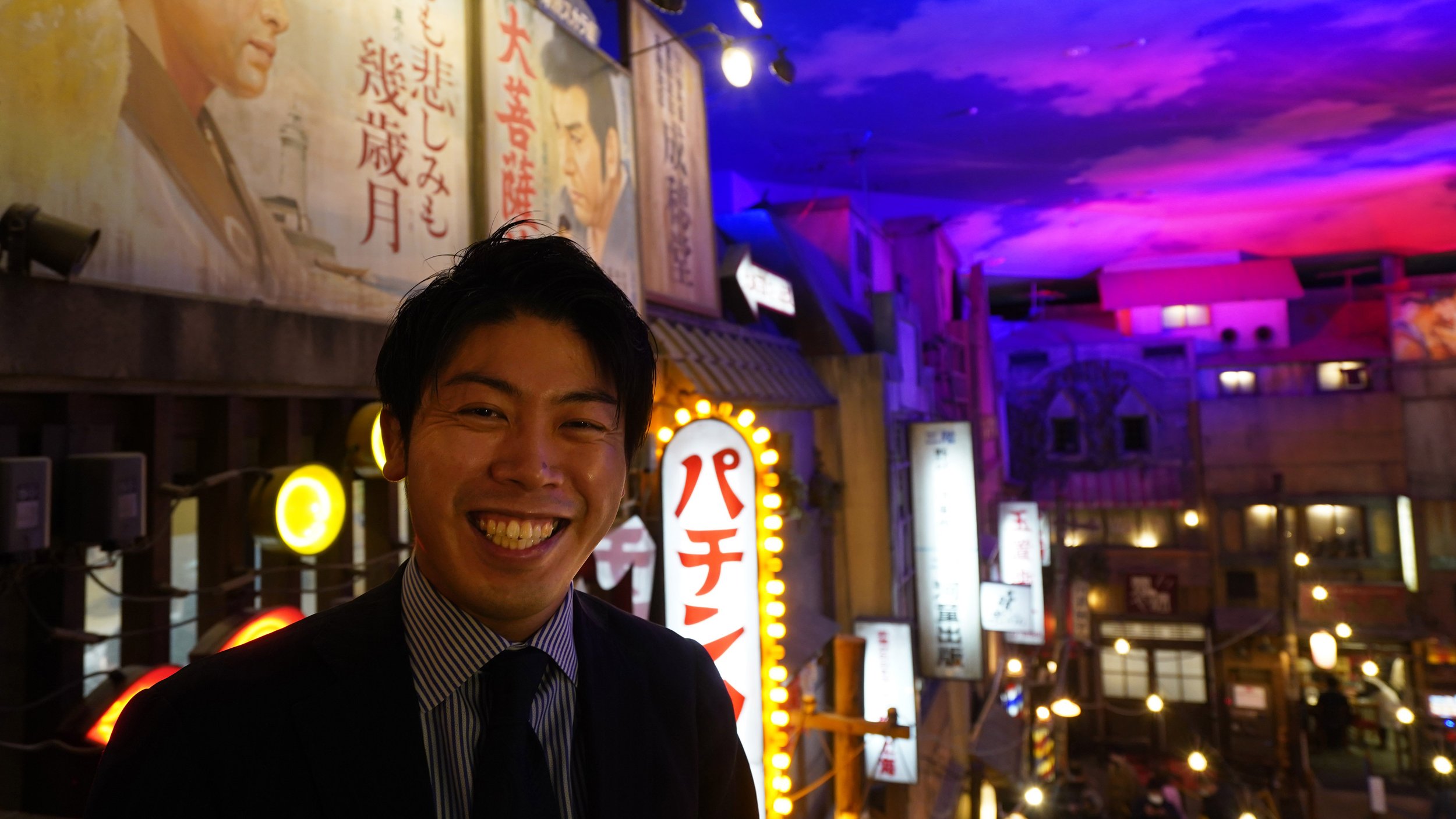



Museum founder Iwaoka’s son, Takuji explains that his father wanted to recreate a 1958 retro townscape, not just for nostalgia but also because that year marked the invention of instant noodles by Momofuku Ando, a true turning point for the internationalization of ramen.
Heading into the central square, snag tickets from a vending machine for the ramen of your choice. The shops and selections come from around Japan and change occasionally, but the important point is that you can choose regular or “mini portion” servings, which allow you to sample several of the shops’ offerings.
You might see homemade slabs of pork hanging here and there, but vegetarian ramen options are also always on offer (try Komurasaki, from Kumamoto). The variety of soups—usually in soy, miso, or salt seasonings and bases of pork bone, fish, chicken, or vegetable broth—make for infinite combinations. The museum is a great place to develop your vocabulary and taste for ramen, and the atmospheric setting might make you yearn for the good old days of Japan.
The Cup Noodles Museum Yokohama
The year immortalized by the Raumen Museum’s fantasy backstreets, 1958, is the same one in which Momofuku Ando realized his dream of making instant ramen noodles. The whole story behind Ando’s development of instant ramen is packaged beautifully at the Cup Noodles Museum, a 12-minute walk from Sakuragicho Station on the JR Yokohama Line.
The minimalistic red brick exterior of the facility, officially known as the Momofuku Ando Memorial Museum, was conceptualized by Creative Director Kashiwa Sato to express “simplicity devoid of the unnecessary” and to stimulate creative thinking. The vast clean entryway features a 24-meter-high back wall that extends up all five floors of the museum, and a white nebuta-style float made of washi paper in the shape of Nissin’s popular product.
Corporate Communications Division Manager Kazuki Tsurumaru notes that the facility “really looks like an art museum”—an impression borne out by displays on the second floor. One entire room, the Instant Noodles History Cube, has a floor-to-ceiling exhibit of every variety of fast-food noodles, from Ando’s very first pack of Chicken Ramen to the items currently on sale. There are also cup versions, some of which include flavor variations sold in other countries. Tsurumaru points out that the early packets of Chicken Ramen had little windows, “so people could see what was inside, because they didn’t know.” They sure know now.
The next exhibit, Momofuku’s Work Shed, is a faithful recreation of the place in which Ando struggled for a year to create his invention. Tsurumaru reveals that it was Ando’s wife who provided the catalyst for his breakthrough. “Ando watched her cooking tempura and realized that, when the noodles were fried in oil, the moisture was forced out, making it possible to preserve them for a long time. He also discovered that hot water poured over the noodles was absorbed through tiny cavities formed during dehydration. The water seeped into the noodles, restoring them to their original soft state.
The message here is that inspiration for inventions can come from literally anywhere and that, even in humble surroundings, it’s possible to create something extraordinary.





Each of the exhibits on the second floor underlines Ando’s thought process. An oversize cup with white noodles spilling out, for example, has words hidden in the noodles themselves, encouraging viewers to look at things carefully and from all angles. A nearby separate room helps children learn how great ideas can arise from simple tools, and that by using your noodle, so to speak, you can come up with unique inventions by understanding the needs of others.
The third floor offers two hands-on experiences. One (reservations required, tickets ¥800) involves making Chicken Ramen by hand, starting with kneading, spreading, and steaming the wheat flour and then drying it with a flash-frying method. The other (¥400 tickets sold at the entrance) is a fun experience in which you design your own Cup Noodles, from illustrating the exterior of the cup itself to choosing the soup flavors and toppings. Children will love adding the likeness of Chicken Ramen’s mascot Hiyoko-chan, made from dried fish cake, to their concoction. Staff then seal the lid, shrink-wrap your creation, and place it in an “air package” that you pump into a nifty pillow to safely tote home.
To round out the fun, the fourth floor has a fabulous playground (check for current Covid-19 restrictions) where kids “become” noodles in a factory. Nearby, the Noodles Bazaar serves up noodle dishes from eight countries, from Kazakhstan to Italy. The highlight here might be an outrageously confusing, but delicious, ramen ice cream!
Ramen Trick
After two excellent museums, you might want to sink your chopsticks into the ramen made at one of Yokohama’s independent ramen shops. If that’s the case, Yokohama Convention and Visitors Bureau Management Planning Department Manager Shisei Aoki has a recommendation: Ramen Trick, located a minute from the Blue Line’s Yoshinocho Station, Exit 3. Despite the unsettling name and the informal atmosphere of the joint, decorated with bombastic rooster illustrations, the place is the real deal. Ramen Trick was opened in 2012 by Noboru Nishigaki and his wife, Kazumi. “Before opening,” Noboru recalls, “we were working in Chinatown, above the Trick Art museum, and one day, we realized the word ‘trick’ sounded like ‘tori-ku’ (eat chicken), so we chose the name.”


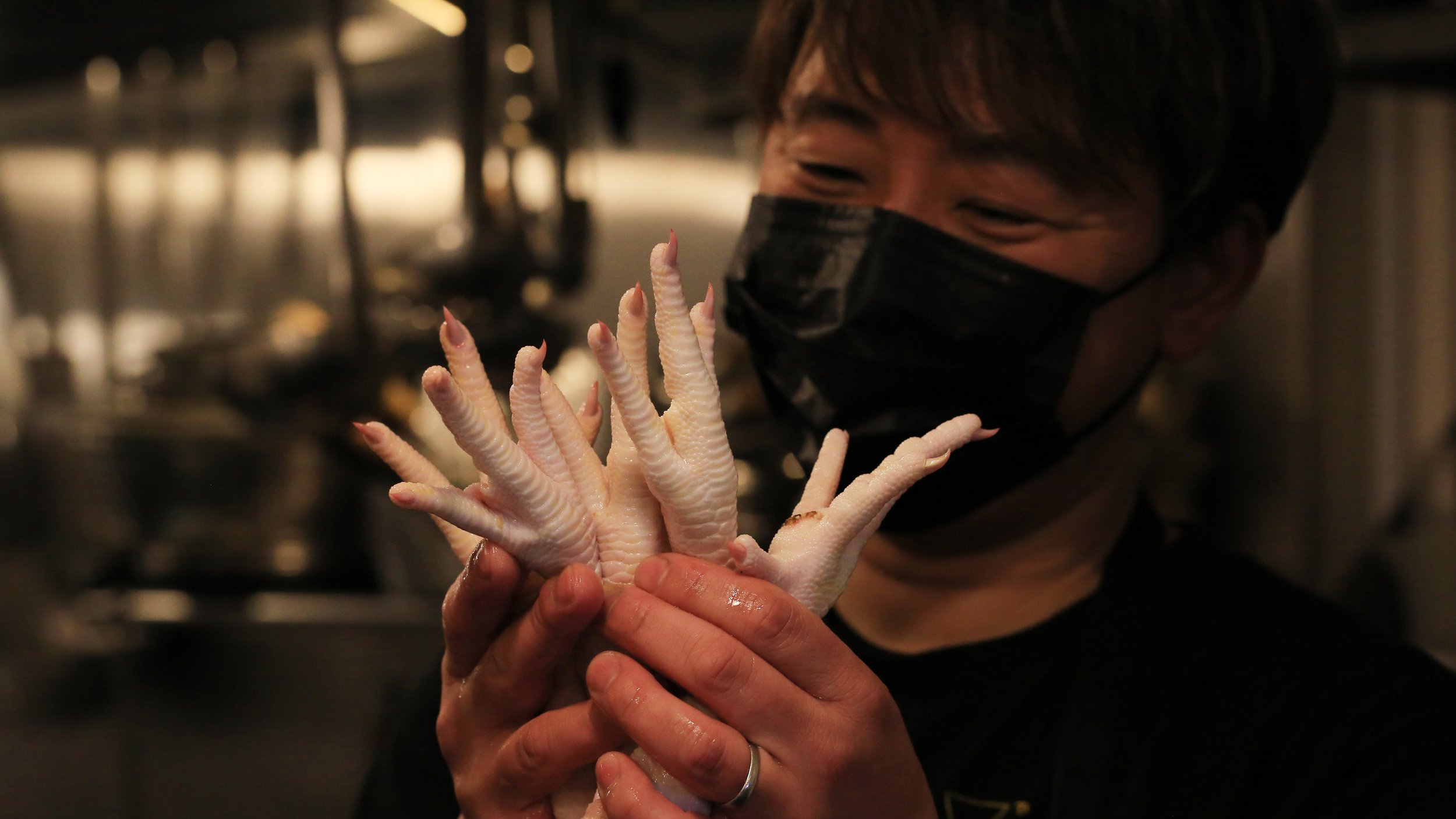


Puns aside, Ramen Trick is all about chicken—no other meat products are on offer—and if you visit between hours, be prepared to see big plastic pails of chicken parts being prepped for the stock pot bubbling away in the back of the kitchen. Three kinds of fowl, including Okayama’s Sansui, Nagoya’s Cochin, and Yamanashi’s Shingen simmer away with dried tomatoes and konbu (seaweed), bringing out unique umami notes. A quick glance at the walls reveals the restaurant has prizes—including a Bib Gourmand Award from Michelin—to back up Aoki’s recommendation.
By all means, try the tokusei (special) salt-broth ramen (¥1,200). In a light golden broth, the toppings include crisp fresh spring onions, chicken meatballs, chicken chashu, a sliver of red onion, both halves of a meltingly soft ajitsuke (marinated) egg. For the salt ramen dishes, the noodles, sourced from noodle-maker Mikawa Seimen, include a bit of bran to add to the flavor and texture. Guaranteed, after tasting this ramen, the main trick will be to resist ordering a second bowl on the spot.
Learn more …
The Raumen Museum: www.raumen.co.jp/english
The Cup Noodles Museum Yokohama: www.cupnoodles-museum.jp/en/yokohama/
Yokohama Convention & Visitors Bureau: www.yokohamajapan.com

Member Highlight: Kevin McAuliffe
Newport Ltd. President and 27-year ACCJ member Kevin McAuliffe shares his business experience in Japan.
The Newport Ltd. president and 27-year ACCJ member shares his business experience in Japan

Listen to this story:
What path led you to your current role in Japan?
I had worked for multinationals such as Time Inc. and Reuters in Asia from the mid 1970s to the early 1990s, but always wanted to start my own business. The opportunity finally came in late 1993, when I was asked by Reuters to transfer from Tokyo to the New York office. A former colleague from my Time Inc. days in Hong Kong was looking for an entrepreneur interested in importing and distributing a variety of consumer products in Japan that he sourced from China and other markets. This was prior to Don Quixote, Costco, and the ¥100 stores, so it seemed like a great opportunity. In January 1994, I left Reuters and established Newport Ltd.
What challenges is your company or industry facing?
Initially the issue was capital. I had to use a combination of my own savings and generous payment terms from my merchandise suppliers to get through the first few years. Next, it was competition as the above-named businesses and others entered the low-priced consumer product market. Newport then pivoted to branded goods and enjoyed solid growth for many years. However, during the past two years, we have seen major changes in consumer purchase patterns and are now testing strategies for the new normal.
What inspires you?
We strive for win–win outcomes in all our transactions. Providing opportunity to our customers, suppliers, and staff has been the driving force behind our growth and longevity.
“As a small to medium-sized enterprise, we succeed by innovating and executing well. In the constantly changing consumer products space, we have developed the capability to bring new products to market incredibly fast.”
What issues are important to you and how can you make a difference through your work?
Our company strives to be a sustainable corporation. We have been ISO 14001 certified since 2002. That’s the internationally agreed standard that sets the requirements for an environmental management system. From the beginning, all staff have been involved, and everyone is a member of a team working on a number of social, economic, and environmental goals. In addition, each of our brands is focused on several relevant Sustainable Development Goals set by the United Nations. Making positive impacts in these areas allows employees to find meaning beyond just their normal work responsibilities.
What is unique about your business?
As a small to medium-sized enterprise, we succeed by innovating and executing well. In the constantly changing consumer products space, we have developed the capability to bring new products to market incredibly fast. One example from some years ago is going from an initial supplier meeting to having a product in retail stores in less than five weeks. Though there are risks in being first to market, we use a kaizen cycle to constantly improve our ability to bring the right products to our customers.
How do you define success in Japan?
We can have profits while performing poorly and can lose money while doing a great job, so financial performance on its own is not enough. Success is a moving target, but I just ask, “Did we do our best?”
What advice do you have for someone new to the market?
Japan is a wonderful place to do business. There are plenty of challenges in finding capital, talent, and customers, but there are so many pluses. Years ago, I remember someone telling me that the opportunities in the Japanese market were in just avoiding the elephant’s feet. As long as you didn’t compete directly with the big players, there was lots of space to operate—especially if you were agile and creative. That was 30 years ago. Today, I would say that there are now more elephant feet, but there is still plenty of opportunity in between.

Welcome to a New Year
This is an important year ahead of us. Not only do we welcome a new ambassador but, as our new administrations on both sides of the Pacific get to work together, there are new, exciting, and dynamic opportunities for all of us engaged in commerce between this important alliance of the US and Japan.
ACCJ President Om Prakash looks forward to a productive 2022

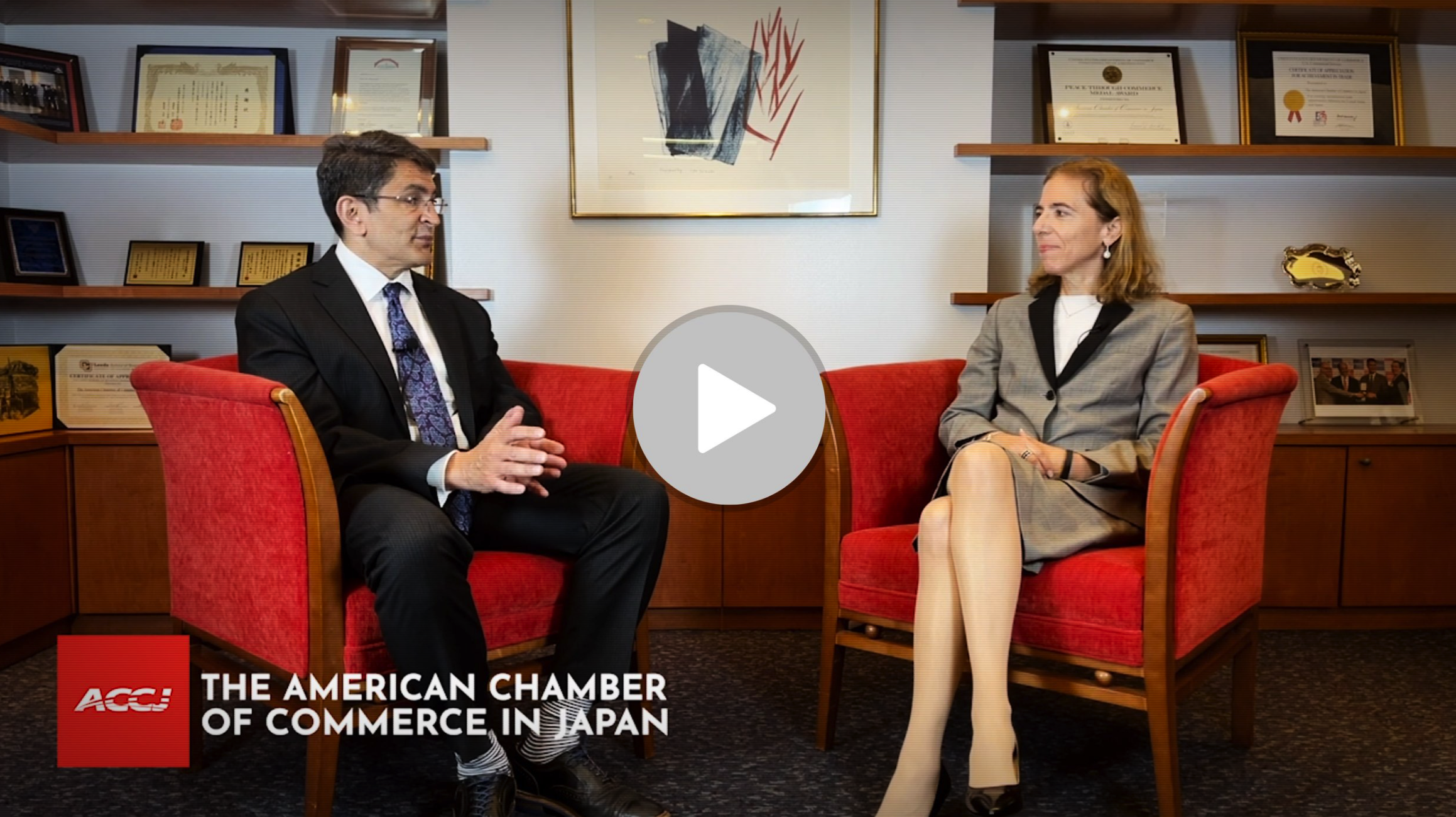
Click on image to watch the video
Hello, I'm Om Prakash, president of the American Chamber of Commerce in Japan. Happy New Year! You're in the most influential, largest international business community in Japan. You are adding your voice to over 600 companies, 3,000 members, and together we make a difference in possibilities for us in Japan.
This is an important year ahead of us. Not only do we welcome a new ambassador but, as our new administrations on both sides of the Pacific get to work together, there are new, exciting, and dynamic opportunities for all of us engaged in commerce between this important alliance of the US and Japan. We're here at the center of global tectonic changes in economies and security, and it's going to be an exciting year for us.
I'm also looking forward to getting out there and seeing you in person, and having in person events, as soon as it's safe to do so. I'm looking forward to the networking, the friendship, the opportunities that these events bring, and the strength that brings to our community.
I do have one ask of you. Get out there, get involved, join a committee, come out to networking events, get to know people. You're going to see you're going to get out of this as much as you put in—hopefully more. We are very active and have over 60 committees. I encourage you to take part in networking and contributing to our task force, to making friends, to making business connections, and making a difference for all of us.
I'm looking forward to working with you and figuring out how we can take these opportunities and maximize the advantage for all of us in business. I want to thank you for your continued support and commitment. See you soon!
President to President
Jenifer Rogers and Om Prakash share why ACCJ leadership matters
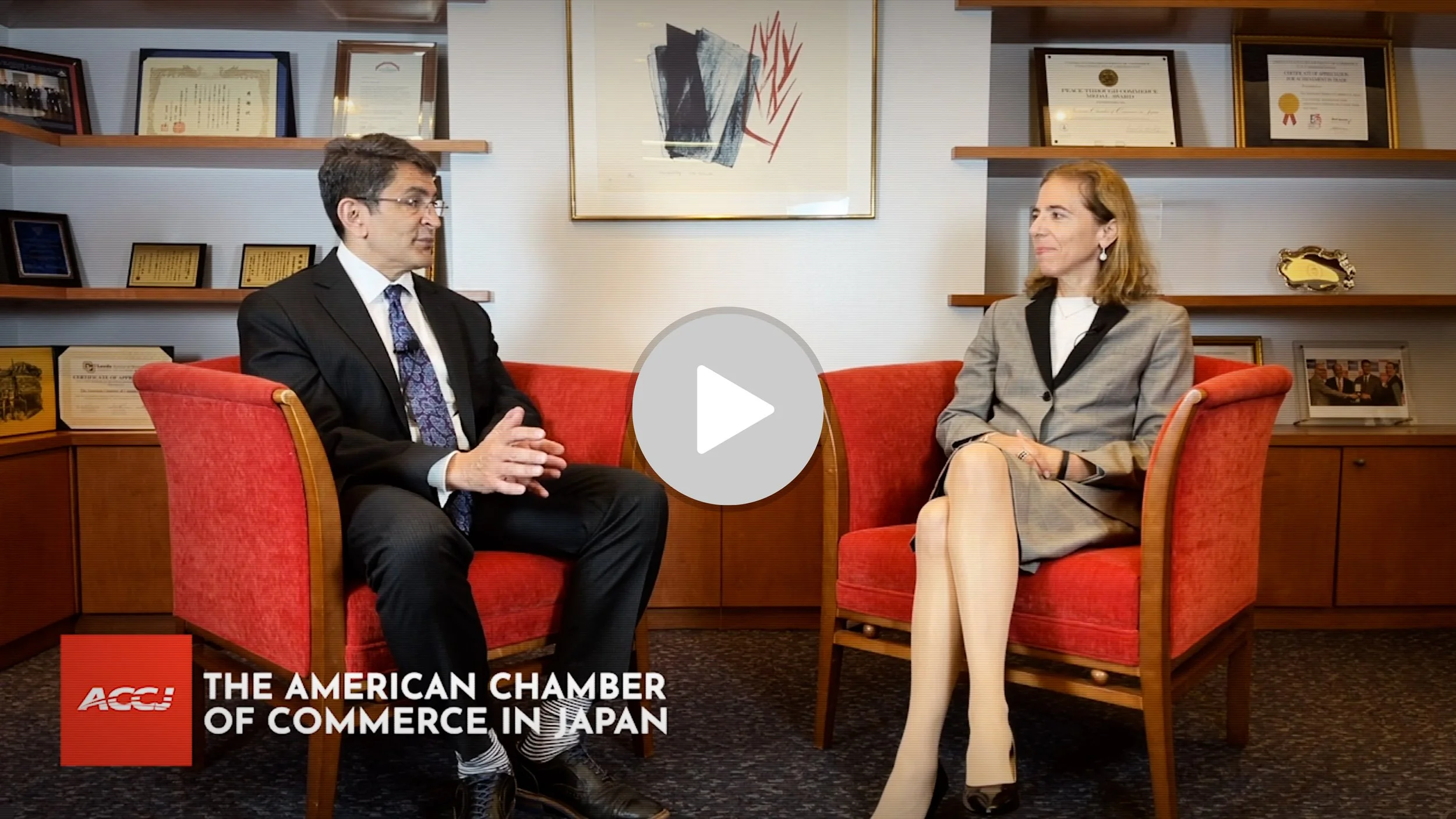
As the world transitions to a third year of the coronavirus pandemic, the American Chamber of Commerce in Japan (ACCJ) undergoes a transition of its own as outgoing President Jenifer Rogers passes the baton to incoming President Om Prakash. A newly elected Board of Governors also takes office for 2022, ready to lead the ACCJ through challenging, but exciting, times for global business in Japan.
Rogers, who is general counsel Asia for Asurion Japan Holdings G.K., and Prakash, chief executive of Northrop Grumman Japan, sat down on the day of the new board induction to talk to The ACCJ Journal about the progress the chamber made in 2021, the possibilities for 2022, and why they both are proud to volunteer their time and leadership.
Prakash: Serving has been my professional life almost in its entirety. I served in the Air Force for over 26 years. I started out mainly as a pilot and a test pilot, but [spent] a lot of time in the Pentagon working on issues for our nation, including industrial policy and working with Congress.
After that, I joined Northrop Grumman, and I’ve been with Northrop Grumman for seven years, three of them here in Japan. I’m super excited to put all that background together and work with all of you and the ACCJ to bring great things for US business, US commerce, and the US–Japan alliance.
Rogers: I’ve been very impressed since I met Om two years ago. I think he has an esprit de corps, and he is such a person with integrity. He reached out to me in the last election to meet up and we’ve had a dialogue over the last two years. I think he is straightforward, a team player, incredibly passionate about improving the US–Japan relationship, and doing the best he can for the chamber. I personally am very excited that he’s been elected to this position.
Prakash: I do absolutely enjoy working with people. I get a lot of energy from hearing other people’s ideas and thinking about it. I’m not afraid to change my mind—so I don’t know if that’ll be sometimes something difficult to work with—but, hopefully, as a group, we’ll all come to good decisions. I like being inclusive and absolutely picking up diverse opinions.
I’m anxious to also get things done. I like to get my hands dirty when necessary, and also see others succeed and be given opportunities. I think the chamber is going to be incredibly fun to work in because, after all, we’re all volunteering our time. We’re putting into it because we believe in something we’re doing. We have passion. Those are interesting things to work with, and around, because we’re not all going to always agree on things. But we’ll certainly be passionate about it, so it’ll be fun.
Rogers: I know from your speech that you have great things to offer. And as the outgoing president, I feel very excited to leave the chamber this year in your very capable hands.
Prakash: Well, thank you. And, also, I can’t thank you enough. I’ve known you for going on two years now, and I was actually really happy you’re the president that I’m coming up behind, because I know you’ve left the chamber in great shape and you’ve done great things with it. I’m truly impressed and thankful for what you’ve done, because you’re certainly going to make it easier for all of us on the next board.
Rogers: Thank you very much. That’s really nice to hear. I feel great that we’ve done a lot of what we set out to do, but I think what’s really nice is that there’s so much more to do. It’ll be exciting to see the chamber continue to succeed under your leadership.
Twenty twenty-one was such an unusual year with the pandemic. We went in thinking we were maybe seeing the end of it. So, we had to really pivot and focus a lot more on pandemic-related advocacy issues: reentry, entry restrictions, vaccines.
What was really nice to see is how our members really communicated their concerns. We rallied to provide vaccine support, get out there into the media, and push the Japanese government to really pursue a more open travel policy and science-based approach to vaccines so we could truly enhance our members’ experience. In a very unique environment—and even though we were virtual—that kind of pandemic situation brought us together.
Also, because of that, I really wanted to leave a legacy around great corporate governance. We established the governance task force, and, really, I wanted to make sure that the chamber was sustainable and a role model in the community. With the constitutional amendments, and a lot of the changes we made within the chamber—including some of the good practices around the induction ceremony today for the Board of Governors—I really feel very proud that we’ve made good strides in being the role model we should be as an organization representing our members in the business community here.
Prakash: I’m just so impressed with all the things that you were able to do in 2021, considering that a really key person—an ambassador, which is so critical for the ACCJ—was absent from the US government side. I’m looking forward to having that person on board quickly in 2022 to really bring new dimensions to what we can do for our members and the US–Japan relationship.
The points you brought up about how none of us expected the pandemic to last this long—how you embraced it and now have made for all our members something that we’re not expecting to ever to go back [from]—it’ll just be continuing evolution of an ongoing situation. I think that’s something that we need to take forward on the new board as One ACCJ, [looking at] all the points that we’ve learned and continuing to learn as the situation evolves.
Rogers: I think we did manage to do some great advocacy around digitalization, sustainability, and even the US–Japan economic partnership in certain ways. But absolutely, I think you’re well positioned with your background. And also, with the new US ambassador and the changes in the government that have taken place under Kishida-san this year as prime minister, I think the chamber is well positioned to make a huge difference. I will be happy to support, but also very excited to see what you’ll be doing in that space next year.
Prakash: Well, all of us will be doing.
Rogers: That’s right.

Resilience, Vision, and Opportunity
As I prepare to pass the baton to Om Prakash as the next president of the American Chamber of Commerce in Japan (ACCJ), I am grateful for what we have all accomplished together this year. He and a newly elected Board of Governors will lead the chamber into 2022 with exciting opportunities for further growth and change.
A challenging year has made the ACCJ stronger than ever
Listen to this story:
As I prepare to pass the baton to Om Prakash as the next president of the American Chamber of Commerce in Japan (ACCJ), I am grateful for what we have all accomplished together this year. He and a newly elected Board of Governors will lead the chamber into 2022 with exciting opportunities for further growth and change.
I am proud that the ACCJ has shown resilience and maintained its status as the preeminent business organization in Japan supporting the foreign business community. It has been an honor and privilege to serve as president, and I look forward to continuing to support the ACCJ in other ways.
Constant Change
The uncertainty that began in 2020 has continued in 2021, and as the pandemic has evolved in unpredictable ways, so has the way in which we work and interact. The political landscape has also shifted, with leadership transitions in the United States and Japan. Change in 2021 has been constant, and the ACCJ has adapted well by becoming a more agile and tech-savvy organization.
As virtual events have become the norm, the ACCJ has embraced this new reality and used it as an opportunity to provide greater accessibility for all members and to increase our digital presence in the broader community. By using social media and bringing The ACCJ Journal in house, we have been able to boost our advocacy efforts. And through our diverse programs, we have reached a broader audience and enhanced our position as the voice of international business in Japan.
This year, we also made changes to the ACCJ constitution that modernize our governance and demonstrate that we are a dynamic and adaptive organization which continues to be a leader in corporate governance best practices.
Transformations
Chamber advocacy on digital transformation could not have been timelier. Our Japan Digital Agenda 2030 report was released just as the importance of technological infrastructure, support, and know-how became central to surviving and thriving as Covid-19 put traditional practices to the test.
And as our members have adapted to the pandemic, we have seen Japan’s overall corporate environment shift as well. Working remotely has been normalized, providing greater workplace flexibility—something the ACCJ has long been advocating.
The ACCJ is providing flexibility in events as well. We have hosted a few hybrid events, which combine the benefits of online and offline gatherings, and are gearing up to offer these more frequently in 2022. Our commitment to providing virtual access to all in-person events remains key to giving members the opportunity to participate in the way that best suits their needs. It also allows members from all chapters and overseas equal access to our programs.

The annual “alphabet battle” featuring (from left) Jesper Koll, William Hall, and Dave McCaughan returned on December 6 as a hybrid event of the kind we plan to host more of in 2022. Also pictured are (from right) moderator Patrick Newell and Special Events Committee Vice-chair Paul Kraft.
Stronger Voice
On the advocacy front, we’ve never been more active nor influential in promoting a positive business environment in Japan. The ACCJ has been one of the most vocal groups regarding border-entry issues and a science-based approach to policy. Together with the European Business Council, we conducted a survey to quantify the impact of border restrictions on our members and businesses in Japan, and we have been a consistent voice in media, advocating for changes to these policies. We have also worked to make our advocacy initiatives more impactful, effective, and efficient by aligning our priorities with four coordination groups:
- US–Japan Partnership
- Health and Retirement
- Sustainable Society
- Digital Society
The latter two were new in 2021 and represent very active areas of focus. For the Digital Society Coordination Group, digital transformation is a highly dynamic topic, and we leveraged the work started last year on the Japan Digital Agenda 2030 report to set up another task force focused on collaborating with the Japanese government to implement the recommendations outlined in the paper.
The Sustainability Coordination Group was created and we realigned the leadership of our Sustainability Committee in response to the pandemic, which increased the urgency surrounding this topic and accelerated the need for the ACCJ to show its strong commitment to being at the forefront on all aspects of sustainability issues.
Advocacy and ACCJ events focused on energy-related aspects of sustainability, social issues, and corporate governance—as well as the importance of diversity and inclusion—brought wider awareness and understanding to these matters.
Looking Ahead
Throughout 2021, the chamber has proven itself to be a responsive and progressive organization, pursuing and prioritizing the key interests of our members in a rapidly changing environment. We met with key US and Japanese government officials in a successful, hybrid-style Diet Doorknock and select in-person meetings with officials such as United States Trade Representative Ambassador Katherine Tai and US Secretary of Commerce Gina Raimundo.
We look forward to the arrival of a new US Ambassador to Japan in 2022 and, hopefully, more opportunities for in-person interaction with the US and Japanese governments.
Whatever the future holds, we can be sure that the ACCJ will continue to be impactful in its advocacy activities.
I want to thank this year’s ACCJ Chair, Eriko Asai, Special Advisor Christopher LeFleur, the Board of Governors, Executive Director Laura Younger and staff, as well as ACCJ leaders and members for their support, assistance, and energy throughout a very unusual year. It’s been challenging but, in some ways, I feel the need for distance has brought us all closer. I look forward to seeing what the ACCJ is capable of under next year’s leadership and congratulate Om and all the new leaders.

A Transformation of Our Own
Transitions have been a way of life over the past two years. The coronavirus pandemic has forced companies to rethink how they operate, how they manage staff and workflows, and how they communicate. The winds of change have also rustled through the pages of The ACCJ Journal. Since bringing the magazine in house at the start of this year, we’ve made some adjustments and additions that have allowed us to better meet the needs of chamber members and communications. This has been a prelude to a bigger shift.
The ACCJ Journal expands from print to become a digital platform in 2022
Listen to this story:
Transitions have been a way of life over the past two years. The coronavirus pandemic has forced companies to rethink how they operate, how they manage staff and workflows, and how they communicate. The ways in which we share information have also been evolving thanks to the internet, social media, and shifting consumption preferences. This, of course, began before Covid-19 forced an acceleration in digital transformation, but the crisis has made things that had been optional a necessity.
From my perspective, this evolution in workstyle and communication has been most welcome. That’s because, for me, it is old hat. I spent 2006–15 working entirely remotely. I embraced cloud-based workflows and project management tools in 2006 as well. And I began podcasting in 2010, launching a podcast network that involved hosts and content production spread across many countries. I was ahead of the curve, and I’ve been waiting a long time for what I consider normal to become so for everyone.
Finally, though the catalyst is an unfortunate one, we are here.
Turn the Page
The winds of change have also rustled through the pages of The ACCJ Journal. Since bringing the magazine in house at the start of this year, we’ve made some adjustments and additions that have allowed us to better meet the needs of chamber members and communications. This has been a prelude to a bigger shift.
As we head into 2022, The ACCJ Journal will undergo a transformation of its own as it moves beyond being simply a print magazine to become a digital platform. While we will continue to produce periodic print editions with focused themes, our primary medium will be digital.
“Providing adequate and timely coverage can sometimes be difficult when tied to a cyclical print schedule. Through The ACCJ Journal digital platform, we’ll be able to react at the right time and share the messages and views of the chamber more effectively.”
This will benefit the ACCJ and members in many ways. Perhaps the biggest benefit is flexibility. The pace of activities, discussion, advocacy, and business quickens all the time. Providing adequate and timely coverage can sometimes be difficult when tied to a cyclical print schedule. Through The ACCJ Journal digital platform, we’ll be able to react at the right time and share the messages and views of the chamber more effectively.
We’ll also be bringing stories to life in ways not possible on the printed page. This year, we added audio to The ACCJ Journal with narrated versions of stories available for streaming on our website and as a podcast. In 2022, we’ll be expanding this with more audio-first content and video which supports ACCJ advocacy and global business in Japan. And where the written word is concerned, a wider range of options will help us provide leaders with the best tools for achieving their goals.
Next Chapter
It’s an exciting time to be a publisher, and I’m looking forward to bringing many approaches that I have long used for other publications to The ACCJ Journal. But make no mistake: as the magazine spreads its wings beyond print, it carries with it a 58-year history of supporting the chamber. And it’s that history on which we will build a publication that’s fully at home in this age of digital transformation.
I’d like to close out the year by thanking you for supporting The ACCJ Journal—especially those who so generously give their time to share expertise and insights with our writers and readers. Although there will be fewer print editions of The ACCJ Journal, I know that this latest evolution of the publication will bring even greater access to the incredible knowledge of our members and the broader business community.

Supplier D&I
While there is much talk in Japan about diversity and inclusion (D&I) in the workplace, another important, though less-discussed, aspect of D&I involves suppliers. Some major companies have long championed diversity in their supply chains, but the issue is now getting more attention—and progress is being made—thanks to the efforts of socially conscious leaders. This was the topic of a November 25 virtual event, hosted by the ACCJ-Chubu Programs Committee and entitled Supplier D&I: Three-Year Journey in the Japanese Market.
WEConnect International’s three-year journey in the Japanese market

Listen to this story:
While there is much talk in Japan about diversity and inclusion (D&I) in the workplace, another important, though less-discussed, aspect of D&I involves suppliers. Some major companies have long championed diversity in their supply chains, but the issue is now getting more attention—and progress is being made—thanks to the efforts of socially conscious leaders.
This was the topic of a November 25 virtual event, hosted by the ACCJ-Chubu Programs Committee and entitled Supplier D&I: Three-Year Journey in the Japanese Market. Speaker Setsu Suzuki, chief executive officer and founder of Hunext, Inc., shared how sourcing from women-owned startups is shaping the Japanese economy.
Connecting Women
Suzuki is the Japan project director for WEConnect International, the Washington, DC-based non-profit organization (NPO) that expanded its certification and market access activities to Japan in 2018. She recalled how, in 2017, she was invited by Gary Schaefer, principal officer at the US Consulate Nagoya, to attend the Global Entrepreneurship Summit in Hyderabad, India. Some 6,000 women business owners took part in the three-day event. There she had her first contact with WEConnect International, which helps drive money into the hands of women business owners by enabling them to compete in the global marketplace.
“That’s fantastic, right?” Suzuki exclaimed. “So, I immediately said that I want to be a member of this organization.” After getting to know leaders of the enterprise during the summit, she was asked to become the director of WEConnect in Japan. Three months later, she signed a contract with the international body and led its expansion into the market. Noting that WEConnect International is the only certifying body in the world that supports supplier diversity, Suzuki explained that there are five categories:
- Women
- Challenged
- LGBTQ
- Racial minority
- Veterans
“And women are really key,” she said. Globally, just one percent of procurement by governments and corporations goes to women-owned business.
“WEConnect International began studying this 12 years ago, but the number is still only one percent. We want to push it to two percent,” she explained.
“According to a World Bank report, 32–39 percent of companies around the world are owned by women. So, definitely, women are key to a diverse economy.”
Next, Suzuki introduced the companies among WEConnect International’s 143 member buyers that are most active in Japan:
- Accenture
- Johnson & Johnson
- Intel K.K.
- IBM Japan, Ltd.
- EY
- P&G Japan G.K.
- Microsoft Japan, Co., Ltd.
- Micron Memory Japan, G.K.
“More and more Japanese corporations are starting to pay attention to supplier diversity,” she said.
Where Are the Women?
There are 3.8 million small businesses in Japan, but only 500,000 are owned by women. What constitutes a woman-owned business (WOB)? It seems straightforward, and Suzuki noted that we use the term a lot in English.
But to make it clear what this means by definition, she explained that it should be “an incorporated company with at least 51 percent of the business owned and managed, or governed, by one woman—or more.” The WEConnect certification standards state that ownership “is determined based on title to, and beneficial ownership of, stock, membership interests, or other equity in the business.”
WEConnect allows self-declaration as a WOB. Such registration in their database is free and carries limited benefits.
“WEConnect International … helps drive money into the hands of women business owners by enabling them to compete in the global marketplace.”
There is also the Women Business Enterprise (WBE) designation (pronounced “weebee”). This certification opens the door to the procurement departments of 143 member companies and enables business owners to connect with 12,000 women entrepreneurs in more than 110 countries.
In this case, there is a fee, and membership includes unlimited access to WEConnect benefits. The money is used to fund the NPO’s operations, which are driven by three pillars: certification, connection, and education.
Three-Year Journey
WEConnect International’s launch in Japan took place three months after Suzuki took on her role as country director. The expansion into Japan was made possible through the Strengthening Market Access for Women Business Owners initiative, a consortium that includes Accenture, Intel, and Johnson & Johnson. The founding members are working closely with WEConnect to leverage its powerful global networks and experience working with women business owners, and there are now 28 certified WBEs in Japan.
The launch was marked by a hybrid event, making it possible to connect women business owners from Hokkaido to Okinawa. It was supported by the American Chamber of Commerce in Japan, and Women in Business Committee Vice-chair Makiko Tachimori (Fukui) helped facilitate.
A business-to-business matchmaking event was held on November 26, 2020, in which 10 member buyers, 14 tier-one corporations, and 51 WOBs and WBEs participated. Suzuki said that three women business owners got contracts following the event, showing how even online meetings can really make business happen.
The session will take place again in February—rebranded as the P&G Academy Women’s Entrepreneurs Business Development Program—as an eight-day intensive series.
With the support of Johnson & Johnson and Dell Technologies, WEConnect conducted a survey of 191 Japanese female entrepreneurs in Japan between August and September 2020. According to results, the top challenges faced by WOBs are:
- Balancing work and family (65 percent)
- Gender discrimination (30 percent)
- Market entry (11 percent)
She also noted that many women who responded to the survey cited the issue of surnames as an obstacle to their business lives. Because Japan continues to require that women take their husband’s surname, some women said that they must use a false name in work, so that their husband’s family will not discover that they are entrepreneurs—a role that goes against traditional views of a woman’s place in society.
On the brighter side, Suzuki said that WOBs in Japan are thriving across a wide range of industries. Many fall under the United Nations (UN) Sustainable Development Goals (SDGs), which are an important part of WEConnect International’s activities. The organization is working with governments, the UN, and others to help achieve SDG number five: gender equality in the economy.
Japan WBEs
There are only 28 certified WBEs in Japan, but Suzuki is dedicated to expanding that number. She introduced two success stories during the event, starting with Yuko Takahashi, president of Osaka-based Japan Engine Valve Mfg. Co., Ltd. Known by the brand name Dokuro, the company began producing engine valves in 1949.
Takahashi, who was unable to attend due to a business event, delivered a short, vibrant video in which she flew a drone around the Dokuro offices and production facilities to explain how her company makes after-market auto parts. The parts are shipped around the world to meet the needs of those who own Japanese cars.
Next, Ayako Mochizuki, a Japan native who moved to the United States at the age of 22, shared her experiences running a small and medium-sized enterprise in Japan, doing business with large companies on a global basis.
In 2014, she became president of IBS Japan Co., Ltd., the 35-year-old value-added reseller of data communication products, founded by her father. She runs the company from her home in Boulder, Colorado, while her father remains involved as an owner in Ebina, Kanagawa Prefecture, where the corporate headquarters is located.
IBS Japan’s mission is to make life easier through the application of technology, and the company was certified as a WBE by WEConnect International in 2019. “Since then, I have had many successes [as a result of] being a WBE,” she said. One such success, she noted, involved the sale of thermal camera technology to a major pharma company soon after the start of the coronavirus pandemic.
Despite these successes, challenges remain—particularly with traditional mindsets about gender roles in business. Mochizuki shared an interesting example from within her own company.
“When I got certified [as a WBE] in 2019, one of my employees—a key person for me—actually told me that I should not be certified,” she recounted. “He said that if we are certified, if they find out that I’m a feminist—that’s the word he used—we are not going to get business, because it’s a male-dominated industry that we serve. He was very concerned.”
She noted that this worry is real in Japan, because the country remains very much dominated by men, and many of the business leaders are aged 60 and over.
So, the shift in mindset takes time. But through the efforts of Suzuki, WEConnect, and women business owners such as Takahashi and Mochizuki, that change is taking place.

The Case of the Missing Startups
University and government venture funds play a much larger role in Japan than they do in Western countries. Yet we see fewer biotechnology startups here compared with, say, the United States, which is home to eight of the top 10 highest-funded ventures. Why?
Why biotechs find it hard to get going in Japan

Listen to this story:
University and government venture funds play a much larger role in Japan than they do in Western countries. Yet we see fewer biotechnology startups here compared with, say, the United States, which is home to eight of the top 10 highest-funded ventures. Why?
I explored this with Dr. Hiroaki Suga, co-founder of biotech company PeptiDream Inc., in a recent episode of my podcast Disrupting Japan. A professor at the University of Tokyo, Suga did his post-doctoral study under Nobel Prize-winning biologist Jack Szostak at Harvard Medical School. As an academic and a researcher, Suga knows well the dynamics at play in biotech development and application in Japan.
With PeptiDream, which has created a platform for the discovery of highly diverse, non-standard peptide libraries that can be developed into peptide-based therapeutics, Suga has taken a different approach to funding. And it has paid off.
Founded in 2006, PeptiDream is now worth more than $3 billion and collaborates with many of the world’s largest pharmaceutical companies, including American Chamber of Commerce in Japan (ACCJ) members Eli Lilly Japan K.K., Bayer Yakuhin, Ltd., AstraZeneca K.K., and Novartis.
Less is More
What I learned from our discussion is that, in this situation, smaller investments may lead to better results.
“If you have $10 million, you will just burn through it,” Suga said, adding that less capital will keep you focused and get results that can lead to bigger things.
In PeptiDream’s seed round, it received $1 million from The University of Tokyo Edge Capital Partners Co., Ltd., a Japan-based seed- and early-stage deep-tech venture capital firm.
With limited funds, “You need to really develop technology that will allow you to collaborate with big pharmaceutical companies,” Suga explained. These companies set criteria, and don’t give you money immediately. “Once you reach [one set of] criteria, you can get money. Then you get to another stage and you get more money,” he said.
This approach carries less risk for pharmaceutical companies, and Suga sees little risk for PeptiDream, because he is confident that they can meet the criteria.
Obstacles
This unusual approach has worked well for PeptiDream, so why don’t we see more biotech startups succeeding this way in Japan?
Suga said there are several reasons.
“Venture capitalists are not investing in risky companies, and biopharmaceutical companies are high risk,” he explained. “If you are developing business software, after six months, you know if it isn’t working. But drug development is a long-term commitment.”
“The first is that venture capitalists are not investing in risky companies, and biopharmaceutical companies are high risk,” he explained. “If you are developing business software, after six months, you know if it isn’t working. But drug development is a long-term commitment. Venture capitalists have to wait, and they may not be able to do so. They may need to wait 10 years to realize the potential, but they are looking for five.”
“The second reason is that Japanese society prefers to go with what’s known,” he continued. In this case, it means that talent heads for the largest pharmaceutical companies, which are seen as stronger and a safe harbor. “For example, all my students go to big pharma. They don’t go to PeptiDream.”
But this isn’t so much a case of risk aversion—often cited as an obstacle to success in Japan—as one of familiarity. Their parents know the names of the big players, but not of small ones such as PeptiDream.
Large Japanese companies tend to have little interest in helping smaller ones. This chasm is one that the ACCJ is attempting to bridge with its Healthcare x Digital initiative, which completed its second annual competition in November.
Spin-off vs. Startup
The third obstacle that Suga cited is the fact that many startups in Japan are research units that have been spun off from large companies that chose to leave Japan. “They had a very good team here, so they decided to spin off. They already have a background from big pharma and continue doing [what they were doing],” he explained. “That means that they aren’t hugely different from the big companies.”
In the end, Suga said that the biggest change that needs to take place for Japan to become more fertile ground for biotech startups must be made at the university level.
“Professors really need to work hard to get technology to be very practical, to be very robust. You really have to put forth effort to get to the end,” he said. “Then, the Japanese government needs to support this type of research. That’s very critical.”

D&I Hiring in Healthcare
It has been two decades since the Japanese government set its target of having women in 30 percent of management positions by 2020. The country has fallen far short of that goal, which the government has pushed off to 2030. Titan Consulting K.K. Business Development Manager Sophia Plessier certainly noticed the imbalance on her arrival in Japan. Coming from San Francisco, where discussion of diversity and inclusion (D&I) and support for women in business are a part of everyday life, she found it striking how few Japanese companies were promoting these important issues.
Titan Consulting helps companies put diversity policies into action
Listen to this story:
It has been two decades since the Japanese government set its target of having women in 30 percent of management positions by 2020. The country has fallen far short of that goal, which the government has pushed off to 2030.
Titan Consulting K.K. Business Development Manager Sophia Plessier certainly noticed the imbalance on her arrival in Japan. Coming from San Francisco, where discussion of diversity and inclusion (D&I) and support for women in business are a part of everyday life, she found it striking how few Japanese companies were promoting these important issues.
At Titan, she helps clients increase the diversity of their leadership. It’s a natural progression of her career in executive recruitment for the pharmaceutical, biotechnology, medical devices, and technology industries. She began that journey in 2015 in the United States, where she partnered with top healthcare companies to fill key spots in their management.
Focus on Diversity
Filling those positions is about more than just reaching a percentage. It’s about benefiting society through the innovation and solutions that emerge from teams built on diverse views, experiences, and backgrounds. And Titan’s area of focus—healthcare and life science—requires a little extra attention.
As Business Operations Manager Sean Lindley noted: “The benefits of having a more diverse leadership team are well established, but building that team can be more of a challenge in healthcare—especially in Japan—due to the somewhat conservative nature of the industry.” The way in which these companies approach screening adds an extra layer that must be overcome, he explained, “but with this challenge come opportunities, and if you’ve got something which can potentially remedy that, then the most conservative industry is probably where you want to try and apply the solution.”
The solution he speaks of is the D&I Spotlight Package, which Titan has created, inspired by another product they offer to clients which focuses on medical-doctor hiring. The package helps clients who wish to start putting their D&I policies into action through talent acquisition do so in the most effective way possible.
“Titan takes the time to understand the areas on which the client is aiming to focus their D&I hiring and the foreseeable challenges.”
The D&I Spotlight Package is a 12-month commitment from Titan Consulting which starts with an in-depth discussion to understand the client’s current situation and business needs. Titan takes the time to understand the areas on which the client is aiming to focus their D&I hiring and the foreseeable challenges. This offers a close partnership in which Titan provides detailed market analysis, access to an extensive network of professionals, a market map that identifies candidates, and ongoing, proactive support. Whether the client just wants a market map, needs to hire for key positions, or has extensive hiring needs, Titan is ready with a tailored service.
“We work with the client to pinpoint what type of professionals they want to engage with,” explained Partner Daniel McGrath. “Some clients have urgent and immediate needs while others are more focused on casual exploratory meetings for pipelining. Whatever their situation, Titan offers the opportunity to turn D&I hiring ambitions into reality for companies that are serious about evolving their business.”
Real World Results
Plessier shared an example of a successful placement. In another case, a medical device client, which was focused on Japan and had an entirely male executive team, was given a big incentive from the global executives to push for more diversity. They needed to replace their head of research and development, so decided to invest in diversity hiring and work with Titan. In just six weeks, the final candidate was selected from three finalists.
If you’re ready to strengthen your management team with more female leaders and greater diversity of voices and ideas, Titan Consulting is ready to help.

Learn more about the D&I Spotlight Package:
titanconsulting.jp/diversity

Explore Kumamoto
The southern island of Kyushu is famous for hot springs, active volcanoes, breathtaking nature filled with lush greenery, and a relaxing lifestyle that is a refreshing escape from the hustle and bustle of Tokyo. If you are looking for a domestic getaway that will delight the whole family, you can’t go wrong in Kumamoto, the island’s third largest city. Here are 12 must-visit locations in the city and around the prefecture.
Nature and culture await on the island of Kyushu
The southern island of Kyushu is famous for hot springs, active volcanoes, breathtaking nature filled with lush greenery, and a relaxing lifestyle that is a refreshing escape from the hustle and bustle of Tokyo. If you are looking for a domestic getaway that will delight the whole family, you can’t go wrong in Kumamoto, the island’s third largest city. Here are 12 must-visit locations in the city and around the prefecture.
Kumamoto Castle
One of the three most famous castles in Japan, Kumamoto Castle was built in 1607 by the daimyo Kato Kiyomasa (1562–1611). It was one of the main stages of the Satsuma Rebellion in 1877, during which it was partially burned. The castle was designated an Important Cultural Property in 1933 and the main keep, along with several walls and towers, was rebuilt in 1960. The grounds, which are home to the Kumamoto Museum and Kumamoto Prefectural Art Museum, are particularly beautiful during cherry blossom season (late March). The castle tower was damaged during the series of earthquakes that struck Kumamoto in 2016, but reconstruction has progressed and you can once again enter. https://castle.kumamoto-guide.jp/en/
Josaien
A small shopping center modeled after the alleys of an Edo-Period castle town, Josaien in located right next to Kumamoto Castle. It’s a great spot for exploring the culinary delights of the region and picking up souvenirs. It is also home to Yamami Chaya, a restaurant specializing in horse meat. https://josaien-shops.jp
Suizenji Jojuen Garden
A Momoyama-style tsukiyama (circular) garden, Suizenji Jojuen was built in its current form in 1671 by the feudal lord Tadatoshi Hosokawa (1586–1641). The main feature of the 640,000-square-meter grounds is the Izumi Shrine. The garden was officially designated a National Scenic Spot and a National Historic Site in 1929. www.suizenji.or.jp



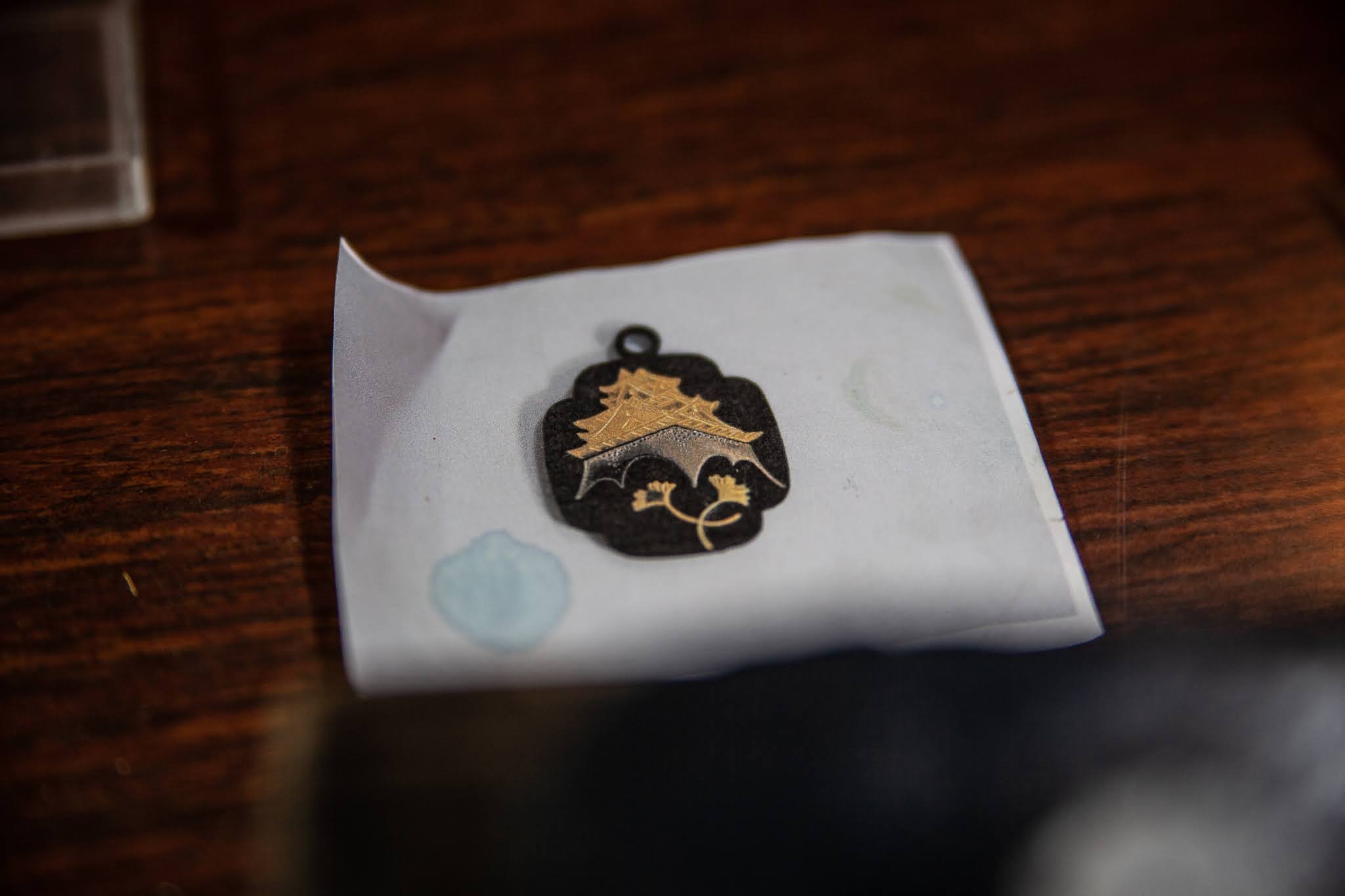
Higo Zogan
Specializing in Higo zogan, a traditional craft of the prefecture, Mitsusuke is a workshop established in 1874 that prides itself in continuing the 400-year-old art form and evolving it with the times. The workshop’s pieces have been commissioned by the Imperial Household as well as by the prefectural government. Here you can learn to craft a small piece with designs that include the famous Kumamoto Castle or the beloved local character Kumamon. https://mitsusuke.com
Meihodo
This 60,000-square-meter facility surrounded by nature was designed to resemble a traditional samurai villa. Built in 1997 as a private martial arts training facility, it gradually expanded its activities to a broad range of learning experiences focused on traditional Japanese arts and crafts. http://meihodojp.com
Fumoto Ryokan
Founded in 1955, Fumoto Ryokan is a gorgeous traditional Japanese inn located at the heart of Kurokawa Onsen. Open-air and guest-only hot springs, as well as traditional Japanese-style rooms with tatami and futon, provide a simple, cozy, and relaxing experience. www.fumotoryokan.com/en/index.html
Aso Volcano Museum
Established in 1982, Aso Volcano Museum helps visitors better understand Japan’s largest active volcano. The second and third floors feature an exhibition about volcanoes, local wildlife, and a 17-minute documentary on the history of Mount Aso. There’s also an observation deck. www.asomuse.jp/facility/
Kokindenju no Ma
A beautiful tea house inside Suizenji Jojuen Garden, Kokindenju no Ma was built inside the Kyoto Imperial Palace during the Edo Period and moved to its current location in 1912. Enjoy matcha with sweets while sitting on tatami and contemplating the tsukiyama landscape. www.kobai.jp/kokin/




Kurokawa Onsen
North of Mount Aso, this beautiful onsen village with a history spanning more than 300 years boasts some 30 outdoor onsen (hot spring) ryokan. Wooden architecture dominates the landscape in this small valley, transporting visitors to olden days surrounded by nature’s beauty. www.kurokawaonsen.or.jp/eng_new/
Kimono Experience
If you’d like to try a traditional Japanese kimono—or the more casual yukata, which is popular in summer—drop by Wa Collection Mito, a shop founded in 1967 and located next to Suizenji Jojuen Garden. With a selection numbering over 200, they have designs that appeal to everyone. https://wa-collection.jp
Mount Kishima Trekking
One of five peaks in the Mount Aso area, Mount Kishima offers trekking with an elevation difference of about 200 meters. It takes about two hours to traverse the trekking course, starting at the Aso Volcano Museum. From the top of the mountain, you can enjoy great views. www.aso-geopark.jp/kyoukai/event/events.shtml?no=9
Aso Kuju Cycle Tour
An excellent option for exploring the breathtaking landscapes and highlights of the countryside area surrounding Aso-Kuju National Park, Aso Kuju Cycle Tour offers many family-friendly options as well as those designed for different fitness levels. http://aso-cycletour.com
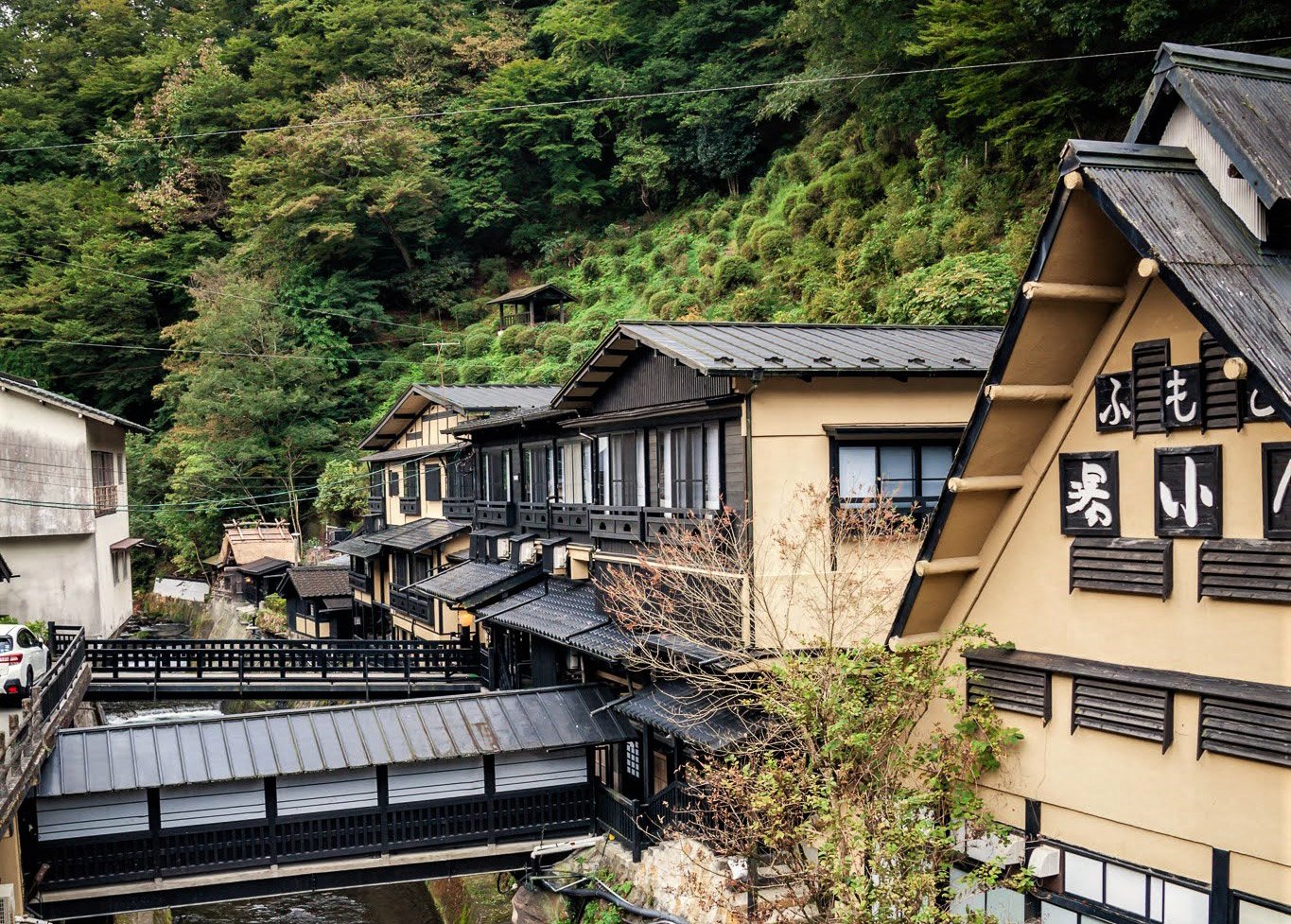




Iiyama Winter Wonderland
Nagano is well known as a destination for winter fun, thanks to its role as host of the 1998 Winter Olympics. As a result of that global prominence, a high number of visitors chart course for the beautiful, snowy landscape where those Winter Games were held. The area is home to many excellent ski resorts, such as Nozawa Onsen and Ikurao Kogen—conveniently located near Iiyama Station—where you can enjoy powder just two hours from Tokyo.
Enjoy a family vacation or workcation off the beaten path
Nagano is well known as a destination for winter fun, thanks to its role as host of the 1998 Winter Olympics. As a result of that global prominence, a high number of visitors chart course for the beautiful, snowy landscape where those Winter Games were held. The area is home to many excellent ski resorts, such as Nozawa Onsen and Ikurao Kogen—conveniently located near Iiyama Station—where you can enjoy powder just two hours from Tokyo.
Madarao Mountain Resort
Snowy fun for the whole family awaits at the largest of Iiyama’s resorts. At an altitude of 1,350 meters—just shy of the 1,382-meter peak of Mount Madarao—this resort boasts 29 courses accessible via 16 lifts. The Madarao Mountain Hotel, with its Japanese and Western-style accommodations, is a great base from which to venture into the snow. Ski lessons with English-speaking instructors, backcountry tours, and a play area with a wide sledding run where can frolic in the snow kids provide something for all skill levels. And for those looking to escape the city but still get remote work done in a relaxing and inspiring atmosphere, the Madarao Mountain Resort is a great choice for a workcation.
Togari Onsen Snow Resort
Nestled in the Sekita mountain range bordering Nagano and Niigata Prefectures, Togari Onsen Snow Resort is smaller and has fewer runs but offers something unique: Japan’s only snowbike park. If plunging down the slopes on a fat-tired mountain bike sounds like just the sort of exhilarating experience you need after so many months at home, this is the destination for you. Three distinct slopes, reserved exclusively for cyclists, offer options for riders of all abilities. There’s a simple slalom skills course with limited moguls, a technical course with narrow trails and groves, and an 800-meter downhill slope. For kids, there is also Snow Strider Park, where those not ready for a snowbike can ride a strider, a bicycle without pedals designed for children.






Nabekura Kogen Heights Mori-no-Ie
Away from the slopes you’ll find another enchanting experience on the Madarao Plateau, in Iiyama City. A collection of cottages nestled in the beautiful beech forest are available for rent and can accommodate groups of five to seven. With fully equipped kitchens, wood-burning stoves or space heaters, and Japanese and Western-style lodging, these cottages are ideal for a tranquil and safe getaway that puts you back in touch with nature. Snowshoe through the beautiful forest and along streams, or take a night hike in the snow and enjoy the moonlight and starry skies. Numerous pensions can also be found around Madarao. With private rooms and shared dining and bath facilities, most are family run and offer great hospitality and home-cooked meals.
Iiyama Kamakura Village
Another ethereal experience to be had is evening dining in a kamakura, a traditional domed hut made of snow. Each winter, from late January to late February, 20 of these huts are built to form the makeshift Iiyama Kamakura Village. Originally a place to worship the gods, the kamakura is today used as a place to savor nabe (hot pot), a Japanese dish of local vegetables, mushrooms, and pork that will warm you up as you relax in the snowy paradise.
During the day, you can enjoy activities such as sledding and riding a snowmobile.
Book Your Trip
Ready for a winter experience you won’t soon forget? Whether for a family vacation or a productive workcation, Iiyama Tabi-Tabi plans make arranging your trip simple. Several one- and two-night itineraries are available that include the activities described here. Just book your choice and let our friendly staff handle the rest. All you have to do is relax and enjoy a winter holiday.
Access
Take the Hakutaka on the Hokuriku Shinkansen from Tokyo Station to Iiyama Station. The journey takes about 110 minutes and costs about ¥8,250.


2021 Leaders and Volunteers of the Year
Each year, the American Chamber of Commerce in Japan (ACCJ) honors members who have shown extraordinary dedication. The ongoing coronavirus pandemic once again made the usual celebratory gathering at Tokyo American Club difficult, so ACCJ President Jenifer Rogers presented certificates as part of a virtual Leadership Forum on December 16, 2021.
The ACCJ recognizes exceptional contributions from across its three chapters
Listen to this story:
Each year, the American Chamber of Commerce in Japan (ACCJ) honors members who have shown extraordinary dedication. The ongoing coronavirus pandemic once again made the usual celebratory gathering at Tokyo American Club difficult, so ACCJ President Jenifer Rogers presented certificates as part of a virtual Leadership Forum on December 16.
Leaders of the Year

Royanne Doi
As chair of the Governance Task Force, Doi worked tirelessly throughout the year, leading numerous meetings and discussions related to enhancing the chamber’s governance practices. She ensured that the decision-making process was inclusive and transparent, giving multiple stakeholders opportunities to share input.

Eric Waters
As vice-chair of the Women in Business Committee, Waters played a key role in shaping the agenda and activities while providing the perspective of male leaders and allies—a critical factor in driving change. He inspired other men to step up as allies of women in business, and advance diverse leaders in the workplace.

Julian Bashore (Chubu)
Bashore revitalized the Aerospace and Manufacturing Committee as its chair by recognizing the need for continued aerospace representation while also incorporating the local manufacturing focus that is critical to the Chubu region. And as vice-chair of the Programs Committee, he led the Charity Golf Tournament, enabling the ACCJ to support local charities.

Rica Bradshaw (Kansai)
As chair of the Kansai Community Service Committee, Bradshaw helped restructure the committee’s focus, increase the number of active members, and establish close relationships with local groups to enhance education on environmental issues in schools. She also executed the fundraising alliance with the ACCJ No-Show Charity Ball to support the Kansai Food Bank.

Yuri Ichihashi (Kansai)
Ichihashi was a driving force behind the 10th annual Kansai Leadership Series. The first to be held virtually, this year’s series had a record number of registrants. And as co-chair of the Diversity and Inclusion Committee, her leadership in organizing the 7th annual Diversity and Inclusion Summit Series was indispensable.
Volunteers of the Year
Noriko Morikawa
A member of the Women in Business Committee, Morikawa’s valuable insights on the workplace challenges facing women in Japan led to better tailored events and an impressive network of speakers. She served as an inspiring speaker herself, as part of the Women in the Boardroom Series, and helped explore collaboration with groups such as the Keidanren (the Japanese Business Federation).
Daisuke Yasumizu
Yasumizu contributed endless energy and expertise to the Healthcare Committee, proactively proposing new speaker programs and advocacy initiatives. He has been a key catalyst in driving greater alignment between the committee and the Healthcare x Digital (HxD) initiative, and provided the ACCJ with crucial information regarding our Covid-19 vaccination rollout.

James Hedden (Chubu)
A supporter of the Chubu Children’s Fund and Chubu Walkathon, Hedden’s commitment to volunteerism and his community is unparalleled. For more than five years, he has devoted immense resources. Most recently he served as “Walk Tanto,” developing new ways to secure funds and creating tie-ins that benefited the charities, sponsors, and participants.

HxD Initiative Team (Kansai)
Torsten Kanisch, Francisco Proaño, Christian Boettcher, and Yasuhiko Iida successfully executed the first ACCJ HxD startup pitch event in 2020, and followed that up this year by increasing submissions by 30 percent. The HxD team embodies all four ACCJ core pillars, and their groundbreaking work is making a positive impact on the chamber’s healthcare and digital transformation goals.
Special Achievement Award

Robert Noddin
As founder and chair of the F500 CEO Advisory Council, Noddin enabled large-company CEOs to become more actively engaged with the ACCJ. He has also been a strong champion of advocacy with the US government, participating in DC Doorknock visits to Washington. And as a member of the ACCJ Election Governance Task Force in 2020 and the Governance Task Force this year, he has helped bring significant, positive changes to the chamber’s governance.

Innovation Destination
As a super-aging society with a population of more than 100 million, Japan has the potential to become a destination for healthcare innovation. Its citizens have easy and equal access to quality healthcare services, with pharmaceuticals and medical devices playing important roles in improving quality of life. But there are technological obstacles to overcome. The US medical device industry is leading the effort to develop a data platform in Japan which will enable traceability in healthcare.
US-led platform to provide healthcare traceability and stability in Japan
Listen to this story:
As a super-aging society with a population of more than 100 million, Japan has the potential to become a destination for healthcare innovation. Its citizens have easy and equal access to quality healthcare services, with pharmaceuticals and medical devices playing important roles in improving quality of life.
But there are technological obstacles to overcome. The US medical device industry is leading the effort to develop a data platform in Japan which will enable traceability in healthcare. The platform will allow the collection, storage, and sharing of information among stakeholders (e.g., manufactures, vendors, and hospitals). It will become a critical tool for improving the quality and efficiency of Japan’s healthcare system and will help ensure a stable supply of medical goods for healthcare providers.
Leveraging Tech
High-speed internet is nearly ubiquitous across Japan, but its benefit to healthcare is hampered by rules, systems, and business practices put in place before the internet era. Healthcare data is stored in a way that makes it difficult to share among stakeholders. This issue became obvious as the Covid-19 pandemic took hold and the country found it difficult to:
- Track medical supplies
- Monitor public health
- Analyze collected data
Medical devices in Japan now carry a unique device identifier and all products are labeled with a GS1-128 bar code that contains a Global Trade Item Number. Some products, such as those related to orthopedics, are even tagged with radio frequency identification (RFID) information so that every item can be tracked, traced, and reported on.
Currently, RFID is only used to improve productivity within an organization. But as more companies introduce RFID technologies, to minimize confusion and inconvenience, the industry has agreed to:
- Standardize the RFID format
- Develop a platform to store and share data
The platform will enable manufactures to offer products that allow stakeholders to use all associated information to improve the quality and productivity of the healthcare system and to stabilize the supply of medical products. Expected to be available in mid-2022, the platform is being developed under the Smart Logistics Service portion of the Japanese government’s Cross-ministerial Strategic Innovation Promotion Program.
Government Support
The US medical device industry is part of a study group supported by Japan’s Ministry of Health, Labour and Welfare (MHLW), which provides grants to help enable traceability of drugs and medical devices to improve safety and efficiency in hospitals. The goal of this study group is to set the basic feature requirements for electronic health-record systems used in hospitals. Guiding documents help hospitals and vendors introduce and use bar codes and RFID technology. With these two systems, traceability in the Japanese healthcare system can be dramatically improved.
Traceability in healthcare enables us to see the movement of prescription drugs and medical devices through the supply chain. We can trace the history of the transfers and locations of a product, starting from the point of manufacture. We can also look ahead to see the intended route of the product to the point of care. It also helps provide greater oversight of medical device performance for effective post-market surveillance in the event of adverse event reports or product recall alerts.
With increased traceability and productivity along the whole supply chain, the quality and efficiency of healthcare services provided in Japan will improve, and a stable supply of medical goods will be guaranteed. Data can also be collected automatically, and shared among stakeholders for analysis that will lead to improvements in care.

Added Disclosures
The journal entries used to record the transactions of a typical trading company seem basic and are usually taught in introductory accounting classes. But while simple, when coupled with financial management concepts such as reverse factoring, supply chain finance, or supplier finance arrangement, these entries may require additional disclosures for financial reporting purposes. In November, the International Accounting Standards Board (IASB) proposed additional disclosure requirements to enhance the transparency of supplier finance arrangements.
Proposed reporting rules eye supplier finance arrangements
The journal entries used to record the transactions of a typical trading company seem basic and are usually taught in introductory accounting classes. But while simple, when coupled with financial management concepts such as reverse factoring, supply chain finance, or supplier finance arrangement, these entries may require additional disclosures for financial reporting purposes. In November, the International Accounting Standards Board (IASB) proposed additional disclosure requirements to enhance the transparency of supplier finance arrangements.
The Transaction
A trading company generally purchases on account from its suppliers, and is invoiced after the receipt of goods. This poses no issues if the company is in good financial condition, but it can be a challenge if the company has liquidity concerns. When a company cannot pay the invoiced amount, as a rule the supplier will decline further transactions with the company or will impose stringent credit measures. This may disrupt the company’s supply chain. To avoid this and secure the supply chain, the company may enter into a supplier finance arrangement with a financial institution.
Under such an arrangement, the financial institution pays the supplier at a discounted rate and the company later reimburses the financial institution. This may sound like factoring, but it differs in that factoring is normally initiated by the supplier, who sells its accounts receivable. Here, reverse factoring is initiated by the buyer obtaining a loan to defray payables.
A supplier finance arrangement is beneficial for both supplier and buyer. The former is assured of payment and can collect the amount due earlier than the due date of the invoice, while the buyer benefits from an extended due date.
Accounting Concerns
But there are things to consider. On the supplier’s side, such an arrangement is like selling accounts receivable to a financial institution, only it is buyer initiated. In other words, like a factoring of receivables, this can be viewed as off-balance-sheet financing that allows a company to increase its cash without reporting a corresponding increase in liability or equity.
On the buyer’s side, a supplier finance arrangement adds another layer to the purchase-to-pay cycle. Instead of the usual buy and pay, it becomes buy, loan, and pay. The issue here is whether accounts payable must be converted into loans payable and disclosed in financial statements.
International Financial Reporting Standards 7 Financial Instruments: Disclosures (IFRS 7) requires an entity to disclose information that enables users of its financial statements to evaluate the nature and extent of risks arising from financial instruments to which the entity is exposed at the end of the reporting period.
International Accounting Standards 1 Presentation of Financial Statements (IAS 1) requires companies to distinguish financing from working capital purposes.
A company that is protecting its current ratio would like the payable, arising from the supplier finance arrangement, to be classified as loans payable instead of trades payable. This is because loans payable can be reported as non-current when they are to be settled more than 12 months after the reporting period. This cannot be done for trades payable, which are always reported as current liabilities even if they are due to be settled more than 12 months after the reporting period. Thus, a disclosure requirement for supplier finance arrangements is necessary to understand the transaction and standardize the financial reporting requirements.
As IASB Chair Andreas Barckow explained: “Investors require more detailed disclosures about companies’ supply chain finance arrangements, as these funding practices are becoming increasingly common. The proposed requirements are designed to give investors the information they need to assess the effects of such finance arrangements on a company’s liabilities and cash flows.”
Proposed Solution
The IASB plans to amend IFRS 7 and IAS 7 Statement of Cash Flows, to require buyer companies to disclose information that enables investors to assess the effects of a company’s supplier finance arrangements on its liabilities and cash flows.
The proposed rule requires an entity to disclose, at the beginning and end of the reporting period, the line items in the statement of financial position in which the entity presents financial liabilities that are part of a supplier finance arrangement.
The proposed financial reporting requirements for supplier finance arrangements are still on the IASB’s exposure draft and are open for comment until March 28, 2022.
For more information, please contact Grant Thornton Japan at info@jp.gt.com or visit www.grantthornton.jp/en

Hidden Treasure
The Japanese government calls it a “digital cliff”—a projected shortfall of 450,000 engineers, programmers, and other tech workers needed by 2030 to undertake the country’s digital transformation. Harnessing the largely untapped potential of Japanese women—who are drastically underrepresented in science, engineering, and computer programming jobs and college degrees—could help narrow that gap.
Can women overcome obstacles to fill Japan’s tech gap?
Listen to this story:
The Japanese government calls it a “digital cliff”—a projected shortfall of 450,000 engineers, programmers, and other tech workers needed by 2030 to undertake the country’s digital transformation.
Harnessing the largely untapped potential of Japanese women—who are drastically underrepresented in science, engineering, and computer programming jobs and college degrees—could help narrow that gap.
“Authorities realize they face a big labor shortage, and some people talk about opening up immigration. But, already, we have a huge resource: Japan’s hidden treasure is the power of women,” said Annie Chang, vice-chair of the ACCJ Independent Business Committee and head of IT recruiting company AC Global Solutions Ltd. In 2013, Chang co-founded Women in Technology Japan, a group dedicated to boosting female participation in the tech industry through workshops and mentorships.
And yet women face a host of obstacles—cultural, educational, corporate, and familial—that keep them from playing bigger roles in technology. As a result, Japan has a large digital gender gap, with some of the lowest shares globally of women in tech jobs and college programs, even compared with many developing Asian nations.
According to UNESCO data, just 14 percent of university graduates with engineering degrees in Japan are women. Compare this with 20.4 percent in the United States, 24.5 percent in the Philippines, and 30.8 percent in India. Among engineering researchers, Japanese women account for just 5.6 percent. That’s left a dearth of female role models to inspire girls about their futures.
“It’s embarrassing,” said Asumi Saito, 30, who co-founded Waffle, a non-profit in Japan that works to support teenage girls interested in science and technology at a critical juncture in their lives, when they must choose between pursuing science or humanities tracks in high school.
“I’m hopeful about the younger generation,” said Saito, who believes that bringing more women into technology will benefit the broader economy and society. “It will lead to greater diversity in innovations and, likely, more humane applications of technology in areas such as health and childcare.”
Allowing women to play a bigger role in the tech industry would “lead to so many more business opportunities,” said Yan Fan, a software programmer who previously worked in Silicon Valley and, in 2017, co-founded coding academy Code Chrysalis, which runs intensive 12-week programming boot camps in Japan. About a quarter of its students are women. Fan and her academy were featured in the April 2019 issue of The ACCJ Journal.
“The message I want Japanese women to have is: ‘You are 50 percent of one of the most powerful economies in the world. You are a significant part of the workplace,’” Fan explained.
And that could lift Japan on the IMD World Digital Competitiveness Ranking, where the country languishes at 28th globally and seventh in Asia, behind Hong Kong, Singapore, China, and South Korea.
Systemic Change
But Japan’s digital transformation could leave many of its women behind. Those at home with children, or who are middle-aged, have little chance to learn new in-demand skills, such as programming, machine learning engineering, and data science.
That’s a global concern: as automation takes over low-skilled jobs around the world, women stand to lose more than men, the 2021 UNESCO Science Report warns.
Fan isn’t confident that Japanese society can shed the constraints and cultural assumptions that impede women. She points to the oft-heard microaggression, “Even a housewife can do this,” as an example of the mindset that grips Japan. “When you hear those kinds of things day after day, it becomes ingrained in you.”
Systemic change is needed, Fan said. “The onus seems to fall mostly on women. There’s little talk about all the other changes that need to happen for women to actually make the space in their lives to learn new skills. So, I think women will fall further behind as the country digitizes.”
Still, Fan is optimistic about Japan’s potential—and the wider impact it can have. “If we can elevate women in this society, we can create reverberations throughout the world just due to the sheer size and power of Japan’s culture and its economy.”
Mindset Change
There are signs of modest progress. Compared with 20 years ago, there’s greater awareness of diversity, and companies are taking steps to hire and promote more women. That’s thanks partly to former Prime Minister Shinzo Abe’s promotion of Womenomics, a term he apparently borrowed from Kathy Matsui, the former Goldman Sachs Japan vice-chair who, earlier this year, co-founded MPower Partners, Japan’s first venture capital fund focused on environmental, social, and corporate governance (ESG). “Just the fact that diversity is part of the vernacular is a huge step forward,” Matsui said.
But, more importantly, there’s been a mindset change at some corporations. Leaders have realized that giving women bigger roles in projects and leadership isn’t just a human rights and equality issue, but a driver of economic growth, she added.
“If you don’t think diversity is a competitive and growth imperative, it really isn’t going to get any traction,” she said. “But if you think it is a weapon for growth and a competitive advantage, and you filter that down through your organization, you can get buy-in. Then you can start to change how you recruit, how you evaluate, how you promote. That’s the only way you’re going to get women into those leadership positions.”
One step in this direction is the appointment of Yoko Ishikura, professor emeritus of Hitotsubashi University, to be the No. 2 official in charge of Japan’s new Digital Agency.
The number of women seeking and finding jobs in the tech industry is slowly growing. Of the 27,300 candidates placed by tech recruiting company Wahl + Case since 2014, the portion who are women has risen from 27 percent to 38 percent, explained founder Casey Wahl. However, women make up 14 percent in highly technical positions such as software coding, he said; more go into marketing and product design.
Women who do land tech jobs find they pay better than work in many other industries. The average annual salary for candidates recently placed by Wahl + Case has been about ¥9 million ($80,000).
Compared with 20 years ago, Wahl said he sees major changes in the role of women in the workplace. “There’s a big trend going on, a generational time shift,” he noted. “The people in their thirties and forties—when they get into power, then things will change even more.”
The combination of soaring demand for tech jobs and greater commitment to diversity presents women with an opening—provided they have the right skills. “Women have a great opportunity now,” Chang said. “But the pipeline is so small. How do you increase this from the grassroots level?”
Home Front
Parents and teachers have the biggest responsibility in nurturing—or discouraging—girls’ interest in science, math, and computers, Chang, Matsui, and others said.
When Chang asks Japanese female engineers who had the biggest influence on their career choice, the frequent response is their fathers. Ironically, it is more often their mothers who tried to dissuade them, she explained. “The moms are generally stuck at home, so they don’t have much exposure to technology. They’re not very encouraging of daughters who are interested in science and don’t think the image is very good.” Some even worry about their daughter’s marriage prospects if they pursue an engineering career.
Even today, there is a persistent bias in Japan that girls aren’t particularly good at science and math. Parents and teachers may express such views, and girls pick up cues from anime and TV shows that tend to portray boys tinkering with robots or computers, but not usually girls.
Those images can influence girls’ self-image and confidence, said Miki Ito, 38, an aerospace engineer and general manager at Astroscale, which is engaged in removing space debris circling Earth. “There’s the idea that if you go study science at university, it’s full of men, or it’s really difficult,” she said.
Ito’s parents were surprised but supportive when, as a teen, she expressed a desire to study space. Her only model was Chiaki Mukai, Japan’s first female astronaut. In college and graduate school, most of her college classmates and all her teachers were men, but Ito said she didn’t encounter any discrimination.
“I actually think women are well-suited to programming. It involves setting up steps to carry out a plan, like going on a trip. Women are good at that kind of planning for their families,” Ito said. “As more women take these IT jobs, they will become role models for the younger girls, who will realize they can do those jobs.”
Digital Future
To prepare Japan’s youth for the digital future, the government now requires computer programming to be taught in elementary schools. At that age, boys and girls are equally enthused about technology, said Haruka Fujiwara, 34, who has been teaching and coordinating programming classes at her school in Tsukuba, located north of Tokyo in Ibaraki Prefecture.
“The kids love it. They naturally engage with each other and talk about projects together. Children who were kind of quiet or not very confident now brag about their projects,” Fujiwara said. “I haven’t seen any gender difference in enthusiasm or ability.”
To create projects, fifth and sixth graders use software and tools such as Microsoft Excel and Scratch, a coding language and community developed for children by the US-based non-profit Scratch Foundation. One of their projects measured the amount of carbon dioxide in the air, Fujiwara explained. Seventh graders at her school start learning the JavaScript programming language. “In the upcoming generation,” she said, “I think girls will be using computers just as confidently as boys.”
Until age 15, Japanese boys and girls perform equally well on international standardized math and science tests. But a gap develops once they enter high school and are required to choose between science and humanities tracks. More girls choose the latter, perhaps because science seems daunting or because they are encouraged to do so by their teachers or parents.
The gender gap widens further in college and graduate school, where engineering and tech programs are dominated by male students and teachers. In many countries, this leaky pipeline phenomenon is common: the higher the education level, the fewer the women. But in Japan’s case, the flow narrows to a trickle.
And working women are generally expected to quit once they bear children, removing their ideas and contributions from the marketplace. When women are at home, they have few opportunities to gain tech skills, and tend to settle for part-time, low-paying jobs such as supermarket cashiers—a position that is dwindling as checkout kiosks take over.
While more young mothers are returning to work after maternity leave, finding daycare can be difficult—especially if they have to work late. And working women are still generally expected to do most of the housework and child-rearing, as well as care for elderly parents or in-laws.
To flourish and advance in the workplace, women may need to think more about how to brand themselves—how they can use their unique gifts and strengths to be successful, said Nancy Ngou, an ACCJ governor and co-chair of the Human Resource Management Committee, who is also head of organizational change and diversity at accounting firm EY.
“They shouldn’t have to emulate the male personality,” Ngou said. “Maybe they’re better at networking or building trusting relationships with people. As a leader, those are very important qualities.”
Reframing the Narrative
At Waffle, Saito and her co-founder, Sayaka Tanaka, are trying to change the narrative about technology and gender.
They run one-day camps for girls in middle and high school that cover programming basics and offer career talks, as well as hands-on experiences that emphasize the problem-solving, community-building, and entrepreneurial aspects of technology. “We want to create a safe space where girls can talk about these things freely,” said Saito, 30, who holds a master’s degree in data analytics from the University of Arizona.
Earlier this year, Waffle supported 75 young women who participated in a Technovation Girls contest, in which teams developed and pitched apps to a panel of judges. Many of the apps were intensely practical. One provided advice on where to find vegan food, and another divvied up household chores among family members. Recently, they received a grant from Google to support their work.
Saito said she receives text messages from girls about the opposition they face at home. One said her father refused to pay for her university tuition if she was going to major in data science and told her instead to study medicine—considered a scientific field more suited to women. Another girl said her parents didn’t want her to study physics because they were afraid that she would never get married.
“A lot of these girls don’t have adults around them to listen to them seriously,” said Saito. “That’s a huge problem in Japan.”
Creative and Flexible
Coding academies have popped up across Japan, but enrollment is heavily weighted toward men. Most women simply don’t have the time, money, or inclination to attend.
Trying to make programming attractive to women, Hitomi Yamazaki in April co-founded Ms. Engineer, Japan’s first coding academy expressly for women. With female models and muted purple tones, the website emphasizes the flexibility that programming offers, including working from home. Even the startup’s name is meant to convey the idea that being a female engineer is cool.
“We wanted to avoid the geeky image and stress the creative monozukuri aspects of programming,” Yamazaki said, using a Japanese term meaning craftsmanship or making things. “We also emphasize that programming is well-suited to a woman’s work style—the freedom of working hours and location.”
Applicants to the first class want to change careers or achieve more in their jobs, Yamazaki said, and 70 percent of inquiries have come from women with children. The pandemic has helped both working women and stay-at-home moms realize that working from home is a realistic option, she said.
Ms. Engineer aims to produce graduates who can do full-stack programming, meaning they can design web applications as well as manage databases and servers. The course costs ¥1.42 million, or about $13,000.
Yamazaki has worked to promote her new business among social media influencers, including Yuri Sasagawa, a model, TV announcer, and new mother who recently attended Ms. Engineer’s kickoff event and tweeted enthusiastically about the future opportunities for female engineers.
Elevating Women
Companies embracing diversity have taken various approaches to narrow the digital gender gap. Some have set numerical targets and implemented steps to reach them, while others have focused on changing hiring and promotional practices.
ACCJ member company Hitachi Ltd. recognizes that the input of women is essential to address consumers’ needs, said Tomoko Soma, a manager at the company’s diversity and inclusion development center. “Our entire business is changing, and we are not trying to sell products as much as services that provide solutions to everyday problems,” she explained. “To do that, we need a variety of employees coming up with ideas.”
Hitachi, which has been implementing initiatives to support and elevate women for more than 20 years, recently reached two goals: the employment of 800 female managers, who account for 6.3 percent of all the company’s managers, and raising the portion of female senior executives to 10 percent.
By 2030, the company aims to raise the ratio of female senior executives to 30 percent through its long-term plans to identify and develop promising young employees and by absorbing talent through global acquisitions, Soma said.
In keeping with government guidelines, female Hitachi employees can take up to two years of maternity and childcare leave, then come back to the same job. If the women have a hard time finding daycare for their child, Hitachi will help them and can extend the leave for a third year. “In situations where there are no nursery vacancies, we don’t want women to quit their jobs just for that reason,” Soma said.
Changing Hiring Practices
Online marketplace Mercari, launched in 2013 and one of Japan’s most successful startups, decided not to set numerical targets for women because doing so might lead to mistaken notions that some women were hired just to meet a quota, said D&I Strategy Team Manager Hirona Hono. “People may feel that they have to reach the goal for the sake of reaching the goal, instead of addressing the fundamental problem behind why this is happening,” she said.
Instead, the company has changed its hiring practices by expanding the pool of candidates to include as many qualified women as possible through recruiting events, women’s coding groups, and other methods. It also has installed checks in the hiring process that might detect bias. Human resources staffers check the pass-through ratios of male and female candidates after each interview to see if there’s any significant disparity and discuss the results with division leaders, she said.
Hono also added a series of diversity questions to the company’s internal promotion recommendation forms, including asking the person filling it out if other candidates from different backgrounds had been considered. If they hadn’t been, she wants to know why. “These questions keep people accountable,” she said.
At EY, while female employees are out for maternity leave, the company offers them a tablet so that they can stay connected to their peers and do e-learning if they want to stay up to speed, Ngou said. The company also provides women returning after maternity leave with an independent coaching service to help them work out daycare, their schedule, and the career they want when they return.
For real change to occur, Ngou said, there must be genuine commitment by the top of the organization—usually a man—displayed in public and behind closed doors. “If the leader doesn’t take it seriously, isn’t active in it, and doesn’t hold his other male leaders accountable for advancing women, nothing’s going to happen.”
Once the top adopts a change, the middle managers can confidently carry out the policies throughout the company, Ngou explained. “The top is so important. Change happens middle-out in Japan. But without the top leader voicing it, nothing will happen.”
Not a Sense of Crisis
The Japanese government has come under fire for doing little to address the shortage of women studying and training for jobs in technology—especially since doing so would help the country meet its digital transformation goals. One suggestion mentioned by several people interviewed for this story was to offer scholarships for female students interested in studying engineering.
“There’s still not a sense of crisis,” said Dr. Jackie Steele, a Canadian political scientist who has lived in Japan for more than 20 years. “I think Japan is going to have to hit an even bigger wall economically before the political and economic elite will admit that there are systemic hierarchies rewarding masculinity, senior age, and ethnocultural purity. These biases must be consciously eliminated. This undermines Japan’s ability to attract diverse talent in a global market.”
To give middle and high school girls exposure to tech workplaces, the government’s Gender Equality Bureau Cabinet Office set up a program in 2015 that promotes events where students can interact with female engineers, including those at ACCJ member company Amazon Web Services Japan G.K., and visit computer labs or university campuses. In 2019, some 36,000 people participated.
To help boost the number of workers with digital skills, the Japanese government offers subsidies that cover 70 percent of the cost of pre-approved training courses in artificial intelligence, data science, and other topics that are offered by private cram schools, explained Takefumi Tanabe, a director at the Ministry of Economy, Trade and Industry. While these don’t target women in particular, Tanabe sees Japan’s digital transformation as an opportunity for women to join the IT workforce.
Husband of the Year
The growth of ESG investing, or funding companies that meet certain environmental, social, and governance standards, can bring investor or market pressure for change, said Matsui, whose MPower Partners runs such a fund. For example, these funds will focus on ESG considerations, such as board diversity, which remains a big challenge in Japan.
“Japan is one of the fastest-growing markets globally for ESG investing. Every asset owner is increasingly focused on how to ‘ESG-ify’ their assets,” Matsui said. So, in addition to examining company fundamentals, fund managers are asking questions about the company’s carbon footprint, as well as its supply chain resilience, child labor policies, employee well-being, and the diversity of the workforce. “To me, the ESG movement is going to be a huge force for change,” she added.
A critical, but almost entirely overlooked, step is to educate and support Japanese men about their changing roles in society—and to celebrate those who are supportive husbands, said Wahl. There are plenty of seminars on what it means to be a working mother, but virtually none on what it means to be a working father. Many men assume that their main role is to work hard and provide for their families financially, although that view is changing among younger men.
“There should be a Husband of the Year award,” said Wahl. “He should get a prize and all kinds of recognition as his wife gives the speech about how she is successful because of what he did. And this has to be seen as cool.”
And if the government is going to offer women scholarships in technology, then it should also offer scholarships for men in caregiving, said Steele. “We need to work on both sides of the equation,” she added. “Men also face gender-based harassment if they stray from the corporate-warrior masculinity model.”
Matsui is encouraged by the differences she sees among the young men with whom she interacts. “They don’t necessarily want to work like their fathers and grandfathers, they don’t want to be slaves to their employers. They want to spend more time with their families. So, their values are more aligned with what many women have been striving for.”
That bodes well for the future. “The younger generation wants a world that is more equal. They want their spouses or partners to maximize their own potential,” Matsui added. “They’re still young, so they’re not necessarily in decision-making roles. But it’s only a matter of time before we see this generation leading Japan, and that makes me optimistic.”