

Bridging Nations
The 75th anniversary of the ACCJ is an important time to reflect on all we’ve accomplished, how far we’ve come, and how much more there is to achieve. As we find ourselves in a much more complex world the ACCJ must be agile and adapt if we are to continue serving our purpose and our members.
On 75 years of shaping US–Japan business relations and our evolving role.
The 75th anniversary of the American Chamber of Commerce in Japan (ACCJ) is an important time to reflect on all we’ve accomplished, how far we’ve come, and how much more there is to achieve.
The ACCJ was founded in 1948 by 40 companies. Today, the chamber comprises nearly 600 companies and 3,100 members.
The mandate 75 years ago was clear: to further commerce between the United States and Japan, to support Japan’s economic recovery following World War II, and to improve the international business environment in Japan. Today, the two nations have one of the world’s most important alliances. Based on shared values, the bilateral relationship is the cornerstone of peace and stability in the Indo–Pacific region.
As we find ourselves in a much more complex world—one that is changing rapidly—the ACCJ must be agile and adapt if we are to continue serving our purpose and our members.
State of the Chamber
Over the past year, through strong advocacy and high-caliber speaker and networking events, the ACCJ has proven why it is known as the voice of global business in Japan. This is a tribute to all the contributions of our members, who are the lifeblood of the chamber and drive its activities.
We’ve made significant progress on the four priorities tied to the ACCJ core pillars that I outlined at the start of the year:
- Maximize advocacy impact
- Increase in-person networking
- Improve committee efficiency
- Deepen community service
We’ve seen great strides in key advocacy areas: strengthening the US–Japan security and economic partnership, digital transformation, and promoting diverse talent, including marriage equality in Japan.
Our many engagements with US and Japanese government officials—including during both the DC and Diet Doorknocks—highlighted how policymakers trust the ACCJ as a resource on US and international business issues in Japan. We’ve strengthened relations with stakeholders across both sides of the Pacific and continue to make our positions heard on key issues impacting US–Japan relations.
Act Fast and Be Decisive
As I mentioned, the world is changing and the ACCJ must continuously improve itself to remain effective. I started my career as a fighter pilot, and the key to winning in aerial combat is to make decisions in an ever-changing environment. We called it the OODA loop—observe, orient, decide, act. The pilot with the faster cycle was usually the winner. The same applies to business and the chamber.
The US–Japan relationship is at its highest point ever. Good times like this present the best opportunities to get the most done and have the difficult conversations, and the ACCJ and our members have a critical and relevant role to play.
This year also marks the end of my presidency. I thank all my fellow board members, committee leaders, and ACCJ members for their contributions and support. Personally, and professionally, it has been a privilege to work alongside you. I learned so much from our members and made many friends.
I’m honored to pass the reins to Victor Osumi. I know he will do an amazing job as your next ACCJ president.
I strongly encourage more members—especially our newest members—to participate and get involved. We need your passion, expertise, and voice to continue effecting much-needed change.
Seven-and-a-half decades after its founding, the chamber continues to thrive and grow, and I’m confident that, whatever challenges lie ahead, all of you will advance our strong 75-year legacy and further enhance the US–Japan business environment as well as our alliance and friendship.
I wish you all a safe, healthy, and prosperous New Year, and look forward to participating in the ACCJ’s success in the future!

Ancient Trails, Modern Tales
Many visitors to Japan are familiar with the Tokaido Shinkansen. What they may not know is that the tracks run alongside an ancient route built not for bullet-train carriages but rather palanquins. We take a tour through Kanagawa Prefecture to explore past and present.
Traversing Kanagawa reveals paths from long ago and comforts of today.
To keep feudal lords loyal during the Edo Period, the Tokugawa shoguns forced them to live in the new capital of Edo every other year. And when they returned to their home province, they had to leave their families behind in the capital as hostages.
The back-and-forth journey they had to make was long, something we discover firsthand on a hot and sunny autumn day under the guidance of local Shin Kaneko. As the nationally licensed tour guide leads us along a stone-paved road running through the beautiful forest—beams of sunlight piercing the leafy canopy of towering cedar trees—we find ourselves on a trek made by nobles and commoners alike for hundreds of years.
Many visitors to Japan are familiar with the Tokaido Shinkansen. What they may not know is that the tracks run alongside an ancient route built not for bullet-train carriages but rather palanquins. Thankfully, unlike passengers of old, today’s travelers need not bite on rope to protect their tongues from the rough ride.
Born and raised in Hakone, Kaneko also spent six years in France and five in the United States growing up. Later, he studied business at the University of Southern California and set off on a career as a strategist for Japanese retail giant Aeon Co., Ltd. But the call of home—and nature—grew louder and louder, and he left Tokyo life in 2015 to make his way back to the lakeside haunts of his childhood.
As Kaneko observed English-speaking visitors staring holes through maps as they tried to guide their own way, he decided to create Explore Hakone, a bespoke agency that provides tours limited to one group per day. And by group, I mean a family, a couple, or a solo adventurer. This personal treatment has made Kaneko’s adventures very popular among those seeking to experience authentic Japan. And today, we get to experience it for ourselves.
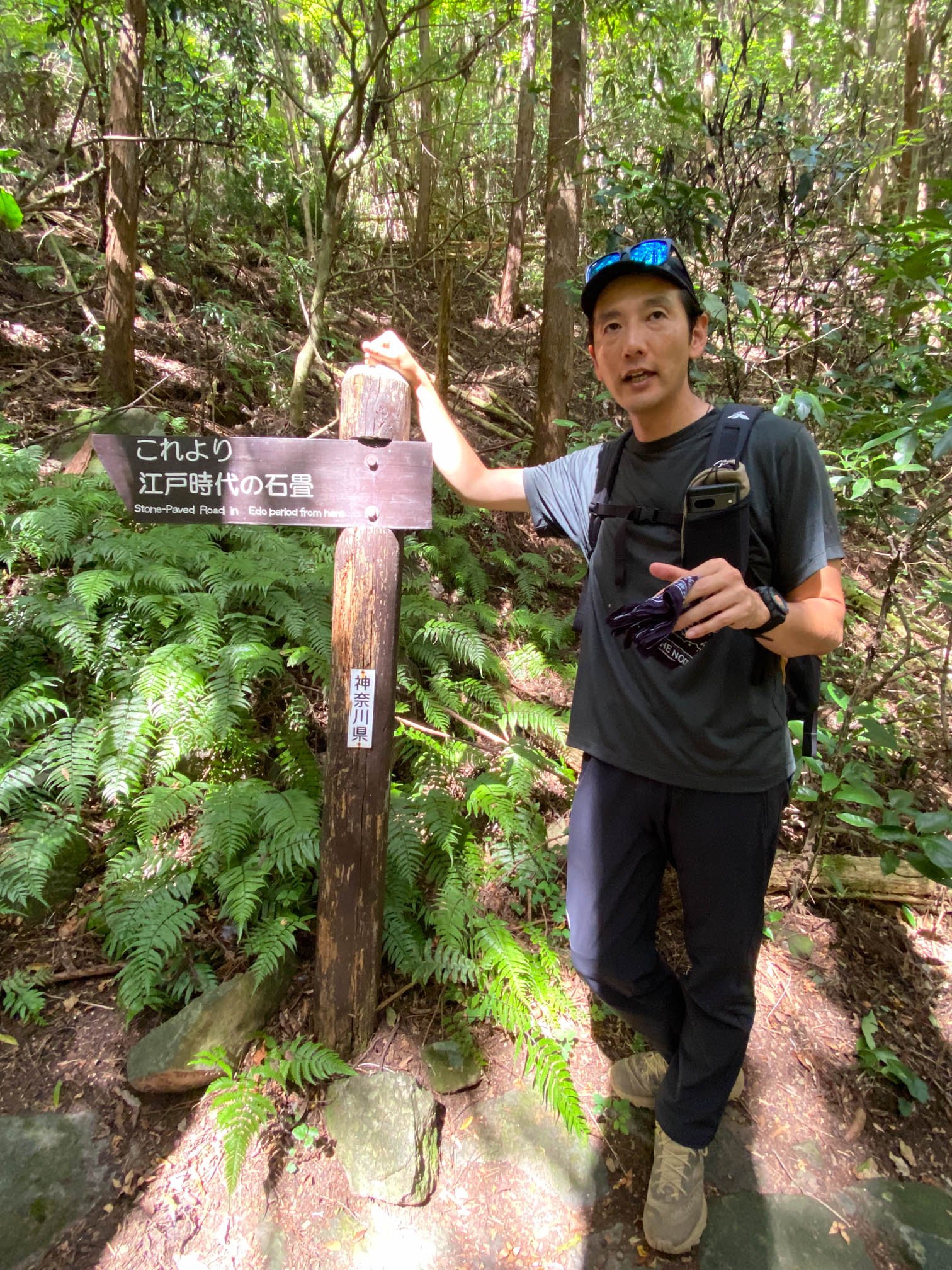


The development of the Old Tokaido Road, Kaneko explains, is tied to key events in Japanese history, and the preferred paths through the Hakone area have changed over the centuries. Some 1,300 years ago, during the Nara and Heian Periods, people used the longer, flatter Ashigara Mountain Pass to the north, which runs along the border of Kanagawa and Shizuoka Prefectures. But when Mount Fuji erupted in 802, the path was covered in ash and became difficult to traverse. Travelers began opting for the shorter but more mountainous route we are taking today.
I can only imagine how difficult the climb up and down these hills must have been in those days, when the path was paved with thinly cut and dried bamboo. It wasn’t until 1860 that the large stones which now mark the trail were put in place.
As we make our way through the tranquil woods on our seven-hour, 6.5-kilometer hike, Kaneko shares an enormous amount of the trail’s fascinating history.
The section of the 500-kilometer Old Tokaido Road that we’re traversing is known as the Hakone Hachiri, the 32-kilometer stretch between the Odawara and the Mishima post stations. Hakone Sekisho is located at Lake Ashi, one of 53 checkpoints erected by the Tokugawa Shogunate. Due to the very steep climbs—the total elevation change is about 900 meters—travelers during the Edo Period needed regular breaks. There were once nine teahouses on the route offering refreshment. Today, just one remains: Amazake Chaya.
We stop for an energizing cup of amazake, the warm non-alcoholic rice drink from which the rustic rest stop takes its name. Paired with two surprisingly filling pieces of mochi rice cake, the amazake was a welcome respite, as it must have been for those ancient sojourners.


While rejuvenating for the next leg of our journey under the thatched roof of history, we talk to Satoshi Yamamoto, the current owner of the business that has been passed through his family for 13 generations.
For more than 400 years, the doors of Amazake Chaya have been open, every single day. The only time they were closed was for a brief period during the coronavirus pandemic.
“I want to keep the teahouse as it has always been, serving people in a traditional way,” Yamamoto says. “Although we own the teahouse, the atmosphere is created by our customers. We only provide service. The culture and story behind [Amazake Chaya] have been made by travelers for centuries.”
He says he also enjoys meeting travelers from abroad and learning more about other cultures while sharing his own.
“While the world might change, communication between us and the travelers will never change,” Yamamoto adds. “They may have different outfits, they may speak different languages, but the concept of welcoming guests will always remain the same.”
Back on the road with renewed energy, we pass across one of the highest points between Tokyo and Kyoto and begin our descent to Lake Ashi, our final destination.
As we near the Hakone Sekisho checkpoint, we walk under the shade of 400-year-old cedar trees planted by the shogun to shelter travelers from the elements at this key point of their long journey. A nice gesture. But off in the distance is Otamaga Pond, named after a woman who was captured and beheaded for sneaking out of Edo. So, while the shogun could show kindness, he also showed no mercy. You played by his rules. But those rules also brought peace to Japan after nearly two centuries of civil war and upheaval, allowing art and culture to bloom and the society we know today to take shape.

Kijitei Hoeiso
After the long hike along the Old Tokaido Road, my legs are demanding a reprieve. Fortunately, Kijitei Hoeiso ryokan was happy to oblige.
Nestled in the verdant hills of Hakone, the traditional Japanese inn is a delightful escape from the stresses of modern life. Like Hakone Hachiri, Hoeiso transports you to a simpler time when nature was an integral part of life.
We are welcomed by the inn’s owner, Kenichiro Hara, who shares a bit of the property’s history as we gaze out windows that dissolve against the lush backdrop of the mountainside. In the distance, we see the open-air hot springs we’ll visit later tonight.
And as a tease of the delectable flavors to come, we are offered yumochi, a traditional Japanese sweet made of rice flour. During my 27 years in Japan, I’ve enjoyed many such sweets, but this is truly a standout. (I even went out of my way to visit the shop near Hakone Yumoto Station the next day and buy more as gifts.)
After the exertion of the day’s hike, I’m certainly feeling peckish, and a highlight of my stay is the cuisine. Hoeiso is renowned for its menu that features pheasant—a game bird often associated with the British countryside that is actually native to Asia—and the chef’s creativity does not disappoint.




Of particular note is how Hoeiso can accommodate various dietary needs and preferences. While the pheasant menu is very popular, vegetarian options are readily available—something not easy to find in Japan.
I opted mostly the standard course, but, because I do not eat most seafood, Hoeiso prepared a course that was perfect for my palette. This is often a sticking point for me in Japan, but is no problem here.
Steamed pheasant egg custard with ginger and tri-colored dango dumplings lead the way ahead of pheasant round with salt from Sado Island, sashimi of fresh pheasant breast with ponzu, and pheasant and shiso porridge. Just highlights of an overflowing kaiseki course dinner bursting with color and flavor.
As dusk gives way to the darkness of night, I grab my towel and make my way to the private outdoor onsen situated alongside a mountain stream. I cannot adequately express how rejuvenating it is to sit alone in the steaming water, the sound of the trickling stream dancing in the background as I look up at the twinkling stars in the pitch-black sky. I’ve rarely felt so connected to the universe as in this moment. It’s as if the energy of distant worlds is flowing around me.


Retiring to my spacious room, I gaze out the windows at the night sky that is normally obscured by city light and recall those childhood evenings of stargazing in my grandmother’s countryside front yard.
Carefully prepared amenities make for a restful night.
The next morning, Hara and several Hoeiso staff see me off as I board the bus to Hakone Yumoto Station. An impeccable ending to an absolutely relaxing stay.

Kamakura Gardens
From Hakone, we make our way around Sagami Bay to Kamakura, seat of the first Kamakura shogun, Minamoto Yoritomo, more than 400 years before the Tokugawa shogunate developed the Old Tokaido Road. But we’re not here to see the usual landmarks such as the Great Buddha. Instead, our journey today takes us around the historic city to explore its rich heritage through gardens.
We meet our guide, Saori Imoto, just outside Kita-Kamakura Station. Imoto is a garden designer who studied in Japan before moving to the United Kingdom. The Kamakura local joined her husband there when he was transferred for work and found the perfect opportunity to build on her love of horticulture. Studying in London, she became an expert in English garden design and has won multiple awards for her work. Since returning to Japan, in addition to crafting landscapes for clients, she has been sharing the beauty and history of Kamakura with visitors through private guided tours.
Central to our adventure are the area’s Zen temples, home to many of Kamakura’s most beautiful gardens. And our first stop is Engaku-ji. Founded in 1282, it is one of Japan’s most important temples and the second of what are known as Kamakura’s Five Mountains or Gozan.
“The reason I choose this temple,” she explains, “is that it has a beautiful Japanese garden and is surrounded by mountains, so we can see a lot of natural scenery as well.”
As we approach the Butsuden main hall, small children from the nearby kindergarten are practicing in the courtyard for their upcoming undokai, or sports day. Surrounded by a circle of seven juniper trees, they run, jump, and laugh as popular kids’ music plays on portable speakers. It’s a striking juxtaposition of ancient and modern culture and traditions.
The excitement of the children also contrasts with the reason we find evergreens here.
“Zen temples are very strict, and the monks need to concentrate on meditation and train very hard every day,” Imoto explains. “If there are a lot of deciduous trees, like cherry trees or Japanese maples, the monks can enjoy the seasonal transformation. They’re not allowed to do that, so Zen temples prefer planting evergreen trees, which create a calm and unchanging atmosphere, and show longevity.”
And the reason for seven? “Odd numbers are believed to bring good fortune,” Imoto says. “When we plant symbolic trees, we never use even numbers; we use odd numbers, because they cannot be divided.”


After touring the temple’s halls, we come upon a tranquil garden that reflects the landscape of Japan. A small pond at the center represents the sea, undulations conjure mountains, and gravel paints the coast.
To Western eyes, the lack of color may seem unusual. But, Imoto explains, there’s a reason for the absence of flowers. “In Japanese gardens, we try to replicate the natural scenery of Japan.” That means mountains, not fields—some 70 percent of Japan is mountainous. “Mountains are covered with trees, so we use a lot of trees instead of flowers,” she adds. “This creates a calm atmosphere, highlighting the simple beauty typical of Japanese gardens.”
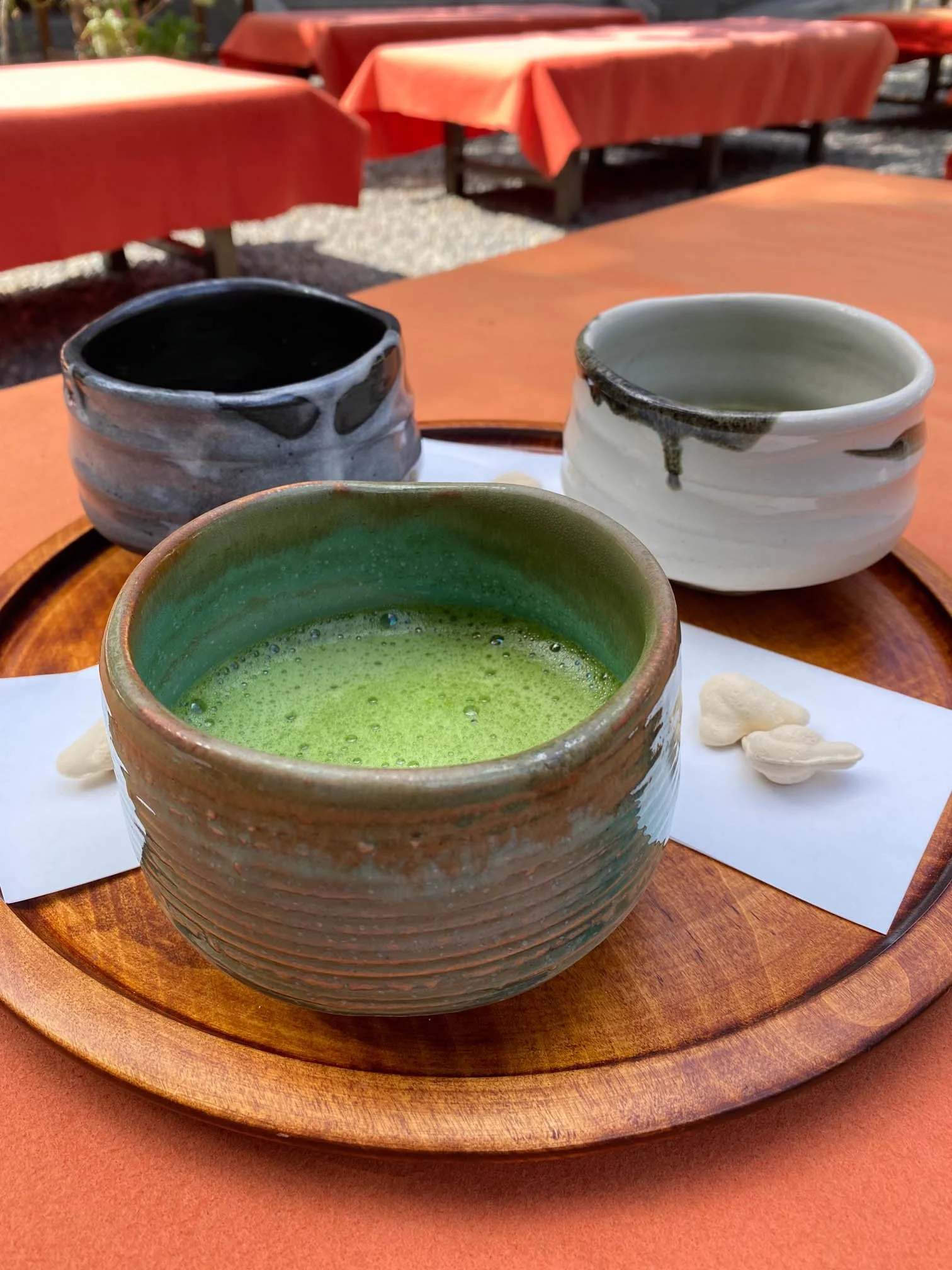
In need of a rest, we stop at Butsunichian, an open-air café on the temple grounds that serves green tea as well as other light drinks. The tea is refreshing—I opt for hot matcha despite the unseasonably warm day—and am soon ready for the hike to our next destination.
As we leave the temple grounds and walk along backstreets, the lack of tourists is noticeable. While Kamakura teems with visitors, we’re enjoying a quiet tour using routes only the locals know. And we’re learning a great deal about the area along the way as Imoto shares details about the hidden spots we pass.


After a long walk, we arrive at Eisho-ji, Kamakura’s only nunnery, founded by a wife of Tokugawa Ieyasu in 1636.
The grounds are covered by higanbana, or red spider lily. This striking flower, Imoto explains, is a symbol of Ohigan, a Buddhist period that falls around the spring and autumnal equinoxes. Higanbana mark the September observance. During this time, whose name means “other shore,” Higan, the world of enlightenment, and Shigan, our own world of greed and earthly desires, are believed to come closest to one another. This makes it the ideal time to remember those who have passed and to focus on spiritual awakening.
To end our exploration of Kamakura, we visit a cemetery at nearby Jufuku-ji Temple where Hojo Masako, the wife of the first Kamakura shogun Minamoto Yoritomo, is said to be buried. Masako was key to Yoritomo’s success and the power of the Kamakura Shogunate. Following his death in 1199, she became a nun but continued to yield great influence over the government until she passed away in 1225.
As we search for her final resting spot, we cross paths with a group of students who have dropped by the graveyard after school. Given Masako’s place in history, Imoto notes, they study about her in class and are curious to see the tomb firsthand. Like us, they use smartphones and GPS to locate the alcove tucked away in the back of the grounds.
As has happened many times during our two days in Kanagawa, past and present intersect in ways that highlight just how far back the history and culture of Japan stretch. There’s also something new to learn and explore.

Learn more and plan your visit …
Hakone Reset
✉️ info@explore-hakone.com
Kijitei Hoeiso
✉️ kiji@hoeiso.jp
Kamakura’s Gardens
✉️ info@mitate.kyoto

November 2023 Event Highlights
View a collection of photos from the ACCJ’s November 2023 events.

From left: ACCJ Governor John Carlson, Governor Mark Hosang, Governor Meghan Barstow, President Om Prakash, Special Advisor Jenifer Rogers, Vice President Robert Roche, and Treasurer Steve Briggs pose at the 16th Chubu Champagne Ball and Awards Evening, held on November 17 at the Hilton Nagoya.
The American Chamber of Commerce in Japan hosted 55 events in November 2023. Among these were:
- Conversation with Takami Former CEO Yuji Okamura
- G7 Competition Enforcers and Policymakers Summit Side Event
- Chubu Walkathon Charity Fund Presentation Ceremony
- AI in Marketing and PR: The Winning Formula
- 2022 ACCJ Person of the Year Award: Mr. Akio Mimura
- Nomu-nication: Celebrating the Reunion with America-Japan Society
- Celebrating Seisho Kondo: Community Champion
- Sales Support Alliance November Meeting
- ACCJ & JASO Thanksgiving Party
- Welcome to the Wild, Wild West! The 2023 ACCJ/TJCS Champagne Ball and Awards Evening
- Healthcare x Digital 2023: Generative AI: Boosting Healthcare
- Kansai Tech Series #11: Long-chain DNA Synthesis and the Potential of Biofoundry for Gene Therapy
- ACCJ-CSC: Urban Gardening 2023 (Part 2)
- Diversity & Inclusion Summit Series 2023: Unleashing the Power of Inclusion, Day 3
Here are some of our favorite highlights.





Cities on the Hills
While Tokyo has established itself as one of the world’s leading urban centers, it can still improve its cultural magnetism, livability, and attractiveness for overseas businesses. Helping the city rise in the world’s esteem by gradually transforming Tokyo is at the heart of Mori Building’s mission.
Mori Building’s signature complexes connect communities
Azabudai Hills
In our globalized society, it is only natural to compare cities to one another—assessing their relative strengths and weaknesses to help us determine exactly where they stand in the world.
And while Tokyo has established itself as one of the world’s leading urban centers, it can still improve its cultural magnetism, livability, and attractiveness for overseas businesses.
Helping the city rise in the world’s esteem by gradually transforming Tokyo is at the heart of Mori Building’s mission. And central to this goal is the development of its Hills projects, starting with ARK Hills in 1986. This was followed by Roppongi Hills in 2003; Toranomon Hills, with its four distinctive towers and new metro station that were in development from 2014 to 2023; and finally, Azabudai Hills, which just opened in November.
The Hills are the brainchild of late Chairperson Minoru Mori, who espoused the concept of “vertical garden cities,” which are based on the ideas of the famed architect Le Corbusier and infused with advanced technology and modern perspectives. The complexes are built tall, on single large floor plates that have been created out of small plots of land, which Mori aggregates by negotiating with individual landowners over decades.
As well as being architecturally impressive, these complexes are united by common themes. They are green, they are locations that improve the safety of their surrounding neighborhoods, and they offer a stimulating cultural atmosphere.

Azabudai Hills Food Hall
A Green Base
When visiting the Hills, you are not only struck by the towering skyscrapers that are the complexes’ hubs, but by the greenery that can be found at their ground levels.
As Mariko Murata from Mori Building’s Environmental Promotion Unit explains, nowhere is this more apparent than at Azabudai Hills. “Based on the design and concept by Heatherwick Studio, who designed the landscape of the low-rise area of Azabudai Hills, about 320 plant species have been selected that express each season. For example, the Central Square is planned around deciduous trees from the native vegetation of the area, so that visitors can feel the changes of the four seasons.”
She points out that by building high on a large scale, the Hills projects are not only able to support beautiful green spaces but also be more environmentally sound. “With this method, we can increase green coverage by up to 30 percent and energy efficiency by up to 40 percent. In addition, we can significantly improve environmental performance, as the buildings have a much longer life and the use of energy and resources is a great deal more efficient.”

Azabudai Hills orchard
Safe Havens
The Hills also stand out for their safety. As well as featuring structures that can easily withstand natural disasters such as earthquakes, they are central locations where residents can go in times of need. As Takashi Hosoda, senior manager at Mori Building’s Disaster Emergency Office points out, “Mori Building has been engaged in redevelopment projects in its hometown of Minato Ward under the slogan, ‘cities to escape to, rather than flee from.’” Roppongi Hills can accommodate 5,000 people, Toranomon Hills 5,200 people and Azabudai Hills 3,600 people who may be unable to return home in the case of an emergency.
The company has taken the lessons of the past—such as the Great Hanshin-Awaji Earthquake of 1995 and the Great East Japan Earthquake of 2011—to heart, recognizing the necessity for secure systems and infrastructures. Through cooperation between the public and private sectors, Mori Building has strengthened both the hardware and software systems of the complexes to ensure the safety of tenants, residents, visitors, neighbors, and the employees who use the buildings and facilities it manages and operates.
Hosoda adds that the complexes will allow the quantity and quality of disaster preparedness in Minato Ward to improve, helping “the urban structure to be transformed to one in which ‘homes, offices and the town [Hills] where you are now are the safest places to be.’”

Toranomon Hills dampers
Grand Designs
As well as creating areas around Minato Ward that are both green and secure, Mori Building aims to strengthen their cultural capital. Yoshinao Matsushima, the PR and Promotion Group senior manager in the Cultural Affairs Department, explains that with Roppongi Hills, which is home to the Mori Art Museum, the company was inspired to address the fact that Tokyo needed a cultural center to rival locations such as New York’s Lincoln Center, London’s Covent Garden, and Paris’ Centre Georges Pompidou.
To establish locations that are culturally rich, the Hills complexes not only house galleries with exhibits by the world’s leading artists, but pieces of public art that are meant to create spaces that enrich people’s everyday aesthetic lives, Matsushima points out. “The Hills feature artworks that visitors to the city can touch and enjoy. There are many works by internationally acclaimed artists, so visitors can enjoy high-quality, genuine art experiences at any time.”
United by the aim of drawing people in with green oases and stunning art, while also creating safe refuges, Mori Building has its eyes not just on the immediate future, but generations ahead. As Murata reveals: “In this era of fierce intercity competition, where people, goods, capital, and knowledge gather in attractive cities across borders, a city’s potential and possibilities have a great impact on the economy as well as the future of urban living. In this context, Mori Building has created the grand design for Tokyo with a long-term perspective of 50 to 100 years and is striving to achieve it.”

Azabudai Arena at dusk


Diversity & Inclusion Summit Series Day 3
The ACCJ hosted its first in-person Diversity & Inclusion Summit since the pandemic on Day 3 of the "Unleashing the Power of Inclusion" series.

Participants in the first in-person Diversity & Inclusion Summit since the pandemic gathered on Day 3 of the Unleashing the Power of Inclusion series.
The ACCJ hosted its first in-person Diversity & Inclusion Summit since the pandemic on November 28. Day 3 of the series was entitled Unleashing the Power of Inclusion.
The event, held at the Intercontinental Hotel Osaka, featured a panel discussion with:
- Simone Thomsen, president and representative director, Eli Lilly Japan K.K.
- Steve Briggs, president, Northeast Asia, Kraft Heinz
- Haruko Watanabe, representative director, president, and chief executive officer, American Home Assurance Company, Ltd.; director and vice chairman, AIG Japan Holdings KK
- Lavanya Wadgaonkar, global vice president, communications and global DEI champion, Nissan Motor Co. Ltd.
- Nuala Connolly, head of talent, DEI country lead, and deputy head of HR, AIG Japan
Hosted by the Kansai Diversity & Inclusion, Women in Business, and Kansai Business Programs Committees, the three days of training sessions, workshops, and discussions aimed to create safe and inclusive environments in the workplace.





October 2023 Event Highlights
View a collection of photos from the ACCJ’s Ocotober 2023 events.

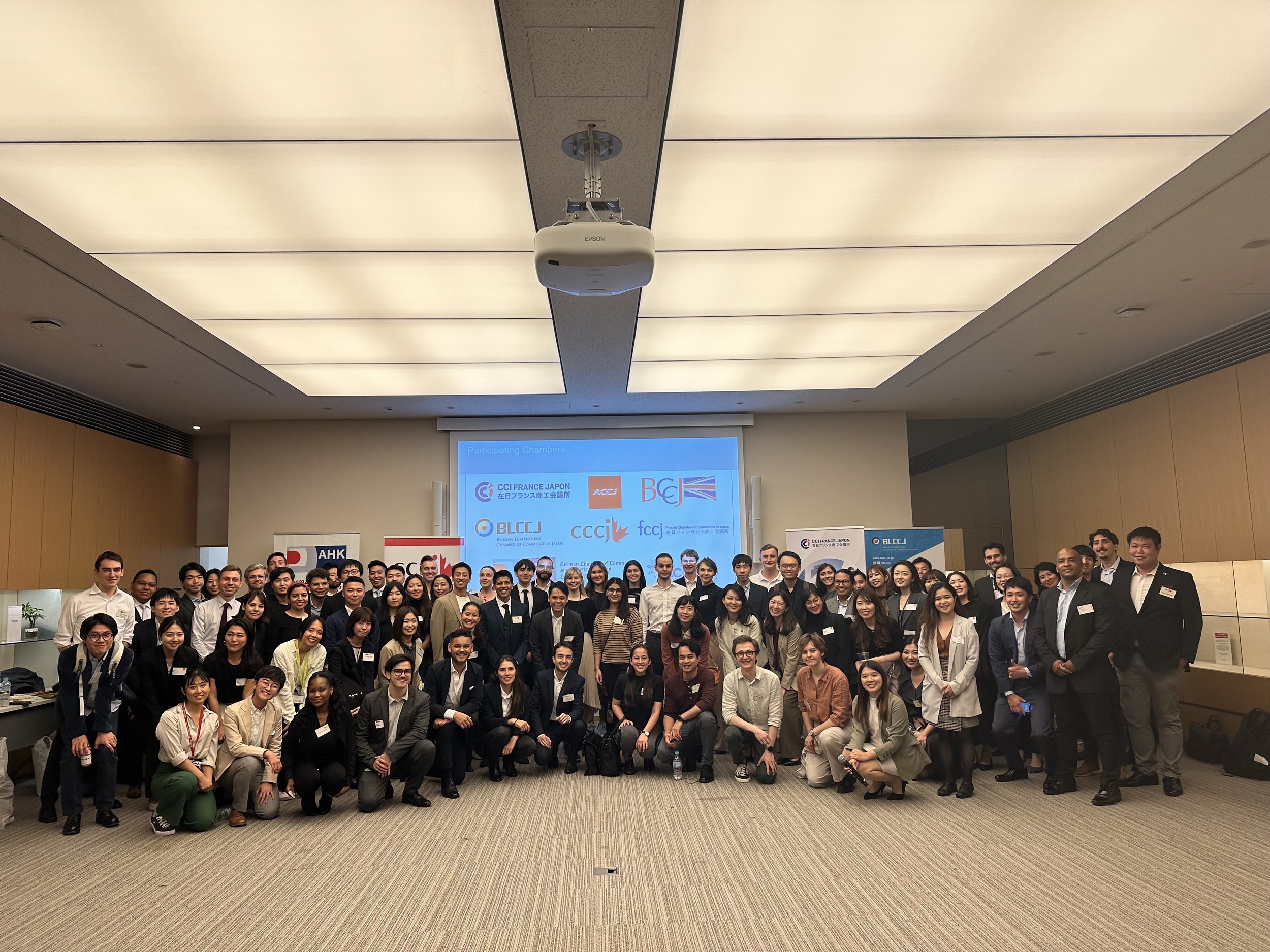
The Cross-Chamber Young Professionals Speed Networking event held on October 25 featured support from eight chambers of commerce in Japan.
The American Chamber of Commerce in Japan hosted 57 events in October 2023. Among these were:
- The North America–Europe Golf Challenge in Japan 2023 (October 6)
- Innovation in Residential Energy Business Models (October 10)
- Villanova University MBA Delegation Meeting (October 10)
- Diversity & Inclusion Summit Series 2023 "Unleashing the Power of Inclusion" Days 1 and 2 (October 5 and 13)
- Chubu Children's Fund Golf Tournament (October 13)
- Policy Briefing with Eric Pan of Investment Company Institute (October 16)
- New Jersey First Lady Tammy Murphy (October 17)
- Sales Support Alliance October Meeting (October 18)
- The New Social Customer and How to Access Your Audience (October 19)
- Ordinary General Meeting (October 24)
- Cross-Chamber Young Professionals Speed Networking (October 25)
- Generative AI: How It Will Shape Businesses Tomorrow and Is Transforming Legal Work (October 25)
- Unveiling the Power of DEI in Corporate Success (October 26)
Here are some of our favorite highlights.






September 2023 Event Highlights
View a collection of photos from the ACCJ’s busy schedule of September 2023 events.

Renowned economist and Japan optimist Jesper Koll (center left) delivered a compelling case for Japan’s future on September 4 at an event hosted by the ACCJ Alternative and Foreign Direct Investment Committee at Tokyo American Club.
The American Chamber of Commerce in Japan hosted 50 events in September 2023. Among these were:
- Japan Outlook and Opportunities: Ambitious Re-imagination with Jesper Koll
- Security Clearances in Japan
- USG Briefing w/ Deputy Secretary of Commerce Don Graves
- DC Doorknock Debref with Keizai Doyukai
- Joint Networking with the Ireland Japan Chamber of Commerce
- Summer's End Multinational Chamber Networking Matsuri
- September Leadership Forum
- T&L Meetings and Networking Event
- Innovate & Connect: Tokyo’s ICT Networking Fiesta at Havana Café
- Thinking Local to Go Global: NBA Lessons on Business Expansion
Here are some of our favorite highlights.






2023 DC Doorknock
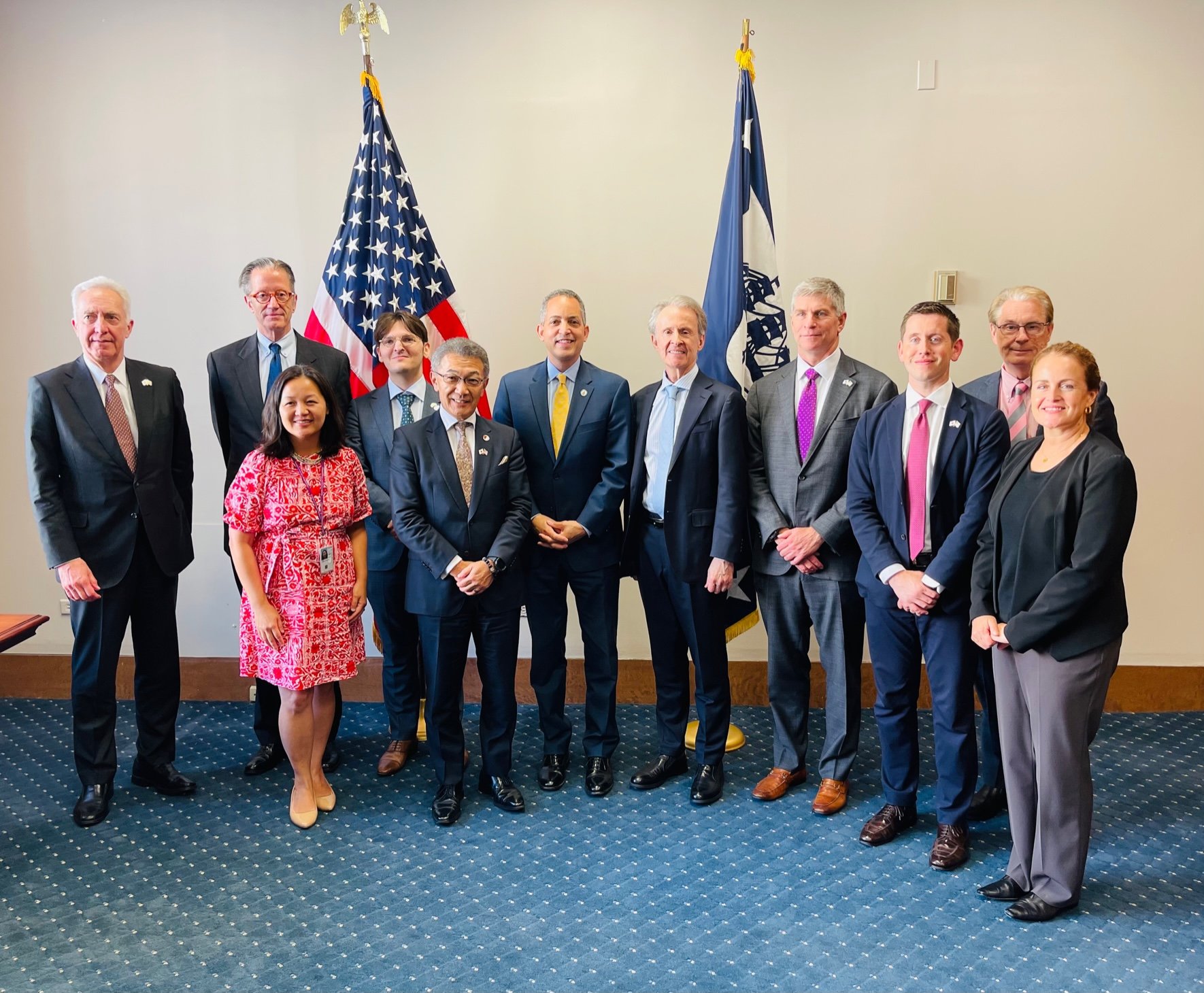
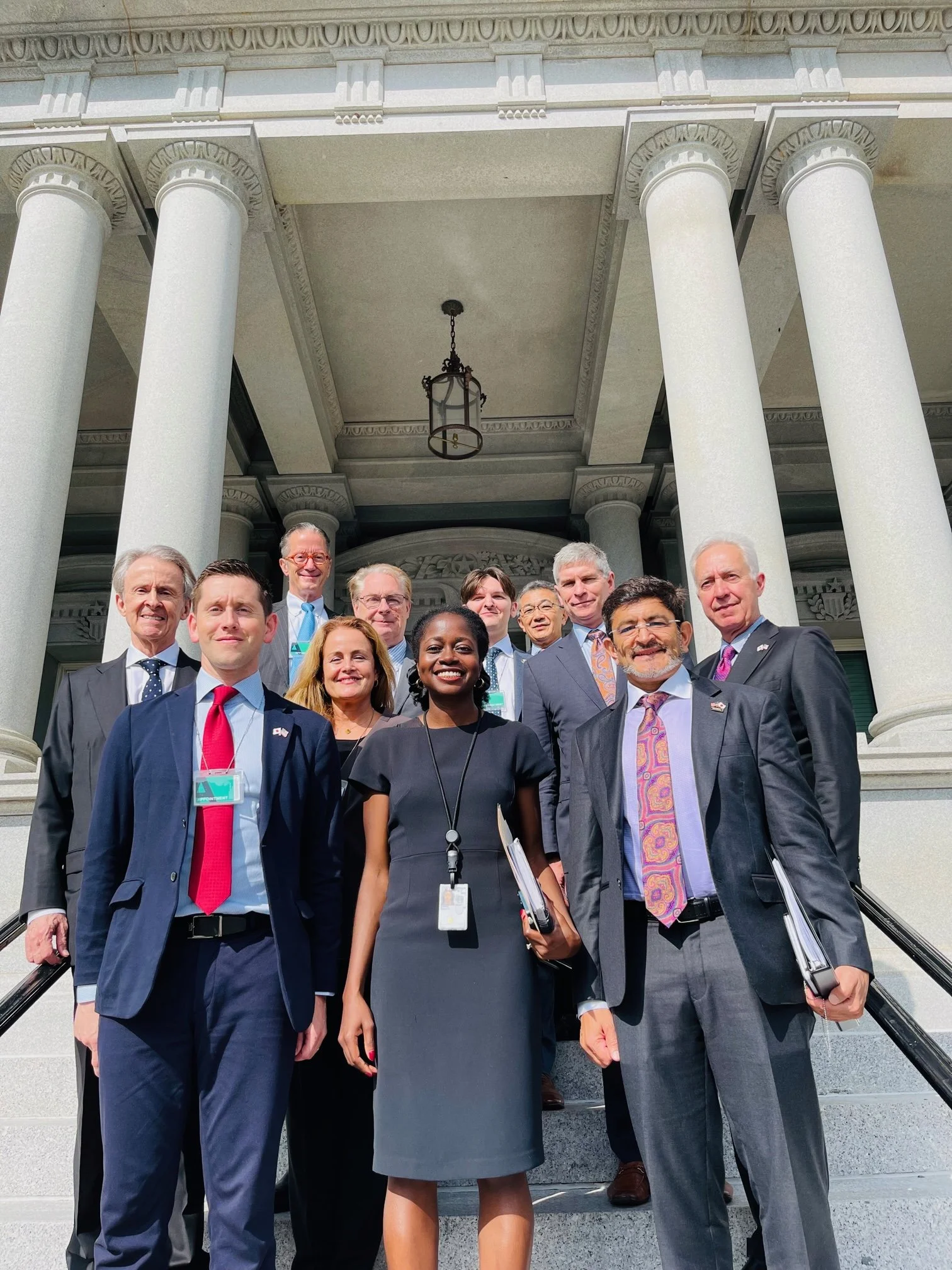
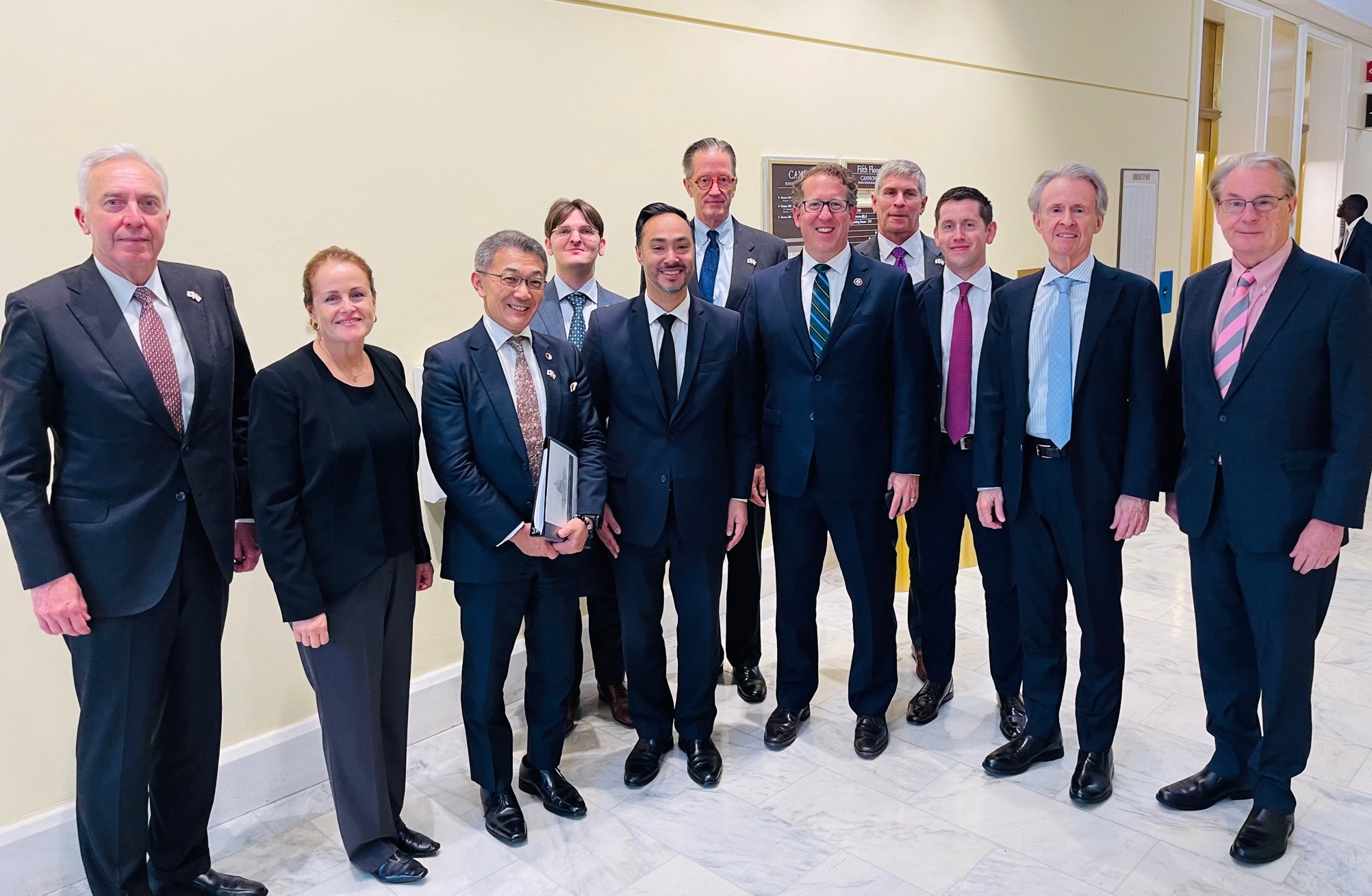
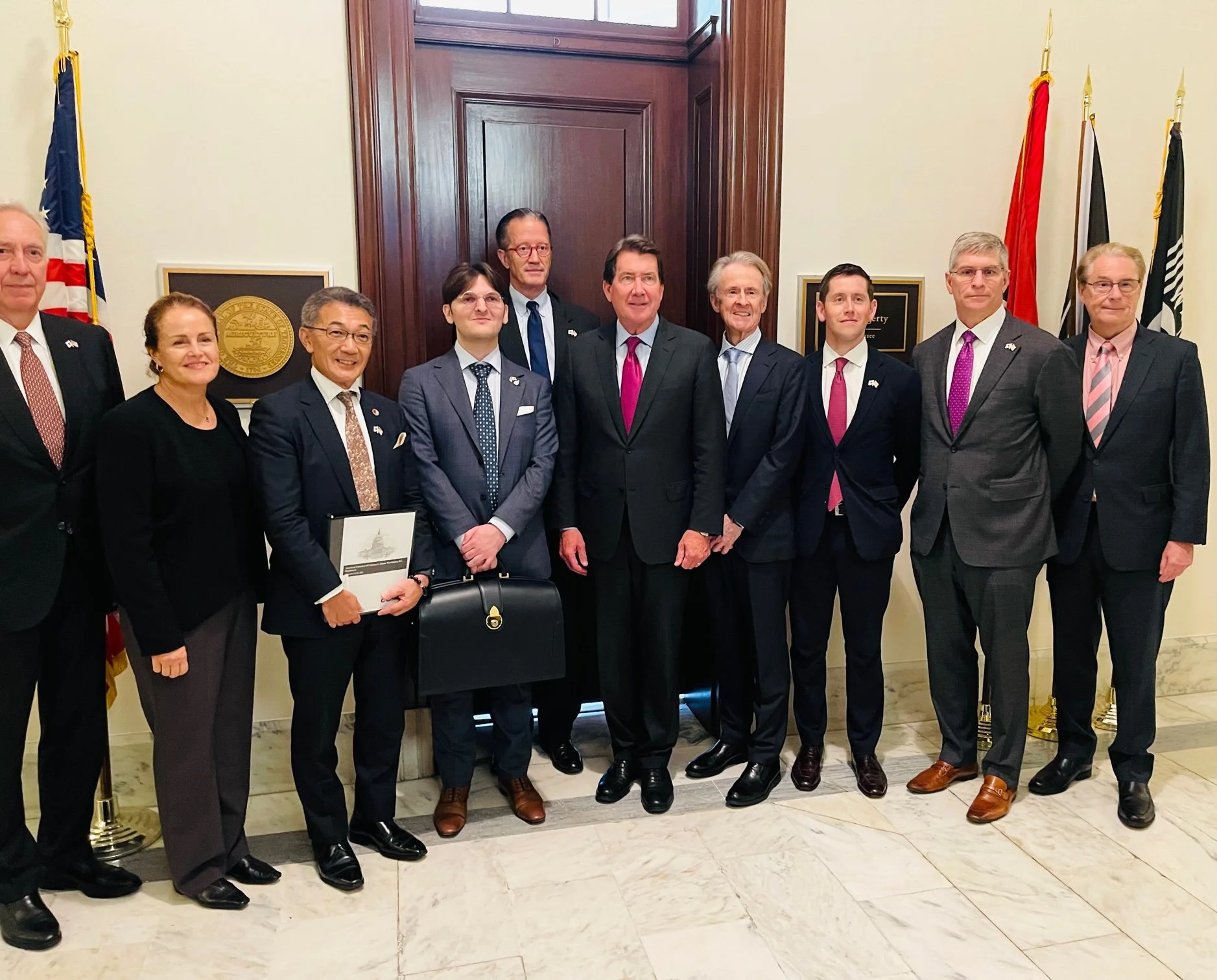
During the first full DC Doorknock since 2019, ACCJ delegates met with leaders in Washington, DC, to discuss security, economic, and strategic partnerships.

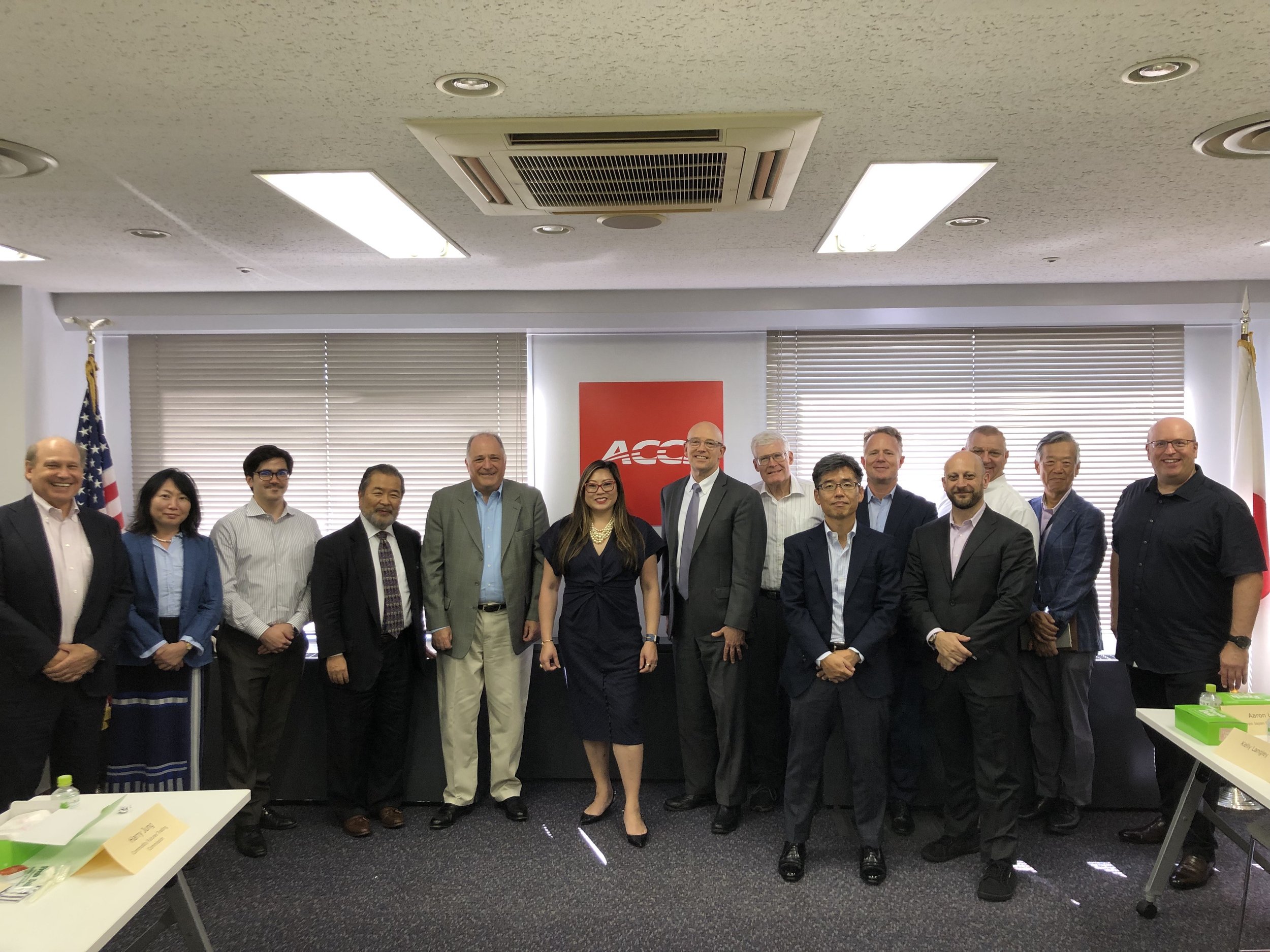
The 2023 ACCJ DC Doorknock delegates gather in front of the US Capitol.
On September 12 and 13, American Chamber of Commerce in Japan (ACCJ) leaders made their first full visit to Washington, DC, since the start of the coronavirus pandemic. These DC Doorknock visits are an important part of the ACCJ’s advocacy efforts and strengthen US–Japan relations.
ACCJ President Om Prakash was joined by Vice Presidents Jason Hyland and Victor Osumi; Governors Hans Klemm, Frank Packard, and Will Shaffer; Treasurer Steven Briggs; Special Adviser Christopher LaFleur; Digital Forum Vice-Chair Kristopher Tate; and Executive Director Laura Younger.
The delegation was warmly welcomed by administration officials, members of Congress, and officials from the Embassy of Japan and the US Chamber of Commerce. Topics of discussion included security, economic, and strategic partnerships.





Strengthening Cyber Risk Management
ACCJ member Ted Sato shares how his new cybersecurity book, written in collaboration with Keidanren, came about and discusses the issues it addresses.
Keidanren collaboration delivers book with practical advice to corporate leaders
As concern about cyber risk grows in Japan, a new book by veteran American Chamber of Commerce in Japan member and Marsh Japan, Inc. Senior Vice President Ted Sato aims to help corporate management find the most effective approach to mitigating risk and effectively responding to events.
Sato authored the book with Toshinori Kajiura, a member of Keidanren (the Japan Business Federation) and a senior researcher for information and communications technology policy at Hitachi. Kajiura was previously chair of Keidanren’s Working Group on Cybersecurity Enhancement.
🔼 Watch the video above for more insights from Sato himself.
Published in February by the Nikkan Kogyo Shimbun, a Japanese industry newspaper, Strengthening Cyber Risk Management: A Keidanren Handbook to Cyber Risk Management is designed to provide corporate managers with practical guidance for dealing with cyber risk.
Not to be confused with cybersecurity, cyber risk is defined by the US Department of Commerce’s National Institute of Standards and Technology as the “risk of financial loss, operational disruption, or damage from the failure of the digital technologies employed for informational and/or operational functions introduced to a manufacturing system via electronic means from the unauthorized access, use, disclosure, disruption, modification, or destruction of the manufacturing system.”
Sato told The ACCJ Journal that the book, which spans more than 200 pages, was written by professionals from the battlefield in easy-to-understand language. “We wanted corporate managers to be able to ask effective questions at the earliest stages of any cyber risk event. That is very important.”
“We wanted corporate managers to be able to ask effective questions at the earliest stages of any cyber risk event. That is very important.”
The idea came after a series of events last May which Sato conceived with Nikkan Kogyo Shimbun. The well-received sessions showed corporate managers how to deal with cyber risk, not solely as a technical issue but to emphasize management and factors related to organizational culture.
Keidanren had been hosting its own events since 2014, working to change the mind-set of corporate management on this critical issue. The organization built on Sato’s efforts to bring together professionals with similar motivation to create the Cyber Risk Management Japan Study Group, which was a supporting contributor to the book.
These efforts were also supported by the late Hiroaki Nakanishi, who was chair of Hitachi and Keidanren and contributed the foreword.
The book’s core advice draws on a 2014 report by the Internet Security Alliance and the National Association of Corporate Directors’ handbook on cyber risk, which recommends a one-team approach to corporate management. Beginning with the importance of expert advice from outside the company, the book advises an “art of science” approach that balances technology, human factor management, and operational excellence to ensure an organization’s readiness, response and recovery, and recurrence prevention.
The book has been well received by reviewers for its practical guidance.
“It is very meaningful to promote cooperation with experienced US firms at this early stage for Japanese companies,” Sato said. “If all goes well, next we plan to make an English version to share in Asia.”

The Bishop Family Memorial Scholarship Fund
On June 12, the ACCJ and the United States–Japan Bridging Foundation gathered at Tokyo American Club to honor the family and launch the Bishop Family Memorial Scholarship Fund at an event entitled Lives Lived for Bridging the United States and Japan.
Honoring the legacy of ACCJ leader Bill Bishop and his family through education
As a typhoon slammed Yokota Air Base in July 1974, a plane rocked its way down to the runway. Onboard was navy photographer Bill Bishop. That first night, he also experienced his first earthquake. It was a dramatic start to a five-decade relationship with Japan that would lead the South Dakota native to become a key part of the US business community in the country.
Last December, on Christmas morning, Bishop, his wife Izumi, and their daughter Sophianna lost their lives, killed by their neighbor at their family home in Saitama Prefecture.
Members of the American Chamber of Commerce in Japan (ACCJ) remember Bishop for his kindness, humor, friendship, and dedication to the chamber, where he served as chair, vice-chair, and board liaison of the Healthcare Committee over the years.
On June 12, the ACCJ and the United States–Japan Bridging Foundation gathered at Tokyo American Club to honor the family and launch the Bishop Family Memorial Scholarship Fund at an event entitled Lives Lived for Bridging the United States and Japan.
In attendance were US Ambassador to Japan Rahm Emanuel, representatives of Tochigi Prefecture Governor Tomikazu Fukuda, and ACCJ members and guests.
“We hope creating a fund that will support students who will come from the US to study in Japan, at Temple University, will be an incredible way to support Bill and his family’s legacy.”
Tom Mason, the foundation’s executive director, said, “We hope creating a fund that will support students who will come from the US to study in Japan, at Temple University, will be an incredible way to support Bill and his family’s legacy.”
Bishop studied in Japan himself and received a bachelor of arts degree from Sophia University. He earned a master’s degree from Temple University in Philadelphia, and later became a lecturer and board member at the Japan campus.
The event also marked the 25th anniversary of the United States–Japan Bridging Foundation, which provides US undergraduates—especially those from historically underrepresented communities—with scholarships to study abroad in Japan. It also offers mentorship and networking opportunities to build a Japan-related career, fostering the next generation of US leaders with connections to the bilateral relationship. Since its founding in 1998, the group has supported more than 2,000 students.
Some of this year’s Bridging Scholars, as well as alumni, also joined the event to share their experiences studying in Japan thanks to the foundation’s support.


The Bishop Family Memorial Scholarship Fund will be based at, and managed by, the US–Japan Bridging Foundation, which will administer and manage the scholarship and its programs—including the recruitment of students. Logistics, fundraising, and community support will be provided by the ACCJ.
Education Committee Vice-Chair Thierry Porte, who is also chairman of the United States–Japan Bridging Foundation, is happy to be a part of this.
“I knew Bill Bishop well,” he told The ACCJ Journal. “He and I worked together in the late 1990s to early 2000s at the ACCJ, and he was an active member of the American community in Japan. As [he was] someone who was very active working with students, there was quite a bit of movement in the community to remember Bill and his family.”
Porte said the Bishop Family Memorial Scholarship Fund will be a “living memorial to Bill, his wife, and his daughter and the logical place to collaborate would be the ACCJ, where Bill was very active and his daughter interned.”

Happy Independence Day 2023!
On the 247th anniversary of the birth of our great nation, I would like to extend my warmest wishes for a Happy Fourth of July to our friends and partners at the ACCJ.
A special message for ACCJ members from US Ambassador to Japan Rahm Emanuel

On the 247th anniversary of the birth of our great nation, I would like to extend my warmest wishes for a Happy Fourth of July to our friends and partners at the American Chamber of Commerce in Japan (ACCJ). Going on my second year in Japan, I am humbled by what we were able to accomplish. The ACCJ’s leadership played no small role in helping accomplish our mutual goals. While looking at our impressive accomplishments, it is important to note that there is much left to do.
Over the past few years, the US–Japan Alliance has become a cornerstone of peace and stability in the Indo–Pacific. As discussed at the G7 Summit in May, the importance of defending democratic values in eastern Asia cannot be overstated. Japan’s dedication to this cause can be seen by its reinforcements of defensive and diplomatic capabilities. Our bilateral cooperation has only deepened behind the promise to protect the rule of law and sovereignty.
Russia’s war in Ukraine is a direct attack on international order and the biggest modern threat to sovereignty globally. The invasion threatens to undermine the principles of sovereignty and territorial integrity. In response to the unjust war, the United States and Japan held steadfast in our dedication to global security and led international pushback against the Kremlin. Japan and the United States led sanctions, export controls, freezing of Russian assets, and donations to the Ukrainian cause.
This challenge strengthened international cooperation to create a united front against the aggressions of Russia. This war and our united response to it has much wider ramifications than just in Ukraine. As the People’s Republic of China (PRC) continues to test the boundaries of the South China Sea and Taiwan, it is evident that the outcome of Russia’s invasion holds great weight in determining the PRC’s aggressiveness in the Indo–Pacific region. In response to the PRC’s encroachment in the South China Sea, the United States and Japan have advocated for a rules-based order in the region, condemning their behavior. To this end, we have worked with other countries in the region to promote freedom of navigation and overflight to address the PRC’s aggressiveness.
“Over the past few years, the US–Japan Alliance has become a cornerstone of peace and stability in the Indo–Pacific.”
As we address international concerns, we must not forget the urgency of combatting climate change. The United States and Japan are global leaders in the fight against climate change and in recent years our cooperation has only grown stronger. The US–Japan Climate Partnership is an example of this cooperation, which commits us to achieve net-zero emissions by 2050. We are making significant progress on this goal by increasing renewable energy and through researching and developing new clean technologies. Our cooperation is essential to addressing the climate crisis and acting as leaders in an international response.
All of this must be accomplished without neglecting the economies of both countries. The advancement of US–Japan economic relations in the past two years is a positive development for both countries and the global economy. Concurrently, we have launched several initiatives to support economic investment in Southeast Asia and to promote free trade in the region. We are committed to working together to address common economic challenges and we are well-positioned to continue to advance our economic relationship in the years to come.
We are fortunate to have strong allies in the ACCJ with common goals. We must never forget that our unity is our greatest strength. It is what gives us the power to defeat tyranny and build a better world. What we can accomplish with the US–Japan alliance in the next two years will shape the future of the Indo–Pacific region for decades to come.
Happy Independence Day. I am confident in our work together. Let’s get it done.
Disclaimer: Opinions or advice expressed in the The ACCJ Journal are not necessarily those of the ACCJ.

Juneteenth: Seeds of Hope (Audio)
The ACCJ Journal sat down with CIC founder Tim Rowe in the bustling Toranomon Hills networking hub to learn more about how he went from sharing a space with friends to leading a community for entrepreneurs that includes more than 1,000 companies at centers in eight cities around the world.
Legacy Foundation Japan's LaTonya Whitaker shares inspiration and plans to celebrate this important American holiday and build bridges between the US and Japan.
Ahead of the Juneteenth holiday, we sit down with LaTonya Whitaker, executive director of The Legacy Foundation Japan, to talk about plans for the foundation’s Seeds of Hope gala at Tokyo American Club.
As an entrepreneur, the Mississippi native is well known to many in our community for Soul Food House, the comfortable and delicious oasis of authentic Southern food in Azabu-juban. But her work extends far beyond those flavors. In this interview, LaTonya shares her experiences learning about the history of June 19, the inspiration for the gala (now in its second year), and how the business community can get involved.
Learn more about the Seeds of Hope Gala
Learn more about The Legacy Foundation Japan
Innovation Engine
The ACCJ Journal sat down with CIC founder Tim Rowe in the bustling Toranomon Hills networking hub to learn more about how he went from sharing a space with friends to leading a community for entrepreneurs that includes more than 1,000 companies at centers in eight cities around the world.
CIC co-founder Tim Rowe shares his entrepreneurial journey and vision for collaboration in Japan.
Like so many new graduates, Tim Rowe and his friends from the Massachusetts Institute of Technology (MIT) left their Cambridge campus with diploma in hand and took “ordinary” jobs. A few years later, in 1999, they quit those jobs to build
start-ups.
But they needed offices—not the easiest thing for young entrepreneurs to pay for in a town that’s home to two of the world’s most prestigious universities. So they decided to share a space near MIT and Harvard to lighten the financial load. At least one of their companies would make it, they thought.
The shared space led them down an unexpected path, however, as more companies moved in and they went from five to 10 to 50 to 100. The Cambridge Innovation Center (CIC) was born.
Fast forward two decades and CIC opened its first Asia facility in Tokyo, in the Toranomon Hills Business Tower. The ACCJ Journal sat down with Rowe in the bustling networking hub to learn more about how he went from sharing a space with friends to leading a community for entrepreneurs that includes more than 1,000 companies at centers in eight cities around the world.
How did CIC expand?
For the first 13 years or so, we just grew right there in Cambridge. I had little kids at the time and didn’t really want to travel as much. And Cambridge is an amazing place for start-ups. So, we just kept taking more space and filling it. It was really kind of a surprise to us. We didn’t set out to build a shared space for start-ups as a business. We were actually just
using it for ourselves.
My mother had been the ombudsman at MIT, and one of her friends who had been the provost of MIT, Mark Wrighton, had become the chancellor of Washington University in St. Louis, one of the top medical schools in the United States. She said, “Mark called and wants you to come to St. Louis.” I was about to give all the reasons why I didn’t know if I could do that, but then she was like, you gotta go. Okay, Mom. So, I flew to St. Louis and met with Mark Wrighton. He said, “Look, we want you here, and we’re going to help you figure it out.”
One thing led to another and we opened in St. Louis. A few years later, the federal government was looking for a home for the National Geospatial-Intelligence Agency, and they toured St. Louis. They came to our center and said this is the kind of vibe they were looking for. They actually testified before Congress that they selected St. Louis because of their experience at our center. It was a $2 billion investment, a big deal for the local economy. After that, as other people came and knocked on the door, we said, “Sure, let’s look into it.”
How has the view of start-ups changed?
If you survey new college graduates, they often say the number one thing they want to do is go create a start-up. I think it’s good for the world, because what we’ve learned is that innovation has the power to make the world better in so many ways. But what we’re finding is that innovation gets into the world, is adopted and spreads much more quickly, through new enterprises rather than existing ones.
When we’re part of a larger organization, we want to respect all the rules that exist in that organization. Doing new things becomes rather hard. We hear things such as, “We tried that once and it didn’t work,” or “That sounds interesting, but that’s 1/1,000 of the revenue of this company, so we can’t prioritize it.” That’s normal, and it’s been well studied. But the bottom line is that existing enterprises find it very difficult to introduce true innovation.
“They understand that it’s not about them so, when there’s something really new and interesting that they have in their company, they push it out. It’s like asking your teenager to move out of your house. It’s time now, it’s time to go off.”
I think the smarter of the big organizations understand this. They understand that it’s not about them, so, when there’s something really new and interesting that they have in their company, they push it out. It’s like asking your teenager to move out of your house. It’s time now, it’s time to go off. They do the same thing and take those teams and move them out of headquarters.
Why did CIC choose Japan?
There’s a personal reason and there are professional reasons. The personal reason is that, in my youth, my dad said that if I studied Japanese for a while he would help me get an internship here. And my grandmother spent about 10 years in Asia in her youth, in the 1920s—mostly in China but some in Japan—and she taught me kanji when I was a kid. That all got me interested in Japan, and I was fortunate to do an internship here during high school.
Professionally, if you look at the most successful companies in the world—and you can use any measure, but one would be the Russell 2000 Index—all those companies were at one point start-ups. So, another way to look at that list is that it is a list of the 2,000 most successful start-ups ever. When you break them down by country, you find that the United States and Japan tie for the number of companies on the list adjusted by population. So, historically, Japan ties for number one as a place to build start-ups. That’s a reason to be here.


Photos: ©CIC Tokyo
Is the Japanese government doing enough to support start-ups?
Building a start-up ecosystem is a decade-long process. A piece can come from a supportive government, and it’s really terrific that the Japanese government is leaning in. Other governments that have leaned in, such as Israel, have done really well. It’s clear that a national policy that pushes in this direction can pay big dividends.
But it’s not the only thing that needs to happen. You also need the entrepreneurs themselves. And I think the Japanese innovation ecosystem is responding. These days, if you talk to young Japanese people—and this is a change, perhaps just like what started to happen a decade ago in the United States—you see many more who say they want to build a start-up.
I see Japanese universities leaning into this, which is important. They’re doing entrepreneur programs like those US universities started a decade or more ago. I see a growing awareness of, and interest in, what we call innovation infrastructure. This is things such as shared wet laboratories, the physical infra-structure that allows for new start-ups in, let’s say, the biotech field.
We’ve built shared workspaces focused on a number of industries. The largest so far is the wet lab for life sciences. We collaborated with others to found a nonprofit doing that in Cambridge. It’s called LabCentral and is, as far as we are aware, the largest shared wet lab on the planet. It’s over 20,000 square meters and has every possible piece of equipment you would need in life sciences. Then we figured out how to make that commercially viable and built a similar facility, a commercial one, called CIC Labs in Philadelphia. It’s the largest commercial shared wetland facility in the world, to our knowledge.
How can Japan and the United States work together?
The good news is that the interests are very aligned for Japan, for the United States, for Japanese companies, and for US companies in Japan. Everyone in this circle benefits when they figure out how to get these collaborations to work well, and set a different way.
If you aren’t out there working with new technologies, which are often coming from start-ups, then you’re at risk that you’ll be Airbnb’d or Uber’d. You’re in the hotel business and someone figures out another way to have lodging. You’re in the taxi business and someone figures out another way to get people around the city.
“If you aren’t out there working with new technologies, which are often coming from start-ups, then you’re at risk that you’ll be Airbnb’d or Uber’d.”
This is core to the ACCJ itself. Really, what you’re talking about is brokering conversations. You’re getting people to know each other and to talk about what they’re doing, and how they might help each other.
When I was a young person at the Mitsubishi Research Institute in the early 1990s, I was a member of the ACCJ, because I saw—and I convinced my bosses—that the connections that could be made were meaningful and important. I think it’s no less relevant today. And I think that, as many of these companies have evolved, one of the things they’ve come to realize is that, while the connections between larger organizations are important, the connections between larger organizations and smaller fledgling ones are also important. The challenge is figuring out how to find those little companies and how to know which ones to work with.
What’s next for CIC in Japan?
We were approached by Nishitetsu, the major private railway company in Kyushu. They said, we like what we see at CIC Tokyo and we’d like to work with you to build another one in Fukuoka. We have announced that we’re in a formal collaboration and will soon finish all the due diligence to make sure this will really work. Then we can announce if, in fact, we’re moving ahead with construction, but it’s looking very good and we’re excited to be headed to the second site.
We’re also in several conversations about building some of those shared wet laboratories, robotics laboratories, and other kinds of deep tech shared spaces here in Japan.
We’d love to hear from Journal readers on this; if they have ideas, they should let us know. We think there’s a lot of demand for this kind of innovation infrastructure. Not only does it propel start-ups, but it also creates an environment much like CIC Tokyo does, where larger companies can interact with, and find interesting, smaller companies. Those are our two main areas in the future: more in deep tech and more locations around Japan.

Healthy Makeover
ChatGPT may be all the buzz right now, but it's just one of the digital tools transforming virtually all industries, including healthcare. ACCJ leaders share their views on how digital transformation can benefit patients as well as those charged with caring for them.
How are digital transformation tools changing healthcare in Japan?
ChatGPT, that large language model that is stealing the headlines these days, may be all the buzz, but it’s just one example of how technology is rapidly changing the way we work and do business. And while the artificial intelligence (AI) bot may represent a leap forward, the deployment of digital technology across an organization’s operations has been on the rise in all industries since the advent of the World Wide Web in 1989.
Today, we call it digital transformation (DX), and it is bringing computation, Big Data, AI, other digital applications, as well as connected devices, to bear on how products and services are made and/or delivered, in industries as diverse as education, finance, and logistics.
Healthcare could also greatly benefit from these incredible advances, and the industry is undergoing its own DX revolution—including in Japan. Here, healthcare DX is gaining traction in part due to the advocacy efforts of the American Chamber of Commerce in Japan (ACCJ).
However, speaking to The ACCJ Journal, industry insiders—including members of the chamber’s Healthcare Committee—note that adoption of healthcare DX in Japan lags that of other countries, especially those in North America and Europe.
“I think the current situation is that [Japan is far behind] compared with countries such as Denmark or the United States,” said Makoto Kawai, director of government affairs at Zimmer Biomet G.K., a global medical technology company. Kawai is also co-chair of the ACCJ Healthcare Committee.
Maya Mamiya and Diogo Rau share similar sentiments. Mamiya is an associate director of global public policy for Asia at Eli Lilly Japan K.K. and a Healthcare Committee vice-chair, while Rau serves as Eli Lilly’s chief information and digital officer.
Also sympathetic to Kawai’s view are healthcare industry expert and committee Vice-Chair Eiji Sasahara, and Go Ikeda, a senior manager in the Healthcare Economics and Government Affairs Division of medical devices maker Medtronic Japan Co., Ltd.
Data Utilization
Dr. Sasahara noted that healthcare DX in Japan—especially optimal utilization of Big Data—is still low. Why? It is in large part because “operations heavily depend on manual and paper-based processes,” he explained. “It’s not easy to utilize [the] merits of digital technologies, such as accessibility, scaling, and automation.”
However, optimizing Big Data use in healthcare is important for a variety of reasons. One area where its effective deployment is critical is in determining the health outcomes of patients, the experts pointed out.
Rau identified even more areas where optimal use of DX tools can make a difference. In the case of Eli Lilly, Big Data, AI, and machine learning can be used to:
- Develop digital connectivity for clinical trials and therapeutics
- Deploy solutions to manage patient-specific digital information
- Speed up the discovery of new life-changing medicines
- Design and implement clinical trials
- Increase accessibility to and diversity of medicines
- Obtain more accurate efficacy/safety data
- Improve patient experience
- Improve the safety and effectiveness of medicines
- Manage and interpret patient data from connected therapeutic devices
Medtronic’s Ikeda agrees. “In order to link personal health records [(PHRs)] and medical information, it is necessary to build a platform and take measures to shift data ownership and management to individuals,” he explained.
“By connecting and sharing data such as PHRs and medical information, the value of medical care will be improved, allowing for early diagnosis and prevention of disease progression.”
“By connecting and sharing data such as PHRs and medical information, the value of medical care will be improved, allowing for early diagnosis and prevention of disease progression.”
To provide better healthcare while maintaining universal access, the current fee-for-service health insurance system should be shifted to value-based healthcare (VBHC), Ikeda suggested. “DX of healthcare is an important precondition for VBHC.”
Sasahara refers to this new paradigm as “citizen-centered care”—a form of healthcare that not only makes use of digital tools such as Big Data, but also puts patient outcomes at the core of the industry.
Healthy Prices
The upside of deploying healthcare DX can be enjoyed not only by patients and the private sector, but the public sector, too, the experts noted.
Government ministries and agencies—as well as the hospitals and other healthcare institutions and research and development (R&D) centers they fund—will be able to reduce costs through the effective deployment of DX strategies.
Ikeda noted: “DX will promote R&D and enable outcome-based reimbursement evaluation, supporting a reduction of medical and nursing care costs. It can also support the healthcare workforce shortage [to] benefit patients overall.”
Data Security
Improving data security is another benefit the DX revolution will confer on the healthcare industry, according to the experts. This is especially the case when securing the privacy of patient records, an area of concern many of them highlighted.
Healthcare DX, they said, should adhere to international standards of security. These standards are based on interoperability of systems and use of platforms such as cloud computing. In Japan, however, patient data is usually stored on premises and in stand-alone systems, which are not necessarily secure.
“With regard to data storage, the current mainstream on-premises, stand-alone system has increased security risks, and it should be considered that an open mechanism using the public cloud paradoxically improves security,” explained Ikeda.
Lilly’s Rau added: “Some of the key concerns include ensuring the confidentiality of this data when tied to a patient and the integrity of the data when billing and making care decisions.”
Sasahara agrees. He also noted that, in Japan, there is a lack of in-house security expertise. “It is usual that there is no [chief information security officer] at Japanese hospitals.” Kawai held a similar view.
However, this opens up an opportunity not only to acquire the necessary human resources but also to “develop and utilize emerging privacy-enhancing technologies,” Sasahara and Kawai agreed.

Securely digitizing patient records will be key to realizing the potential of healthcare DX.
Prevent and Cure
The reach of healthcare is broad. It includes the prevention, diagnosis, and treatment of diseases, injuries, and ailments, and encompasses a wide area of professions and fields—from doctors to nurses to medical researchers—as well as facilities such as hospitals, clinics, and research institutions.
In the healthcare technology space, a few themes are emerging at the forefront. For Ikeda, three areas of particular note are:
- Grand design
- Value assessment
- Private–public partnership (PPP)
Regarding the path to implementation, Ikeda shared: “We believe that it is necessary to first illustrate a grand design for the overall picture of what the platform should be in order to realize medical DX, and then the process for building that overall picture should be presented.” It is the remit of the government, working with stakeholders across society, to provide that grand design or vision, he added.
“DX will promote R&D and enable outcome-based reimbursement evaluation, supporting a reduction of medical and nursing care costs. It can also support the healthcare workforce shortage [to] benefit patients overall.”
As for value assessment of digital health technology, Ikeda noted that this is difficult to properly assess under existing medical service reimbursement systems.
“To reduce the burden on medical professionals, as a new evaluation perspective unique to digital health technology [emerges], to equalize and improve the efficiency of technology, and to evaluate products that match the speed of product development and improvement, it is necessary to build a new evaluation system by referring to overseas cases and the utilization of non-insurance combined medical care systems,” he explained. Here, stakeholders in Japan and abroad can learn from each other.
And what of private–public partnerships? To enhance PPP, Ikeda added, it is also necessary to set up new forums for information sharing and discussion among the public and cross-cutting private sectors. “I am expecting that the ACCJ could be the hub of PPP.”
Sasahara mentioned three more trends to keep an eye on as paradigms change in the healthcare industry:
- Citizen engagement
- A shift from reactive treatment to data-driven prevention
- Utilization of gamification tech for patient care

The ACCJ Healthcare x Digital program focused on empowering elderly patients through digital health in 2022.
Advocating for Change
To keep abreast of fast-changing developments in the industry, the ACCJ Healthcare Committee was invited in March to an event hosted by the American Medical Devices and Diagnostics Manufacturers’ Association (AMDD).
Led by Ikeda, who is chair of the AMDD’s Digital Health Committee, the event featured Dr. Kengo Miyo of the National Center for Global Health and Medicine, a hospital and international medical research and healthcare training facility located across Tokyo. Miyo is the director of the institute’s Department of Planning Information and Management.
Ikeda explained that the event was organized to realize medical DX in a situation where the environment is changing, and technology is progressing rapidly. “Cooperation among stakeholders toward a shared goal, and understanding of medical DX as a whole, are indispensable,” he stated.

Future Ready
If Japan is to remain globally competitive and secure its future economy, overcoming the digital talent gap is a must. To find out where Japan is on the road to readiness, _The ACCJ Journal_ spoke with corporate leaders about the current state of talent acquisition and retention.
What must Japan do to ensure that its workforce can compete in a digital world?
We’ve been living in a digital world for quite some time. More than three decades have passed since the World Wide Web began connecting us through zeros and ones. For most of that time, it’s been possible to straddle the line between digital and analog. But if the first quarter of 2023 has made anything clear, it’s that we’re at an inflection point when it comes to technology.
If Japan is to remain globally competitive and secure its future economy, it must embrace digital transformation (DX).
Despite increased efforts to push DX, Japan dropped to 29th place in the 2022 IMD World Digital Competitiveness Ranking, an annual report published by the Switzerland-based International Institute for Management Development that assesses and compares the digital competitiveness of countries based on their ability to adopt and explore digital technologies.
More concerning is that Japan ranked 41st in the talent subcategory and 54th in future readiness.
Overcoming this digital talent gap is a must. For companies, the required skill sets are shifting, impacting not only talent acquisition and retention, but also the country’s education system and overall workplace culture.
To find out where Japan is on the road to readiness, The ACCJ Journal spoke with corporate leaders making DX possible, as well as those helping companies and talent come together for success in today’s digital-driven world.
Widening Gap
Talent acquisition has become a pressing issue for companies across Japan. In a 2022 survey conducted by the Ministry of Internal Affairs and Communications (MIC), 67 percent of Japanese respondents cited a shortage of information and communications technology (ICT) personnel as a roadblock to their DX efforts.
Surveys conducted by recruitment site Doda show a sharp rise in the monthly number of job openings per candidate for engineers and other tech professionals—from 3.44 in March 2019 to 9.54 in March 2022. The Ministry of Economy, Trade and Industry (METI) projects a shortage of 450,000 ICT workers by 2030.
“We have a big problem. It’s a serious talent crisis that is going to get much worse,” said Daniel Bamford, associate director of technology for Asia–Pacific at specialized recruitment agency Robert Half Japan.
Changing Workplace
Faced with a dwindling talent pool and fierce competition, the Japanese labor system must change within a few years if Japanese companies are to acquire good talent, Megumi Tsukamoto, senior adviser at global consultancy J.S. Held Japan LLC, told The ACCJ Journal. The country’s traditional human resources model, according to which compensation is based on age and seniority, has exacerbated the digital talent shortage.
A 2016 comparative survey by METI found that the average annual salary of ICT personnel in Japan was roughly half that of their US counterparts. Workers in their twenties in the United States earned an average of $77,990 per year, while their Japanese counterparts took home just $31,300.
“Workers in their twenties in the United States earned an average of $77,990 per year, while their Japanese counterparts took home just $31,300.”
Tsukamoto noted that, in a bid to obtain and retain talent, some Japanese companies are beginning to offer salaries two to three times higher than previous packages. Some are offering much more than that. This is the result of ICT professionals either moving abroad, or choosing to work for such foreign companies in Japan as Google.
However, higher salaries are just one piece of the puzzle, said Victoria Ryo, associate director at Robert Half. In-demand ICT tech workers expect more.
“A company that provides workplace flexibility, along with benefits, interesting projects, and an international environment, is going to be more attractive,” she explained.
Ryo pointed to innovative initiatives that catch the attention of potential ICT workers. As an example, she mentioned the financial services organization Money Forward’s Culture Hero campaign, which awards employees who epitomize the company’s inclusive culture. But Bamford warns that a good diversity, equity, and inclusion (DEI) policy is not enough to attract these in-demand talents.
“For them, it’s a base expectation, not something that will win them over,” he said. “But if you’re not providing a diverse and inclusive environment, you will lose people.”
Looking Abroad
To address the domestic talent shortage, companies such as Fujitsu Japan Limited have accelerated plans to hire non-Japanese engineering researchers in the wake of recent mass layoffs in the US tech sector.
While skepticism remains that ICT workers from abroad can thrive in Japanese workplaces, where language—and sometimes insufficient DEI culture—remains a barrier, Tsukamoto cites Mercari, Inc. as a domestic player that has found success hiring international talent.
The thriving e-commerce company began its full-scale efforts to recruit overseas talent in 2018. Today, more than 50 foreign nationals are working at Mercari’s Tokyo office, according to their FY2022 sustainability report.
Last year, the company opened a subsidiary in Bengaluru, a hub for IT companies in southern India, with the goal of recruiting IT workers. As of last July, it had attracted 45 new graduates from the Indian Institute of Technology.
The school has been a popular source of tech talent for Japanese companies such as Rakuten Group, Inc., whose Bengaluru base grew from six engineers in 2014 to more than 1,000 in 2020.
The Japanese government has responded to this trend by launching two new visa schemes in April that target highly skilled foreign workers, such as researchers and engineers, as well as graduates of highly ranked universities.
The Japan System for Special Highly Skilled Professionals, or J-Skip, visa allows researchers, engineers, and business managers to bypass the points-based system used to award visas to skilled professionals.
Meanwhile, the Japan System for Future Creation Individual, or J-Find, visa allows graduates from highly ranked universities to live in the country for up to two years while they find employment.

Evolving Workforce
The Japanese government also pledged last October to spend ¥1 trillion over the next five years on reskilling workers to address the shrinking pool of tech talent.
In January, Japanese Prime Minister Fumio Kishida said that guidelines will be drawn up in June to increase labor market flexibility to encourage workers to move to high-growth sectors.
Major companies are also contributing. Amazon Web Services Japan G.K. (AWS) has invested more than ¥1.3 trillion to help its Japanese customers modernize their IT systems and to overcome their digital skills gap through education programs, training, and certification.
“Cloud and cybersecurity skills will be the two most sought-after digital skills by Japanese employers by 2025,” said James Miller, the company’s head of public policy. “AWS has trained over 400,000 individuals in Japan with cloud skills since 2017, providing them with in-demand skills and best practices to help learners and organizations innovate in the cloud.”
Miller—an American Chamber of Commerce in Japan (ACCJ) governor who also serves as co-chair of the chamber’s Digital Transformation Committee and vice-chair of the Secure Digital Infrastructure Committee—shared an example of how AWS extended a 21st-century hand to a 19th-century company.
In 2021, the company helped Toppan Printing Co., Ltd., the 122-year-old Japanese global juggernaut, embark on a full-scale digital transformation. More than 1,600 of its employees received AWS training over three months and 1,050 pursued AWS certifications in a single year.
Room for Movement
As businesses make DX a point of emphasis, having a range of skill sets has become more important. In terms of hard skills, such as cloud and DevOps, Bamford noted that recruitment has gone from a T-shaped model, where someone has broad awareness and one deep specialization, to a V-shaped one, where the candidate’s deep specialization is complemented by medium-depth knowledge in other areas.
“The other side is that the soft skills aspect is really focused on being able to bridge global and local, while also bringing technical and people skills,” he added.
While senior managers who can lead a company’s DX efforts are in demand, companies should look inward for potential employees who they can elevate, according to Bamford. He pointed to a client that was looking for a certified ScrumMaster and, rather than hiring someone already at that level, found success in ambitious young candidates who the company could train to be certified.
“Since there will be that much more demand, and that much more shortage, the secret is to unlock the skill sets of the people you currently have. Experience is nice, but learning mindsets are even better.”
“Since there will be that much more demand, and that much more shortage, the secret is to unlock the skill sets of the people you currently have. Experience is nice, but learning mindsets are even better,” he added.
Ryo noted that this can help companies retain their technical talent. “I think the number one reason people leave an organization is because they don’t feel they have the opportunity to grow.”
Preparing Future Generations
While reskilling offers companies a path to overcoming current DX issues, Japan’s new ¥10 trillion national endowment fund to boost research at universities in strategic priorities such as artificial intelligence (AI), biotech, and quantum technology is expected to help train the next generation.
However, Matthew Wilson, dean and president of Temple University, Japan Campus, believes that changing student mindsets is arguably more important to reversing the tech talent drain.
He contrasted students in the United States, who define their future goals by jobs they want to pursue, with Japanese students, who aspire to work for specific companies.
“If your goal is to work at a company, your pathway is going to be a lot different,” he said, noting that the practice of job rotations at Japanese companies, in which employees are transferred from department to department every few years, provides fewer incentives to focus on specific fields.
Wilson also noted that Japan’s public education system is “very conservative, which is difficult to change,” but is optimistic that the government’s push for DX and the advent of new AI technologies, such as ChatGPT, the conversational large language model developed by OpenAI, will accelerate change.
“It’s going to force people to educate differently and to assess differently,” Wilson said. “The point isn’t catching somebody who just did their essay with ChatGPT. Rather, it’s how to educate somebody so they have the skills and the knowledge they’re going to need for a job five years down the road.”
Unified Response
Steps have been taken to reshape the country’s education system with last year’s release of the Roadmap on the Utilization of Data in Education. A joint statement issued by the Digital Agency, MIC, METI, and the Ministry of Education, Culture, Sports, Science and Technology states that, by 2030, the government aims to create “a society where anyone can learn in their own way, anytime, anywhere, with anyone.”
While Wilson recalls similar government ambitions, such as former Japanese Prime Minister Yoshiro Mori’s “one student, one computer” initiative more than two decades ago, which had little success, he is optimistic about the Digital Agency and Minister Taro Kono, whom he praises for being “energetic and constantly finding ways to challenge processes and procedures.”
But he also noted that, while things are starting to move, “it’s going to take a while to get Japan to the digital utopia that they’ve been talking about for 25 years.”

Surf the DX Wave
A digital transformation (DX) wave is sweeping across Japan, but learning to surf that wave takes experience. Another group of islands that know a bit about surfing, and have ridden DX to their advantage, could be a guide.
Five big lessons for Japan from Hawaii

As Japan’s fledgling Digital Agency finds its way through its second year of existence, and the Tokyo Metropolitan Government’s new start-up strategy takes hold, a digital transformation (DX) wave is sweeping across the country. Learning to surf that wave takes experience, however, and another group of islands that know a bit about surfing, and have ridden DX to their advantage, could be a guide for Japan.
How the Hawaiian tourism industry found renewed life through digital transformation was the subject of a February 28 event held at Tokyo American Club and online, and entitled How to Surf the DX Wave: Five Big Lessons for Japan from Hawaii. The American Chamber of Commerce in Japan Tourism and Hospitality Committee luncheon—co-hosted by the Digital Transformation and the Information, Communications, and Technology Committees—welcomed Mayumi Nakamura and Mike Birt of Ascent Partners, LLC to discuss the restructuring of Hawaii’s tourism management system.
When the Covid-19 pandemic forced a total shutdown of travel, tourism hot spots such as Honolulu, which had welcomed a record 10.4 million visitors in 2019, went from overtourism to dead empty in just a few days. The islands fell quiet. And when tourism returned in 2021, it was not the same.
Recovering from Wipeout
“As people started coming back, the domestic travel industry was just a madhouse,” Birt explained. It was clear that the pandemic had left Hawaii’s tourism industry scarred and unprepared for the influx. Change was needed.
The seeds for change were planted even earlier. When heavy storms hit Haena State Park, on the island of Kauai, in April 2018, major access roads were shut down and neither tourists nor locals could enter.
It was a needed pause, however. Before the disaster, some 3,000 tourists had visited daily, leaving little room for Hawaiians. “There was some conflict there, and many people couldn’t enjoy their own homeland,” Nakamura explained.
While the storm was a multi-million-dollar disaster for many, others saw it as divine intervention, an opportunity to reappraise the management of state parks and give greater consideration to the balance of tourists and locals.
When the decision was made to transform the system, the Hawaiian government approached Ascent Partners for help. Nakamura led a team that designed a timed-entry reservation system. Entry was restricted to those with reservations, and daily tourist admission was capped. This allowed locals more opportunities to enjoy their own land. Greater emphasis was also placed on hiking the trails and evoking the experience of the natural land as the Native Hawaiians saw it.
Due to the pandemic, all the work had to be done remotely. The Hawaii project was run from Seattle, while the software development team was in India and various support staff were scattered across the US mainland.
The project was a great success. Not only were there societal benefits, but economic ones as well. The state brought in 250 percent of its projected tourism revenue in the first year.

The island of Kauai, home to Haena State Park
Model for DX
Birt believes the fact that this project could be carried out remotely with such great success shows the potential for adapting the approach to other countries, with each following their own philosophy of reimagining post-pandemic tourism.
“It became a model for how to scale and develop very effective software digital transformation projects that can literally span the world,” he explained. “Destination management is a key element—and this isn’t just Hawaii. Venice, Iceland, Amsterdam … there are a number of [places] that have really had to work on how to manage their destination so that it doesn’t become overrun, and the community can still enjoy where they live.”
“It became a model for how to scale and develop very effective software digital transformation projects that can literally span the world.”
Birt and Nakamura said they learned a lot during their three years working with the Hawaiian state government. They shared five lessons which they believe Japan could put into action to transform its own post-pandemic tourism.
Lesson 1: DX requires leadership and vision
“Without a vision, none of the people around [you] can support the project. In the case of Hawaii, it was a return of aloha spirit,” Nakamura said. What made the project possible, she added, was that both the state government and private individuals were on board and committed to using the pandemic to take a bold step.
Lesson 2: DX has customers—and adversaries
“The state parks are literally part of [Hawaii’s] soul; Hawaiians think of their parks as almost a living thing,” Birt explained. Undertaking such a large-scale project, therefore, brought together many parties with a vested interest, whether emotional or financial.
Naturally, with this came those who strongly opposed the transformation. But nobody, Birt and Nakamura acknowledged, knowingly played the role of adversary; they resisted change simply for self-preservation. What saved the project from failure was that powerful friends in the Hawaiian state government shared the vision and supported it from the start.
Lesson 3: Technology is powerful
DX is not a simple one-and-done operation. It is an everyday effort that must be constantly analyzed and adjusted to fit the needs of the project. The DX wave does not stop or slow down. Everyone must be skilled and educated to properly participate in the journey. Questions must be constantly asked. In the case of the Hawaii project: Where are the tourists going? How are they going? How could communication be improved? What could smooth entrance into the parks?
Lesson 4: Expectations change
While the aloha spirit is the genuine treasure of Hawaii, it must always be met in balance with malama, the respect for the state and environment, as well as the customs and culture that come with it. You receive the generosity of Hawaii, but you are obliged to pay it back in appreciation. The same balance is sought in DX, where it has the potential to bring revenue and benefits, but we must be careful to not kill the goose that lays the golden eggs.
Lesson 5: DX waves won’t stop, learn to surf them
Lastly, there must be an emphasis on change, and an understanding that there is no final resting point in DX. Nakamura referred to the decline of Facebook and the rise of the artificial intelligence tool ChatGPT as examples of the unpredictable nature of technology. “You have to be ready to ride the waves as they comes,” she said. “Be adaptable, be adjustable. Don’t think of it as a destination, but as a journey.”

Big Moves Moving
Transformations take time. Reaping rewards can take longer. For Japan, shedding analog processes is critical for future prosperity. The ACCJ is bringing together the broad expertise of its membership to reassess the JDA 2030 and assist with the push for digital transformation.
Two years into the JDA 2030, ACCJ leaders take stock of progress.
Transformations take time. Reaping rewards can take longer. For Japan, shedding analog processes is critical for future prosperity, and the American Chamber of Commerce in Japan (ACCJ) is bringing together the broad expertise and experience of its membership to assist with the push for digital transformation (DX).
In early 2021, the ACCJ unveiled a comprehensive white paper entitled Japan Digital Agenda 2030 (JDA 2030) that outlined 11 big moves which could position the country as a global leader as we dive deeper into the 21st century. Produced together with McKinsey & Company, the JDA 2030 presents technology use cases and describes how Japan could realize a transformation that would put the world’s third-largest economy on equal footing with leading digital nations.
These measures to bolster DX in Japan call for concerted steps by major industries and stakeholders in areas such as digital talent, industry transformation, digital government, and economic renewal. And in the two years since the paper was published, the need for cross-industry collaboration to make many of the JDA 2030’s big moves a reality has become increasingly clear.
An Evolving Proposition

What has also become clear is that the pace at which digital everything is infiltrating all aspects of business and society calls for a reassessment of the JDA 2030. The ACCJ’s new Digital Forum, confirmed by the Board of Governors in April and led by Chair Mitsuhiko Ida, along with Vice-Chairs Kristopher Tate and Scott Warren, will be leading this task, working with the various digital-related committees to coordinate the chamber’s voice and position on DX.
And with DX impacting all organizations, not just those in technology fields, everyone has a role to play.
“The question is swiftly becoming, Is there such a thing as a non-tech field?” Warren told The ACCJ Journal. “We are seeing technology being applied in almost every business. I think the application of technology is almost too alluring—and necessary to keeping a competitive edge—to be ignored.”
ACCJ Digital Transformation Committee Co-Chair Jim Weisser agrees. “All businesses are digital or have a DX component. Trying to figure out which piece to transform—and how to do it—is a problem for all companies.”
“All businesses are digital or have a DX component. Trying to figure out which piece to transform—and how to do it—is a problem for all companies.”
Fellow co-chair and ACCJ Governor James Miller added: “The most important thing for members to keep in mind is the cross-sectional view versus the deep dives. There are sets of concerns that are technology specific, but we are continuing to focus on sharing what sets of issues business leaders should prioritize that are cross-sectional.”
Already, the chamber is looking at a variety of mechanisms to bring together the insights from the JDA 2030—and those continually being developed by the ACCJ’s committees—to refine its position and recommendations to provide the best guidance in a rapidly changing environment. This effort, supported by the work of the digital committees on technology-specific issues, is focused on teasing out the common positions across the broad range of committees to bring the whole chamber to bear on DX.
A question about the big moves outlined in the JDA 2030 is whether they might require a longer timeline to be realized than the seven years that remain until the original target date. This has spurred an effort to learn from the chamber’s landmark 2009 white paper Achieving the Full Potential of the Internet Economy in Japan, how progress was achieved, or efforts stalled, and how the digital agenda itself can evolve.
While a lack of dialogue or substantive business input may have slowed progress, the Great East Japan Earthquake and Tsunami of March 11, 2011, reignited interest in resilience. Similarly, former Japanese Prime Minister Shinzo Abe’s focus on the role of data at the 2019 World Economic Forum Annual Meeting in Davos has since proved to be a major lift for the JDA 2030.
Data, Trust, and Talent
At the center of Abe’s Davos proposal was Data-Free Flow with Trust (DFFT), something which Japan and its allies have struggled to define in the years since, said Warren, who is also co-chair of the ACCJ Legal Services and IP Committee as well as vice-chair of the Information, Communications, and Technology Committee.
“How we achieve [DFFT] will be one of the main topics discussed during the G7 conference. The real challenge, I think, is that the definition cannot be static, as it is very dependent on the type of data—critical infrastructure data versus other data—and the question of how much you trust the receiving entity and country. I think the true answer has to take those factors into account.”
Ida, an ACCJ governor, noted that the establishment of a new organization to promote DFFT was agreed at the G7 Digital Ministerial Meeting held in Gunma Prefecture in April. “For this, governments want private sectors to share our experiences, needs, and suggestions for policymaking. This is just one case in which the ACCJ can contribute,” he said.
Another area of great importance to successful DX is the acquisition and training of digital talent. But for a company to build a deep bench of world-class talent, with the digital know-how that is increasingly critical to success, takes time, Weisser said.
Megumi Tsukamoto, a vice-chair of the ACCJ Task Force on Economic Security, said that it is likely to take five years or so for Japanese companies to establish their digital bench once they recognize the need and begin fostering this talent. First, they must overcome major challenges in their operating cultures to provide levels of compensation expected by these professionals.
She also notes that opportunities are emerging that might enable Japanese companies and IT vendors to build their digital talent sooner. One is the sudden availability of personnel following the recent restructuring in the IT sector, both in Japan and in key markets overseas. “They’ll do it because, without IT talent, it is very difficult to compete with other global companies. It is an urgent issue,” Tsukamoto emphasized.
Companies are also increasingly aware of the business opportunities digital can drive, and are developing their people to realize them. Tsukamoto points to one Japanese service provider that is working to create tools, some powered by artificial intelligence, to help staff who lack digital skills. By pooling specialists in planning, user interface design, and the core product—and combining these with dedicated IT support—they are able to develop in-house software that can enable service staff to focus on the highest value tasks while leaving the software to automate others. She also mentioned a Japanese manufacturer that is already pairing robots with its production line workers to realize mutual benefits.
Now Is the Time
New tools such as these show that technology concerns are not the biggest obstacle. “Oftentimes, it is the business thinking that we should be focused on,” said Miller. “A lot of tools can be used to reduce risk and mitigate concerns in a way that was not conceivable a decade ago.”
Japan also brings to the table a high level of competency in science, technology, engineering, and mathematics, or STEM disciplines, that enables it to leverage a strong legacy of engineering capabilities. “Combined with being the world’s third-largest economy, the level of scale and scope of opportunities seen in Japan are really unrivaled,” added Miller.
“Combined with being the world’s third-largest economy, the level of scale and scope of opportunities seen in Japan are really unrivaled.”
These insights are the basis for plans to coordinate DX leaders across the ACCJ’s various digital committees. The goal is to
understand the high-level points and the depth of topics, ranging from talent acquisition to cybersecurity.
“Now is the time to work together,” Miller concluded. “We’re seeing dramatic changes in Japanese policy and company environment that we haven’t seen for 30 years. We are seeing a lot more combined interest in [the US–Japan] partnership.”
The ACCJ, with its diverse and multinational membership, is one of the few organizations that can pull such voices together and bring industry views to both the US and Japanese governments, noted Ida. “We can partner with both governments to support their policymaking by providing our experiences, needs, and technical assistance.”
Warren invites all ACCJ members to get involved in shaping the chamber’s digital advocacy.
“The ACCJ has consistently espoused, for years, that whatever new policies are created in Japan must be fairly implemented across both domestic and international companies,” he said. “As for specific policies to implement related to digital transformation, the ACCJ is in the process of gathering those. If you have ones you think important, please submit them to one of the many digital policy committees or to your committee leadership.”

Have an idea? Get involved!
The ACCJ has a range of committees working on leadership and advocacy for Japan’s DX journey:
Digital Transformation • Digital Economy Task Force on Economic Security • Secure Digital Infrastructure • Information, Communications, and Technology • Healthcare • and many more

In Praise of the Salaryman CEO
They are not really part of the global Davos jet set. Many still proudly print a fax number on their cards. And in the age of the short quip, they lack a strong social media presence. But if you’re looking for extraordinary resilience and all-around competence, Japan’s salaryman CEOs have a very impressive track record, explains Jesper Koll.
Japanese corporate leaders are much better than their reputation.
They are not really part of the global Davos jet set. They don’t fly around the world in their private jets. Many still proudly print the office fax number on their business cards. And in the age of the short quip, they lack a strong (or any) presence on social media. They even very much prefer to stay silent in investor-relations or press meetings.
But if you’re looking for extraordinary resilience and all-around competence to get the job done, Japan’s salaryman CEOs and their teams actually have a very impressive track record.
In fact, the data strongly suggests Japanese salaryman CEOs have absolutely nothing to be ashamed of in comparison with the superstar CEOs of Wall Street.
Decades of Growth
Since 1995, Japanese listed companies have seen their top-line sales basically stagnate, up a mere 1.1 times in 2022 from their 1995 level. But there was a whopping 11-fold surge in profits over the same period.
Anyone who has ever invested in or run a business knows how impossibly difficult it is to grow profits without the tailwinds of rising top-line sales. For one year, maybe. But for 30 years? Clearly, Japanese salaryman CEOs must have done something right.
Meanwhile, since 1995, superstar CEOs in the United States delivered a 6-fold increase in profits, generated by a tailwind of top-line sales rising 3 times. Of course, the Wall Street superstar CEOs deserve to be proud of having delivered such profits over the past 27 years. But compared with the 11-fold surge produced by Japan’s salaryman CEOs, the US superstar performance looks rather unimpressive—particularly since the salaryman CEOs got no tailwinds from rising sales. No wonder Warren Buffet is impressed by Japan’s Wall Street counterparts.
Pay for Performance
Interestingly, the impressive performance of Japanese salaryman CEOs has been reflected in their compensation. Since 1990, pay for the top CEOs has almost tripled. So, there is pay for performance in Japan for CEOs—profits up 11 times, compensation up a more modest 3 times, but still in sync with performance.
Meanwhile, in the United States, the link between corporate performance and CEO compensation is much tighter. CEO compensation has mirrored the rise in profits, both basically marking a 6-fold jump since 1990.
The biggest difference between the salaryman CEO and the superstar CEO is, of course, the absolute gap in compensation for the chief executive position relative to average employee pay. In Japan, this is now just about 12 times on average, with the top 50 CEOs making 50 times.
On Wall Street, it’s a different world altogether; the average annual salary of a CEO now is just under 400 times that of their average employee.
Put another way, a Wall Street CEO earns in one day what one of their employees earns in a year. But in Japan, it takes the 50 highest-paid CEOs about a week, and the average CEO a month to bring in what their staffers make in one year.
Don’t get me wrong. This piece is not about whether US-style or Japanese-style corporate leadership is better. It is about highlighting some of the actual performance indicators and, most importantly, demonstrating that Japanese corporate leaders did in fact deliver what had been asked of them. They focused on profits, profits, profits.
Future Focus
So why was this tremendous achievement by salaryman CEOs not reflected in higher share prices? Unfortunately, the answer is very simple: salaryman CEOs did not invest in their businesses. Since 1995, the capital expenditure (capex) of listed companies in Japan has declined by more than 10 percent. In contrast, capex for US listed companies has surged by more than 150 percent over the same period.
Also, Wall Street CEOs raised their employees’ compensation by about 90 percent since 1995, while Japan’s salaryman CEOs actually managed to decrease employee compensation almost 25 percent over the same time frame.
“Since 1995, Japanese listed companies have seen their top-line sales basically stagnate, up a mere 1.1 times in 2022 from their 1995 level. But there was a whopping 11-fold surge in profits over the same period.”
Make no mistake: share prices reflect potential returns on future corporate performance, and dreaming about future performance is basically impossible without corporate leaders investing in both human and productive capital.
The good news is that there’s absolutely no reason that salaryman CEOs cannot become great investors in their companies. In my view, because there has been a change in three parameters—human capital, technology access, and economic security—a capex and investment super-cycle is on the horizon in Japan.
A labor shortage and war for talent are forcing a complete rethink of human-capital deployment. One result is rising wages, but more important will be the growing focus on pay for performance and a shift towards genuine career development, i.e., a break with the lazy pay-for-seniority culture.
As workers grow increasingly scarce, machines and artificial intelligence will be deployed more broadly.
Ironically, the previous reluctance of salaryman CEOs to invest in better IT may turn into a classic backwardness advantage. If you’ve never embraced cloud computing, you now can go straight from hanko to blockchain. Japan’s DX protocol has a good chance of becoming best in class in the same way shinkansen bullet train technology set the global standard for high-speed railways.
National economic security and changing geopolitical realities will force new investment in supply chains and production facilities, as well as research and development centers.
Japan should be proud of its salaryman CEOs. For the past 30 years, the focus has been on growing profits by cutting excess costs (and debt), which has delivered in impressive ways. Now, the goals have been reset. You must invest and accelerate the growth of your business. Like Warren Buffet, I have no doubt they can deliver.

Growing Greener
The ACCJ Kansai chapter recently led a series of events that brought together community members, businesses, and organizations in an awe-inspiring effort to foster sustainable gardening practices and address food insecurity in the region.
The ACCJ–Kansai leads sustainable gardening and food security initiative.
As our world faces the convergence of issues such as climate change, supply chain disruptions, and economic instability and inequality, food security has become a growing concern.
This holds true right here at home, and the American Chamber of Commerce in Japan (ACCJ) Kansai chapter recently led a series of events that brought together community members, businesses, and organizations in an awe-inspiring effort to foster sustainable gardening practices and address food insecurity in the region.
At the heart of these endeavors is the Healthy Urban Gardening (HUG) initiative, the first event of which was held at the Osaka YMCA International School (OYIS) on a sunny Sunday last November. Hosted by the ACCJ–Kansai Community Service Committee (Kansai–CSC), the day of sustainable fun drew more than 100 attendees, including ACCJ members, supporters, parents, and students, who all came together for hands-on workshops and educational activities.
Viviana Di Blasi and her dedicated team took the stage to demonstrate how to make “seed bombs” using a range of soils and seeds, while Cyd Forster, Eva Spanring-Forster, and members of the local Girl Scouts shared the ins and outs of using worm boxes for vermicomposting, the use of earthworms to convert organic waste into fertilizer. Meanwhile, Mark White and a team from OYIS engaged attendees in the construction of raised planter beds made from discarded wooden cargo pallets.
The depth of knowledge and passion exhibited was further highlighted by a captivating video presentation by Joshua Bryan, an industrious seventh grader who showcased his own home-composting project. The session concluded with an engaging quiz on the importance of composting, prepared by other students.


Throughout the day, the younger attendees actively participated by moving compost from a corner of the schoolyard to a newly established garden area. Armed with shovels and spades, they eagerly loaded compost into wheelbarrows, joyfully transporting it to its new home. Their efforts exemplified a shared sense of purpose and commitment to create a more sustainable environment.
In addition to the enriching workshops, the event offered moments of entertainment and generosity. During a well-deserved break, attendees were treated to musical performances by talented students. Not only were these performances entertaining, but they also served to raise funds for Food Bank Kansai, a Kobe-based non-profit organization that collects donated food products and distributes them to people in need, single-mother families, and others.
The ACCJ has long been a supporter of Food Bank Kansai’s vital work, and donations collected during the events—as well as the ongoing support from ACCJ members—have helped Food Bank Kansai continue their mission of providing food assistance to those in need.
Building on this success, the Kansai–CSC continued its commitment by organizing a second HUG workshop together with Deutsche Schule Kobe International (DSKI). Held in April, the event attracted more than 100 participants and featured a range of activities that further underscored the importance of community-driven vegetable gardens and sustainable living practices.
The HUG initiative has energized community engagement and grown a sustainable circle of direct fresh vegetable donations.
These collaborations with OYIS and DSKI were not only about education and hands-on experiences, but also had a profound impact on the community, showcasing the power of collective effort in addressing pressing issues. By working together, we can create a greener, healthier, and more sustainable future for Kansai and beyond.

Equal and Secure
The May meeting of G7 leaders in Hiroshima has focused efforts across the ACCJ to ensure that our voice is heard—and the importance of the chamber reinforced—as Japan and the United States work to coordinate critical policies. Of particular importance are all matters digital.
Charting a path to a diverse, digital future.
The ACCJ Board of Governors gathered for their November meeting in Nagoya on November 18 prior to the ACCJ/TJCS Champagne Ball.
The May meeting of G7 leaders in Hiroshima has focused efforts across the American Chamber of Commerce in Japan (ACCJ) to ensure that our voice is heard—and the importance of the chamber reinforced—as Japan and the United States work to coordinate critical policies.
Of particular importance are all matters digital. For Japan, digital transformation has become a core part of the government’s push to prepare the country for a prosperous future. The ACCJ is dedicated to being a leading voice and partner, representing the global business community, and I am pleased that the Board of Governors confirmed our new Digital Forum in April.
Led by Chair Mitsuhiko Ida, and Vice-Chairs Scott Warren and Kristopher Tate, the forum will enhance the coordination of the chamber’s array of digital committees. As a central hub from which to promote policies and advocacy with one voice, the Digital Forum will no doubt boost our effectiveness in addressing key digital issues in the US–Japan partnership, keeping us at the center of the action.
Equality for All
Also high on our priority list are LGBTQ+ rights. Just before this year’s Tokyo Rainbow Pride event, held in Yoyogi Park April 22–23, the ACCJ issued an open letter calling on the Government of Japan to join its G7 peers in legalizing marriage equality and enacting anti-discrimination protections.
It is vital for the government to bring these protections in line with those of other G7 nations to bolster Japan’s ability to attract global talent, further economic potential, and create a more inclusive living and working environment.
Diversity truly is key to business success, and we were honored to celebrate the completion of the Women in Business Committee’s Transforming Ourselves Together: A 2x4x4 Formula series with US Ambassador to Japan Rahm Emanuel and more than 200 members and guests at Tokyo American Club on April 11. Programs such as this are critical to developing champions of diverse leadership. They also encourage workplace policy changes that benefit all employees and attract a more diverse workforce that will contribute new innovations and ideas that positively impact society.
Economic Security
Also critical to a prosperous society are free trade and economic growth, and the US–Japan bilateral partnership is key to driving regional collaboration on these issues in the Indo–Pacific region and beyond.
Through our relationship with both governments, the ACCJ continues to focus on our core advocacy area of enhancing economic security as the foundation for flourishing business.
In particular, we must deepen collaboration in the promotion of digital infrastructure development. At the heart of this is the need for enhanced cybersecurity within Japan’s critical industries. With underinvestment in this area now being addressed, there are greatly increased prospects for more US–Japan cooperation that we, as a chamber, need to be at the center of.
I, along with the ACCJ Task Force on Economic Security, specifically discussed the issue of security clearance classifications with Minister of State for Economic Security Sanae Takaichi on April 19. We look forward to continuing this dialogue and engaging with the Government of Japan to further strengthen the US–Japan partnership on key issues related to economic security as we step together into a digital future.
Finally, I’d like to thank each of you for all your contributions to the ACCJ. Together we have made great strides this year. I look forward to seeing you in person around the many activities of the chamber.