Creative Cures
Twelve innovators share their solutions at the ACCJ’s Healthcare x Digital Pitch Day Event.
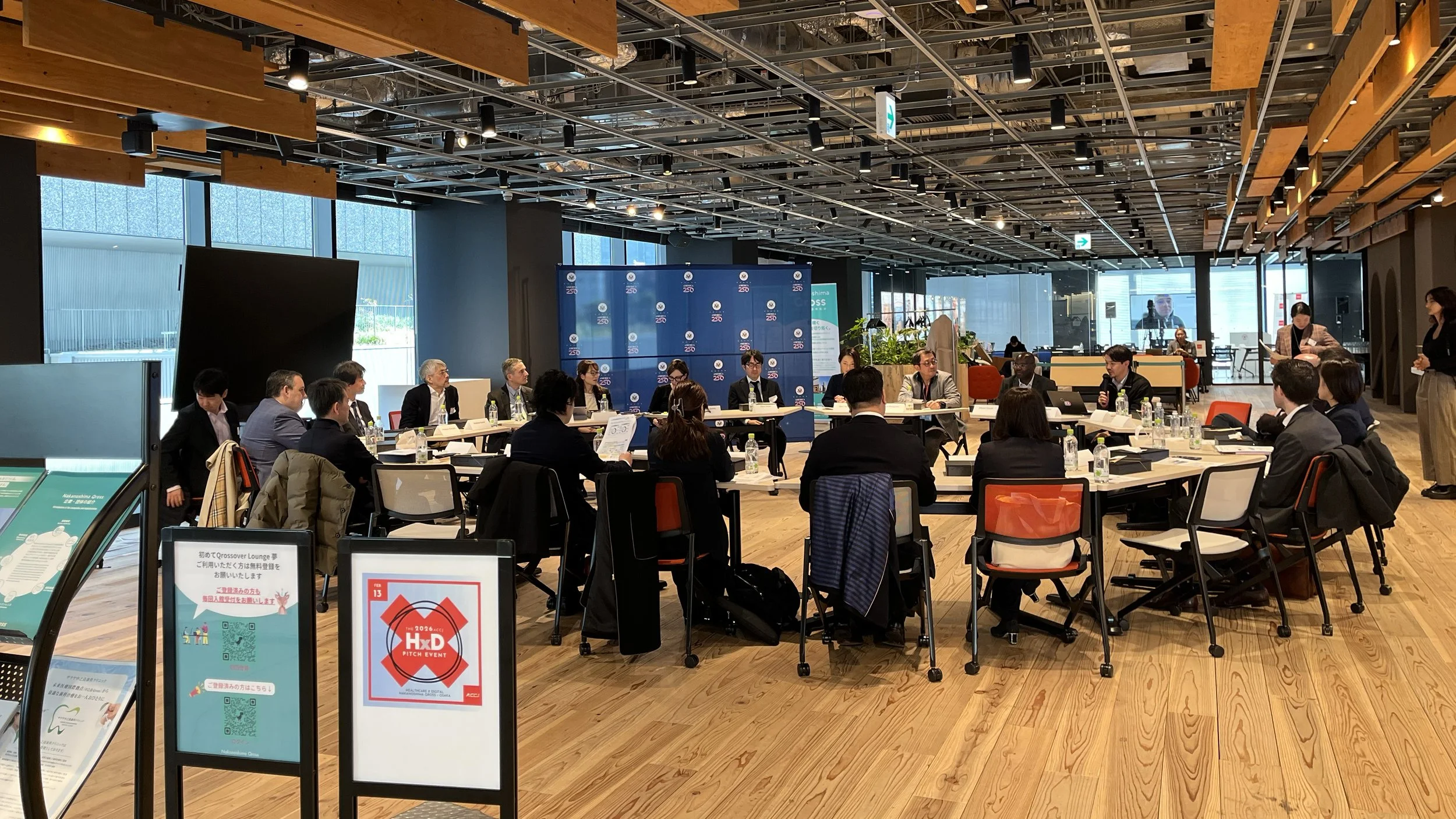
Startups convened once again in Osaka on February 13 for a chance to get Japan’s healthcare research to the people who need it through the American Chamber of Commerce in Japan (ACCJ) Healthcare x Digital (HxD) initiative. Now in its sixth year, the program spearheaded by the ACCJ Kansai chapter connects startups, academics, corporations, and government to develop ideas for community healthcare and individual patient care.
The 2026 HxD Pitch Event took place at Osaka’s Nakanoshima Qross and featured a panel discussion followed by two rounds of pitches from healthcare startups competing for five awards.
The event was cohosted by Nakanoshima Qross and supported by the US Commercial Service, part of the US Consulate General Osaka-Kobe. The top prize was a complimentary trip to the 2026 SelectUSA Investment Summit, a US Department of Commerce program that has generated more than $250 billion in new investment to date. This year’s summit ran May 3–6 in National Harbor, Maryland.
“The startups pitching today represent the best of Japan’s healthcare innovation,” Consul General Richard N. Larsen told the room at the opening of the event. “Your solutions address real challenges, and your willingness to compete on this stage demonstrates the entrepreneurial spirit driving progress in this sector.”
Hirokazu Shimoda, senior director at the Japan Agency for Medical Research and Development (AMED), previously worked at the Ministry of Economy, Trade and Industry and the Japan External Trade Organization’s San Francisco office. Leading the pre-event roundtable, he said that working groups are now operating across 17 fields to determine where Japan should concentrate its resources.
At the J.P. Morgan Healthcare Conference earlier this year, US investors kept asking him the same question: how AMED’s own subsidies could be used to coinvest in Japanese companies. He also pointed to Japan’s supporting industries—manufacturing, materials, robotics—as a real strength once paired with artificial intelligence (AI) and Japanese data, later noting that AMED’s funding is now extending to top-tier venture capital as well.
Japanese Healthcare: A Future Up for Debate
A panel discussion, moderated by Zimmer Biomet Director of Government Affairs Makoto Kawai, brought together Yasuhiko Iida, then of ACCJ President’s Circle member Eli Lilly Japan K.K., Dr. Okechi Oduori of Nakanoshima Qross, and Marisa Watanabe of the University of New South Wales, who joined remotely from Australia.
The conversation fell within HxD’s three standing focus areas: overcoming Japan’s urban–rural healthcare divide, reimagining the hospital of the future, and empowering patients to own their healthcare. As the discussion progressed, the topic turned to whether Japanese healthcare technology has to prove itself abroad before Japan’s own system will accept it.
Japan has strong basic research, Oduori said, but it isn’t as “gifted when it comes to social implementation,” which he described as getting high-quality research to the patients themselves.
Watanabe described a validation trap: Japanese corporate partners want proof of value before investing in technologies that first of all need investment to be tested.
“A lot of technologies worldwide are being lost because we just can’t get over that initial hurdle,” she said. One advantage, she noted, is already available: Australia’s approval process aligns closely with that of the US Food and Drug Administration (FDA), giving startups a faster on-ramp than the US process alone.
Japan’s acceptable margin of risk, Kawai argued, is effectively zero, which is why he told startups to prove themselves in other markets first.
Watanabe raised a second fix of her own for lower-risk categories. “[We need] a sandbox system where we can actually try to speed up approval processes for certain types of technologies that are less [of a] health risk,” she said, as an example pointing to fall-prevention technology that could be validated safely, given available countermeasures if something goes wrong, and processed faster as a result.
Oduori differed slightly, arguing that startups should work with regulators from day one. “There is always an opportunity that we can work closely with the regulatory authorities at the very beginning, incorporating them as you do your studies,” he said.
Kawai added: “It’s just easier for people to go outside, prove it, and come back with that proof. To get Japanese to jump off the boat, you tell them that everybody already has jumped off.”
The conversation ranged further, with L.E.K. Consulting Partner Christian Boettcher raising the long-standing tension between Japan’s Ministry of Health, Labour and Welfare and the Ministry of Economy, Trade and Industry over how fast to move on approvals. Eli Lilly Japan’s Iida argued that patients increasingly want quality of life rather than a fix for a disease, pointing to Asics as an example of a wellness-adjacent company with few avenues for talking to doctors or pharmaceutical companies.
A question from the floor turned to whether Japanese universities still favor publishing research over patenting it. Oduori said the situation has improved, with more universities now advising on intellectual property, but that patents held inside university walls still complicate industry collaboration.
By the end of the discussion, when an audience member asked who should actually guide a startup from concept to market, Oduori said that getting a startup to commercialization takes the same kind of cooperation that your fingers require when you eat with chopsticks.
“Know who is more important than know-how,” Kawai said, closing the panel.
ACCJ–Kansai Governor Kevin Yamaga-Karns, associate vice president of legal affairs at Eli Lilly Japan, then presented the panelists with certificates of appreciation.
Let the Games Begin
The pitch competition’s 12 healthcare startups presented their solutions to an expert panel of judges: Mari Ogihara of AstraZeneca K.K., Yasuhiko Iida of Eli Lilly Japan, Dr. Robert Brand of EY, Dr. Yu Moriguchi of Osaka University and Nakanoshima Qross, Akira Omae of The Kobe Shimbun and Anchor Kobe, and L.E.K. Consulting’s Boettcher. Competing this year were:
- SalivaTech Co., Ltd.
- Nonat Inc.
- I.W.G. Inc.
- PurinoScience
- Craif, Inc.
- MIG Inc.
- Heliex Inc.
- Quadlytics Inc.
- Ekei Labs
- Aman Wellness Solutions (AWS LLC)
- VisionPath
- Xupra
SalivaTech’s SalivaChecker, an AI-powered saliva test that screens for six cancers from a single sample, already serves more than 110,000 users. Chief Executive Officer Dr. Makoto Sunamura, a pancreatic surgeon at Tohoku University Hospital, framed the product as screening rather than diagnosis, with the company’s US launch built around CLIA-certified labs ahead of full FDA approval.
According to World Health Organization data cited by Nonat Inc., just 18 percent of high-risk pregnant women worldwide receive proper treatment. With that in mind, the company pitched a wearable device and an AI system for remote pregnancy monitoring.
I.W.G. Inc., founded by a team that previously scaled a medical AI startup to unicorn status—meaning a valuation of more than $1 billion—pitched two products: AI Referral, which standardizes referral and discharge data across formats, and DOCloud, a workflow and communications platform that the company said has already cut client data transfer time from four days to 40 seconds, alongside a 90 percent drop in human error. I.W.G. said it has been selected by the Mayo Clinic as the first and only Japanese company in that ecosystem.
No approved drug exists anywhere for sarcopenia, the natural loss of muscle tissue due to age, according to PurinoScience Chief Executive Officer Kotaro Hisamoto. He pitched an oral combination therapy built on a repurposed gout medication that Japanese research already links to lower sarcopenia rates combined with a marketed adenosine triphosphate, or ATP. According to cofounder Ken Okamoto, of the University of Tokyo, the precursor restores muscle energy through the body’s own purine salvage pathway.
Craif, Inc. brought a related pitch built on an already-proven distribution network: its urine-microRNA platform serves more than 50,000 users through some 2,000 clinics and 4,000 pharmacies, and its new product, miSignal Age, estimates biological age and cardiometabolic risk from the same single sample.
Half the people in their forties and fifties, MIG Inc. President and Chief Executive Officer Hidetaka Kai told judges, already show the first brain-cell changes of Alzheimer’s disease, with no symptoms at all. The startup’s solution to this is a six- to eight-minute virtual reality test. The results, Kai said, correlate closely with p-tau181, a blood biomarker for the disease. New Alzheimer’s drugs from companies such as Eisai, Biogen, and Eli Lilly exist, but patients often arrive at the hospital too late to use them, he said.
Heliex Inc., based in Akita Prefecture, pitched “health intelligence” based on CT scans for personal trainers and nutritionists.
Quadlytics Inc. built its pitch around the fact that an epilepsy diagnosis in Japan often means immediate loss of a driver’s license. The company’s development, the Epilepsy Alarm, is a wearable that reads heart-rate variability to predict a seizure one to 20 minutes before it occurs. The company cited more than $10 billion in annual US emergency costs tied to epilepsy hospitalizations.
Ekei Labs, based at the Okinawa Institute of Science and Technology, pitched epigenetics chemistry paired with AI to predict drug trial success before a trial runs, claiming a 30 percent cut in trial costs, a 50 percent cut in trial failures, and 55 times more data per dollar spent than conventional methods.
Aman Wellness Solutions pitched a cross-border second-opinion platform connecting Japanese and US medical care. Founder Sahiora Nurujai was candid about a barrier few others mentioned, saying many Japanese hospitals are running deficits and so remain reluctant to devote domestic resources to foreign patients.
VisionPath Chief Executive Officer Jake Smith, a first-year student at Ritsumeikan University, pitched a smart walker inspired by his grandmother’s difficulty crossing a room for a glass of water. The company has not yet incorporated, but it has already secured a spring clinical trial with the city of Minoh.
Xupra closed the pitches with a foundational AI model built for pharmaceutical data, pitched through the story of a fictional drug rep, Yamada-san, coached before doctor visits and corrected after them. The company said it already runs a paid pilot with more than 400 users at a major pharmaceutical company.
And the Winners Are …
After deliberation, the judges announced five awards:
- SelectUSA Investment Summit Award: SalivaTech Co., Ltd.
- Anchor Kobe Award (Kobe City): Aman Wellness Solutions
- Nakanoshima Qross Award: PurinoScience
- Osaka Bio Headquarters Award (Osaka Prefecture): Quadlytics Inc.
- Osaka LifeScience Nexus Award: VisionPath
SalivaTech’s win secured its trip to the SelectUSA Investment Summit, following the path of past HxD winners such as Anaut Inc. and AMI Inc., both of which used their trips to Maryland to build connections with US investors and partners.
An Ongoing Effort
“This is not the last event,” Boettcher told the startups after announcing the results. “We had companies in the past that reapplied and then won. So, thank you for everybody’s efforts today, and congratulations to the winners.”
The next HxD event—Connected by Data, Powered by AI, Enabled by Technology: Reimagining People-Centered Care—is scheduled for October 30 at Nakanoshima Qross.