

Young Professionals to Watch: Skyler Scofield
The Covue Japan client services director shares how she has benefited from ACCJ connections, mentorship, and events.
The Covue Japan client services director shares how she has benefited from ACCJ connections, mentorship, and events.
The Young Professionals Forum (YPF) serves as a platform to connect working professionals aged 35 and under within the American Chamber of Commerce in Japan (ACCJ). In this installment of our Young Professionals to Watch series, we talk to Skyler Scofield, client services director at Covue Japan, about the real-life lessons she has learned by participating in YPF events, which go beyond traditional networking to give young professionals opportunities to learn directly from senior ACCJ members in intimate settings.
What do you do at Covue Japan?
I serve as director of client services and oversee the full ecosystem of services that support international brands entering and operating in the Japan market. My role sits at the intersection of strategy, structure, and people, ensuring that our clients experience clarity, consistency, and seamless execution across all touchpoints.
Raised in Europe and the United States, and now building my career in Japan, I draw on a globally diverse background that helps me understand the cultural, operational, and emotional nuances that brands face when expanding into a new market. I naturally gravitate toward environments that are evolving—places where things aren’t set in stone and where thoughtful structure can make a real difference. What energizes me most is helping brands navigate Japan’s unique business landscape while empowering our internal teams to deliver their best work.
What is the most memorable project you have worked on? How did being a young professional make a difference?
A meaningful turning point for me came from a leadership moment rather than a single project. A team member approached me, unsure how to handle a complex client situation. Instead of giving them the answer outright, I asked guiding questions, encouraged them to think through the options, and supported them as they built their own solution. Not only did they resolve the issue, but their approach ended up improving our internal communication flow. Watching their confidence grow taught me that great leadership isn’t about having all the answers; it’s about developing people so they can find the answers themselves.
That moment shaped how I show up as a young leader: with patience, intention, and a focus on empowering my team. Being a young professional has helped me in many ways. I move quickly, adapt easily, and bring a modern, human-centered mindset to problem-solving. The challenge, of course, is earning credibility in rooms where I am often the youngest. But that has pushed me to communicate intentionally, prepare deeply, and lead with confidence—qualities that continue to serve me well.
How does Covue empower young professionals?
What I appreciate most about Covue is the freedom and trust I’m given to build, innovate, and lead. We operate in a uniquely complex space, covering everything a brand needs to function in Japan. This means that no two days look the same and there is always something new to learn. Because Covue supports the full ecosystem of market entry and operations, I get to think like a brand owner: identifying pain points, proposing solutions, and collaborating across teams to bring those solutions to life. It feels like solving a new puzzle every day, bringing different pieces together and seeing the entire picture come into focus. Young professionals at Covue are empowered through early ownership, exposure to cross-functional decision-making, and the opportunity to design real systems that shape how the company operates. It’s an environment that values initiative and welcomes fresh perspectives.
Do you have a memorable moment from a YPF or ACCJ event?
One of my most memorable experiences was attending the first speed-networking event in 2023. I remember walking in and being genuinely surprised, in the best way, to see so many young professionals gathered in one place. In Tokyo, people like us are often scattered across industries and schedules, so it was refreshing to find a space designed specifically to bring us together. The turnout impressed me, and the energy in the room was unforgettable. Beyond making business connections, I met people I genuinely connected with on a personal level, some of whom I still keep in touch with today. It was one of those moments where you realize how valuable the YPF community is, both professionally and personally.
What are your expectations for the YPF and the ACCJ?
As a next-generation professional, I’m drawn to communities that challenge how we think about leadership, ambition, and the kind of impact we want to create. Networking matters, but what truly accelerates growth are the conversations that push you to elevate your perspective, sharpen your thinking, and step into bigger roles.
Looking ahead, I hope the wider ACCJ continues to bring young professionals into rooms where decisions are made. When emerging leaders and seasoned executives collaborate intentionally, you get a blend of speed, insight, and experience that drives real progress. That exchange—across industries, ages, and viewpoints—is where innovation happens.
My goal as a leader is to build environments where people feel confident taking ownership, thinking creatively, and solving problems with independence. I believe the next wave of leadership will come from those who listen deeply, move deliberately, and empower others to grow. I hope the ACCJ keeps championing that direction, helping young professionals evolve into leaders who will shape the future of business in Japan and beyond.
Reverse Mentoring
Executives expressed interest in how younger generations navigate the growing demands of modern work, while young professionals highlighted the need for clearer expectations, balanced workloads, and supportive management.
Dialogue between executives and young talent turns a new lens on leadership.
Reverse mentoring challenges the traditional notion of mentorship by reversing the flow of insight. Instead of guidance coming from senior leaders to rising professionals, young professionals take the lead, offering their perspectives to executives.
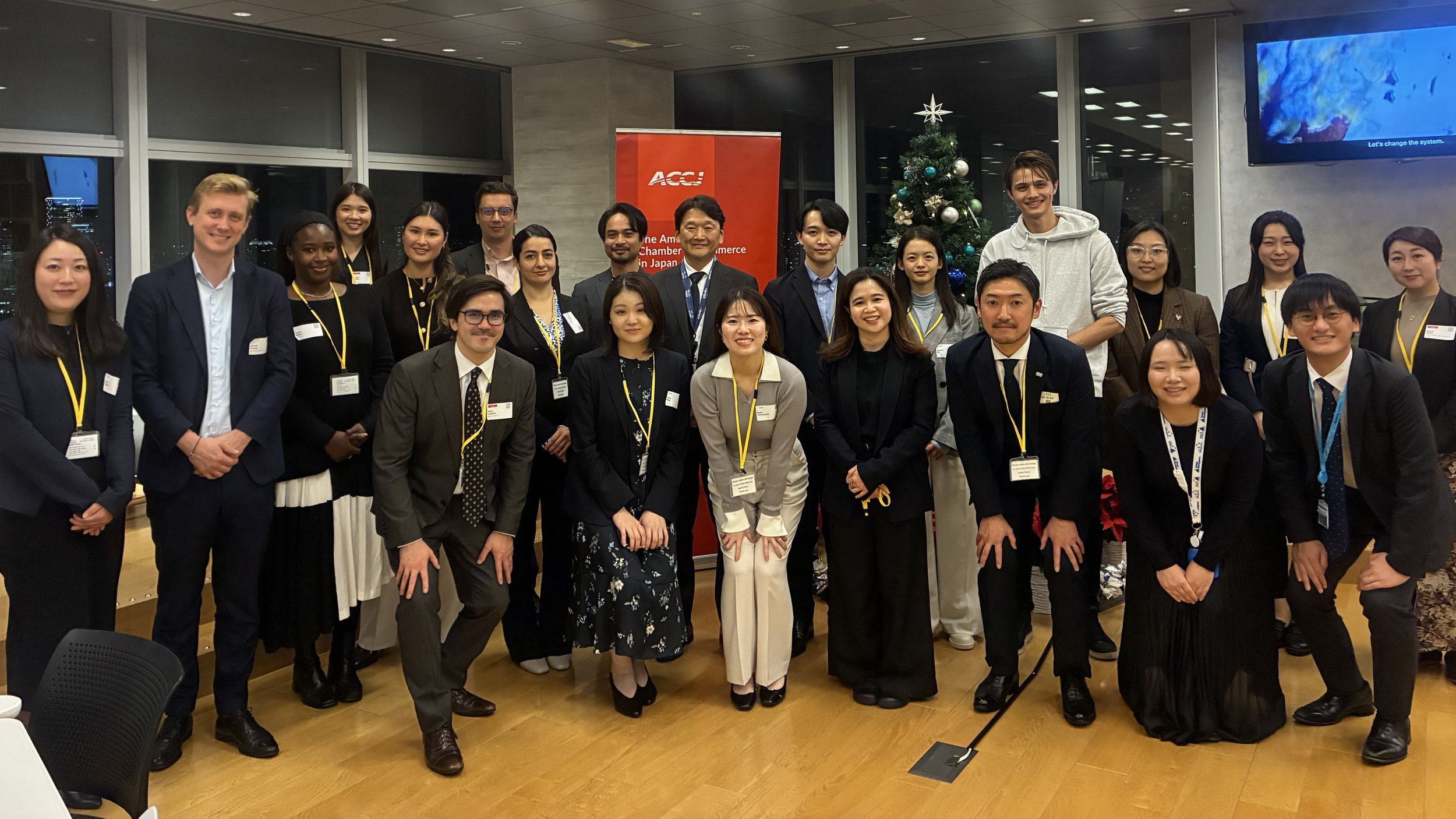
In December 2025, the ACCJ Young Professionals Forum (YPF), together with the ACCJ CEO Forum, hosted the second Reverse Mentoring event to create meaningful dialogue across generations. The evening was generously hosted and sponsored by Cisco Systems G.K., whose support helped set the tone for open and thoughtful conversation.
This year’s event brought together six senior executives who stepped into the mentee role with genuine curiosity and openness. Participants included:
- Mizuho Abe, corporate officer of the Corporate Segment Division and head of the Financial Lines Department at AIG General Insurance Co., Ltd.
- Sarah Bader, executive director at Gensler Associates International Ltd.
- Anderson Carneiro, managing director for Northeast Asia at The Kraft Heinz Company
- Azusa Koike, executive director at Morgan Stanley Japan Holdings Co., Ltd.
- Yoshiyuki Hamada, president and executive officer of Cisco Systems G.K.
- Jarrod Trusler, president of Dow Chemical Japan Ltd.
They were joined by 23 young professionals from diverse industries and backgrounds, organized into small groups of three to four per executive.
The evening encouraged candid exchanges that bypassed the typical constraints of hierarchy. What immediately distinguished this event from a typical mentoring or networking session was the tone. The conversations were warm, honest, and unfiltered. Executives asked questions that are rarely answered candidly in their own organizations, and young professionals spoke openly about their experiences, expectations, and concerns.
Several themes surfaced throughout the evening. Talent retention and employee alignment emerged frequently as executives sought to understand what keeps high-potential young talent engaged and motivated. Young professionals emphasized the importance of transparent communication, opportunities for growth, and leadership that models the values it promotes.
Stress, workload, and burnout were also major points. Executives expressed interest in how younger generations navigate the growing demands of modern work, while young professionals highlighted the need for clearer expectations, balanced workloads, and supportive management.
The most prominent topic of the night was the role of artificial intelligence (AI) in the future of work. Executives were eager to learn how young professionals use AI tools, what excites them, and what concerns they have about shifting job roles. Young professionals shared a mix of optimism and uncertainty, noting that AI improves productivity and creativity but also raises questions about which skills will matter most in the future. Both groups acknowledged that adapting to AI requires collaboration and continuous learning across generations.
The reverse mentoring initiative reflects the YPF’s commitment to bridging the communication gap between young professionals and senior leaders. In many organizations, rising talent and executives rarely have opportunities for real dialogue, and the views of the next generation can be difficult to access. By placing young professionals in the mentor seat, the event creates the conditions for candor, mutual learning, and a deeper understanding of the challenges and motivations present at all levels of an organization.
Executives left the event with valuable insights into the expectations and work styles of younger employees—perspectives that are increasingly essential in shaping modern workplace culture. Young professionals, in turn, gained a clearer view of the realities executives navigate, recognizing that leadership involves constant decision-making, uncertainty, and a strong desire to steer their organizations forward. The blend of Japanese and international participants enriched the discussion further, reflecting the ACCJ’s multicultural environment and the diversity that defines its membership.