
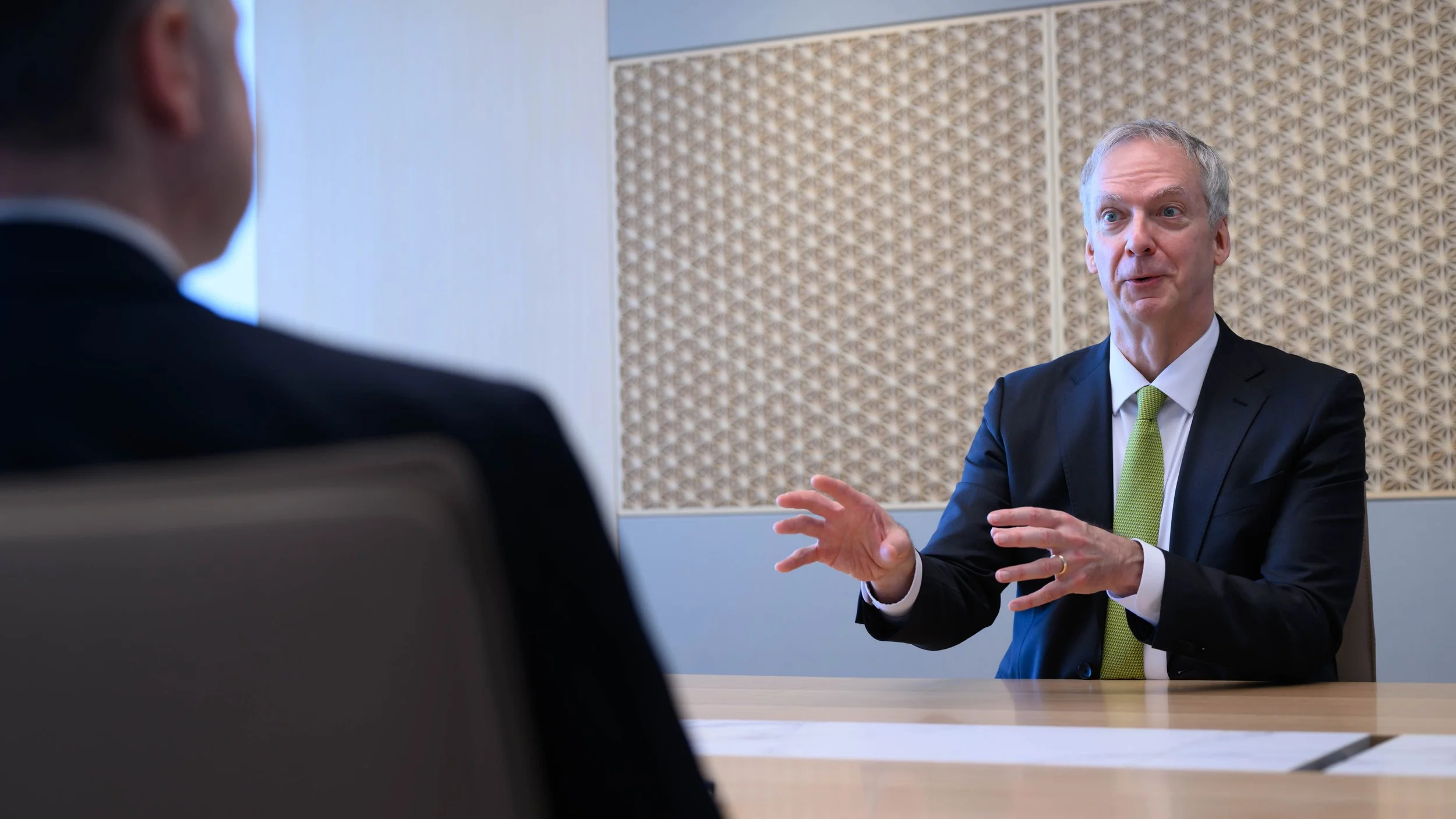
At the Center of the Game
ACCJ President Eric John shares thoughts on the chamber’s role in the bilateral relationship during a milestone year.
ACCJ President Eric John shares thoughts on the chamber’s role in the bilateral relationship during a milestone year.
Photos Antony Tran/LIFE.14
Earlier this year, The ACCJ Journal sat down with Eric John as he took the helm of the American Chamber of Commerce in Japan (ACCJ). Halfway through a busy year of outreach and activity, we check in with the Boeing Japan K.K. president about how he sees the chamber in a time of rapid change, uncertainty, and new challenges facing the US–Japan partnership.
You took office with a focus on policy creation and advocacy. How are those goals progressing?
We set out to strengthen the ACCJ’s committee-driven policy advocacy and accelerate our engagement with the Japanese and US governments. As a result, we have built a stronger foundation, improved cross-committee collaboration, and are now better prepared to act quickly and effectively in order to remain relevant in advocacy.
In Japan, we have proactively met with cabinet ministers, Diet members, and other key leaders in both business and government. On the business side, we met with leaders at Keidanren (the Japanese Business Federation) and Keizai Doyukai (the Japan Association of Corporate Executives) to discuss our priorities and deepen our understanding of their focus and goals. When meeting with government officials and politicians, we shared our views in a straightforward manner, and I believe we have built closer relationships through which we can exchange views more openly.
In June, we visited Washington for our annual DC Doorknock, where we met with key administration officials and a number of congressional members, as well as Japanese Ambassador [Shigeo] Yamada. As the voice of global business in Japan, we provided strategic recommendations to address critical issues affecting US companies and outlined measures to further strengthen the US–Japan economic alliance.
This year’s DC Doorknock highlighted the continued strength and momentum of the US–Japan economic partnership and provided an important opportunity for the ACCJ to advance key priorities across our advocacy focus sectors. We were encouraged by the palpable recognition throughout the US government of the strategic importance of the US–Japan relationship and by the continued progress being made to deepen investment, strengthen economic ties, and address shared challenges.
We are seeing progress in policy development and advocacy, and this will continue to be our focus for the remainder of the year.
Because the ACCJ is committee-driven, our policy work depends heavily on the time and insight of member volunteers, and I am grateful for that effort. We have also worked to strengthen coordination across committees and between the board and committee leaders, including through in-person Leadership Forum meetings and closer liaison support.
A strong example of this approach came in 2025, when we were able to gather committee input quickly and provide a coordinated response on a major policy issue. That experience reinforced the importance of having a clear policy foundation and being able to act quickly when opportunities arise.
Looking ahead, we need to stay agile. Both the US and Japanese governments like to move fast, and the ACCJ must be ready to do the same if we want to remain an effective voice for our members.
Another goal was to continue growing the chamber. How is that going?
I am glad to see the progress we have made. We added a third member to the President’s Circle and six new Corporate Sustaining Members. This contributes to our bottom line, but more importantly, it contributes to our influence.
Where do you see the bilateral relationship—and its role on the regional and global stages—as the United States marks its 250th birthday?
The US–Japan relationship is marked by significant progress, including the 2025 trade agreements and Japan’s substantial $550 billion investment commitment in the US economy. Japan remains the United States’ largest foreign investor, and overall bilateral trade in goods and services reached $324 billion in 2025, with the US maintaining a strong $12.6 billion surplus in services.
At the same time, US companies continue to face persistent trade challenges. The ACCJ encourages the Government of Japan to address nontariff barriers, promote further investment, and enhance regulatory transparency to strengthen bilateral trade. As a business organization, we are focused on improving ties that serve the interests of both our stakeholders and our members. We also appreciate that the US and Japan are pursuing what they believe to be in their best economic interests.
This year is also a special one for the United States as we continue to mark the 250th anniversary of our founding. While celebrating America’s development and the strong US–Japan relationship, I am excited by how the ACCJ has worked so far this year to build on recent successes, shape our shared future, and strengthen our resilience. I also thought that A Night of Stars and Stripes, our Independence Day event on July 1, was a perfect celebration of our nation’s birthday and bilateral relations.
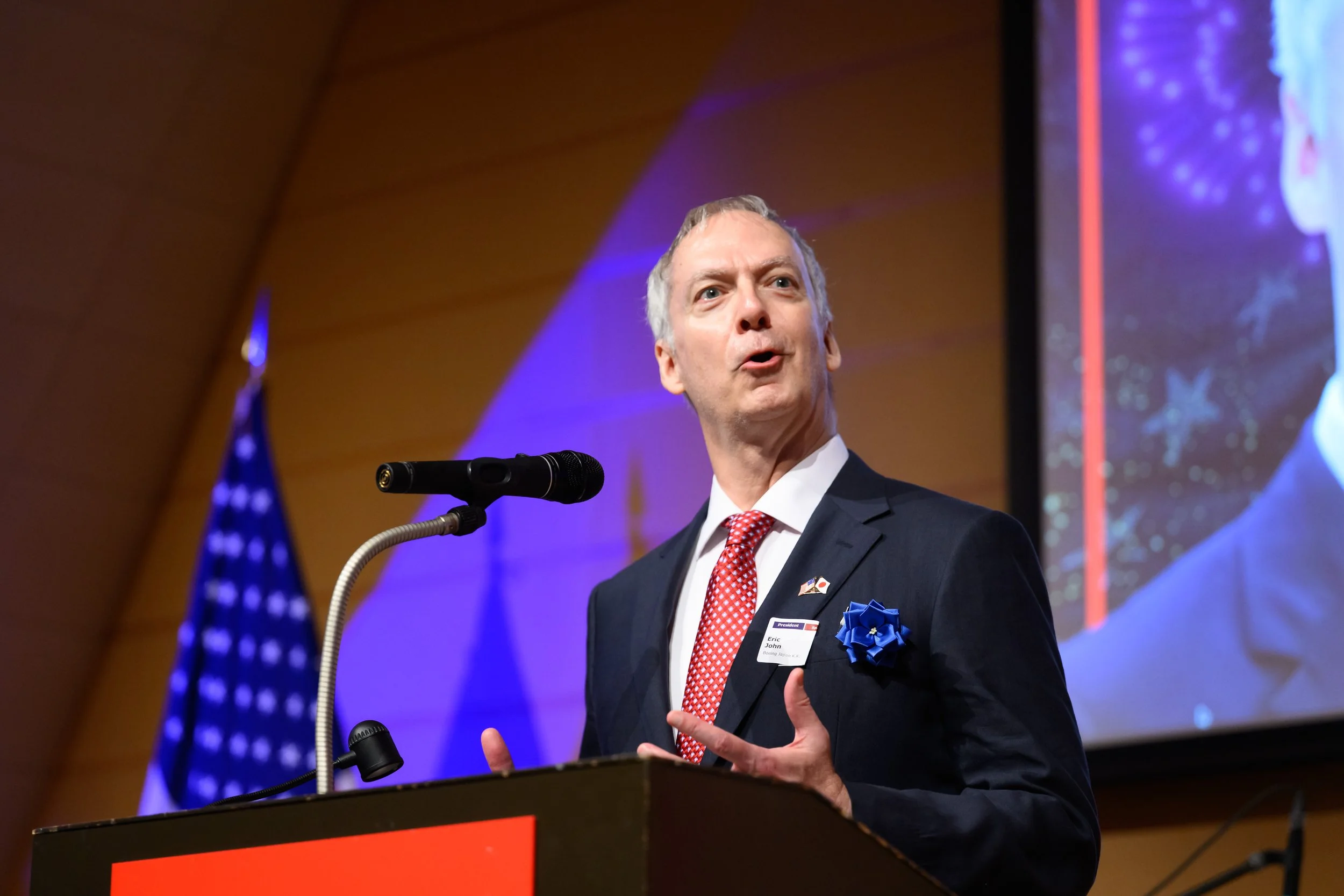
ACCJ President Eric John speaks at A Night of Stars and Stripes, the chamber’s Independence Day celebration, on July 1, 2026, at Tokyo American Club.
How do the chamber and the US embassy collaborate? How critical is the support from each side?
I, and many others, regularly meet with Ambassador [George] Glass. In addition, the board and embassy leaders meet monthly. We coordinate on our top priorities and exchange information and views about the evolving economic relationship and planned joint tactics.
Speaking for the chamber, I know that the embassy’s role has been essential for us to achieve many of our policy goals. I would also like to think that the initiatives of the ACCJ help the embassy team achieve their goals in their relationships.
How was this year’s DC Doorknock?
As mentioned, this year’s visit to Washington was very positive and reinforced the continued strength and momentum of the US–Japan economic partnership. A key takeaway was the strong recognition throughout the US government of the strategic importance of the relationship, as well as the continued progress being made to deepen investment, strengthen economic ties, and address shared challenges.
At the same time, we emphasized that persistent nontariff barriers still need to be addressed. We also reaffirmed the importance of reducing these barriers, boosting investment, and improving regulatory transparency to support growth and innovation across our key sectors and further strengthen bilateral trade.
What were your goals for March’s roundtable with Japanese media?
Good question. It had been years since the ACCJ had held a media roundtable, and I thought we needed to rebuild that relationship to be able to get our message out to the Japanese public. Our goal, therefore, was to clearly convey our intent and activities and position the ACCJ as a reliable source on the US–Japan economic relationship. This set a strong foundation for future engagements with the media.
The US and Japan are indispensable economic and strategic partners, and our bilateral alliance—grounded in shared values and common interests—supports peace and prosperity in the Indo-Pacific region. The ACCJ believes it is important to continuously and proactively communicate the value of this relationship to Japanese media and to help them gain a deeper understanding of the importance of a healthy economic relationship for both countries.
What do you see as the biggest challenges that lie ahead?
I see this to be coordinating the chamber’s six key focus sectors, as well as our business priorities, with Prime Minister Takaichi’s 17 strategic growth priorities. To tackle that specific challenge, we established a growth strategies task force earlier this year, and we are also focusing on this in our committees.
What else would you like to say to members?
Simply, thank you. This is a huge volunteer effort to create policy, advocate, and move the business of the chamber forward. It’s been the product of so many people. I think we should all appreciate how much our members contribute to the success of the chamber.

Pieces of the Same Puzzle
ACCJ President Eric John shares his thoughts on 2026 and the chamber.
ACCJ President Eric John shares his thoughts on 2026 and the chamber.
Photos Antony Tran/LIFE.14
January 1 marked a change in leadership for the American Chamber of Commerce in Japan (ACCJ) as Eric John, president of Boeing Japan K.K., was elected to guide the chamber in 2026.
A former US diplomat, John spent more than three decades in government and served as US ambassador to Thailand from 2007 to 2010. After arriving in 2024 from South Korea, where he was also Boeing president, he quickly became part of the ACCJ and served as a governor in 2025.
The ACCJ Journal sat down with John at Boeing’s office in Toranomon Hills Station Tower to learn more about his career in the Foreign Service, his views on the new US–Japan trade agreement and the opportunities for member companies, and his vision for a new year—one in which the United States celebrates its 250th birthday.
How did you become involved in the ACCJ?
It was shortly after I arrived in Japan. Laura Younger approached me, and Sarah Bader convinced me to run for the board.
Of course, I’ve been involved with chambers throughout my career in diplomacy and business. The reason I got involved in the ACCJ is because there is no more important bilateral relationship in the world for the United States than with Japan; and right at the center of that relationship is the chamber.
Why did you choose to take on the role of president?
I deeply believe in the mission of the ACCJ. It’s a critical point in the relationship. As a diplomat, you’re always saying that, but it really is, because you’re looking at new governments in both the United States and Japan.
You’re also coming off the momentum from the trade deal, the positive, dynamic relationship between the prime minister and the president—and you’re looking at the table being set very nicely to significantly move the economic relationship forward.
I’ve looked at bilateral relationships for 40-plus years as a diplomat and with Boeing. This is one of those rare instances where both sides are coming in with a win-win mentality, and you’re also building on very strong foundations.
So, it was an opportunity that presented itself, and I thought I could help as president.
With the new trade deal, what do you see as the biggest challenges facing the bilateral relationship and US businesses in Japan in 2026?
I see the opportunities as larger than the challenges. There are some things to be resolved on market access and other issues, but for the most part, the two leaders and the two governments have a deep bench and want to see trade expand. So, it’s not something where there are walls being put up. It’s not driven by a punitive spirit. It’s driven by a growth spirit. And in that sense, I see this as much more of an opportunity-oriented trade deal.
The challenge is that it’s very ambitious. You can look at the investment fund on the Japanese side—$550 billion—and there’s a total cumulative investment over many decades of close to $900 billion. So you’re looking at having to put a very significant additional delta of investment from Japan into the United States. And that’s a challenge if not handled properly.
But again, I see that more as an opportunity, where both sides recognize that it’s valuable to invest in the United States. Similarly, the US is the No. 1 investor in Japan as a foreign partner. So I think that we can do that well and make this relationship grow.
As Japan looks to invest in the United States, almost all these investments are going to require strong partners. And almost all the strongest partners are members of the ACCJ, so I think we’re a good umbrella organization for enabling that.
Why have you identified policy creation as a principal goal of your presidency?
The chamber does a lot of things, and it does a lot of things really well. It serves a wide community—3,000-plus members—all of whom have very different interests and things they want out of the chamber. Some see it primarily as an educational tool, some see it as a social networking tool, others see it as a business networking tool.
But at its heart, and what drives the chamber’s reason for existence, is policy. If you look at the 1980s and ’90s, in my experience, all the chambers in the region were helping fight some pretty tough battles on market access. Now, in the 2020s, it’s a very different climate. Many of those battles have been won, but there’s still a very significant policy role for the chamber.
You never hit nirvana for a business climate anywhere in the world, so there remains a lot of policy formulation that we need to do. And it does sound like common sense to have policy formulation and advocacy as one and the same. But often, they’re viewed as separate, and you can’t have serious advocacy or engagement with the Japanese government if you don’t have a really solid foundation of policy.
Similarly, none of our committees, none of our members are really going to care about formulating policy if we just put it on the bookshelf and admire it. We have to be taking it out and advocating with it.
How can committees support this policy formulation and advocacy?
We always say that the ACCJ is a committee-driven organization, because committees drive the formulation of policy.
I think it’s important that we recognize that all of us are volunteers—this is not generally our day job—so it is a way of giving back to and being part of the community. And the job that the committee leaders do takes a lot of work to do right. So I appreciate the effort that goes into that.
For the committee leaders to develop good policy, they have to see how doing so is going to be effective. The DC Doorknock this year as well as regular ongoing engagement with the Takaichi administration and the embassy will reinvigorate not just our efforts to formulate policy but how we put it into the machine of advocacy.
We saw a very good example of this in 2025. The United States Trade Representative, the USTR, requested feedback early in the Trump administration for how the US government could engage with the Japanese government.
We reached out to all the committees through the Policy Advocacy Task Force and put together a very strong answer based on their feedback. The information we put forward was almost entirely incorporated into the USTR’s engagement with the Japanese government and formed a major component of the final trade deal.
So you really need to look back no further than just a few months to see how quickly we can advocate if we have that strong foundation of policy. And I think more people need to know about that very positive effort that we made in 2025, and that we should have the ability to keep doing that in the coming years.
One thing about policy formulation and advocacy is that it’s not very effective if it’s just done by a cloistered group of people, some 20 or 30 of us who do that while the others go about their business. That’s not a good way to do it. There are levels of detail in policy that maybe just not everybody wants to or needs to know, but it behooves everybody, all 3,000-plus members, to know the big billboard policy issues that we’re advocating for.
In 2026, we should be aware that both the US and Japanese administrations like to move fast, so we need to be prepared to move fast. If we can keep that pace with our two governments, then we can remain right at the center of the game and be relevant players.
How does your experience as a diplomat help advance these efforts?
You have to be inherently optimistic that you can get a deal when you enter into bilateral negotiations. And you have to be able to reach across the table and understand what the other side wants, what the other side is thinking.
So in terms of leading the ACCJ in how we engage with the Japanese—managing relationships between the ACCJ and the embassy—I’ve done a lot of that.
I’ve also led what was, at the time, the fourth-largest embassy in the world. We had 2,000 staff from 40-plus government agencies and offices. I’m used to working in an environment where everybody is on the same team but all have different priorities. Coordinating those priorities into a cohesive position is something that I feel a background as a diplomat helps with.
How can the chamber best work together with Ambassador Glass and the US Embassy?
Speaking personally, as an ambassador, what you value most from a chamber is the ability to describe effectively the business environment as they see it on the ground. We’re the ones who are working and living in it 24/7, 365. So first and foremost is providing the embassy with that information.
Part of that is sharing what’s going really well. That’s useful to know as an ambassador because you can feed those models back to Washington. We can also share what needs to be better, the macro environment, specific cases or case studies, and the policies that we would like to see. It’s extremely valuable for an embassy team to hear that and have real examples of how they could help solve problems.
This embassy, perhaps more than any other, gets a lot of visitors from Congress, from the administration, from state and local governments. There’s a plethora of visitors, and they benefit from hearing the same things that the ambassador does. And to the degree that the embassy has confidence in the ACCJ as a partner for really being able to describe the honest-to-goodness business environment in Japan, they will see that visitors can benefit from that same perspective.
And as the embassy engages with the Japanese government and the Diet on how to improve the business relationship, they’ll not only be able to draw on the policies and experiences that we present, but they can also help open doors, encouraging politicians and lawmakers to meet with the ACCJ. That can be a force multiplier for how we engage with the Japanese government.
What does America’s 250th birthday mean for the ACCJ?
I know that the ambassador will be driving a lot of 250th anniversary celebration events throughout Japan all year. We want to partner, to the degree possible, with the embassy as they do that.
Likewise, I think that we could advantage ourselves with Japanese counterparts if we look at hosting speaking events with them or with US visitors to help celebrate the 250th and where we are in the business relationship.
So, you take this great embassy, combine it with the momentum we have on the bilateral relationship, and place all of that on a solid foundation of the ACCJ’s strategy and advocacy, and you have something that all of us as members should be excited about.
How can the chamber nurture and benefit from young talent?
When I look back at my twenties and thirties, as I was engaging—even as a government employee—with chambers, I recall that I was always curious. What are the really hard issues? What are the interesting issues? How do you make money in [South] Korea or Japan or Thailand?
I think if you’re a young professional, in addition to just your particular field—whether it’s IT or banking or you’re a startup—you also want to know how others are doing things. What are other companies here doing in a general sense? What are the really tough issues they face and what is the chamber doing to help them?
The chamber can provide value on policy, on education, on learning about Japan. As a young professional, if you’re asked “What do you do in the chamber? What does the chamber do?” you want to be able to talk about policy around a few of the big issues. I’m not trying to turn everybody into an ACCJ missionary, but I think if you’re part of an organization, generally you want to have pride of ownership and to be able to encourage somebody to think about joining, or to invite them as your guest to an event you think they’ll enjoy.
There are young professionals, but there’s also someone like me. In terms of being in Japan, I’m a baby professional; I don’t have a lot of time on the ground here. I can learn from the experiences of others who have been doing business here as a startup, the experience of learning Japanese and working at the same time. I think that there’s a really good exchange that we can get out of that.
A big challenge is less about the ACCJ and more about how young people network differently today. If you wanted to meet a lot of people in the 1980s or ’90s, you had to go to a place where there were a lot of people. Now you don’t need to go to a place.
Likewise, in the ’80s and ’90s, the place where there were a lot of people was the chamber. I’d say in the 2020s, we’re not that only place. There are a lot of options. So I think we’re hitting up against a different sociodemographic milieu than we faced 30 years ago. We have to adapt to that and meet people differently where they are.
How can the ACCJ best support members in 2026?
One challenge we all face is finding employees. We haven’t run out of people, but they’re in short supply, and talent is very precious in Japan. Whether you’re a major company, a startup, a senior professional, or a young professional, we all have to find talent and new colleagues all the time. We’re always refreshing, we’re dynamic, and that’s an area where we’re all going to have to work together.
A way in which we’re a little different from Japanese companies is that we offer a different value proposition. A lot of us at ACCJ companies, we’re not seen as places where you come, you work for 35 years, and you retire automatically. But we do offer a multicultural experience, a different office environment, different working hours. How we can promulgate and exploit that advantage we have as US and multinational employers in the Japanese marketplace is where the ACCJ and Japanese companies can work together really well, because we’re different pieces in the same puzzle.
One other item is generating buzz. I was always excited at other chambers’ events when a major figure, such as a cabinet member, would come and speak. It’s something that we should strive for. It’s one way to get people—and maybe even young professionals—excited, because if we are only a policy and advocacy organization, it gets a little boring. We’re not just a think tank, so to generate some buzz around the ACCJ is an important goal and where we want to go this year.
What else would you like to say to members?
Everybody should be very excited about 2026. We could not be more fortunate to have the embassy that we have here. I was in the State Department for 32 years. The US embassy in Japan always attracted the top level of talent. Granted, I was never in that embassy, but they always had the best people, and the current team is no different. The talent level and the dedication level are super high, and it’s led by somebody who’s an experienced ambassador, in his second ambassadorship, with access to the administration that most other US embassies only dream of.
So, you take this great embassy, combine it with the momentum we have on the bilateral relationship, and place all of that on a solid foundation of the ACCJ’s strategy and advocacy, and you have something that all of us as members should be excited about.